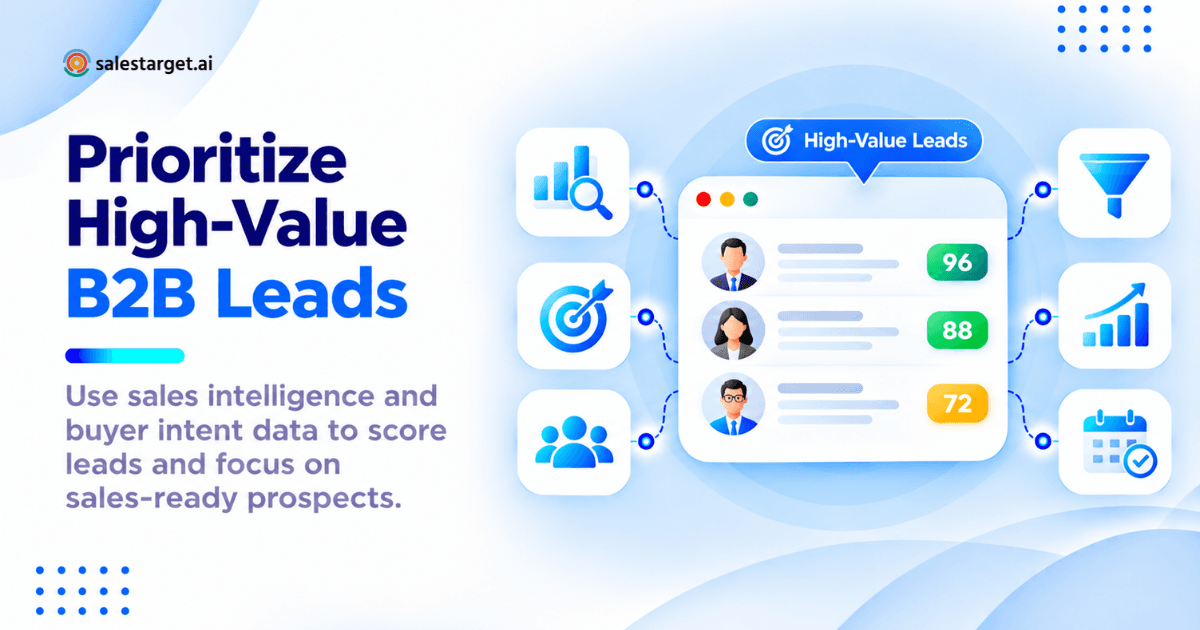
Monday morning. Your SDR opens a list of 1,800 leads that marketing tagged as qualified, with no honest way to pick the twelve worth the first hour. A slice of those emails will bounce. Another slice belongs to people who left the company two quarters ago. So the rep sorts by logo recognition, burns the morning on research the list should have done upfront, and books nothing.
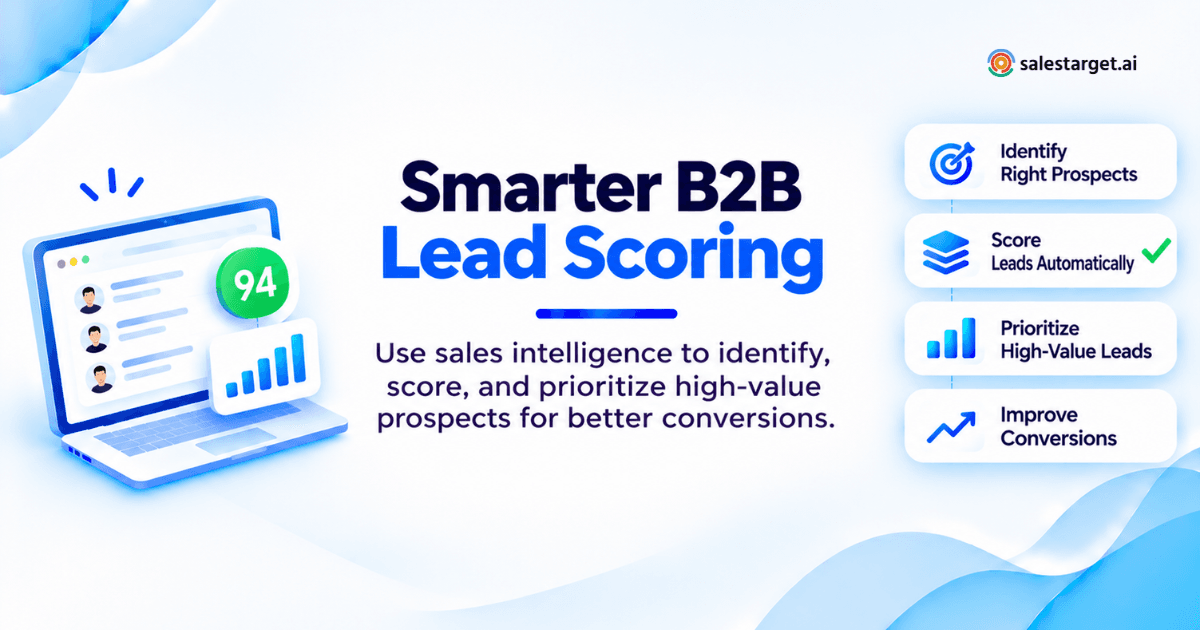
Short answer: Sales intelligence improves B2B lead scoring by attaching three layers of live data to every prospect: fit (does this company look like your best customers), intent (are they researching the problem right now), and engagement (what have they done with you). Give each layer points, add them into one score out of 100, then work the top band first. The ranking then reflects current buying behavior instead of a form fill from six weeks ago.
The Challenge of Identifying High-Value B2B Sales Prospects
Finding B2B prospects stopped being hard years ago. Telling apart the ones who will take a meeting from the ones who merely match a job title filter is the hard part.
Poor Lead Quality and Wasted Prospecting Efforts
Most lists get built on title and industry, two of the weakest predictors of a closed deal. Reps then spend 30 to 45 minutes per account rebuilding context the list should have carried.
Missing Buyer Intent and Incomplete Contact Data
Add blank mobile fields and catch-all addresses, and the team guesses twice: once about timing, once about whether the message arrives at all. Proper B2B sales intelligence closes both gaps on the same record.
The Impact of Poor Lead Prioritization on Sales Pipeline Performance
Unranked lists push reps toward whoever is easiest to reach rather than whoever is closest to buying.
The Role of Sales Intelligence in B2B Lead Scoring
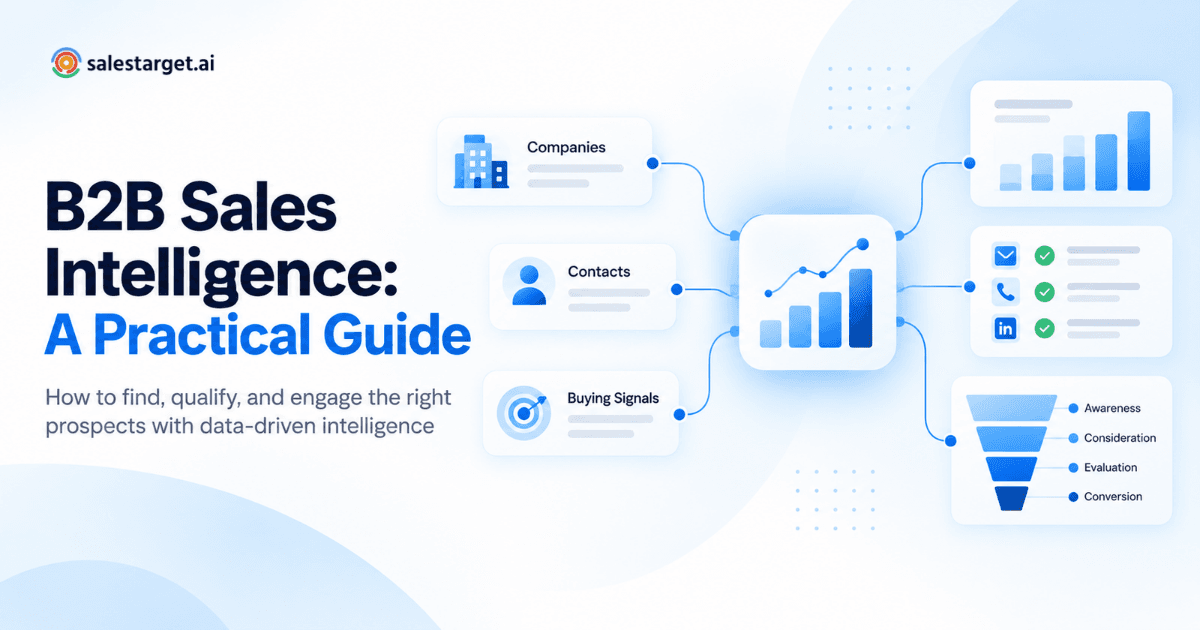
Sales intelligence supplies the three inputs a score needs: who the account is, whether it is buying, and whether you can reach the right person inside it.
Using Firmographic and Technographic Data to Evaluate Prospect Fit
Firmographics (industry, headcount, revenue, location) draw the outer boundary of your ICP. A prospect already running a competing tool has approved budget, a renewal date, and a reason to compare, which makes installed tech the strongest single fit signal in SaaS. Lead Explorer stacks firmographic and technographic filters across 146M+ business entities.
Identifying Purchase Intent Through Buyer Signals
Intent data shows research activity before anyone fills a form. Salestarget.ai surfaces 4,000+ intent and buyer signals, including Bombora Intent Topics plus business events such as funding rounds, hiring spikes, leadership changes and awards, on a 30 to 90 day lookback. Three open SDR roles is a budget signal dressed up as a job post.
Combining Prospect Engagement With Account Intelligence
Contact-level behavior means little without account context.
Improving Lead Qualification With Accurate Contact Data
Salestarget.ai verifies contacts at the point of enrichment rather than whenever the record was first scraped, unlocking verified professional email, personal email, phone, and mobile in one click. That timing is what separates raw contact data from a working prospect.
Key Benefits of Data-Driven Lead Scoring for B2B Sales Teams
Scoring converts a list into a work order.
Better Prospect Qualification and Sales Readiness
Scoring forces you to write down what qualified means. Once fit, intent, and engagement carry explicit weights, qualification stops being an argument and becomes a number any rep can defend.
Faster Identification of High-Value Sales Opportunities
Weekly rescoring surfaces the account that sat at 48 last month and reads 86 today after a funding round and a jump in intent topics.
Improved SDR Productivity and Outreach Efficiency
Salestarget.ai measures roughly six hours saved per rep each week and 2.4X more meetings from the same lead pool.
Stronger Sales and Marketing Alignment
A shared model ends the MQL argument. Marketing sees which scoring attributes convert into SQLs and builds campaigns against those attributes.
A Step-by-Step Process for B2B Lead Scoring Using Sales Intelligence
Eight steps, from ICP definition to weekly refinement.
Step 1: Define Your Ideal Customer Profile and Target Accounts
Pull your last 20 closed-won deals and find what they share: industry, headcount band, revenue, tech stack, region, trigger event. That overlap is your real ICP, not the one on the pitch deck.
Step 2: Collect and Enrich B2B Prospect Data
A missing field scores as zero and quietly buries good accounts below mediocre ones. Enrich at the moment you find the lead so the record and the score come from the same snapshot.
Step 3: Identify Buyer Intent and Engagement Signals
Attach intent topics and business events at account level, then layer contact behavior: replies, clicks, pricing page visits, LinkedIn acceptances. Stamp a date on every signal.
Step 4: Establish Lead Scoring Criteria and Weightage
Split 100 points across the three layers. A workable starting split for outbound teams is 40 fit, 35 intent, 25 engagement.
Step 5: Calculate Lead Scores Based on Fit, Intent, and Engagement
Add the three layers, apply negative points, then apply decay. Intent points should lose about half their value after 30 days and expire at 90. Most published models add and never subtract, which is why a hot list fills up with cold accounts by week six.
Step 6: Segment Prospects by Sales Priority
Use bands, not a single cutoff.
Step 7: Align Lead Scores With Personalized Outreach
The score should decide the channel and the opening line, not just the queue order.
Step 8: Review Lead Performance and Refine Scoring Rules
Each month, compare every band against booked meetings. Any attribute that fails to separate the bands is noise, so cut its weight or drop it.
Steps 1 through 3 collapse into a single pass inside Lead Explorer, which filters, enriches, and attaches live signals to the same record.
Building an Effective B2B Lead Scoring Model
A working model has four scoring layers and one disqualification layer.
Demographic and Firmographic Fit Scoring
Score the account first, the person second.
Behavioral and Engagement-Based Scoring
Weight each action by what it costs the prospect. An open costs nothing and belongs near zero, more so now that privacy proxies inflate open counts across every major sending platform.
Buyer Intent and Purchase Readiness Scoring
Score intent by surge, not presence. The accounts worth points are the ones whose activity jumped against their own 90-day baseline.
Negative Scoring and Lead Disqualification
Subtract for free email domains, student and intern titles, competitor domains, companies under your minimum headcount, and any record that failed verification. Reachability belongs inside the model: a 92-point lead behind a risky catch-all address is worth less than an 80-point lead with a verified mobile. Almost no published scoring framework includes it.
Lead Scoring Thresholds for Sales Qualification
Set three bands and attach a response-time commitment to each.
Practical Example of a 100-Point B2B Lead Scoring Model
Here is a model you can copy for a B2B SaaS motion: 40 points of fit, 35 of intent, 25 of engagement.
Lead Scoring Criteria and Point Allocation
- Fit (40): industry match 10, headcount band 10, competing or adjacent tool installed 12, region 5, revenue band 3
- Intent (35): intent topic surge in the last 30 days 15, funding round or hiring spike 12, leadership change in the buying function 8
- Engagement (25): reply 10, pricing page visit 7, LinkedIn connection accepted 5, email click 3
- Negatives: unverified or risky email -10, free email domain -8, non-buying title -12, competitor domain -25
Sample Scoring Table for B2B SaaS Prospects
| Prospect profile | Fit | Intent | Engagement | Negatives | Total | Tier |
|---|---|---|---|---|---|---|
| VP Sales, 180-person SaaS, competing tool installed, funding round 3 weeks ago, replied after a pricing visit | 40 | 27 | 17 | 0 | 84 | A |
| Head of Sales, 90-person SaaS, adjacent tool, intent surge, new CRO started, no engagement yet | 40 | 23 | 0 | 0 | 63 | B |
| Marketing Ops lead, 300-person SaaS, no intent activity, visited pricing and clicked an email | 40 | 0 | 10 | 0 | 50 | C |
| Freelance consultant, Gmail address, two-person firm, clicked one email | 15 | 0 | 3 | -20 | -2 | D |
Calculating Scores for Different Buyer Profiles
Row four scores below zero, and that is the point: a model with a floor at zero ranks a bad lead above an empty one.
Classifying Leads Into High, Medium, and Low Priority
80 to 100 is Tier A, worked within 24 hours. 60 to 79 is Tier B, nurtured with a 30-day signal recheck. 40 to 59 is Tier C, qualified before any rep time gets spent. Below 40 is parked or removed.
B2B Prospect Prioritization Strategies Based on Lead Scores
Split fit and intent into a two-by-two and give each quadrant its own play. Treating all four the same turns a scoring model into a reporting exercise.
High-Fit, High-Intent Prospects for Immediate Outreach
Multichannel, same week, opening line built on the signal itself. A line like "saw the raise and three open SDR roles" outperforms any template.
High-Fit, Low-Intent Prospects for Lead Nurturing
Right company, wrong moment. Keep them in a low-frequency sequence and set a signal alert so the account promotes itself the day intent fires.
Low-Fit, High-Intent Prospects for Further Qualification
Treat these as research rather than leads. A repeating cluster of low-fit accounts studying your category frequently means your ICP definition is narrower than your real market, and the fix sits in the filter, not the lead.
Low-Fit, Low-Intent Prospects for Disqualification
Remove them. Dead records inflate database counts and drag list hygiene down.
Account-Level Prioritization for B2B Buying Committees
Score the account, then pick two to four contacts across the committee. Cap how much any one account can contribute so five contacts at the same company do not produce five Tier A leads and five separate sequences into the same building.
AI Lead Scoring and Predictive Sales Intelligence
Rules tell you what your team believes. Predictive models tell you what your closed-won data believes.
Rule-Based vs. AI-Powered Lead Scoring Models
Rule-based scoring is transparent and arguable, which matters on the day sales and marketing disagree in front of the CRO. Start with rules: a model needs labeled outcomes before it has anything to learn from.
Predictive Lead Scoring Using Historical Sales Data
Predictive scoring needs volume. Under a few hundred closed-won records, the model mostly memorizes your largest customer and scores everything resembling it a 90.
Automated Lead Scoring for Large Prospect Databases
Past a few thousand records, manual scoring stops working. Intent-Based Lead Scoring inside Lead Explorer applies fit filters and live signals across the full database.
Choosing the Right Scoring Approach for Your Sales Team
Under roughly 500 deals a year, run rules plus intent. Above that, run predictive beside your rules and compare meeting rates band by band.
Integrating Lead Scoring With B2B Sales Outreach and CRM
A score living in a spreadsheet changes nothing. It has to drive the list, the sequence, the channel, and the follow-up task.
Creating Priority-Based Prospect Lists
Save each tier as a live segment, not a static export.
Personalizing Cold Email Campaigns Using Lead Intelligence
Map the top-scoring signal straight into the first line. Email Outreach builds multi-step sequences from a plain-English audience description, and runs inbox rotation with SPF, DKIM and DMARC checks so Tier A messages reach the inbox. 90% of emails are validated before sending, and campaign build time drops by about 35%.
Using LinkedIn Outreach for High-Priority Prospects
Tier A earns two channels. LinkedIn Outreach runs connection requests, DMs and follow-ups in the same coordinated flow as email, with rate limits and warm-up logic protecting the account.
Managing Lead Ownership and Follow-Ups in CRM
Campaign leads land in the built-in CRM with no import step. Every email and call logs to the lead timeline, and follow-up tasks create themselves when a lead replies, which is where SDR teams stop losing deals to contact data gaps.
Updating Lead Scores Based on Sales Conversations
The highest-value scoring input in any CRM is the rep's disqualification reason. Capture it as a structured field rather than a free-text note, then feed the top three reasons back as negative scoring rules the following month.
Common B2B Lead Scoring Mistakes and Ways to Avoid Them
Five failure modes account for most broken models.
Relying on Incomplete or Outdated Prospect Data
Missing fields score as zero and push good accounts down the queue. Validate and enrich before scoring, not after the bounce report lands.
Overvaluing Weak Engagement and Intent Signals
Email opens and generic topic presence are the two most over-scored inputs in B2B. Weight replies, pricing page visits, and surges measured against an account's own baseline.
Ignoring Negative Scoring and Disqualification Rules
Addition-only models drift upward until everything looks like Tier A.
Applying the Same Scoring Criteria to Every Buyer Segment
A 50-person startup and a 5,000-person enterprise share no buying signals. Run one model per segment.
Failing to Review Lead Scoring Performance
A model built once and never checked is a guess with a decimal point attached.
Measuring the Success of B2B Lead Scoring and Prospect Prioritization
Five metrics, all measured per band. A scoring model works when the bands separate.
Lead-to-Meeting Conversion Rate
Measure it per band, never in aggregate. Tier A should convert at several times the Tier C rate.
Sales-Qualified Lead Conversion Rate
The share of scored leads your AEs accept. High scores paired with low acceptance points at your fit weights, not at rep effort.
Pipeline Contribution by Lead Priority
Watch for the case where Tier B produces more revenue than Tier A, a reliable sign intent is over-weighted against deal size.
Sales Cycle Length and Rep Productivity
Salestarget.ai's CRM records 3.2X faster deal cycles and 91% follow-up completion.
Improving Scoring Accuracy With CRM Performance Data
Export closed-won and closed-lost by band each quarter, then refit the weights. Run this review alongside the rest of your B2B sales intelligence practices.
Key Features to Look for in B2B Sales Intelligence Tools
Six capabilities. Missing any one forces another subscription and another export step.
Accurate B2B Lead Data and Contact Enrichment
Ask a vendor when a record was last verified, not how many records they hold.
Advanced ICP Filtering and Prospect Segmentation
Stackable business and people filters: industry, role, seniority, department, headcount, revenue, location, tech stack, intent topics.
Buyer Intent Data and Sales Intelligence Signals
Topic-level intent plus business events, with a stated lookback window.
CRM Integration and Sales Workflow Management
A score that cannot create a task is a report.
Email and LinkedIn Outreach Capabilities
Tier A prospects need multichannel sequences launched from the same record.
AI Assistance for Prospect Research and Qualification
Plain-language search across the database and sequence drafting from the same record. A side-by-side of sales intelligence tools matched to how you sell is worth 20 minutes.
Why Choose Salestarget.ai for B2B Lead Scoring and Prospect Prioritization?
Apollo gives you data and engagement, then you bolt on deliverability and a CRM. Instantly, Smartlead and Lemlist handle cold email well, with no native B2B database, no LinkedIn automation, and no real CRM behind them. Salestarget.ai keeps the whole scoring-to-close loop on one platform.
Find ICP-Matched Prospects With Lead Explorer
840M+ verified professional profiles, 146M+ business entities, 50+ data sources. Layer 4,000+ intent and buyer signals on top to rank what comes back.
Improve Prospect Qualification With B2B Data Enrichment
One click unlocks verified professional email, personal email, phone and mobile. Enrichment runs at the moment you find the lead, so the score and the record share a timestamp.
Validate Contact Information Before Outreach
The email validator runs MX and SMTP checks, disposable-domain detection and risk scoring. Feed that risk score into your model as a negative and the reachability problem leaves your Tier A list. Contact data sits at 99% verified.
Engage Prioritized Leads Through Email and LinkedIn Campaigns
Tier A moves into a coordinated email and LinkedIn sequence from the same record. Unibox pulls every reply into one view, sorts by intent (Interested, Follow-Up, Not a Fit), assigns an owner, and syncs the deal to CRM.
Organize Sales Opportunities With Built-In CRM
Lead management, deal pipeline, tasks, activity tracking, reports, and a click-to-call dialer that logs itself. It connects with HubSpot, Salesforce and Zoho, and setup takes under a day.
Support Lead Research and Outreach Planning With AI Copilot
AI Copilot is free inside the platform. Ask for your Tier A segment in plain language, generate a personalized sequence for it, query deals, meetings and tasks.
Frequently Asked Questions About B2B Lead Scoring
What Is a Good Lead Scoring Threshold for B2B Sales?
Most B2B teams set sales-qualified at 70 to 80 points on a 100-point scale. The number matters less than the bands around it: three tiers with response-time commitments beat a single cutoff.
How Is Sales Intelligence Different From a Lead Database?
A lead database tells you who exists. Sales intelligence adds buying signals, business events, verified contact details, and tech stack data, so you can rank the list instead of reading it.
Should Buyer Intent Data Expire?
Yes. Intent points should halve after 30 days and reach zero at 90. Scores that only climb are the main reason a Tier A list stops producing meetings after a few months.
Build a More Qualified Sales Pipeline With Salestarget.ai
Back to Monday morning and that list of 1,800. The fix was never more leads. It was a ranked list where fit, intent, and reachability are scored before a rep opens it.
That only holds together when the data, the signals, the verification, the sequences, and the CRM share one record. Stitch five tools together and the score ages somewhere between the export and the send. Salestarget.ai keeps them in one place: find the ICP match in Lead Explorer, enrich and verify it in the same click, push it into an email and LinkedIn sequence ordered by score, and close it in the built-in CRM with follow-ups already created.
Build one scored segment, work it for two weeks, and compare the meeting rate against your current list. That comparison settles the argument faster than any framework. Start free with Salestarget.ai.