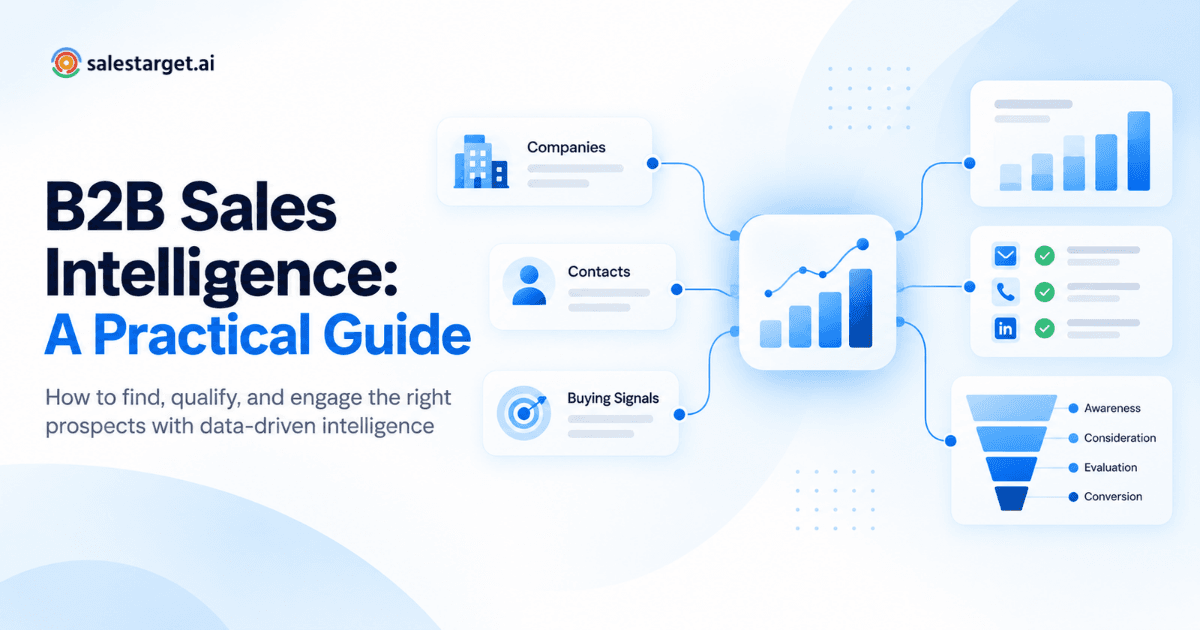
B2B sales intelligence is the practice of collecting, organizing, and applying data about companies, contacts, buying signals, and market activity to find, qualify, and engage potential customers. Rather than relying on cold lists and manual research, sales teams use intelligence platforms to surface the right prospects at the right time with context that actually supports a meaningful conversation.
For SDRs, BDRs, account executives, and revenue leaders, the shift from gut-feel prospecting to data-informed outreach represents a significant operational improvement. Sales intelligence brings together firmographic details, technographic profiles, org charts, verified contact data, and buyer intent signals in a single workflow. The result is fewer wasted calls, shorter sales cycles, and outreach that speaks directly to a prospect's situation.
This guide covers what B2B sales intelligence actually means in practice, the types of data it includes, how sales teams apply it at each stage of the pipeline, and what separates a genuinely useful sales intelligence platform from a glorified database.
What Is B2B Sales Intelligence?
B2B sales intelligence refers to the collection of actionable data and insights that help sales teams identify, understand, and engage prospective business customers. It goes beyond basic contact information to include company demographics, technology usage, organizational hierarchy, financial indicators, and real-time buying signals.
Think of it as the difference between knowing who a prospect is and understanding why they might be ready to buy. A contact name and email is just a data point. Sales intelligence wraps that data point in context: What does their company do? How large are they? What tools do they use? Have they recently raised funding or expanded into a new market? Are they actively researching solutions in your category?
Sales intelligence platforms aggregate this data from public records, proprietary databases, web activity, social signals, and third-party intent providers, then deliver it in a format that reps can act on immediately during prospecting and outreach.
Why B2B Sales Intelligence Matters
Manual prospecting is slow, inconsistent, and increasingly ineffective. Reps who spend their mornings combing through LinkedIn profiles, company websites, and industry directories are doing research that could be automated and enriched with signals they cannot see on their own.
B2B sales intelligence matters because it addresses three persistent problems in pipeline generation:
- Wasted effort on unqualified leads. Without firmographic and intent data, reps treat every contact as equally promising. Sales intelligence filters out poor-fit accounts before outreach begins, so time goes toward prospects who match the ideal customer profile and show signs of active interest.
- Stale and inaccurate contact data. B2B contact data decays as people change roles, companies restructure, and email domains shift. Intelligence platforms verify and refresh records continuously, reducing bounce rates and protecting sender reputation.
- Generic outreach that gets ignored. When a rep knows a prospect's tech stack, recent funding round, or hiring activity, they can craft a message that references real context rather than a vague value proposition. That relevance drives higher reply rates and better first conversations.
For sales leaders, intelligence data also supports territory planning, pipeline forecasting, and coaching. When managers can see which accounts are in-market and which reps are engaging them, decisions about resource allocation get sharper.
How B2B Sales Intelligence Works
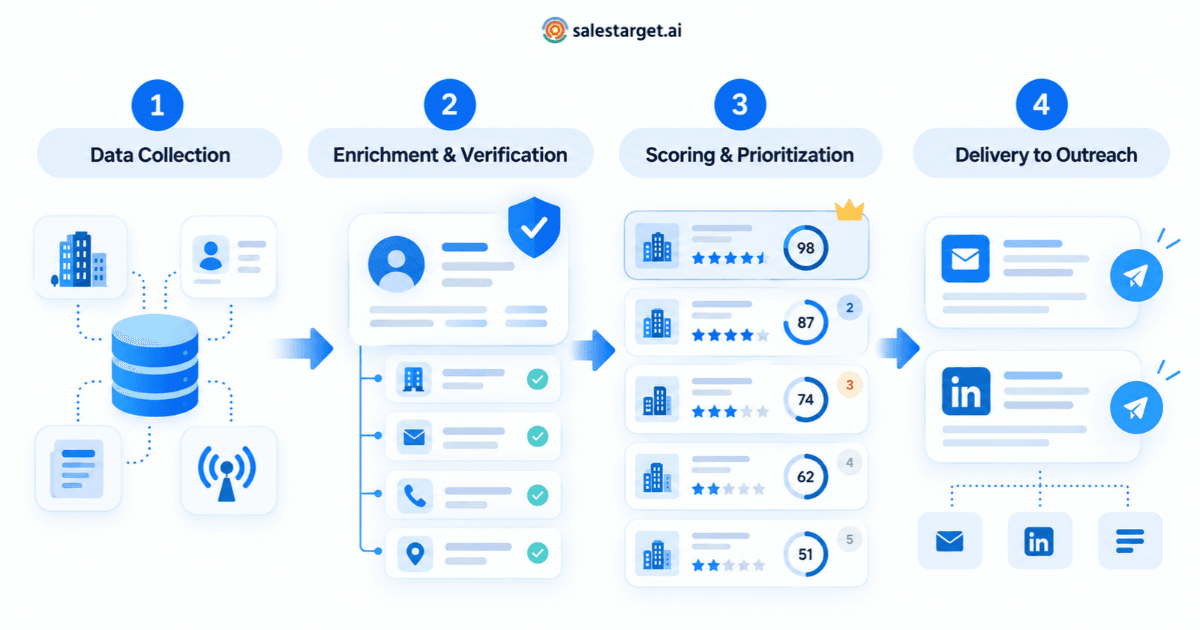
Sales intelligence platforms operate through a cycle of data collection, enrichment, scoring, and delivery. Understanding each step clarifies why the output is more useful than a static list.
Data Collection
Platforms pull information from a wide range of sources: public business registries, SEC filings, job boards, press releases, social media, website metadata, and partnerships with third-party data providers. A platform like SalesTarget AI aggregates data from over 50 sources to build profiles covering 840M+ contacts and 146M+ companies, giving sales teams a broad starting point regardless of their target industry or geography.
Enrichment and Verification
Raw data is only as good as its accuracy. Enrichment fills in missing fields like direct phone numbers, verified emails, and technology usage. Verification confirms that the data is current, typically through MX/SMTP validation for email addresses, cross-referencing for job titles, and periodic data refreshes. Records that cannot be verified are flagged so reps do not waste sequences on dead addresses.
Scoring and Prioritization
Once enriched, leads are scored based on how closely they match the ideal customer profile and whether they show intent signals. A lead that matches the ICP on firmographic criteria and is actively researching relevant topics scores higher than one that merely fits on paper. This scoring turns a flat list into a ranked queue that guides daily prospecting.
Delivery to Outreach
The final step is getting intelligence into the hands of reps in a form they can use. The most effective platforms push enriched and scored leads directly into outreach sequences and CRM records, eliminating the export-import cycle that slows teams down. When intelligence and execution share the same workspace, the gap between identifying a prospect and reaching them shrinks to minutes instead of days.
Types of Sales Intelligence Data
Not all intelligence is the same. Different data types serve different purposes at different stages of the sales cycle.
Firmographic Data
Firmographics describe the characteristics of a company: industry, revenue, employee count, location, and growth trajectory. This is the foundation of any ICP definition and the first filter reps apply when narrowing down a total addressable market.
Technographic Data
Technographics reveal the technology stack a company uses. Knowing that a prospect runs a particular CRM, marketing automation tool, or ERP system helps reps tailor messaging around integration, replacement, or complementary workflows. It also signals budget and sophistication level.
Contact and Organizational Data
This includes verified email addresses, direct phone numbers, job titles, reporting structures, and department details. Accurate contact data is non-negotiable for cold outreach. Organizational data helps reps identify the right entry point within a company and understand the buying committee structure.
Buyer Intent Data
Intent data tracks behavioral signals suggesting a company or individual is actively researching a topic, category, or solution. These signals come from content consumption patterns, search behavior, review site activity, and third-party tracking networks. SalesTarget AI's Lead Explorer surfaces over 4,000 buyer intent signals, enabling teams to prioritize accounts that are in an active evaluation phase rather than simply matching static profile criteria.
Trigger Events and Business Signals
Trigger events are specific, observable changes at a company: new funding rounds, executive hires, office expansions, product launches, or regulatory changes. These events create natural openings for outreach because they often coincide with new budget, new priorities, or new pain points that a sales team can address.
How Sales Teams Use Sales Intelligence
The practical value of sales intelligence depends on how it is woven into daily workflows. Here is how different roles apply it.
Prospecting and List Building
SDRs and BDRs use intelligence filters to build targeted prospect lists based on ICP criteria. Instead of pulling a generic list of marketing directors in North America, a rep can filter for marketing directors at SaaS companies with 50 to 200 employees that use HubSpot and have shown intent around demand generation topics. The specificity reduces list size but dramatically improves conversion rates from outreach.
Lead Qualification and Scoring
Sales intelligence automates much of the manual qualification process. Rather than a rep spending 15 minutes researching each lead, the platform applies scoring criteria automatically, weighing firmographic fit, intent signals, and engagement history. This allows reps to focus on leads already cleared through qualification thresholds.
Personalized Outreach
Intelligence data is the raw material for personalization that goes beyond inserting a first name. When a rep knows the prospect's tech stack, recent company news, and the topics they are researching, an email or LinkedIn message can reference specific context. A note mentioning a prospect's recent Series B or their migration to a new platform feels distinctly different from a template pitch.
Account Research and Multi-Threading
For account executives working strategic deals, intelligence helps map the buying committee. Understanding who reports to whom, which stakeholders influence decisions, and what departments are involved makes multi-threading possible. It also reduces the risk of a deal stalling because the rep was only speaking with one champion who lacks budget authority.
Pipeline Management and Forecasting
Sales leaders use intelligence dashboards to monitor which accounts are showing increased intent, which deals are progressing, and where pipeline gaps exist. When intent data reveals that several target accounts are entering research mode simultaneously, leadership can allocate additional resources or adjust territory assignments accordingly.
Key Benefits of B2B Sales Intelligence
The advantages compound over time as data quality improves and teams build muscle memory around intelligence-driven workflows.
- Shorter research cycles. Reps spend less time finding and verifying prospects manually. Intelligence platforms do the collection and verification at scale, returning hours of selling time each week.
- Higher lead quality. Filtering on firmographic fit and intent together means outreach targets prospects who are both a good match and showing active buying behavior. This combination improves conversion rates at every funnel stage.
- Improved email deliverability. Verified contact data reduces bounce rates and protects domain reputation. Platforms that validate addresses before they enter a sequence prevent the sender-reputation damage that comes from batch-sending to stale lists.
- Better conversation quality. When a rep enters a call knowing the prospect's company size, tech stack, recent news, and research interests, the conversation starts from a place of relevance rather than cold discovery.
- Stronger alignment between marketing and sales. Shared intelligence data creates a common language around what qualifies as a good lead. Marketing can generate demand against the same ICP criteria sales uses for outbound, reducing friction during handoff.
- Accurate pipeline forecasting. Intent data and engagement metrics give managers a forward-looking view of pipeline health, rather than relying solely on rep self-reporting and deal stage labels.
B2B Sales Intelligence vs. Traditional Prospecting
Traditional prospecting typically involves a rep manually researching companies online, finding contacts through LinkedIn or directories, copying information into a spreadsheet, and crafting outreach one prospect at a time. It works, but it scales poorly and relies heavily on the individual rep's research skills and patience.
Sales intelligence transforms this process in several measurable ways:
| Dimension | Traditional Prospecting | Sales Intelligence |
|---|---|---|
| Data Source | Manual web research, directories | Aggregated from 50+ verified providers |
| Contact Accuracy | Varies; often outdated | Verified before outreach |
| Prospecting Speed | Hours per list | Minutes per list |
| Personalization | Limited by research time | Powered by firmographic and intent data |
| Intent Visibility | None | Real-time buying signals |
| Scalability | Limited by headcount | Scales with platform capacity |
The shift does not eliminate the need for skilled reps. It removes the manual research bottleneck so those reps can spend their time on what they do best: building relationships and closing deals.
Important Features to Look for in Sales Intelligence Software
Not all sales intelligence tools deliver the same depth or usability. When evaluating platforms, prioritize features that directly improve prospecting efficiency and data reliability. For a detailed breakdown, see this guide on choosing the best sales intelligence platform for B2B sales teams.
Comprehensive Contact and Company Database
The platform should offer broad coverage across industries and geographies, with the ability to filter by job title, seniority, department, company size, revenue, location, and technology usage. A shallow database forces teams to supplement with manual research, defeating the purpose of the tool.
Real-Time Data Enrichment
Enrichment should happen at the point of discovery, not on a weekly or monthly batch schedule. When a rep pulls a lead, the platform should return verified email, phone, company details, and social profiles immediately. Delayed enrichment creates gaps where data goes stale before it reaches a sequence.
Buyer Intent Signal Tracking
Look for platforms that surface intent data with clear sourcing, recency indicators, and the ability to filter by topic relevance. Intent signals are most valuable when they combine research-level behavior with concrete business events like funding, hiring, or leadership changes.
Email Verification and Risk Scoring
Every contact should carry a risk classification before it enters a live sequence. Verified, catch-all, risky, and unverifiable labels let reps and ops teams set sending rules that protect domain reputation. SalesTarget AI's Email Validator performs MX/SMTP checks and disposable-address detection, flagging records before they can cause deliverability damage.
CRM and Outreach Integration
Intelligence is only useful if it flows into the systems where reps work. The platform should integrate with your CRM and outreach tools, or better yet, include them natively. A shared data layer between intelligence, sequences, and pipeline management eliminates the sync delays and CSV exports that fragment records across tools.
Advanced Filtering and Saved Search Capabilities
Filters should stack: industry plus seniority plus tech stack plus intent topic plus geography, all in a single query. Saved searches that can be rerun on a regular cadence ensure reps always work from a fresh, relevant list without rebuilding filters from scratch each week.
How to Choose a B2B Sales Intelligence Platform
Selecting the right platform requires more than reading feature lists. Here is a practical evaluation framework.
- Define your ideal customer profile in specific terms before evaluating any vendor. Write down the industries, company sizes, geographies, job titles, and technologies that define your best-fit accounts. Your ICP is the benchmark every platform should be tested against.
- Test data coverage within your actual target market. A platform may claim hundreds of millions of records, but coverage can be uneven across verticals and regions. Pull a sample of your target accounts and check how many contacts the platform returns, and how accurate those contacts are.
- Evaluate data freshness and refresh cadence. Ask vendors how often records are updated, how stale data is identified, and what happens when a contact changes roles. Platforms that verify at the point of discovery are preferable to those running quarterly batch refreshes.
- Run a deliverability test. Pull 100 to 200 contacts from the platform and send a small campaign. Measure bounce rates, open rates, and reply rates against your existing benchmarks to get an honest read on data quality.
- Time the complete workflow from search to first outreach touchpoint. If moving a lead from discovery to a live sequence requires multiple exports, imports, or tab switches, that friction compounds at scale. Platforms that keep intelligence and outreach in one workspace reduce this drag significantly.
- Calculate total cost of ownership, not just the subscription fee. Factor in any additional tools you would need for email verification, outreach automation, and CRM functionality. A platform that bundles these capabilities often costs less than assembling separate point solutions.
Common Mistakes When Using Sales Intelligence
Even the strongest platform underperforms when teams fall into these patterns.
Treating Intelligence as a Set-and-Forget Tool
Sales intelligence is a workflow, not a purchase. Teams that set up filters once and never revisit them miss shifts in their market, ICP, or buying behavior. Regular review of targeting criteria, intent signal relevance, and data quality keeps the platform aligned with evolving sales priorities.
Ignoring Data Hygiene
Sending outreach to unverified or stale contacts damages domain reputation and wastes sequence capacity. Build verification into the workflow so that every contact is validated before it enters a live campaign. SalesTarget AI handles this by validating records at the moment of enrichment, before they reach outreach sequences.
Over-Relying on Intent Data Without Context
Intent signals are powerful, but they represent probability, not certainty. A company researching a topic does not guarantee they are ready to buy this quarter. Effective teams use intent as a prioritization signal alongside firmographic fit and engagement history, not as a standalone qualifier.
Skipping the Process Around the Data
The most common failure is not a data problem but a process problem. Intent alerts with no defined follow-up cadence, enriched leads with no assigned owner, scored accounts with no outreach sequence tied to them. Intelligence requires a response workflow to deliver results.
How Sales Intelligence Supports Better Sales Outreach
The connection between intelligence and outreach quality is direct. Better data in means better messaging out.
When a rep sits down to write an email, the difference between knowing that someone is a VP of Marketing at a mid-market SaaS company and knowing that same person is at a company that recently secured Series B funding, uses Marketo and Salesforce, has been researching demand generation strategies, and just posted three open roles on their growth team is the difference between a generic template and a relevant note that earns a reply.
Intelligence also supports multi-channel coordination. With platforms that combine email outreach and LinkedIn automation in a single sequence, reps can orchestrate touches across channels based on prospect behavior. An email open might trigger a LinkedIn connection request. A LinkedIn profile view might trigger a follow-up call. The intelligence that started the sequence continues to inform how it unfolds.
For teams managing outreach at scale, this intelligence-to-action loop is what separates spray-and-pray campaigns from deliberate, targeted pipeline generation.
Putting B2B Sales Intelligence to Work
B2B sales intelligence is not a category of software to be evaluated in isolation. It is a foundational layer that shapes how sales teams find prospects, qualify opportunities, personalize outreach, and manage pipeline. The difference between teams that build reliable pipeline and those that struggle is increasingly defined by the quality and accessibility of the data they work from.
The practical path forward is straightforward: define the ICP clearly, choose a platform that delivers verified data and actionable intent signals within a connected workflow, embed intelligence into daily prospecting habits, and measure the impact on conversations started and pipeline generated. Platforms like SalesTarget AI aim to bring these capabilities together so that reps operate from a single environment rather than reconciling fragmented tools.
Whether a team is building outbound from scratch or optimizing an existing motion, the investment in sales intelligence pays off in the quality of every subsequent conversation.