I Why GTM and Sales Intelligence Tools Go Hand in Hand
Every B2B company eventually asks the same question: how do we find the right prospects, reach them at the right time, and convert them into customers efficiently? The answer, for most modern revenue teams, lies in how well they combine their go-to-market strategy with the sales intelligence tools that power it.
The GTM and sales intelligence tools used by the company are not two separate categories bolted together — they are complementary layers of the same revenue engine. A GTM strategy defines who you sell to, how you reach them, and through which channels. Sales intelligence tools provide the data, signals, and automation to execute that strategy at scale.
This guide breaks down exactly how companies build and operate this combined stack — from ICP identification and prospect discovery to outbound campaigns, CRM workflows, and AI-powered automation.
What are GTM and sales intelligence tools? GTM and sales intelligence tools are the platforms and software that B2B companies use to identify their target market, discover and qualify prospects, enrich contact data, automate outreach, and track buyer signals - all in service of executing a go-to-market strategy and driving pipeline.
Explore SalesTarget AI | If you're building or refining your GTM and prospecting workflow, SalesTarget.ai is an integrated platform designed to support every stage - from ICP discovery and B2B contact data to outbound automation and sales intelligence.
What a GTM Strategy Requires from Sales and Marketing Teams ?
A go-to-market strategy is the operational plan that determines how a company brings a product or service to its target market. For B2B companies, this encompasses a set of aligned decisions across revenue, marketing, and sales functions.
A well-defined GTM strategy typically requires:
- A clear ideal customer profile (ICP) based on firmographic, technographic, and behavioural criteria
- A defined value proposition tailored to the ICP's pain points
- Channel strategy - whether inbound, outbound, product-led, or a combination
- Sales motion - self-serve, inside sales, field sales, or partner-led
- Messaging frameworks that connect product value to buyer problems
- Metrics and pipeline targets to measure GTM effectiveness
The challenge is that a GTM strategy is only as good as the data and tools behind its execution. Without accurate B2B contact data, buyer signals, and automation to activate outreach at scale, even well-designed GTM plans stall at the prospecting stage.
This is precisely where sales intelligence tools close the gap between strategic intent and market execution.
What Sales Intelligence Tools Do ?
Sales intelligence tools are software platforms that collect, structure, and surface data about companies and buyers that sales and GTM teams can act on. They sit at the intersection of data, automation, and workflow — enabling teams to prospect smarter, prioritise better, and engage more effectively.
At their core, sales intelligence tools provide:
- Verified B2B contact data — direct dials, work emails, LinkedIn profiles
- Company and firmographic data — industry, headcount, revenue range, geography
- Technographic data — the technology stack a prospect company uses
- Buying signals — job postings, funding events, leadership changes, web activity
- Intent data — signals that indicate a company is actively researching a category
- Lead enrichment — automatically filling gaps in CRM records
- Prospecting workflows — filtering, list building, and segmentation
When integrated into a company's GTM motion, sales intelligence tools transform the prospecting process from a manual, time-consuming activity into a data-driven, scalable workflow.
How GTM Teams Use Sales Intelligence Throughout the Buyer Journey ?
Sales intelligence doesn't operate at a single touchpoint — it underpins the entire buyer journey from first identification to closed deal. Here is how GTM teams apply it at each stage:
| Buyer Journey Stage | Sales Intelligence Role | Example Action |
|---|---|---|
| ICP Definition | Data-driven profiling of best-fit accounts | Filter companies by industry, headcount, and tech stack |
| Prospect Discovery | Finding companies that match ICP criteria | Pull a list of target accounts from a prospecting database |
| Contact Enrichment | Appending missing data to CRM records | Auto-fill job titles, emails, direct dials for new leads |
| Prioritisation | Scoring accounts by purchase signals | Surface accounts showing intent or recent trigger events |
| Outreach | Personalising sequences with intelligence | Reference a funding round or new hire in an opening email |
| Qualification | Verifying budget, authority, and fit | Cross-reference firmographics against ICP threshold |
| Handoff to AE | Enriched context for discovery calls | Pass verified contact data and intent signals to AE |
| Expansion | Identifying upsell accounts within customer base | Monitor technographic or headcount changes in existing customers |
Key Types of GTM and Sales Intelligence Tools Companies Use
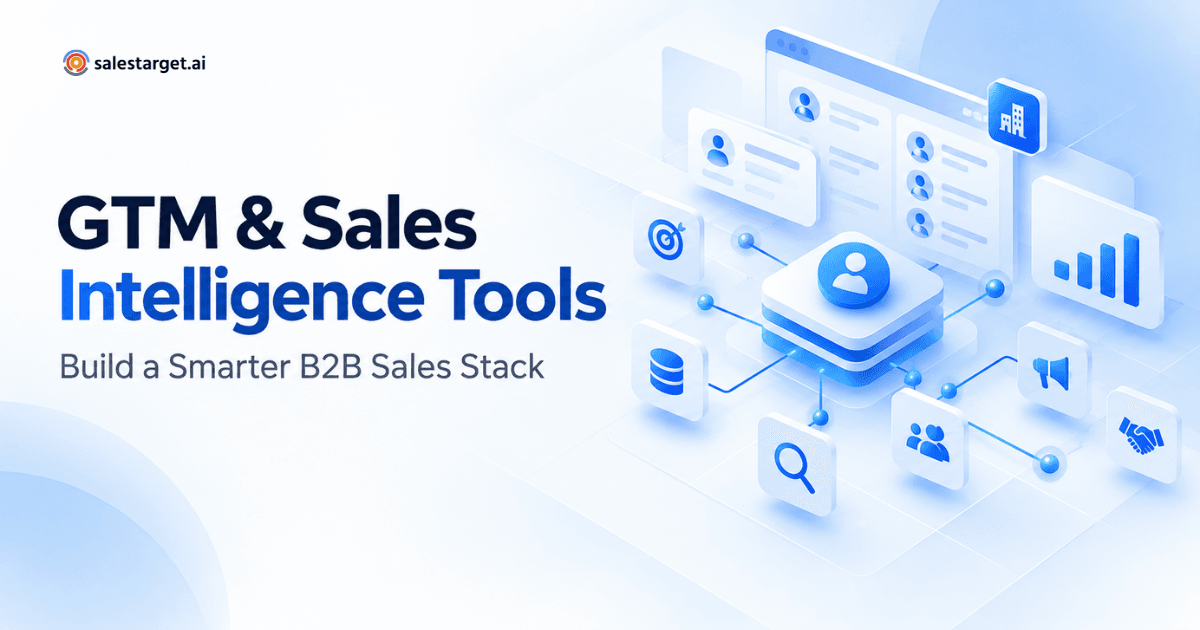
Modern revenue teams rarely rely on a single platform. Instead, they assemble a stack of tools that cover different layers of the GTM and sales intelligence workflow. The categories below represent the primary tool types companies invest in:
1. Prospecting and Contact Data Platforms
These are the foundational layer — databases of companies and verified contacts that GTM teams use to build target lists. Capabilities typically include search and filter by firmographic criteria, contact-level data (email, phone, LinkedIn), and export or CRM sync.
2. Intent Data and Buying Signal Platforms
Intent tools aggregate signals from third-party sources — content consumption, review site visits, category searches — to identify accounts that are actively in a buying cycle. They help teams prioritise outreach toward accounts most likely to convert in a given window.
3. Sales Engagement Platforms
Sales engagement tools manage the execution of multi-channel outreach — email sequences, call tasks, LinkedIn steps, and follow-up automation. They sit between the CRM and the prospect, ensuring reps follow a structured, measurable sales motion.
4. CRM and Pipeline Management
CRMs are the system of record for all prospect and customer data. GTM and sales intelligence tools integrate with CRMs to push enriched data, log activities, update records, and trigger workflows based on deal stage or contact behaviour.
5. Data Enrichment Tools
Enrichment platforms connect to existing contact or account databases and fill gaps — appending missing phone numbers, correcting outdated job titles, or layering technographic data onto company records.
6. AI-Powered Sales Intelligence Platforms
The newest and fastest-growing category — platforms that use AI to automate ICP matching, lead scoring, personalised outreach creation, and signal detection. These tools reduce the manual overhead of prospecting and allow smaller teams to operate at the output of much larger ones.
Tool Category Overview
| Tool Category | Primary Function | GTM Use Case |
|---|---|---|
| Contact Data / Prospecting | B2B contact and company data | ICP list building, outbound targeting |
| Intent Data | Buying signal detection | Account prioritisation, timing outreach |
| Sales Engagement | Multi-channel outreach automation | Email sequences, call tasks, LinkedIn |
| CRM | Pipeline and contact management | Deal tracking, record enrichment |
| Data Enrichment | Filling gaps in contact/account records | Cleaner CRM data, better personalisation |
| AI Sales Intelligence | Automated prospecting, scoring, outreach | Full-funnel GTM automation at scale |
How Companies Identify and Qualify Their ICP ?
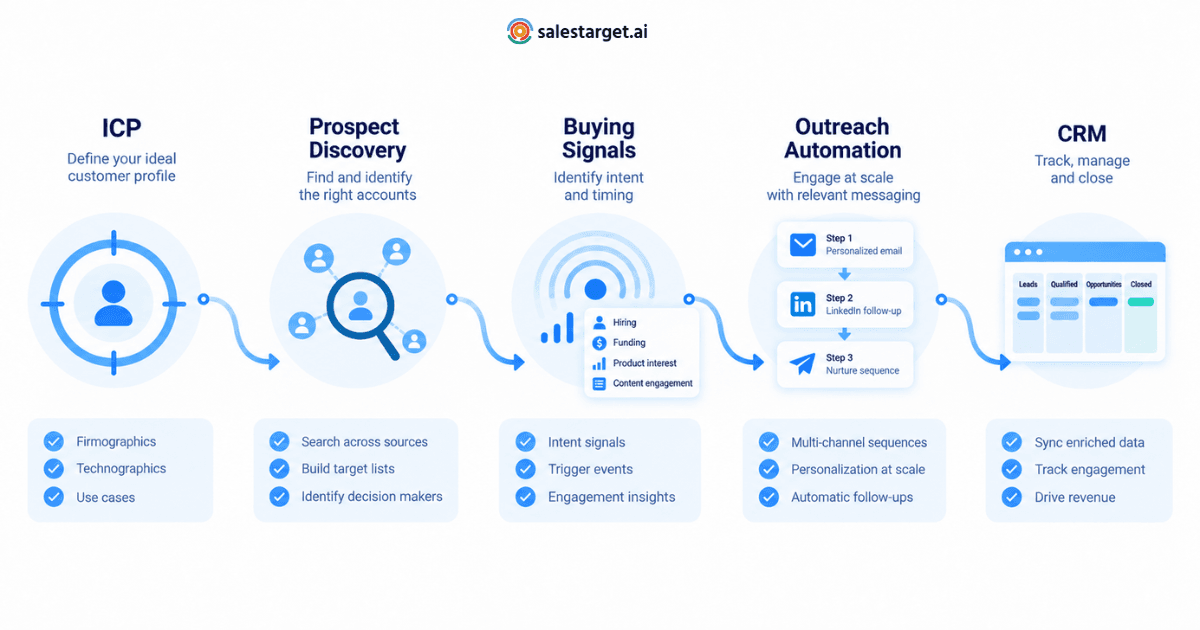
Ideal customer profile (ICP) identification is the strategic foundation of every GTM motion. Without a well-defined ICP, companies waste prospecting budget on accounts that will never convert, and their sales cycles drag.
A meaningful ICP definition goes beyond broad descriptors. It typically combines:
- Firmographic filters — industry vertical, company size, geography, revenue range
- Technographic signals — tools and platforms the company already uses
- Behavioural indicators — growth trajectory, hiring patterns, funding stage
- Negative filters — segments that rarely close, churn quickly, or have low LTV
Sales intelligence tools make ICP development data-driven rather than assumption-based. Teams can analyse their existing customer base, identify the attributes of highest-value accounts, and use those attributes to build prospecting filters that surface similar companies at scale.
ICP qualification doesn't stop at the top of the funnel. Sales intelligence tools support lead qualification throughout the pipeline by surfacing additional signals — like job changes at a target account, or a company expanding into a new market — that indicate the right moment to advance or deprioritise a deal.
How Sales Intelligence Supports Prospect Discovery and Enrichment ?
Prospect discovery is one of the most time-intensive activities in any outbound sales motion. Sales intelligence platforms address this by providing searchable databases of companies and contacts that reps can filter by the exact criteria their ICP demands.
Effective prospect discovery through sales intelligence typically involves:
- Running multi-criteria searches — combining industry, headcount, location, technology, and funding
- Building segmented target lists by persona, territory, or campaign
- Verifying contact data before outreach to reduce bounce rates and protect sender reputation
- Enriching inbound leads with company context before handoff to sales
- Monitoring existing accounts for changes that create new entry points
Data enrichment adds a second layer of value. Even companies with existing CRM databases benefit from enrichment because contact data decays rapidly — job titles change, people move companies, phone numbers become obsolete. Enrichment tools automatically refresh records, fill missing fields, and maintain data accuracy without requiring manual research by SDRs or RevOps teams.
The combined effect of accurate discovery and enrichment is a prospect database that sales teams can trust — and use — without spending hours on manual data cleaning before a single email is sent.
How GTM Teams Turn Prospect Intelligence into Outbound Campaigns
Intelligence without activation is just data. The real value of GTM and sales intelligence tools emerges when prospect data flows directly into outbound sales campaigns — shaping who gets contacted, when, and with what message.
Modern outbound campaigns built on sales intelligence follow a structured flow:
- Define the target segment — ICP-filtered list of companies and contacts
- Layer in prioritisation signals — intent data, trigger events, account scoring
- Build personalised messaging — using company context, pain points, and signals
- Launch multi-channel sequences — email, LinkedIn, phone, across multiple touches
- Track engagement — opens, replies, clicks, call outcomes
- Iterate — adjust messaging and targeting based on performance data
Personalisation at scale is one of the biggest challenges in outbound sales. Generic outreach performs poorly against increasingly distracted and skeptical B2B buyers. Sales intelligence tools address this by giving SDRs and AEs the context they need to reference something specific — a recent hire, a product launch, a technology the company uses, or a market movement that makes their offering relevant right now.
For a detailed breakdown of how AI is reshaping outbound execution, see this guide on GTM strategy using AI outbound sales tools, which covers how AI-driven workflows are changing the way revenue teams build and run their outbound motions.
How Sales Intelligence Connects with Sales Automation and CRM Workflows ?
Sales intelligence tools generate their highest ROI when they are embedded in the systems where sales teams actually work — the CRM and the sales engagement platform. Isolated tools that require manual data exports and imports create friction that slows adoption and reduces data quality.
A well-integrated GTM stack connects sales intelligence to workflows in these key ways:
CRM Integration
- Contacts discovered in a prospecting tool sync directly to CRM records
- Enrichment runs automatically when a new lead is created
- Firmographic and technographic data populates account fields without manual entry
- Deal stages trigger re-enrichment to catch data that has changed since first contact
Sales Engagement Integration
- Prospect lists flow directly from intelligence tools into outreach sequences
- Trigger events — like a funding round — automatically enrol accounts in relevant campaigns
- Contact-level engagement data (email opens, link clicks) feeds back into the CRM
- Call and meeting outcomes update intelligence tool records to keep priorities current
RevOps and Reporting
- Sales intelligence data feeds revenue attribution models
- Pipeline reports reflect accurate account and contact data
- Territory and quota planning uses enriched ICP data rather than guesswork
The tighter the integration between sales intelligence and CRM/automation platforms, the less time sales teams spend on data management — and the more time they spend in actual selling activities.
How AI Is Changing GTM and Sales Intelligence Workflows ?
Artificial intelligence is reshaping every layer of the GTM and sales intelligence stack. What once required hours of manual research, list building, and copy-writing is now being automated, accelerated, and personalised at a scale that was previously impossible for most teams.
Here is where AI is having the most significant impact on GTM and sales intelligence:
AI-Powered ICP Matching
AI models can analyse historical win/loss data, CRM records, and firmographic attributes to automatically identify which companies most closely match a company's best customers — and surface similar accounts in real time.
Automated Prospect Discovery
Rather than manually filtering databases, AI-powered prospecting tools can continuously scan for accounts that meet ICP criteria and trigger alerts or automatically add them to target lists when new companies match.
Signal Detection and Prioritisation
AI processes large volumes of buying signals — intent data, news events, job postings, web visits — and surfaces the accounts most likely to be in an active buying cycle right now. This allows SDRs to focus their time on accounts with the highest immediate potential.
Personalised Outreach at Scale
AI writing tools integrated with sales intelligence data can generate personalised first-touch emails and LinkedIn messages that reference specific, relevant signals — without requiring reps to research every prospect individually.
Predictive Lead Scoring
AI-powered scoring models evaluate hundreds of variables simultaneously to rank prospects by their likelihood to convert — enabling smarter prioritisation across large pipeline volumes.
The shift toward AI in GTM tools is not about replacing salespeople. It is about removing the low-value manual tasks that drain rep productivity and surfacing the right intelligence at the right moment so that every human interaction is better informed and more likely to convert.
What to Look for When Choosing GTM and Sales Intelligence Tools ?
With a crowded market of tools across every category, choosing the right GTM and sales intelligence platform requires clarity on what your team actually needs versus what sounds appealing in a demo.
Key evaluation criteria to apply:
Data Quality and Coverage
Contact and company data is the foundation. Evaluate accuracy rates, update frequency, geographic coverage, and data source transparency. Poor quality data creates more work, not less.
ICP Fit
Not every database covers every segment equally well. Evaluate whether the platform's data aligns with your specific market — whether that's SMB or enterprise, specific industries, or specific geographies.
Integration Depth
A sales intelligence tool that doesn't integrate with your CRM and sales engagement platform creates data silos. Prioritise native integrations or robust API access to ensure your intelligence flows into the tools your team uses every day.
Signal Richness
Beyond contact data, assess what buying signals and trigger event data the platform provides. Platforms that surface intent data, technographic changes, and company events give your team more opportunities to reach prospects at the right moment.
AI and Automation Capability
Evaluate whether the platform uses AI to automate ICP matching, lead scoring, or personalised outreach — or whether these are manual processes. AI-assisted workflows compound productivity gains over time.
Workflow and UX
Sales intelligence tools are only effective when reps actually use them. Evaluate the platform's usability, onboarding friction, and whether workflows match how your team actually operates.
Scalability
Consider whether the platform can grow with your team — in terms of seats, data volume, and feature depth as your GTM motion matures.
Common Mistakes Companies Make When Building Their GTM Tech Stack
The promise of a well-integrated GTM and sales intelligence stack is compelling. But companies frequently make avoidable mistakes during the build-out that undermine their investment.
- Buying tools before defining ICP — without a clear ICP, no prospecting database delivers value because teams don't know what to filter for
- Over-stacking the tech stack — adding too many point solutions creates data fragmentation, poor adoption, and high total cost of ownership
- Treating data as a one-time purchase — contact and company data decays rapidly; without ongoing enrichment and verification, CRM quality degrades
- Skipping CRM integration — tools that don't connect to the CRM force manual export/import cycles that kill adoption and introduce data quality issues
- Measuring tool usage instead of pipeline impact — tracking logins and list exports without connecting intelligence tool usage to pipeline generated and revenue won
- Ignoring outbound personalisation — purchasing contact data but sending generic outreach wastes both the investment and the prospect's attention
- Siloing sales and marketing data — when sales and marketing teams use separate intelligence tools without data sharing, targeting becomes inconsistent and account coverage overlaps
The companies that get the most from their GTM and sales intelligence stack are those that align tools to a clear strategy, integrate them into existing workflows, and measure their impact in terms of pipeline and revenue outcomes.
How an Integrated Platform Can Simplify the GTM Workflow
One of the persistent challenges in building a GTM tech stack is managing multiple point solutions that each handle a narrow slice of the workflow. Separate prospecting databases, enrichment tools, engagement platforms, and AI layers introduce integration overhead, data inconsistency, and higher costs.
An integrated approach consolidates key GTM and sales intelligence capabilities into a single platform — reducing the friction between data, intelligence, and outreach execution.
SalesTarget.ai is built around this integrated model. Rather than requiring teams to piece together a prospecting database, enrichment layer, and outreach automation separately, the platform brings together:
- Prospect discovery and B2B contact data — enabling teams to identify and build target lists based on ICP criteria
- Lead intelligence and enrichment — surfacing company and contact data that gives sales teams actionable context
- Outbound sales automation — supporting multi-step outreach workflows that move prospects through the funnel
- AI-driven workflows — using AI to streamline ICP matching, prospecting, and engagement tasks that would otherwise require significant manual effort
For sales teams, founders, and GTM professionals who want to reduce tool sprawl and run a tighter, more efficient revenue operation, an integrated platform reduces the coordination overhead of managing multiple vendor relationships while keeping intelligence and outreach workflows in sync.
The result is a cleaner data flow — from prospect discovery through enrichment and into outreach — without the data silos and manual handoffs that slow down a fragmented stack.
The GTM and sales intelligence tools used by the company are not optional additions to a sales motion — they are the infrastructure that determines how fast and how efficiently a revenue team can execute its strategy.
When companies align their go-to-market strategy with the right sales intelligence stack, they gain the ability to identify the right accounts, reach the right contacts, deliver the right message at the right time, and automate the workflows that turn prospecting into pipeline.
The shift toward AI-powered sales intelligence is accelerating this further — compressing the time between market signal and sales conversation, and enabling leaner teams to punch well above their weight in outbound coverage and personalisation.
Whether you are building a GTM stack from scratch, rationalising a sprawling collection of point solutions, or looking to add AI-driven prospecting and intelligence to an existing motion, the principles are consistent: start with a clear ICP, invest in data quality, integrate deeply with your CRM, and measure impact in pipeline terms.
Start building smarter with SalesTarget.ai — Ready to put sales intelligence to work for your GTM motion? Sign up for SalesTarget.ai and explore how an integrated platform can power your prospecting, outbound, and revenue workflows from day one.