Your reps spend half their day manually scraping LinkedIn, running list cleaning tools, and fixing broken CRM data. Your pipelines stall since sales follow-ups take days instead of minutes, letting hot opportunities go cold.
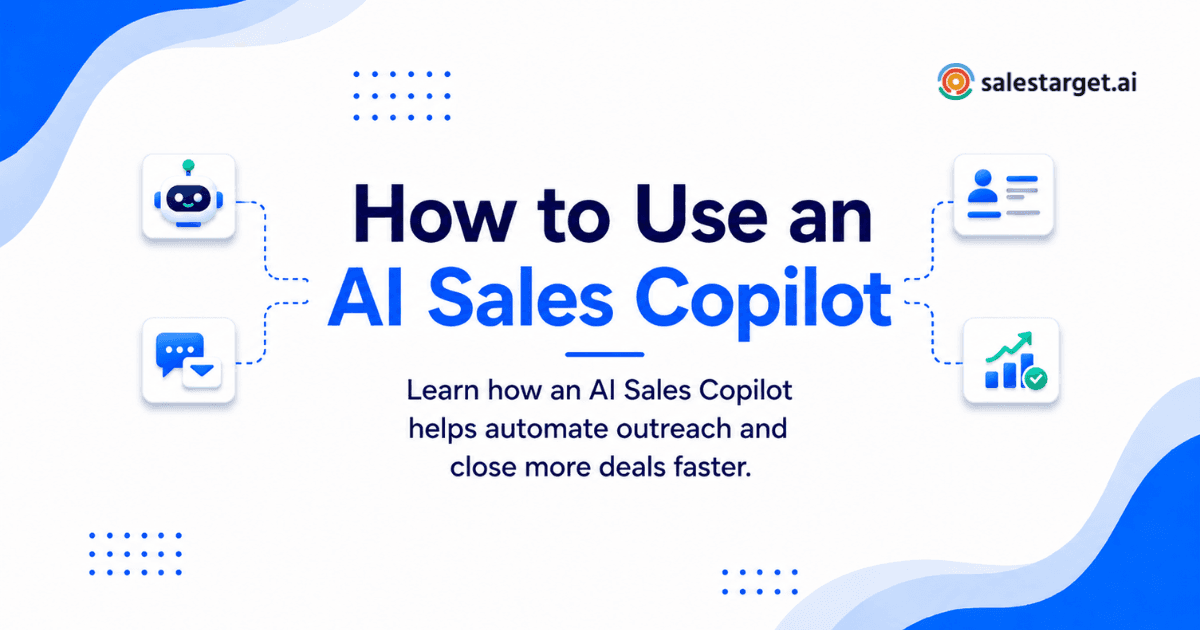
Closing deals faster with an AI Sales Copilot means putting an intelligent, conversational assistant inside your execution platform to handle manual prospecting, real-time message writing, and CRM updates. Instead of bouncing between fragmented tools, sales teams use a copilot to instantly locate high-intent buyers, generate multi-channel playbooks, and automate data entry. This keeps reps focused purely on active sales conversations, cutting pipeline friction and closing cycles.
The current outbound sales problem isn't a lack of rep effort; it is tool fatigue. Teams routinely stitch Apollo together for data, Instantly or Woodpecker for email delivery, separate tracking systems for LinkedIn, and HubSpot for pipeline management. This constant platform switching bleeds revenue.
A recent state of sales study by Salesforce indicates that sales reps spend under 30% of their week actually selling. The remaining hours get sucked up by manual administrative tasks, data cleanup, and tool maintenance.
This is where an AI Sales Copilot fixes the core operational workflow. By embedding conversational intelligence directly into your data and execution layers, a copilot converts hours of manual work into seconds of plain-English text prompts.
What Is an AI Sales Copilot?
An AI Sales Copilot is an interactive, conversational sales partner built directly into your outbound workspace to automate administrative tasks, research buyers, and draft outreach.
Unlike traditional sales software that requires manual button clicks, complex filter stacking, and CSV exports, a copilot understands natural language. You chat with it to extract targeted accounts, build multi-channel copy variants, or update pipeline deals. It functions as an on-demand operations teammate for your front-line reps, handles the technical grunt work, and leaves strategic relationship building to humans.
AI Sales Copilot vs AI Sales Assistant
An AI Sales Copilot works alongside a rep in real time to guide outbound strategy and execute live workflows, whereas a standard AI sales assistant operates as a basic, single-task automation bot.
| Feature | AI Sales Copilot | AI Sales Assistant |
|---|---|---|
| Interaction Style | Conversational chat in plain English | Static forms, templates, and basic buttons |
| Workflow Integration | Manages cross-channel steps and CRM fields | Handles one isolated task like text generation |
| Strategic Guidance | Flags risky deals and recommends next actions | Blindly runs set rules without company context |
| Data Execution | Queries 840M+ profiles and pushes directly to sequences | Requires manual CSV uploads and external syncs |
Why Sales Teams Need an AI Sales Copilot
Deploying AI for sales teams has shifted from a competitive edge to an operational necessity to protect rep capacity.
Too many manual tasks between prospecting and closing
Reps waste hours building lead lists, running them through separate validation checkers, and copy-pasting descriptions into messages. This manual drag delays campaign launches. Modern Sales AI software removes this friction by linking data extraction directly to outreach execution.
Lost opportunities from slow follow-ups
Leads cool down within minutes. When an outbound prospect replies with interest, a delay of a few hours can completely kill the momentum of a deal. A copilot identifies reply intent instantly and prompts immediate follow-up responses.
Switching between disconnected sales tools
Moving data from an isolated lead database to a cold email tool, then to a LinkedIn automation platform, and finally to a CRM creates widespread data drops. This fragmentation causes missed replies and blind spots for leadership. Sales workflow automation requires a single system where all these actions communicate natively.
How to Use an AI Sales Copilot to Close More Deals Faster
You accelerate deals by embedding the copilot into every outbound phase: from conversational list building and automated verification to cross-channel sequences and direct CRM logging.
Step 1: Build a list of qualified prospects with AI
Instead of spending hours stacking complex database filters, tell the AI Copilot what you need in plain text. You can instruct it to find B2B SaaS founders in California with recent funding rounds. Salestarget.ai scans its native database of 840M+ verified professional profiles and 146M+ business entities instantly.
The engine tracks 4,000+ buying signals, pinpointing companies experiencing leadership changes or hiring spikes, letting you run sales prospecting with AI without opening multiple tabs.
Step 2: Verify emails before starting outreach
Bounces ruin domain health and land your messages in the spam folder. When you extract data via the Lead Explorer, Salestarget.ai triggers real-time verification at the exact second of enrichment.
It runs native MX and SMTP checks to weed out disposable or high-risk emails. Salestarget.ai validates 90% of emails prior to delivery, ensuring your sender reputation stays safe from blacklists.
Step 3: Let AI write personalized cold emails
Generic templates get ignored by buyers and flagged by filters. Use the conversational copilot to draft highly targeted messages. Salestarget.ai utilizes an AI Content Generator and an AI Spintax Generator to create human-like variations that bypass standard automation patterns. By streamlining campaign setup, the platform helps outbound sales teams reduce creation time by 35%.
Need to scale personalized outbound without the manual grind?.
Step 4: Add LinkedIn outreach to the same sequence
Relying on email alone limits your conversion rates. Multi-channel sequences optimize AI for customer engagement by meeting buyers where they are active.
Use LinkedIn Outreach in tandem with your email steps. The copilot builds conditional playbooks: if a prospect leaves an email unread, the platform triggers a LinkedIn connection request or profile engagement step using built-in safe rate limits and human-like delays.
Step 5: Use AI recommendations to prioritize buyers
Not all leads hold equal value. The copilot monitors daily response metrics and delivers AI sales recommendations to highlight hot accounts. By tracking real-time buyer intent via Bombora topics, the platform scores leads based on active research behavior, allowing Account Executives to focus their energy on prospects closest to a buying decision.
Step 6: Let AI manage CRM updates automatically
Reps notoriously hate manual data entry, which leads to outdated pipelines. Salestarget.ai features a built-in outbound CRM.
When a prospect responds or books a meeting, the platform updates the stage and logs the communication directly on the lead timeline. This automated system achieves a 91% follow-up completion rate without requiring manual data syncs.
Step 7: Use AI during sales calls
During live phone conversations, the built-in AI dialer takes structural notes so reps can focus on the buyer. The system captures the discussion, isolates key next steps, and saves the call summaries straight to the CRM lead timeline. This eliminates the need for reps to type up notes after every conversation.
Step 8: Review AI insights and improve every sequence
Continuous improvement requires clean, data-driven feedback loops. Review your AI sales analytics to track which angles, titles, and cadences generate open pipeline.
A sales execution report by McKinsey highlights that organizations using advanced data methods see a significant lift in revenue generation. Salestarget.ai users experience 2.4X more meetings from identical lead pools by constantly optimizing sequences based on these automated insights.
How an AI Sales Copilot Fits Into Your Daily Sales Workflow?
A copilot operates as a continuous workflow engine that handles preparation, execution, live meetings, and post-interaction logging without manual tool switching.
Before outreach
The copilot builds your target list using plain-English queries, applies intent filters, triggers real-time data enrichment, and cleans contact data instantly.
During outreach
It coordinates email delivery via intelligent inbox rotation, handles warm-ups, and executes automated LinkedIn touchpoints from one single dashboard.
During meetings
It analyzes active buying signs, syncs with calendar slots, and tracks conversation points through integrated video call plugins.
After every customer interaction
It creates follow-up tasks, updates pipeline values inside the AI-powered CRM, logs dialer summaries, and alerts the account owner of needed next steps.
What Should You Look for in an AI Sales Copilot?
Modern AI for lead generation requires an all-in-one architecture rather than a single plugin bolted onto an old database.
- AI Prospecting and Lead Enrichment: Avoid tools that force you to import external lists. The platform must house a native database with live buying signal filtering.
- AI-Powered Sales Outreach: The system must execute multi-channel plays (email and LinkedIn) using conversational sequence design and human-like spintax generators.
- Built-in CRM Assistant: An isolated AI assistant just writes copy; a true copilot interacts directly with your CRM pipeline, updates statuses, and assigns tasks through chat commands.
- Email Validation: To secure deliverability, the software must clean contacts at the exact point of enrichment rather than relying on stale, scraped data.
- Sales Intelligence and Reporting: Look for software that flags at-risk deals, tracks campaign revenue metrics, and simplifies AI deal management.
Common Mistakes When Using an AI Sales Copilot
Even advanced AI sales automation fails if sales teams treat the technology like a hands-off spam machine.
Sending generic AI-written messages
Many teams let AI write entire email sequences without feeding it specific company context. This leads to generic language patterns that spam filters catch and buyers ignore. Feed the copilot your specific website content, case studies, and exact buyer personas to keep copy on-brand.
Skipping contact verification
Relying blindly on older database records leads to high bounce rates and ruined domain placement. Always run live verification checks before launching any outbound campaign.
Depending on AI without reviewing outputs
AI acts as an execution accelerator, not a complete replacement for human strategy. A human operator must always review sequence structures, double-check variable fields, and guide the overall messaging framework.
Using multiple disconnected sales tools
When lead data moves between Apollo, an external verification API, Instantly, and HubSpot, maintaining consistent and up-to-date records becomes challenging. If a lead opts out on LinkedIn, your email system does not know, leading to frustrated prospects and compliance risks. Keeping everything inside a unified revenue layer prevents this data fragmentation, as detailed on our page comparing Salestarget.ai vs Instantly.
Stop wasting time on broken tool connections. Consolidate your outbound stack with Salestarget.ai.
Why Choose SalesTarget.ai?
Salestarget.ai replaces your fragmented sales stack by combining high-intent B2B data, multi-channel messaging, real-time validation, and a built-in CRM into one centralized, AI-driven workspace.
Find, enrich, and verify contacts from one platform
Skip paying for separate data scrapers and verification APIs. Access 840M+ professional profiles and 146M+ business entities with integrated email cleaning at the exact second of capture.
Run AI-powered email and LinkedIn outreach together
Manage coordinated email and LinkedIn workflows inside a single timeline. Protect your sender reputation using safe rate limits, smart inbox rotation, and automated inbox warm-ups.
Keep prospecting, outreach, CRM, and AI Copilot in one workflow
Chat with your copilot to build targeted lists, generate copy variations, update pipeline deal stages, and review revenue analytics without ever leaving the application.
Save hours every week with fewer manual sales tasks
By removing the need to export CSVs and stitch point tools together, Salestarget.ai helps teams achieve 3.2X faster deal cycles and saves roughly 6 hours per rep every single week, allowing teams to land 2.4X more meetings from the same lead pools.
Final Thoughts
If your reps spend their days fighting disconnected systems, fixing bad data, and manually updating pipelines, your sales velocity will continue to suffer. An AI Sales Copilot solves this operational friction by uniting data, multi-channel outreach, and CRM updates into one conversation. Salestarget.ai delivers this entire outbound workflow inside a single platform on one bill, removing the need to stitch point products together. Ready to accelerate your sales pipeline? Get started with Salestarget.ai today.