Sales teams everywhere face the same problem: too many leads, too little time, and a growing pile of manual tasks that keep reps from actually selling. That's where AI Sales Assistant Software steps in. Instead of asking your team to work harder, this category of tools works alongside reps—handling research, prioritizing outreach, and surfacing the right talking points before every conversation.
The shift is already underway. Sales organizations that have adopted an AI-powered sales assistant are reporting shorter sales cycles, higher connect rates, and stronger pipeline coverage—without increasing headcount. But not every platform delivers on that promise. This guide breaks down what AI sales assistant software actually does, what separates a good solution from a mediocre one, and how to evaluate whether it fits your workflow.
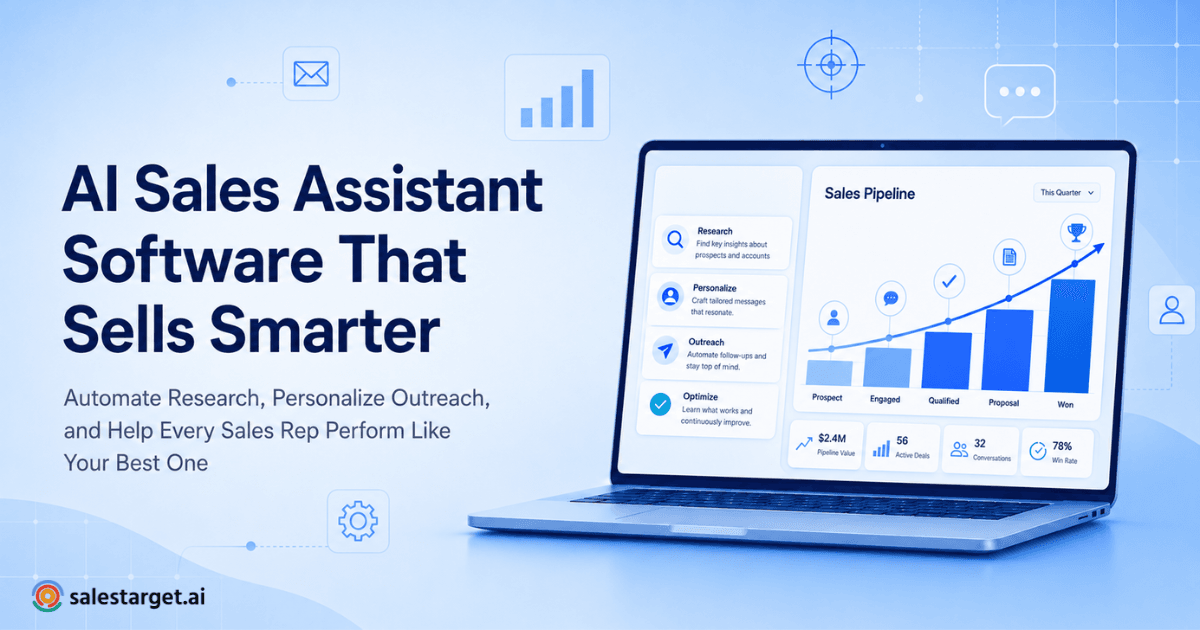
AI Sales Assistant Software helps sales teams automate repetitive work, prioritize leads, personalize outreach, and close more deals by combining AI-powered research, CRM intelligence, and workflow automation into a single platform. It acts as a copilot for every rep—reducing manual effort and increasing productive selling time.
What Is AI Sales Assistant Software?
At its core, AI Sales Assistant Software is a platform that uses machine learning, natural language processing, and data enrichment to handle the manual, time-consuming parts of a sales rep's day. Think of it as a smart layer that sits on top of your existing CRM and sales stack.
Rather than replacing your team, an AI sales assistant augments what they can do. It automates prospect research, drafts personalized emails, scores leads based on buying signals, and recommends next-best actions—all in real time. The result? Reps spend less time on admin and more time having meaningful conversations with qualified buyers.
According to a McKinsey report on AI in sales, companies using AI across their revenue functions have seen a measurable lift in lead conversion and deal velocity. The takeaway: this isn't experimental anymore. It's operational.
Why Traditional Sales Workflows Need AI?
Let's be blunt. The traditional sales workflow is broken in subtle ways that most teams have simply learned to tolerate.
Reps spend hours researching prospects across LinkedIn, company websites, and news feeds—only to send generic outreach that gets ignored. CRMs collect data but rarely surface insights at the moment a rep needs them. Managers build forecasts on gut instinct because pipeline data is inconsistent.
AI sales automation software addresses these gaps directly. It pulls and synthesizes prospect data in seconds. It personalizes messaging at scale, without sounding robotic. And it keeps CRM records accurate by logging activity automatically.
A Salesforce State of Sales report found that high-performing sales teams are significantly more likely to use AI than underperforming ones. That gap is only widening.
Key Features to Look for in AI Sales Assistant Software
Not every AI sales platform is built the same. Here are the features that separate a real productivity multiplier from a dressed-up chatbot.
| Feature | Why It Matters |
|---|---|
| Automated Prospect Research | Pulls firmographic, technographic, and intent data without manual lookups |
| AI-Powered Email Personalization | Generates contextual, human-sounding outreach at scale |
| Lead Scoring & Prioritization | Ranks leads based on engagement signals and fit criteria |
| CRM Auto-Sync | Logs calls, emails, and meeting notes directly into your CRM |
| Real-Time Coaching & Prompts | Surfaces talk tracks, objection handlers, and competitor intel during calls |
| Pipeline Analytics | Provides AI-driven forecasting and deal health monitoring |
Benefits for Modern Sales Teams
When AI handles the grunt work, your team can focus on what actually moves deals forward: building relationships and solving buyer problems. Here's what that looks like in practice.
More Selling Time, Less Busywork
Reps reclaim hours each week that previously went to prospect research, data entry, and email drafting. That time goes directly back into pipeline-generating activity.
Consistent, Personalized Outreach
AI doesn't have off days. Every email, every follow-up, and every touchpoint is tailored to the recipient's context—whether your team sends fifty messages a day or five hundred.
Better Pipeline Visibility
With AI tracking deal signals and engagement patterns, sales leaders get a clearer, data-driven view of pipeline health. No more end-of-quarter surprises.
How AI Sales Automation Improves Revenue?
An AI Sales Copilot doesn't just make reps faster—it makes the entire revenue engine more predictable. Here's the chain reaction:
Better data leads to better targeting. Better targeting leads to higher response rates. Higher response rates lead to more qualified pipeline. And more qualified pipeline leads to predictable, scalable revenue.
Expert Insight: Across AI-driven B2B sales teams we've observed, organizations that automate prospect research and outreach preparation typically reclaim 25–35% of a sales representative's weekly selling time. That's the equivalent of adding one productive day per rep per week—without a single new hire.
That freed-up capacity compounds fast. A ten-person SDR team recovering 30% of their week effectively operates like a thirteen-person team. Multiply that across quarters, and the revenue impact is significant.
How SalesTarget.ai Copilot Fits Into Your Workflow?
This is where platforms like SalesTarget Copilot earn their place. Rather than bolting on yet another disconnected point solution, it functions as a Revenue Layer for Your Sales Stack—sitting between your CRM, communication tools, and data providers to orchestrate every step of the sales workflow.
SalesTarget.ai Copilot automates prospect research by aggregating firmographic, technographic, and intent signals into a single view. It drafts personalized outreach that reflects each prospect's business context. And it keeps your CRM updated without reps lifting a finger.
For SDR teams, it means more qualified meetings booked per rep. For AEs, it means walking into every call prepared. For sales leaders, it means accurate pipeline data they can actually trust.
The platform is designed for B2B teams that want AI to handle preparation and workflow, so reps can focus on conversations and closing.
Common Mistakes When Choosing AI Sales Assistant Software
Buying AI sales tools isn't risk-free. Here are the most frequent missteps we see.
Chasing features over workflow fit. A long feature list means nothing if the tool doesn't integrate with how your team actually sells. Prioritize platforms that match your process.
Ignoring adoption. The best AI sales automation software is the one your reps will actually use. If it adds complexity instead of removing it, adoption stalls.
Expecting magic without clean data. AI is only as good as the data feeding it. Start with CRM hygiene before layering on automation.
The Future of AI in Sales
We're still in the early innings. Over the next two to three years, expect AI sales platforms to move beyond task automation into strategic decision support—recommending deal strategies, predicting churn risk, and dynamically adjusting outreach cadences based on buyer behavior.
The sales AI platform category will consolidate around tools that combine research, outreach, CRM intelligence, and analytics into a unified copilot experience. Teams that invest now in building AI-native workflows will have a compounding advantage over those that wait.
AI Sales Assistant Software isn't a future trend—it's a present-day competitive advantage. The teams that adopt it thoughtfully, with the right platform and realistic expectations, are already outperforming their peers in pipeline generation, deal velocity, and revenue per rep.
The key is choosing a solution that fits your workflow, integrates with your stack, and genuinely reduces the manual effort that slows your team down.
Ready to see what AI-powered selling looks like?