AI Sales Copilot
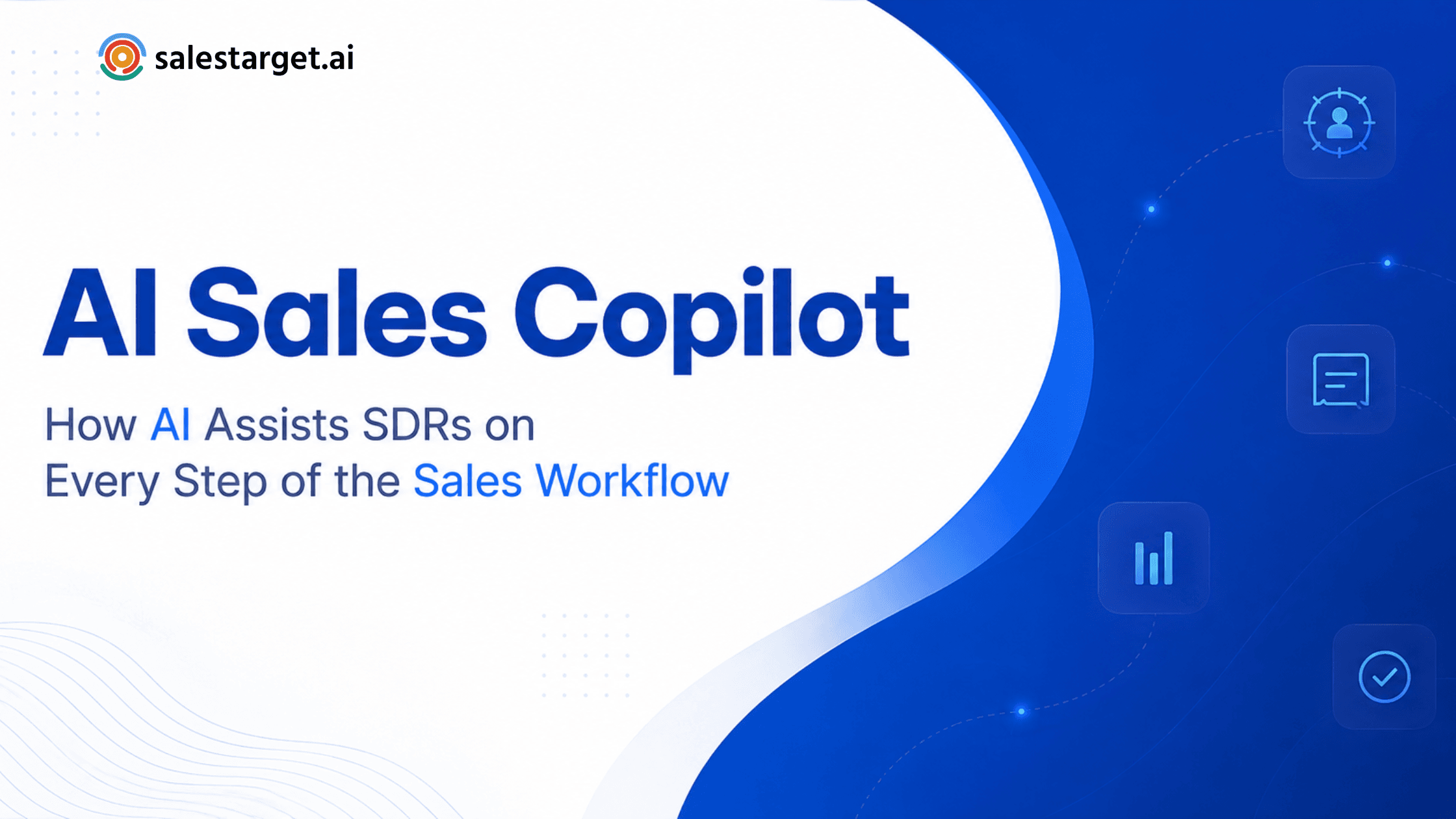
An AI Sales Copilot is an intelligent software layer that works alongside SDRs in real time — handling prospect research, message drafting, follow-up scheduling, and CRM updates so reps can focus on human-led conversations. Unlike basic automation, a copilot provides context-aware guidance at each step of the sales workflow. SDRs are adopting it because it cuts time spent on repetitive tasks by a significant margin while making every outreach interaction more relevant and timely.
The Modern SDR Problem Nobody Talks About
Ask any SDR how their day actually goes, and they'll tell you something surprising: a huge chunk of it never involves selling at all.
Between digging through LinkedIn profiles, updating CRM fields, switching between six different browser tabs, crafting outreach that gets ignored, and scrambling to remember where a conversation left off three weeks ago — the actual sales conversation gets squeezed into a narrow window of the workday.
Tool overload is a real issue. The average sales rep today juggles a CRM, a sales engagement platform, a LinkedIn Sales Navigator account, an email tool, a meeting scheduler, and a note-taking app. Each tool solves one problem and creates three others in the form of context-switching and duplicate data entry.
Then there's the research trap. Before reaching out to a prospect, a diligent SDR should understand the company's recent news, the contact's role, any relevant trigger events, and how the product maps to that specific pain. Doing that thoroughly for every account in a sequence? It's either impossible at scale or it gets skipped entirely.
Studies from HubSpot's research on sales follow-up behavior consistently show that most deals require multiple touches before a response, yet the majority of SDRs stop after one or two attempts because managing the cadence manually is cognitively exhausting.
This is the environment in which AI Sales Copilot tools were built to operate.
What Exactly Is an AI Sales Copilot?
At its core, an AI Sales Copilot is a real-time intelligent assistant that operates within a salesperson's existing workflow — offering guidance, generating content, surfacing insights, and automating low-value tasks without removing the human from the loop.
It's important to distinguish between three things that often get conflated:
- CRM vs. Copilot:
- A CRM is a database. It stores what happened. A copilot interprets what's happening and suggests what to do next. One is a record; the other is an advisor.
- Automation vs. Intelligence:
- Traditional sales automation runs predefined sequences — send email on day 1, LinkedIn message on day 3. An AI sales assistant learns context. It understands that a prospect who just posted about a budget freeze might need a different message than one who just announced a funding round.
- Traditional Tools vs. AI Assistance:
- Older sales tools require the rep to make every decision manually and then execute it. A copilot proactively surfaces the right action at the right moment, reducing the cognitive load on the rep while keeping them in control of the final call.
Think of it like GPS navigation versus a paper map. Both get you to the destination. But one watches the road in real time and reroutes when conditions change.
A Day in the Life of an SDR Using an AI Sales Copilot
Rather than listing features in the abstract, here's what the workflow actually looks like when a copilot is embedded into an SDR's day. For a deeper look at how these steps connect end-to-end, the AI outbound sales workflow guide walks through the full process in detail.
▶ Finding the Right Prospects
Instead of manually building lists from spreadsheets and LinkedIn searches, the copilot surfaces pre-qualified leads based on ICP signals — industry, company size, tech stack, recent hiring patterns, and more. What used to take 45 minutes now takes seconds. The SDR reviews and approves; the copilot does the heavy lifting to surface who's worth approaching.
▶ Researching Accounts in Seconds
Before any outreach goes out, the copilot pulls relevant account context: recent news mentions, executive changes, funding events, LinkedIn activity, and competitive intel. A rep can walk into a cold email or LinkedIn message with the same level of preparation it used to take half an hour to gather. This is where GPT for sales capabilities shine — synthesizing scattered data into a crisp, actionable account brief.
▶ Writing Personalized Outreach
The copilot drafts opening messages tailored to each prospect using the account research it just compiled. The SDR edits, tweaks the tone, adds a personal detail, and sends. The result is messages that read as genuinely researched and human — because a human reviewed and refined them — but at a velocity that was previously impossible. This is the copilot for SDRs use case that teams notice first, because response rates change almost immediately.
▶ Managing Follow-Ups
The copilot tracks open sequences and flags which prospects need follow-up, when, and with what angle. If a prospect opened an email three times but didn't reply, the copilot surfaces that signal and suggests a follow-up that acknowledges the interest without being pushy. No more letting warm leads go cold because the rep forgot to check the sequence.
▶ Preparing for Meetings
When a prospect agrees to a call, the copilot generates a pre-call brief: company overview, pain point hypothesis based on their profile, suggested discovery questions, and potential objections. The rep walks in prepared rather than scrambling to pull notes together five minutes before the call.
▶ Updating CRM Without Manual Work
After activities — emails sent, calls made, LinkedIn messages exchanged — the copilot logs them automatically and updates deal stages based on activity signals. CRM hygiene, which has historically been the SDR task everyone avoids, happens in the background. Managers get reliable pipeline data, and reps get their time back.
The Five Biggest Benefits SDR Teams Gain from AI Copilots
- Faster Prospecting — AI-assisted tools compress the list-building and account research cycle from hours to minutes. Reps start outreach with higher-quality targets and better context before sending a single message.
- Better Personalization at Scale — Personalized outreach is no longer a tradeoff with volume. The copilot handles the research layer, so SDRs can send messages that feel genuinely relevant without handcrafting every word from scratch.
- Higher Activity Levels — When administrative friction is removed, reps naturally do more. More sequences, more follow-ups, more LinkedIn touches — all without burning out. The copilot creates capacity by absorbing the busywork.
- Reduced Admin Work — Teams using AI-assisted workflows often report 30–50% reductions in repetitive sales tasks, according to industry-observed benchmarks across early adopters of AI sales tooling. Automated CRM logging alone accounts for a meaningful share of recovered selling time.
- Improved Pipeline Consistency — When individual SDR performance is less dependent on how organized each rep happens to be, pipeline quality stabilizes. Managers get more predictable forecasts, and reps stop falling through the cracks of their own sequences.
Industry Insight: Teams using AI-assisted workflows often report 30–50% reductions in repetitive sales tasks — a benchmark increasingly observed across early adopters of AI sales tooling.
If you're still figuring out whether this kind of tooling makes sense for your team, what an AI sales assistant actually does breaks down the practical mechanics in plain terms.
Where GPT for Sales Creates the Biggest Impact
Large language models have changed what's possible in sales outreach, but their impact is uneven across use cases. Here's where GPT for sales genuinely moves the needle:
Prospect Research
Synthesizing public signals — LinkedIn posts, press releases, earnings call transcripts, job postings — into a coherent account narrative is exactly the kind of task large language models do well. A model can read 12 sources in seconds and surface the three sentences an SDR actually needs.
Message Generation
First drafts of cold emails, LinkedIn connection requests, and follow-up messages can be generated from the research brief in moments. The best implementations keep the human as the final editor — this is what separates quality AI-assisted outreach from spray-and-pray approaches that damage sender reputation.
Objection Handling
Real-time suggestions for handling common objections during calls or in email replies give SDRs language options they might not have reached for on their own. Over time, the copilot learns which responses work best for specific personas and industries.
Follow-Up Suggestions
Instead of defaulting to generic "just checking in" messages, AI-powered follow-ups reference specific prospect behavior and suggest angles that are more likely to prompt a reply.
Pipeline Recommendations
More advanced copilots surface which deals need attention and suggest next-best actions based on engagement patterns — adding a layer of intelligence to pipeline management that spreadsheets and manual CRM reviews simply can't match.
How to Evaluate an AI Sales Copilot for Your Team
Gartner's research on AI adoption in sales organizations notes that tool selection quality significantly impacts whether AI initiatives deliver measurable pipeline outcomes or simply add to the tool overload problem. Use this practical checklist when evaluating options:
- Data quality and sourcing — Where does the prospect and account data come from? Is it fresh, verified, and compliant with privacy regulations?
- CRM integration — Does it sync bidirectionally with your existing CRM without requiring manual exports and imports?
- LinkedIn workflow support — LinkedIn is where modern outbound starts for most B2B teams. Does the copilot work inside the LinkedIn interface or require constant tab-switching?
- Personalization capabilities — Can it use real account and contact signals to draft outreach, or does it rely on templates with placeholder swaps?
- Workflow automation depth — Beyond drafting messages, can it log activities, flag follow-ups, and surface next-best-actions automatically?
- Ease of adoption — How long does onboarding take? A copilot that requires weeks of training before it adds value will see low adoption regardless of its feature depth.
The Future of AI-Assisted Selling
The shift happening in sales right now isn't a temporary trend. It's a structural change in how outbound teams operate, and the trajectory points toward deeper integration between human judgment and machine intelligence — not a replacement of one by the other.
Human + AI Collaboration will define top-performing teams over the next few years. The SDRs who thrive won't be the ones who resist AI tools or hand everything off to automation. They'll be the ones who get good at directing AI, editing its output, and applying their own relationship instincts where they matter most.
Real-Time Sales Intelligence is moving from a nice-to-have to a standard expectation. Buyers expect relevance. Reps who show up to conversations with outdated context will lose deals that more prepared competitors win. The copilot becomes the mechanism that keeps the SDR perpetually current on each account.
Personalized Outreach at Scale will stop being a contradiction. As AI gets better at understanding buyer context and generating nuanced, specific language, the gap between a high-volume sequence and a hand-crafted message will narrow considerably.
Predictive Guidance will mature from pattern-matching to genuine forward-looking recommendations: which accounts are entering a buying window, which sequences are underperforming and why, and what the next most effective action is for each deal in the pipeline.
The conversation about AI in sales too often fixates on speed. Yes, an AI Sales Copilot helps SDRs work faster. But the more meaningful shift is qualitative: reps who use one work smarter. They reach the right people with the right message at the right time, with the right context backing every interaction.
Prospecting becomes intentional rather than exhausting. Outreach becomes relevant rather than generic. Follow-up becomes timely rather than an afterthought. CRM data becomes reliable rather than a chore. And the SDR's attention — always the scarcest resource on any revenue team — gets directed where it genuinely moves deals forward.
That's not a productivity story. That's a pipeline story. And it's why teams that adopt AI Sales Copilot tools thoughtfully tend to see compound gains: better data leads to better targeting, which leads to better conversations, which leads to more consistent pipeline — and that cycle accelerates over time.
Activate Your AI Sales Copilot Today
See how SalesTarget's Copilot helps SDRs research faster, write better outreach, and keep pipeline moving — without the manual work. No credit card required to start.