Every sales team eventually hits the same wall. The manual prospecting methods that once worked—cold calling from bought lists, scrolling LinkedIn for hours, piecing together contact details from scattered databases—stop scaling. The pipeline slows down, reps burn time on the wrong accounts, and revenue targets start slipping.
This is exactly the problem a lead generation platform is built to solve. It centralizes the entire process of finding, enriching, qualifying, and engaging B2B prospects into a single workflow. Instead of toggling between five or six disconnected tools, your sales and marketing teams work from one system that moves leads from discovery to outreach without the duct tape.
If you are new to the concept, it helps to start with the basics. Our guide on what a lead generation platform is breaks down the foundational ideas before diving deeper.
This article goes further. We will walk through how these platforms actually work under the hood, the features that matter most, common pitfalls to avoid, and how to evaluate which platform fits your team. Whether you are an SDR building pipeline, a founder trying to scale outbound, or a marketing leader exploring new channels, this guide is written for you.
What Is a Lead Generation Platform?
A lead generation platform is a software tool designed to help businesses identify, collect, organize, and act on potential customer data. In B2B contexts, these platforms aggregate information about companies and decision-makers from a range of data sources - public records, web crawlers, third-party data providers, and proprietary databases - and make that information searchable and actionable.
Think of it as the engine behind modern prospecting. Rather than relying on marketing to hand over a trickle of inbound leads or purchasing static CSV lists, sales teams use a lead generation platform to proactively discover accounts that match their ideal customer profile (ICP). The platform then layers on relevant data - contact details, company firmographics, technology usage, buying intent signals - so reps can prioritize outreach based on fit and timing rather than guesswork.
The scope of these platforms has expanded considerably. Early tools focused almost exclusively on providing contact data. Modern platforms are closer to full-cycle prospecting engines, combining lead discovery, data enrichment, lead scoring, and CRM integration into a single interface.
How Does a Lead Generation Platform Work?
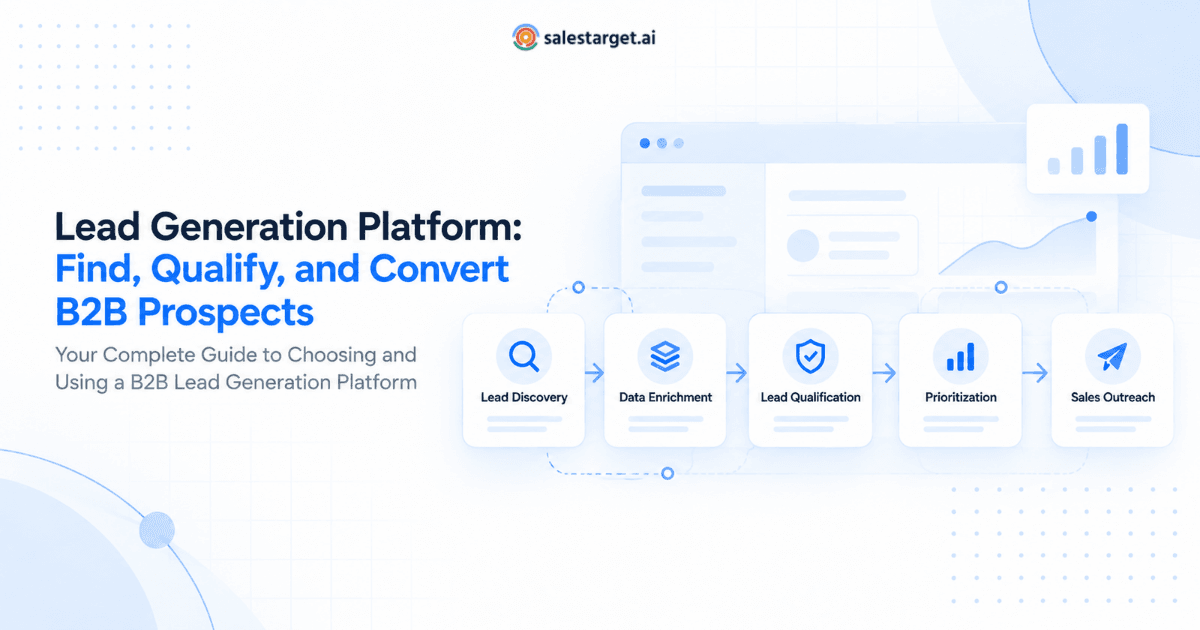
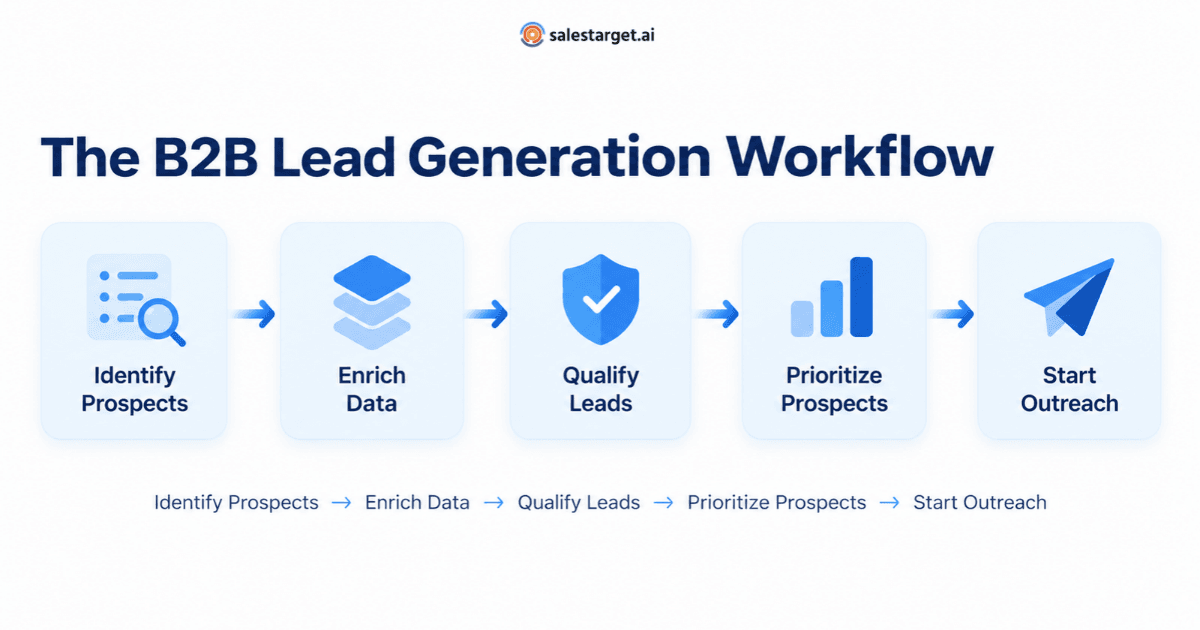
Understanding the mechanics helps you evaluate which platform will actually serve your workflow. At a high level, most lead generation platforms follow a five-stage process:
- Search and Discovery – Users define criteria - industry, company size, job title, geography, technology stack, revenue range - and the platform searches its database to surface matching companies and contacts. Some platforms also support natural-language search, letting you type a description of your target buyer instead of toggling filters manually.
- Data Enrichment – Once a prospect is identified, the platform enriches the record with additional data points: verified email addresses, phone numbers, company firmographics, technographic data, and social profiles. This transforms a bare name-and-company record into a complete prospect profile.
- Qualification and Scoring – Not every lead is worth pursuing. Platforms use a combination of firmographic fit, behavioral signals, and buying intent data to help prioritize which accounts are most likely to convert. Some platforms integrate third-party intent data providers to flag companies actively researching relevant solutions.
- Organization and Segmentation – Qualified leads are sorted into lists, segments, or campaigns based on criteria you define. This makes it easier for reps to run targeted sequences rather than blasting the same message to everyone.
- Activation and Outreach – The final step is getting the lead into a sales workflow. This might mean pushing the record to a CRM, adding it to an email sequence, or flagging it for a phone call. The best platforms minimize the gap between discovering a lead and contacting them.
The platforms that consolidate all five stages into a single interface tend to reduce friction significantly. When reps have to export from one tool, import into another, and manually cross-reference a third, speed drops and data quality suffers.
Why Businesses Use Lead Generation Platforms
The shift toward platform-based prospecting is not just a trend - it is a response to real operational pain points. Here is why sales and marketing teams are investing:
- Scaling outbound without scaling headcount. A well-configured platform lets a single SDR generate the volume of qualified prospects that would have required a team of researchers five years ago. The leverage comes from automation of the repetitive work: searching, enriching, validating, and organizing prospect data.
- Reducing data decay. B2B contact data degrades fast. People change jobs, companies restructure, and email addresses go stale. Platforms that verify data at the point of enrichment - rather than at the point of collection—deliver dramatically better deliverability and connection rates.
- Shortening the sales cycle. When reps start conversations with enriched, qualified prospects instead of cold unknowns, the average time from first touch to closed deal compresses. You skip the research phase and jump straight to relevance.
- Aligning sales and marketing. A shared platform gives both teams the same view of target accounts, the same data, and the same qualification criteria. This eliminates the perennial argument over lead quality.
- Improving targeting precision. Generic outreach wastes everyone's time. Platforms that support ICP-based filtering, firmographic segmentation, and intent-based prioritization ensure reps only spend time on accounts that are both a good fit and actively in-market.
Key Features to Look For in a Lead Generation Platform
Not every platform delivers equal value. When evaluating options, focus on these capabilities:
Comprehensive Search and Filtering
The platform should support multi-dimensional search: filter by industry, geography, company size, revenue, seniority, job title, department, and ideally by technology stack and intent signals. The broader and more granular the filtering, the more precisely you can target your ICP.
Built-In Lead Enrichment
Look for platforms that enrich records natively rather than requiring a separate tool. Enrichment should include verified email addresses, direct phone numbers, company firmographics, and technographic data. Platforms that verify contact data at the point of enrichment - not when it was originally scraped - tend to deliver higher accuracy.
Intent Data and Buying Signals
The difference between a cold lead and a warm lead is often timing. Platforms that incorporate intent data—sourced from third-party providers or proprietary signals - help sales teams focus on accounts actively researching solutions in your category. Common signals include hiring spikes, funding rounds, leadership changes, and topic-based research intent.
ICP-Based Prospecting
Your ideal customer profile should be the foundation of every search. Look for platforms that let you define and save ICP parameters so every search automatically applies your targeting criteria. This prevents list bloat and keeps outbound focused on high-fit accounts.
CRM and Outreach Integration
A platform that sits in isolation creates more work, not less. Native CRM integrations - with tools like Salesforce, HubSpot, Pipedrive, or Zoho - allow enriched leads to flow directly into your pipeline without manual exports or field mapping. Platforms that also connect to email sequencing or LinkedIn outreach tools close the loop entirely.
Data Coverage and Quality
Database size matters, but data quality matters more. A platform with hundreds of millions of profiles is only useful if the records are accurate, regularly updated, and verified. Ask about verification methodology, data sources, and freshness before committing.
How Lead Generation Platforms Help B2B Sales Teams
For B2B sales teams, a lead generation platform is not just a data source—it is an operational backbone. Here is how it typically fits into a modern sales workflow:
- SDRs and BDRs use the platform daily to build targeted prospect lists, enrich records, and feed qualified leads into sequences. The platform replaces hours of manual research with a few clicks.
- Account executives use enriched account data to prepare for conversations, identify additional stakeholders within target companies, and understand the prospect's technology environment before pitching.
- Sales managers use pipeline data from the platform to monitor team activity, identify coverage gaps, and forecast based on the volume and quality of prospects entering the funnel.
- Marketing teams leverage the platform's segmentation capabilities to build targeted ABM lists, align advertising campaigns with sales outreach, and track which accounts are being actively pursued.
The common thread is that the platform eliminates guesswork and manual data assembly. When the right data is already attached to the right account, every conversation starts from a position of relevance.
Lead Discovery, Enrichment, and Qualification: The Core Workflow
These three stages form the backbone of any lead generation platform, and getting each one right has a direct impact on conversion rates.
Lead Discovery
Discovery is the top of the funnel. The platform's job is to surface contacts and companies that fit your criteria from a large, indexed database. The quality of discovery depends on the platform's data sources, the granularity of its search filters, and the freshness of its records. Advanced platforms allow discovery using both structured filters and natural-language prompts, which gives reps flexibility to search by precise parameters or by a description of their ideal buyer.
Lead Enrichment
Once you have identified a prospect, enrichment adds the data you need to reach and engage them. At a minimum, this means verified email and phone. At best, it includes company size, revenue, technology stack, social profiles, recent company news, and organizational hierarchy. The key metric here is verification: platforms that verify contact data in real time deliver significantly better results than those relying on cached data.
Lead Qualification
Qualification separates the leads worth pursuing from the noise. This typically involves matching the lead against your ICP criteria and layering on intent signals. A company that fits your firmographic profile and is showing research intent in your category is a far better bet than one that only matches on company size. Platforms that combine ICP-based scoring with intent data give reps a prioritized list rather than a flat one.
How to Choose the Right Lead Generation Platform
With dozens of platforms on the market, selecting the right one requires more than reading feature lists. Here is a practical framework:
- Start with your ICP. Define exactly who you are trying to reach - industries, company sizes, geographies, roles, seniority levels. Then test whether the platform's database actually has strong coverage for that segment. A platform with 800 million profiles is not useful if your target market is underrepresented.
- Evaluate data quality, not just volume. Run sample searches during a trial period. Check whether the emails are deliverable, whether the phone numbers are direct lines, and whether the firmographic data is current. Volume without accuracy is noise.
- Assess the workflow, not just the features. Does the platform let you move from search to enrichment to outreach without leaving the interface? Or does it force you to export, import, and stitch things together? The smoother the workflow, the more your team will actually use it.
- Check integration depth. Make sure the platform integrates with your CRM and outreach tools natively. CSV export is a stopgap, not a strategy. Look for field mapping, automatic syncing, and deduplication logic.
- Test intent data coverage. If the platform offers buying signals or intent data, verify the source and lookback window. Intent data from a reputable provider with a 30–90 day window is much more actionable than vague "engagement scores" with no clear methodology.
For a side-by-side look at how leading platforms compare across these criteria, our lead generation platform comparison guide is a helpful reference.
- Consider team adoption. The most powerful platform in the world is worthless if your team finds it confusing. Prioritize intuitive interfaces, clean UX, and strong onboarding support.
Common Mistakes to Avoid When Using a Lead Generation Platform
Even with the right tool, execution matters. These are the most frequent mistakes teams make:
- Casting too wide a net. Resist the temptation to pull massive lists. More leads does not mean better pipeline. Tight, ICP-aligned lists consistently outperform large, generic ones in reply rates and conversion.
- Ignoring data hygiene. Enriched data still needs maintenance. Contacts change roles, companies merge, and emails bounce. Build a regular cadence of re-enrichment and list cleaning into your process.
- Skipping intent signals. If your platform offers intent data, use it. Reaching out to a company that is actively evaluating solutions in your space is fundamentally different from reaching out cold. Timing is one of the biggest levers in outbound sales.
- Using the same messaging for everyone. A lead generation platform gives you rich data for a reason. Segment your outreach by industry, seniority, use case, or signal type, and tailor your messaging accordingly.
- Treating the platform as a one-time project. Prospecting is not a batch process. The best teams use their platform continuously - building fresh lists weekly, monitoring new intent signals, and feeding the pipeline with a steady flow of qualified prospects.
- Over-relying on a single channel. A lead generation platform feeds data into your workflow, but outreach should span multiple channels - email, LinkedIn, phone - to maximize connection rates.
How SalesTarget AI Lead Explorer Supports the Lead Generation Workflow ?
SalesTarget AI Lead Explorer is a B2B lead generation platform designed to consolidate prospecting, enrichment, qualification, and outreach activation into a single interface. Rather than stitching together separate tools for each stage of the process, it brings the full workflow under one roof.
Here is how it maps to the core stages we have covered:
- Prospect discovery: Search across a database of over 840 million professional profiles and 96 million business entities using advanced filters - industry, company size, revenue, job title, seniority, geography, technology stack - or use AI-powered natural-language search to describe your target buyer in plain English.
- Built-in enrichment: Select any prospect and unlock enrichment data in a single click. This includes verified professional and personal email addresses, direct phone and mobile numbers, company firmographics, and technology stack details. Contact data is verified at the point of enrichment, not at collection time, which directly improves deliverability.
- Intent signals and buying indicators: Use intent topic filters powered by Bombora alongside business event signals - funding rounds, hiring surges, leadership changes, company awards - to identify accounts that are actively in-market. A configurable 30–90 day lookback window lets you fine-tune signal recency.
- ICP-based targeting: Define your ideal customer profile using the platform's filter panel and apply it consistently across all searches. Every list you build starts with your ICP criteria, which keeps prospecting focused on high-fit accounts.
- CRM and outreach integration: Push enriched, qualified leads directly to HubSpot, Salesforce, Pipedrive, or Zoho - or use the platform's built-in advanced CRM. Launch email sequences or outreach campaigns directly without exporting or switching tools.
The practical advantage is speed and consistency. An SDR can move from a blank search to a fully enriched, CRM-synced, campaign-ready prospect list in minutes rather than hours. And because everything happens in one platform, data quality stays high throughout the process.
If your team is spending more time assembling prospect data than actually selling, SalesTarget AI Lead Explorer is worth evaluating.