Most lead generation campaigns fail before the first email goes out. Not because the offer is weak or the rep isn't working hard enough, but because the campaign was built backwards: tools picked before the audience was defined, sequences written before the list was verified, channels chosen because a competitor uses them rather than because the buyer is actually there.
If you're a sales leader, founder, or RevOps operator responsible for filling the pipeline, you don't need another definition of "lead generation." You need a repeatable process for launching a campaign that produces qualified conversations, not just activity.
This guide covers how to structure a lead generation campaign from audience definition through scaling, plus which tools actually move the needle at each stage.
What Is a Lead Generation Campaign?
A lead generation campaign is a coordinated, time-bound effort to identify, reach, and convert a specific set of prospects into qualified leads. It has a defined audience, a set of channels, a message sequence, and a measurable goal, unlike ongoing "always-on" outbound, which runs without a fixed endpoint.
Every campaign moves prospects through four stages:
- Attract: Surface the right accounts and contacts using firmographic, technographic, or intent data.
- Engage: Reach them through email, LinkedIn, or phone with a message relevant to their situation.
- Convert: Turn a reply or click into a booked meeting or qualified opportunity.
- Nurture: Keep non-ready prospects warm until they are.
Treat these as a loop, not a straight line. The teams that consistently hit pipeline targets are the ones who revisit and refine each stage after every campaign, not the ones who run it once and move on.
Define Your Target Audience and Goals First
Skipping audience definition is the single most common reason campaigns underperform. A perfectly written sequence sent to the wrong list still fails.
Start with what you already know. Pull data from closed-won deals, churned accounts, and your best current customers to find patterns in company size, industry, tech stack, and buying triggers.
From there, build out:
- Firmographic criteria — company size, industry, revenue band, geography.
- Buyer personas — the specific titles and functions involved in the buying decision, and what each one cares about.
- Intent signals — actions that suggest a company is actively evaluating a solution like yours right now, not just a fit on paper.
Pair your audience definition with a specific, measurable goal. "Generate more leads" isn't a goal a campaign can be built around. "Book 40 qualified meetings with VP-level buyers at 200-1000 employee SaaS companies in Q3" is. If you want a deeper look at how intent data changes targeting accuracy, our comparison of the top intent-based lead generation platforms breaks down how different providers score and surface buying signals.
Choosing the Right Lead Generation Tools
The tool stack question trips up more teams than it should, mostly because most stacks are stitched together from three or four point solutions that don't talk to each other. A data provider here, a sequencing tool there, a CRM that nobody updates.
Platforms like SalesTarget.ai, Apollo, and HubSpot approach this differently, each combining several of these functions rather than requiring separate subscriptions for data, outreach, and pipeline tracking. Before picking one, run through this checklist:
- Data coverage and accuracy: How many verified profiles and companies does it actually cover, and how is that data validated?
- Channel support: Can you run email, LinkedIn, and phone from the same workspace, or are you exporting lists between tools?
- CRM and reporting: Does activity automatically log to a pipeline view, or does someone have to manually update records?
- Verification built in: Bad data quietly kills deliverability. Look for validation at the point of list-building, not as a separate step.
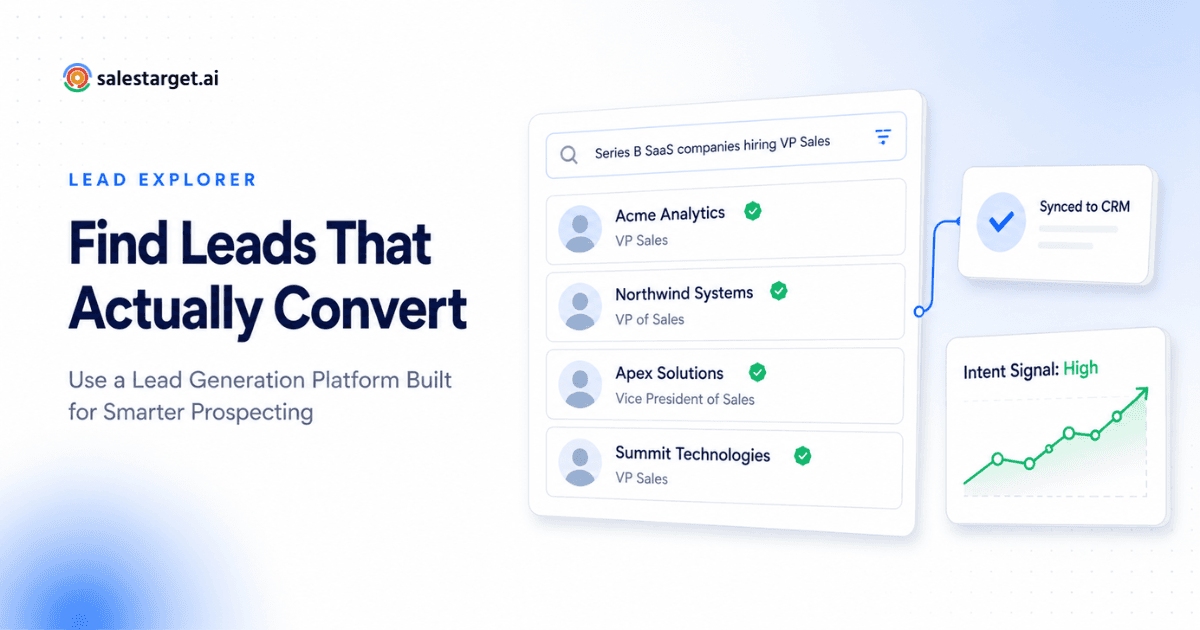
For the prospecting layer specifically, Lead Explorer searches across a database of 840M+ verified professional profiles and 146M+ business entities, with one-click enrichment for verified email, personal email, and phone data pulled from 50+ sources. Real-time buying signals through Bombora Intent Topics help surface accounts that are actively in-market rather than just theoretically a fit.
If you're evaluating providers more broadly, this breakdown of top B2B lead generation campaign providers compares data coverage, pricing structure, and channel support across the major options.
Building Your Lead Generation Strategy, Step by Step
Once your audience and tools are settled, the campaign itself comes together in a predictable sequence:
- Set a measurable goal. Meetings booked, pipeline generated, or opportunities created, tied to a number and a deadline.
- Finalize your target list. Pull it from your data source, filtered against the audience criteria you defined earlier.
- Build your message sequence. Multiple touches across channels, each one adding new information rather than repeating the last.
- Choose your channels. Match channel to buyer behavior. Senior executives often respond better to LinkedIn than a cold inbox; technical buyers may prefer email with detail they can forward internally.
- Launch and monitor early signals. Reply rate and bounce rate in the first 48-72 hours tell you fast whether your list or messaging needs adjusting.
- Nurture non-responders. Not every prospect converts on the first sequence. Route them into a longer-cycle nurture track instead of dropping them.
- Keep sequences short enough to execute well. A five-touch sequence that gets sent on schedule beats a twelve-touch sequence that falls apart by touch four.
Where to Run Your Campaign: Channels and Tactics
Channel selection should follow the buyer, not the other way around. Running the same tactic everywhere because it's easy to set up is how campaigns end up with high volume and low conversion.
Email is still the backbone of most B2B outbound because it scales and supports detailed, asynchronous messaging. Deliverability is the real bottleneck here, not creativity. Email Outreach auto-builds multi-step sequences from a plain-English audience description and handles inbox warm-up, rotation, and SPF/DKIM/DMARC checks automatically, which matters more to reply rates than most people assume.
Deliverability data backs this up. According to Instantly's 2026 cold email benchmark report, the average B2B reply rate across billions of tracked sends sits at just 3.43%, with anything above 5% considered strong performance. A meaningful share of that gap comes down to sender reputation and list quality rather than copywriting, which is why validating your list before you send matters as much as the message itself. The Lead / Email Validator checks MX and SMTP records, flags disposable addresses, and scores risk before a single email goes out.
LinkedIn works well for senior and mid-market buyers who are more responsive to a personalized connection request than a cold inbox message. LinkedIn Outreach automates connection requests, DMs, and follow-ups with AI personalization that adapts to each prospect's role and industry, and includes built-in rate limiting and warm-up logic so accounts stay in good standing.
Your website and landing pages convert warm traffic generated by the campaign. Strong CTAs, minimal form friction, and clear next steps matter more here than volume of visitors.
Coordinating email and LinkedIn in one sequence, rather than running them as separate efforts, tends to outperform either channel alone. A prospect who sees a relevant LinkedIn touch before an email lands is measurably more likely to open and respond.
Adjusting Your Approach by Buyer Type
Not every audience responds to the same playbook. Two examples worth calling out:
Security and compliance buyers move slowly and weigh credibility heavily. Educational content, certifications, and clear proof of reliability matter more here than urgency-driven messaging. Front-load trust signals rather than saving them for a follow-up call.
Consumer-facing and SMB buyers respond better to shorter, more visual, and more emotionally direct messaging than enterprise buyers do. Storytelling and social proof carry more weight than technical detail in these sequences.
The tactics don't change dramatically. What changes is the pacing, the proof points you lead with, and how much detail you front-load versus save for later touches.
Measuring, Optimizing, and Scaling Your Campaign
A campaign without clear KPIs is impossible to improve. At minimum, track reply rate, positive reply rate, meetings booked, and cost per opportunity, reviewed weekly rather than only at the end of the campaign.
Use what you find to run structured A/B tests, one variable at a time: subject line, opening line, CTA, or send time. Testing everything at once makes it impossible to know what actually moved the number.
Once a segment or sequence is consistently outperforming, scale it deliberately, expanding list size or adding a channel rather than changing multiple variables simultaneously. Everything from replies to booked calls should route into a pipeline view your whole team can see, not a spreadsheet one person maintains. The CRM logs every email and call to the lead timeline automatically and creates follow-up tasks without manual entry, which is usually where campaign momentum quietly dies in teams running outbound manually.
Common Mistakes and How to Avoid Them
A few patterns show up in almost every underperforming campaign:
- Vague targeting. "Mid-market companies" isn't specific enough to write a relevant message. Narrow it until the persona feels like a real person.
- No defined goal. Without a number and a deadline, there's no way to know if the campaign worked.
- Skipping list verification. Sending to unverified contacts tanks deliverability for every future campaign, not just this one.
- Set-and-forget sequences. Campaigns that aren't reviewed weekly drift without anyone noticing until the quarter is over.
Most of these are caught early simply by reviewing performance against goals on a fixed schedule rather than waiting for a retro at the end.
Why Choose SalesTarget.ai for Lead Generation Campaigns
Running a lead generation campaign well usually means juggling a data provider, a sequencing tool, a verification service, and a CRM, each with its own login, its own export, and its own bill. SalesTarget.ai combines all of it into one workspace: find a lead, verify it, enrich it, and push it into an email and LinkedIn sequence, all in the same click.
That matters because most B2B outbound platforms specialize in one piece of this. Apollo covers data and engagement but leaves deliverability and CRM as separate problems. Instantly, Smartlead, and Lemlist focus on cold email deliverability but don't offer a native B2B database, LinkedIn automation, or a real CRM. SalesTarget.ai keeps sourcing, outreach, verification, and pipeline tracking under one roof.
A few numbers that reflect what that consolidation does in practice:
- 840M+ verified professional profiles and 146M+ business entities in Lead Explorer, with 99% verified contact data.
- Email Outreach cuts campaign build time by 35% and validates 90% of emails before they're sent.
- Teams using the built-in CRM see 3.2X faster deal cycles, a 91% follow-up completion rate, and roughly 6 hours saved per rep per week.
The AI Copilot ties it together as a conversational layer across the platform. It's free inside the workspace, and reps use it to find leads, draft full sequences, check campaign revenue, or query CRM data without switching screens or waiting on a report. If you're still weighing which type of platform fits your team's workflow, this comparison of lead generation platforms walks through how consolidated platforms stack up against best-of-breed stacks in practice.
Final Thoughts
A lead generation campaign that works isn't the one with the cleverest subject line or the longest sequence. It's the one built on a well-defined audience, run through channels your buyers actually use, backed by clean data, and reviewed often enough to catch problems before they compound.
Start with the audience, keep your list verified, and measure weekly. The rest of the process gets easier once those three things are in place.
If you want to see how sourcing, outreach, and pipeline tracking work together in one workspace, you can try SalesTarget.ai free and run your next campaign without stitching four tools together.