A modern Lead Generation Platform gives B2B sales teams a live view of accounts and contacts, layering AI-driven search, buying signals, and continuous data verification on top of a workable database. That combination shortens research time and increases the odds that every outbound touch reaches a real, in-market buyer.
Traditional contact databases were built for a slower selling era. Most vendors look similar on the surface — big database, enrichment, a Chrome extension. The differences show up two weeks in, when your SDRs are quietly rebuilding lists by hand.
This guide walks through what actually separates a modern lead generation platform from older tools, and how to evaluate options based on how your team really works.
Why Traditional Lead Databases Are No Longer Enough?
Legacy databases were designed around a single job: give reps a big list of contacts. That model held up when buyers moved slowly and territories rarely shifted. Today the picture is different.
People change roles constantly. Companies pivot. Funding rounds reshape buying committees overnight. A record that looked clean in January can be 40% wrong by summer, and buyers expect outreach that reflects what is actually happening at their company right now.
Based on hands-on work with outbound teams, we consistently see reps spending close to a third of their prospecting hours verifying, cleaning, or re-researching contacts they already exported. That is time no one plans for in a sales capacity model, and it quietly wrecks pipeline math.
The gap is even wider for teams focused on niche verticals, where off-the-shelf databases rarely support the granular filters needed for industry-specific prospecting , which forces reps back into manual research.
What Makes a Modern Lead Generation Platform Different?
The best lead generation software today looks less like a directory and more like a workflow tool. Five capabilities set the category apart.
Real-Time Data
Modern platforms refresh contact and company records continuously rather than on a quarterly cycle. That includes job changes, headcount shifts, tech stack updates, and funding events. Reps see the current picture, not a cached one.
Buyer Intent Signals
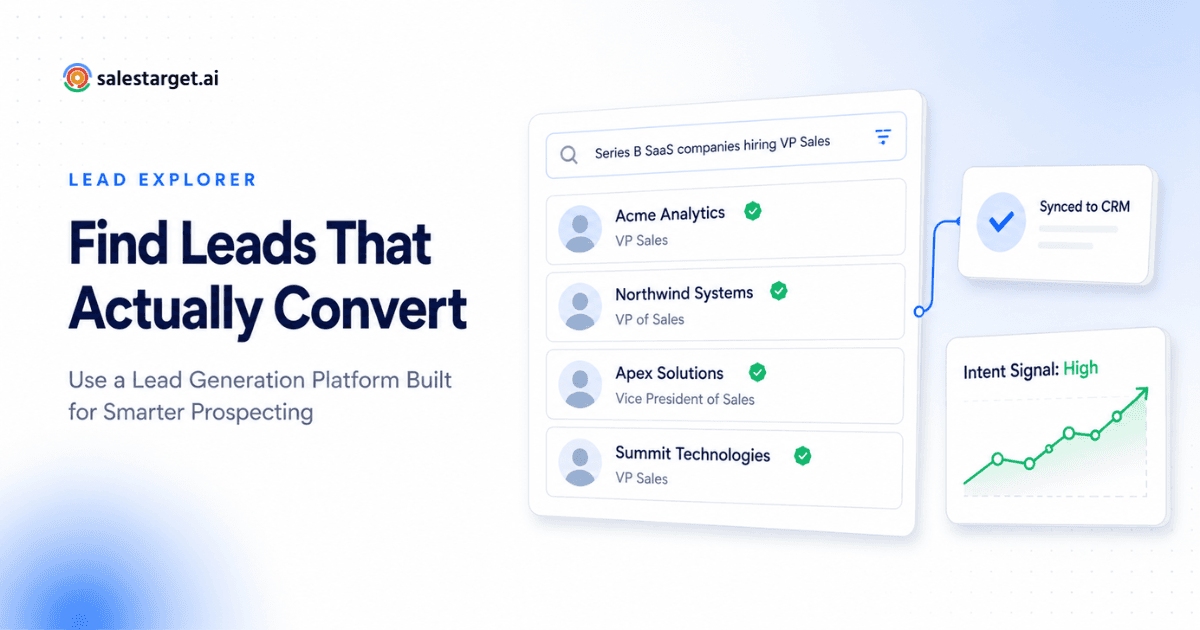
Instead of dumping a list, a modern platform flags which accounts are showing signs of activity — research patterns, hiring surges, product launches, or category shifts. This changes the sequencing of outreach from alphabetical to opportunity-driven.
AI-Powered Search
Filters used to mean checkboxes for industry and headcount. AI search lets reps describe an ICP in plain language — “Series B fintech companies hiring compliance leads in the UK” — and get a usable list back. That is a meaningful shift for lean teams without full-time list builders.
Verified Contact Information
Email and phone verification should be built in, not a separate credit spend. The measure that matters is the percentage of records that lead to a real conversation.
CRM Sync
A prospecting tool that does not push cleanly into Salesforce or HubSpot creates its own tax. Two-way sync, deduplication, and field mapping should be table stakes — not premium add-ons.
Teams selling into technical buyers often need deeper technographic layers than general databases provide. A closer look at lead generation for technology companies is useful if that is your motion.
Lead Generation Platform Comparison
The table below compares the three broad categories of tools reps actually run into during vendor evaluations.
| Capability | Traditional Database | Basic Prospect Tool | Modern Lead Generation Platform |
|---|---|---|---|
| Data freshness | Quarterly refresh | Monthly | Continuous |
| AI search | Not available | Limited keyword search | Natural-language ICP search |
| Buying signals | None | Basic (funding only) | Intent, hiring, tech, news |
| Enrichment | Bulk export only | Manual per-record | Automatic and real-time |
| CRM integration | Flat export files | One-way push | Two-way sync with dedup |
| Workflow support | External spreadsheets | Basic sequences | Built-in list building and filtering |
| Scalability | Costly seat model | Limited API access | Team workflows, API, scaled enrichment |
Traditional databases sell scale. Basic tools sell speed. Modern platforms sell workflow — the thing that actually shows up in pipeline.
Build Your Prospect List
Modern prospecting platforms outperform static lists because they connect discovery, verification, and enrichment into a single motion — so reps spend more time in conversations and less time in spreadsheets. If you want a faster path from ICP to booked meetings, the right tool removes the manual layers that drain SDR productivity.
How Sales Teams Should Evaluate Lead Generation Software?
Use this checklist during vendor demos. It cuts through marketing decks and forces vendors to show working product.
- Search accuracy: Ask the vendor to build your ICP live, in the demo.
- Filter depth: Can you combine firmographic, technographic, and intent filters in one query?
- Enrichment quality: What percentage of exported records include verified email and mobile?
- Native integrations: Is CRM sync bi-directional and mapped at the field level?
- Verification workflow: Are contacts re-verified before export, or only at ingest?
- Automation: Can lists trigger sequences, tasks, or enrichment jobs automatically?
- Scalability: Do usage limits, seats, or API caps quietly punish growth?
If a vendor cannot answer these in real time, that is a signal by itself.
Common Mistakes Buyers Make
A few patterns show up repeatedly in vendor selection projects:
- Chasing the biggest database. Volume is only useful if the records are current. A smaller, cleaner set of prospects almost always outperforms a larger, decayed one.
- Ignoring enrichment as a separate line item. Some vendors quote low base prices, then charge per enrichment credit. Model the true monthly cost, not the sticker price.
- Underestimating data decay. Contact data ages fast. For a fuller view, see B2B data decay and prospect list freshness.
- Skipping intent signals. Teams that buy on database size often rebuild intent logic in a separate tool six months later.
- Weak CRM integration. If ops has to build the sync, the tool is not really integrated.
Analyst frameworks from firms like Gartner and buyer research summaries from HubSpot point to the same trend: data quality and workflow integration now outrank record counts as the top drivers of prospecting ROI.
Who Should Use a Modern Lead Generation Platform
Not every team needs the same feature set. A modern lead generation platform fits:
- Startups that need to reach ICP accounts quickly without hiring a research team.
- Agencies running outbound for multiple clients across different verticals.
- Enterprise SDR teams that need consistent data, territory-level segmentation, and CRM discipline.
- SaaS companies selling to specific tech stacks or product categories.
- Recruiters who need verified contact data at scale.
- Founders running early outbound before hiring their first AE.
If your team fits more than one, workflow quality — not database size — should drive the decision.
A modern Lead Generation Platform is no longer a nice-to-have for outbound teams. It is the connective tissue between an ICP and a pipeline that closes. Teams pulling ahead have stopped optimizing for database size and started optimizing for workflow — real-time data, intent, AI search, and clean CRM sync working together. Treat vendors as workflow partners, not list vendors, and pick the tool that shortens the distance between a target account and a real conversation.