Your SDR spent three hours building a 1,500-contact list. The campaign went out Monday. By Tuesday afternoon, bounce rates were sitting at 16%, two sending domains had been flagged, and the reply data was useless because a fifth of those addresses had gone dark months ago.
This is what unverified lists actually cost B2B sales teams — not just wasted sends, but damaged sending domains, broken campaign metrics, and reps chasing contacts who moved on before the first email ever landed.
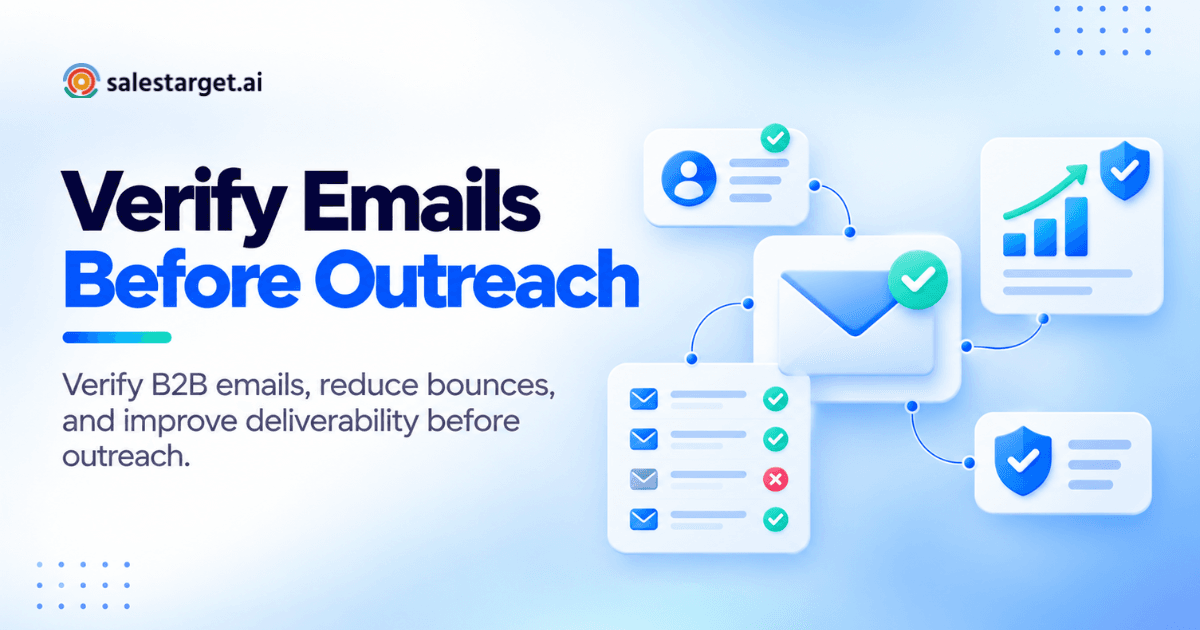
Sales email verification techniques fix this before a single message goes out. Each address is checked through a stack of validations: syntax checks, domain lookups, SMTP probing, and risk scoring. Only deliverable contacts enter your sequences. The result is lower bounce rates, cleaner sender reputation, and outreach metrics that reflect real engagement rather than noise from unreachable prospects.
Why Email Verification Matters in B2B Sales Outreach?
B2B contact data decays faster than most teams account for. According to HubSpot, email databases degrade by roughly 22.5% per year as contacts change jobs, companies rebrand, and domains migrate or expire. On a 5,000-contact list, that's over 1,000 stale records within twelve months.
When those addresses hit a sending campaign, inbox providers register the bounces as a signal of poor list hygiene. Sustained hard bounce rates above 2% put domains at risk of throttling or blacklisting. And sender reputation, once damaged, takes weeks of careful low-volume sending to recover.
Email verification for sales protects the deliverability infrastructure your entire outbound program runs on. One bad campaign against an unverified list can suppress inbox placement on every subsequent send, including the ones going to clean contacts.
How Sales Email Verification Works?
Email Syntax and Format Validation
The first layer checks that an address is structurally correct: a valid @ symbol, no illegal characters, a properly formed domain extension. This step catches input errors and malformed addresses before any deeper checks run.
Domain and MX Record Checks
After syntax clears, verification tools query DNS records to confirm the domain exists and has active mail exchange (MX) records configured. Domains without MX records cannot receive email, regardless of what the address looks like. This filters out expired corporate domains and shuttered business addresses that still appear valid on the surface.
SMTP Mailbox Verification
SMTP verification connects directly to the recipient's mail server and simulates the opening steps of an email delivery without sending an actual message. The server responds with a code confirming whether the specific mailbox exists and is active. This is the most reliable individual-mailbox check available short of sending live mail.
Catch-All Email Detection
Some mail servers are configured to accept every incoming message regardless of whether a specific mailbox exists behind the domain. SMTP probing can't distinguish between a real address and a fabricated one on these servers because both return an accepted response. Good B2B email verification software flags these domains as risky rather than confirmed valid, which matters for segmentation decisions.
Disposable and Role-Based Email Checks
Disposable addresses are temporary inboxes built to bypass form fills or gated content. Role-based addresses like info@, support@, or hello@ route to shared inboxes managed by teams, not the individuals you're trying to reach. Neither type produces results in personalized B2B outreach. Verification tools that identify and flag both categories keep them out of primary sequences before damage is done.
Sales Email Verification Techniques for Better B2B Outreach
Verify Prospect Emails During Lead Discovery
Verification should happen at the moment a contact is found, not after a list is fully assembled. When enrichment and verification run in the same step, only deliverable contacts enter the pipeline from the start. Cleanup time drops. Data quality stays high from the top of the funnel down.
SalesTarget.ai's Lead Explorer handles this natively. One-click enrichment returns verified professional email, phone, and mobile at the point of discovery, drawing from 840M+ profiles across 50+ data sources. Contacts arrive in your pipeline already verified, not flagged for manual cleanup later.
Validate Imported Lists Before Launching Campaigns
Purchased or imported contact lists carry unknown data quality. Before any imported list touches a sending domain, run it through bulk email verification to identify invalid addresses, catch-all domains, and disposable emails before they affect bounce rates or sender scores.
Reverify Older Contacts Before Re-engagement
A contact that cleared verification six months ago may not be reachable today. Job changes, acquisitions, and domain migrations can invalidate addresses that were clean at discovery. Any contact untouched for 90 or more days should go through a fresh verification pass before a re-engagement sequence launches.
Separate Valid, Risky, and Invalid Email Addresses
Verification outputs fall into three distinct categories: verified (safe to send), risky (catch-all or uncertain), and invalid (do not send). Treating these as a single audience distorts campaign metrics and exposes sender reputation to avoidable bounces. Each segment needs its own rules before any campaign touches it.
Keep Verification Connected to Your Prospecting Workflow
Verification running in a separate tool, disconnected from where you find and sequence contacts, creates handoff gaps where unverified addresses slip through undetected. The most effective setups embed verification directly in the prospecting and outreach workflow rather than adding it as a manual cleanup step after the list is built.
How Email Verification Improves Outreach Performance?
Lower Bounce Rates Across Cold Email Campaigns
This is the most immediate gain. Verified email lists produce consistently lower hard bounce rates. SalesTarget.ai validates 90% of emails before sending, keeping bounce rates well within safe thresholds for major inbox providers. Lower bounces protect sending domains and prevent campaigns from triggering spam filters during active sequences.
Stronger Sender Reputation and Domain Health
Inbox providers score every sending domain based on engagement signals, complaint rates, and bounce patterns. Sending consistently to verified addresses builds a favorable domain reputation over time. That reputation compounds into better delivery rates on future campaigns, not just the current one.
Better Inbox Placement for Sales Emails
Sender reputation directly determines where email lands. A domain with a strong sending history places messages in the primary inbox. A domain with a damaged record gets routed to spam or promotions before prospects see anything. Cold email deliverability starts with list quality, and list quality starts with verification.
More Accurate Campaign and Reply-Rate Data
Bounce-heavy campaigns produce unreliable open and reply statistics. When a portion of the list never receives the message, engagement metrics are calculated against the wrong denominator. Verified lists give you accurate data to make real decisions about copy, timing, and follow-up pacing.
Less Time Wasted on Unreachable Prospects
Reps following up on contacts who left their company six months ago aren't just wasting sends. They're spending time that should go into personalization and relationship-building with prospects who can actually respond. Verified contact data keeps outreach focused on people who are reachable at the addresses where they were found.
Email Verification Across the B2B Prospecting Workflow
Lead Discovery and Contact Enrichment
Verification at the discovery stage means every contact added to the pipeline arrives with a confirmed deliverable address. SalesTarget.ai's Lead Explorer enriches and verifies in one click, so contacts enter the workflow clean from the first touch rather than accumulating in a queue for later cleanup.
Prospect Email Verification Before List Building
Before a prospect moves from research into a named list, confirm the address is still active. This single gate prevents the buildup of invalid contacts in lists that become expensive to fix once a campaign is ready to go live.
Campaign Preparation and Audience Cleanup
Run a final verification pass on the full campaign audience before launch. Contacts valid at discovery can become unreachable by the time the campaign is ready. A pre-send cleanup step catches those transitions before they become bounce events in an active sequence.
Email Outreach and Deliverability Monitoring
Once a campaign is running, monitor bounce rates and delivery signals in real time. Rising bounces mid-campaign signal a need to pause and re-verify the remaining audience. SalesTarget.ai's Email Outreach module includes SPF, DKIM, and DMARC checks alongside automatic inbox warm-up and intelligent inbox rotation to maintain sender reputation across active campaigns.
CRM Updates and Contact Data Maintenance
Contacts verified at discovery don't stay current indefinitely. B2B prospect data stored in a CRM should be flagged for reverification after 90 days. Stale records sitting unreviewed become a liability when re-engagement campaigns or new sequences reach them without a fresh check.
Best Practices for B2B Email Verification
Verify Contacts Before Adding Them to Sequences
Make verification a mandatory gate before any contact enters an active sequence. No verification clearance means no sequence entry. This keeps cadences clean without requiring manual list audits before every campaign launch.
Recheck Stored Prospect Data at Regular Intervals
Build a 90-day reverification cycle into your contact management process. Accounts with long sales cycles are especially exposed here: a decision-maker valid at first contact may have moved roles by the time the follow-up sequence runs. The Salesforce State of Sales report consistently identifies contact data quality as a top productivity drain for sales teams — and stale records are the leading cause.
Treat Catch-All Addresses Separately From Verified Contacts
Never mix catch-all contacts into the primary verified segment. Run them at reduced volume with close monitoring. Some catch-all domains deliver consistently; others discard messages silently. Small test sends identify which domains are worth pursuing before you scale volume against them.
Remove Disposable and Invalid Email Addresses
Disposable and invalid addresses produce no real engagement and increase bounce exposure across the list. Remove them during the verification pass and don't reintroduce them. They're not a segment to manage cautiously; they're contacts to exclude entirely.
Keep Verification Rules Consistent Across Sales Teams
One team verifying at discovery while another skips verification on imported lists produces CRM data that can't be reliably compared across the organization. Verification should be a standardized workflow rule at the team level, not an individual preference left to each rep.
Choosing Email Verification Software for B2B Sales
Verification Accuracy and Data Coverage
Accuracy is the baseline requirement. Tools that rely on domain-level checks and skip SMTP verification miss a significant share of invalid individual mailboxes. Data coverage across professional networks determines whether enriched contacts can be confirmed at all, especially for niche industries and smaller company sizes.
Real-Time and Bulk Email Verification
Sales teams need both. Real-time verification catches addresses at enrichment or form submission. Bulk verification cleans imported lists before campaigns launch. Tools that offer only one create gaps where unverified contacts can enter the workflow undetected.
Catch-All and Risky Email Detection
A B2B email verification tool without catch-all detection is incomplete. Without that flag, teams assume uncertain addresses are clean and include them in primary sends, with predictable effects on bounce rates and domain reputation over time.
Prospecting and Enrichment Integrations
Verification running separately from prospecting creates manual handoff steps. The most effective setups connect verification directly to the enrichment layer so contacts arrive pre-verified wherever they enter the pipeline, with no CSV export or re-import required.
Email Outreach and CRM Connectivity
Verification data should flow directly into the outreach platform and CRM without manual transfers. Export-import processes create re-entry points for unverified contacts and add friction that teams work around rather than through, which is where data quality problems start compounding.
For a deeper breakdown of the top tools, see this comparison of best email verification software for sales teams.
Why Choose SalesTarget.ai?
Find Verified Prospects with Lead Explorer
Lead Explorer searches across 840M+ professional profiles using plain-English AI queries or stacked filters covering industry, role, seniority, company size, tech stack, intent topics, and real-time business signals. One-click enrichment returns verified professional email, personal email, phone, and mobile at the point of discovery, with no separate enrichment step and no delayed data refresh.
Validate Contacts with Built-In Email Verification
SalesTarget.ai's Email Validator runs MX checks, SMTP verification, disposable email detection, and risk scoring before any contact enters a sequence. It connects across 60+ platforms and supports both real-time API verification and bulk list cleaning from a single interface.
Move Verified Leads Directly Into Email Outreach Sequences
Once a contact clears verification, it pushes straight into a sequence with no CSV export required. Verified contacts enter the outreach flow immediately, with no manual transfer step and no gap for unverified contacts to re-enter through a re-import process.
Combine Email and LinkedIn Outreach in One Workflow
SalesTarget.ai coordinates email and LinkedIn Outreach in a single multichannel sequence. Context carries across both channels in one platform. A prospect engaged on LinkedIn before the email step arrives with that interaction already logged, so follow-up is informed by the full conversation, not just the most recent touch.
Track Prospect Activity in the Built-In CRM
Every verified contact, outreach action, and reply logs automatically in SalesTarget.ai's built-in CRM. Live deal pipeline, pending follow-ups, and email performance stats are visible on one dashboard without requiring reps to update records by hand. Teams running SalesTarget.ai report 3.2X faster deal cycles and 91% follow-up completion rates.
Use AI Copilot for Prospecting and Outreach Workflows
The AI Copilot handles lead search, sequence generation, deal tracking, and task creation through plain-English conversation. Reps can find verified prospects, build personalized email sequences, and review campaign performance without switching tools or rebuilding context across platforms.
If you want to see how verified prospects flow from discovery into live sequences in a single platform, book a demo and walk through the workflow with your own ICP.
Common Email Verification Mistakes That Hurt Outreach Results
Using Old Prospect Lists Without Reverification
Lists built more than 90 days ago carry meaningful data decay. Sending campaigns against them without a fresh verification pass produces avoidable bounces and distorted engagement data. This is one of the most common and most preventable deliverability problems in B2B outbound.
Sending to Every Catch-All Email Address
Treating catch-all addresses the same as verified contacts is a mistake that surfaces in bounce rates when those domains silently reject or discard messages without returning an error code. Segment them separately and test at low volume before scaling.
Treating a Verified Address as a Guaranteed Inbox Placement
Verification confirms a mailbox exists and can receive mail. It says nothing about whether the email lands in the inbox or the spam folder. Inbox placement depends on sender reputation, email content, sending infrastructure, and prior engagement history. Verification is the prerequisite, not the complete solution.
Ignoring the Source of Prospect Contact Data
Not all contact data sources carry equal quality. Data scraped from public directories with no refresh cycle degrades faster than data verified at the point of enrichment. Teams that don't track the source and age of their contact data run verification passes that address the symptom while the underlying data quality problem continues upstream.
Scaling Outreach Before Cleaning the Email List
Higher send volume amplifies bad list quality. A 5% bounce rate that's manageable at 500 sends per day becomes a domain-threatening problem at 5,000. Verify before scaling. Recovering from one high-volume campaign against an unverified list can take weeks of careful sending to repair.
Handling Catch-All and Hard-to-Verify Business Emails
Why Catch-All Domains Return Uncertain Results
Mail servers configured to accept every incoming message return an accepted SMTP response for any address on the domain, whether or not an individual mailbox exists. SMTP probing can't tell the difference between a real address and a fabricated one on these servers, which is why catch-all domains produce uncertain verification results rather than confirmed valid ones.
How Sales Teams Can Segment Risky Contacts
Keep catch-all contacts in a separate segment with reduced send volume. Monitor bounce and engagement rates on this segment closely. Elevated bounces on a specific catch-all domain are a signal to pause that domain and reassess whether it's worth pursuing at all.
Managing Role-Based Business Email Addresses
Role-based addresses like sales@, marketing@, or hello@ are technically deliverable but land in shared inboxes monitored by departments, not by the individual you're trying to reach. Personalized cold outreach sent to a shared inbox rarely generates a reply. Exclude them from primary sequences unless the use case is explicitly team-level contact.
When Previously Valid Emails Become Outdated
A verified contact from Q1 can be unreachable by Q3 if the person changed employers, the company was acquired, or the domain migrated to a new email provider. Regular 90-day reverification cycles catch these transitions before they appear as bounce events in a live campaign.
Building a Cleaner B2B Outreach Process With Email Verification
Every outbound campaign starts from the same assumption: the contacts on your list can receive your message. Email verification is what makes that assumption accurate rather than optimistic.
Teams that verify at discovery, validate before sending, and reverify on a regular cycle produce outreach where engagement data reflects real prospect interest. Bounce rates stay within safe thresholds. Sender domains build positive reputation over time. Reps spend their follow-up hours on prospects who exist at the address where they were found.
What separates SalesTarget.ai from tools like Apollo, Instantly, or Smartlead is that verification isn't an add-on module or a separate subscription. It runs inside the same platform where prospects are found, sequenced, and tracked. The Email Validator connects directly to Lead Explorer enrichment, to email sequences, and to the CRM, so clean data flows through the full outbound workflow without manual handoffs or disconnected data passes.
For a deeper look at verification methods that hold up across different list types and data sources, the best B2B sales email verification techniques guide covers the edge cases most outbound teams only find out about the hard way.
If your outreach is underperforming and bounce rates are climbing, the problem is almost always upstream from your copy and timing. It starts with the list.
Build your outbound on contact data you can actually trust. Start with SalesTarget.ai.