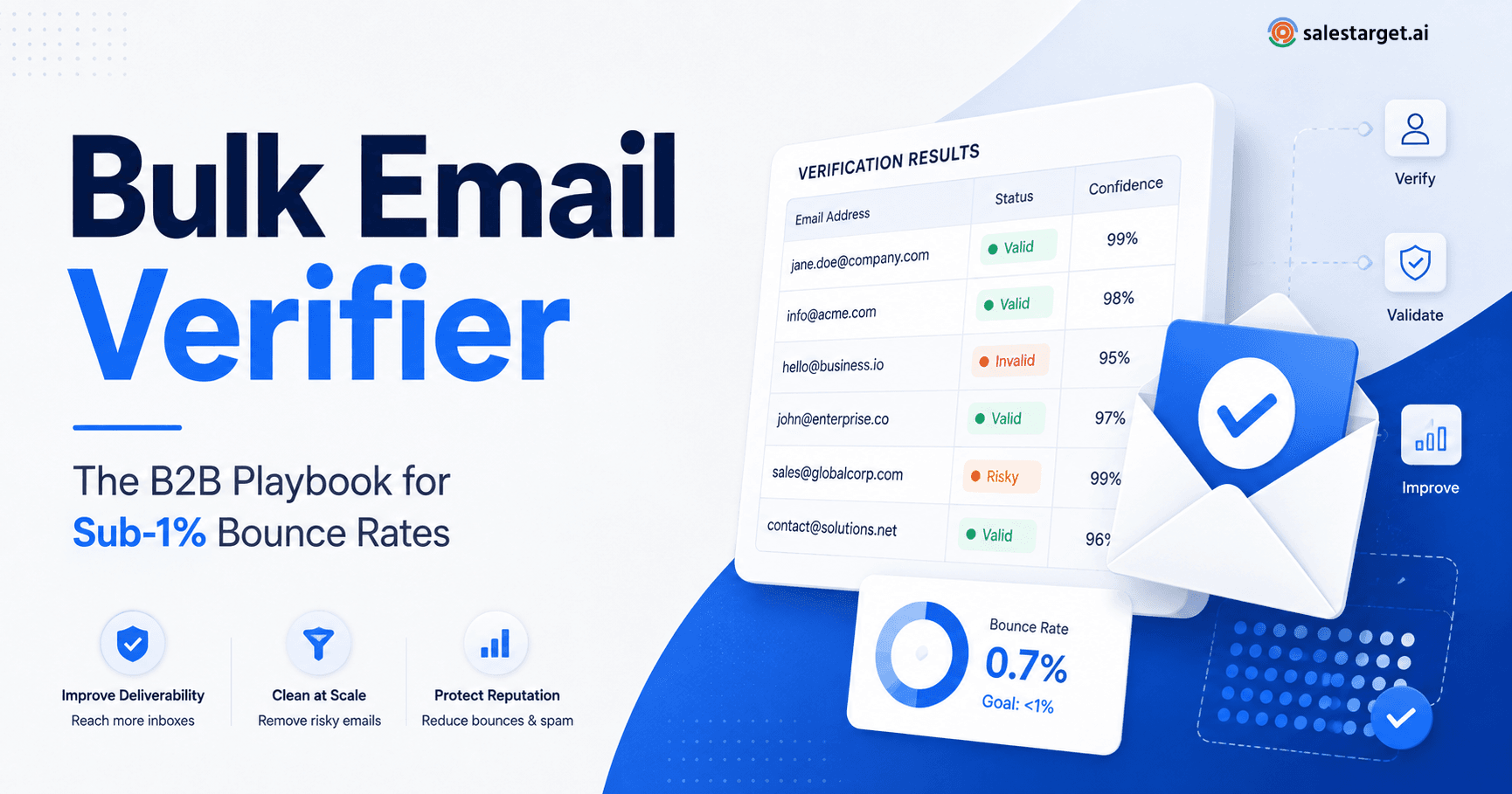
A sequence goes out to 500 contacts and forty bounce back within the hour. The domain that took months to warm up starts sliding toward the spam folder, and every rep on the team feels it in next week's reply rates. Bad email data doesn't just waste a send. It tells Gmail and Outlook that the sender can't be trusted, and that reputation hit follows every future campaign from the same domain.
An email verification tool checks whether an email address is real and able to receive mail before you send to it. It confirms the domain exists, checks the mail server, and flags addresses that are disposable, misspelled, or dead. Run this check before outreach and the bounce rate drops, the sender score holds, and the list stays usable. Skip it and every campaign after the bad send pays the price.
What Is an Email Verification Tool and How Does It Work?
An email verification tool runs a sequence of checks on an address without sending it a real message. It confirms the syntax is correct, looks up the domain's MX records to confirm mail servers exist, and pings the SMTP server to see if the mailbox accepts mail. Some tools add a risk layer on top, including catch-all detection, disposable address flags, and spam trap identification.
The output is a status per address: deliverable, risky, catch-all, disposable, or invalid. A list cleaned this way gives reps a working set of contacts instead of a guess, and it gives the sending domain a fighting chance at the inbox.
Why Email Verification Matters for B2B Sales
Reduce invalid contacts and email bounce rates
B2B contact data breaks down fast. People change jobs, companies merge, domains get retired, and none of that shows up until a send fails. Verification catches the dead addresses before they hit the wire, keeping the bounce count where mailbox providers expect it to be.
Keep prospect data accurate before outreach
A list pulled from a scraped source, a conference badge scan, or an old CRM export carries typos and outdated roles. Checking each address at the point of use, rather than once a year, keeps the working list closer to reality and closer to the person a rep actually wants to reach.
Protect email deliverability during outbound campaigns
Mailbox providers track bounce rate, complaint rate, and engagement as a package. A spike in any one metric drags the rest down with it. Verifying before send keeps bounce rate low enough that the other two metrics get a fair shot at building a healthy sender score.
Improve the quality of sales and marketing lists
A verified list is a smaller list, and that's the point. Fewer wrong numbers means every remaining contact is worth a rep's time, and reporting on reply rate or meetings booked reflects real performance instead of noise from addresses that were never going to open anything.
Key Features to Look for in Email Verification Software
Real-time email verification
A form fill, a manual add, or a lead pulled mid-call needs a check that happens in seconds, not overnight. Real-time verification through an API catches a bad address the moment it enters the system, before it ever reaches a sequence.
Bulk email verification and list cleaning
Older databases and purchased lists need a different motion. Upload the whole file, get a status back on every row, and export a clean set. Bulk processing speed matters here, since a 50,000-row list that takes a day to clear slows down a launch date.
Accurate invalid email detection
Detection accuracy separates a usable tool from a liability. A tool that marks good addresses as invalid costs a team real prospects, and one that lets bad addresses through defeats the purpose. Look for published accuracy figures and test a sample list before committing to a provider.
MX and SMTP verification
Checking MX records confirms a domain can receive mail at all. SMTP verification goes a step further and confirms a specific mailbox is active on that domain. A tool skipping either check is only doing half the job.
Disposable and risky email detection
Temporary inboxes and role-based addresses, think info@ or sales@, rarely belong to a real buyer and rarely engage. A verification tool should flag both categories so reps can decide whether to keep or drop them, rather than treating every address the same way.
API and CRM integrations
Verification is only useful sitting inside the workflow it protects. A tool with an API and native connections to a CRM or outreach platform lets checks run automatically at signup, at import, and before send, instead of becoming a separate manual step someone forgets to run.
Verification reports and export options
A results file broken into clear categories (deliverable, risky, catch-all, invalid) lets a team make fast decisions on what to send to and what to hold back. Export formats that plug straight into a CRM or spreadsheet save an extra round of formatting work.
How to Compare Email Verification Tools
Verification accuracy and data quality
Ask any vendor what percentage of "deliverable" results actually land, and check if they publish third-party audits or guarantees. A tool with vague accuracy claims and no data backing them up is a bet, not a decision.
Verification speed and processing limits
A tool that verifies 10,000 emails in minutes fits a live campaign schedule. One that queues jobs for hours doesn't, no matter how good its detection is. Match processing speed to the volume a team actually sends.
Pricing and cost per verified email
Cost structures vary between per-verification pricing, monthly credit bundles, and unlimited tiers. Map the pricing model against actual monthly send volume before comparing sticker price between vendors, since a cheap per-email rate can cost more at scale than a flat plan.
Bulk verification capabilities
A tool built for real-time checks on new signups may not handle a 200,000-row legacy database well. Confirm the tool's stated bulk limits and turnaround time against the size of the list that needs cleaning.
Integrations with sales and marketing platforms
A verification tool that only works as a standalone dashboard adds a manual export-import step to every campaign. One built into the CRM or outreach platform a team already runs removes that step and keeps verification current as the list grows.
Data privacy and security
Verified email addresses pass through the vendor's servers, so a compliance review matters here. Confirm the vendor's data retention policy, encryption standards, and whether verified data is stored, sold, or shared with anyone else.
Email Verification for B2B Lead Generation and Outreach
Verify leads before adding them to outreach campaigns
The best point to check an address is the moment a lead enters the pipeline, before it lands in a sequence. Catching a bad contact at intake keeps the sequence's send list clean from day one instead of accumulating dead weight over weeks.
Clean purchased, imported, and existing prospect lists
Lists built from multiple sources over time carry the highest risk. Bulk verification on any imported or purchased list before it touches an active sequence keeps one bad source from damaging a domain's reputation for everyone else on the team.
Connect email verification with lead enrichment
Verification confirms an address exists. Enrichment confirms who's behind it and whether they fit the target account list. Run both at the same step and a rep gets a contact that's real and relevant, instead of chasing one without the other.
Monitor bounce rates after verification
A verification pass isn't a one-time fix. Contact data decays continuously as people change roles and companies shut down old domains, so tracking bounce rate after each send flags when a previously clean list needs another pass.
Why Choose SalesTarget.ai
Most teams stitch a standalone verifier into a stack built from separate prospecting, outreach, and CRM tools, and every handoff between them is a place where a bad contact slips through. SalesTarget.ai runs verification at the point contacts enter the system, so the check happens where the lead is found, not as an extra step bolted on later.
Verify B2B contacts with Email Validator
Email Validator runs MX and SMTP checks, disposable-address detection, and risk scoring on every contact, with a real-time API for point-of-capture checks and bulk cleaning for existing lists. It connects across 60+ platforms, so verification isn't locked to one tool in the stack.
Find and enrich prospects with Lead Explorer
Lead Explorer searches 840M+ verified professional profiles and 146M+ business entities, and enrichment happens the moment a lead is found rather than whenever the underlying data was first scraped. Verified professional email, phone, and mobile numbers surface in the same click that finds the contact.
Combine email and LinkedIn outreach in one workflow
Clean data is only half the job. Email Outreach and LinkedIn Outreach run coordinated sequences across both channels, with 90% of emails validated before sending and automatic SPF, DKIM, and DMARC checks protecting sender reputation from the first send.
Manage verified prospects in the built-in CRM
Verified leads land straight into the CRM with no CSV import step in between. Teams running the full workflow report 3.2X faster deal cycles and about 6 hours saved per rep each week, time that used to go into manual list cleanup and data entry.
Use AI Copilot to support sales workflows
AI Copilot sits inside the platform and can pull a verified list, draft a sequence around it, or check which campaigns are converting, all from a plain-language chat instead of switching between five separate tabs.
Common Email Verification Mistakes to Avoid
Sending emails without checking new contacts
A single unverified batch can undo months of sender reputation building in one send. Treat verification as a required gate before any new contact touches a live sequence, not an optional step for when there's time.
Relying on outdated verification results
An address confirmed clean six months ago isn't guaranteed clean today. Domains get retired, employees leave companies, and mailboxes close, so a status from months back tells a team less than it thinks it does.
Ignoring risky and catch-all addresses
Catch-all domains accept mail for any address without confirming a specific mailbox exists, which puts them in a gray zone between deliverable and invalid. Sending to a large batch of catch-all addresses without a plan for them raises bounce risk unpredictably.
Focusing only on verification volume instead of data quality
Running millions of checks a month means nothing if the accuracy rate behind those checks is weak. A smaller, more accurate verification pass protects a sender's reputation better than a high-volume tool with loose detection standards.
Failing to monitor bounce rates and deliverability
Verification reduces bounce risk. It doesn't remove the need to watch bounce rate, spam complaints, and inbox placement after every send. Skipping that follow-up step means a growing problem goes unnoticed until a domain is already flagged.
Building a Reliable Email Verification Process
Verify new leads before outreach
Set verification as a fixed checkpoint the moment a lead enters the pipeline, whether it comes from a form, an import, or a prospecting search. This keeps the standard consistent across every source a team pulls from.
Clean existing email databases on a regular schedule
Contact data degrades at roughly 2% a month, and older CRM records need a scheduled refresh rather than a one-time cleanup. A quarterly bulk pass catches the decay before it shows up as a bounce spike.
Remove or suppress risky addresses
Not every flagged address needs deleting outright. Suppress high-risk and disposable addresses from active sequences and keep the record on file, in case a contact resurfaces through a different channel with a working email.
Track verification results and campaign performance
Pair verification status with campaign outcomes: bounce rate, reply rate, and meetings booked by list source. This shows which lead sources are worth the investment and which ones need tighter filtering before the next pull.
Keep verification connected to the sales workflow
A verification step that lives outside the CRM or outreach tool gets skipped under deadline pressure. Building the check into the same platform reps already use for prospecting and sending keeps it from becoming an optional extra.
Choosing the Best Email Verification Tool for Long-Term Use
Evaluate accuracy, scale, pricing, and integrations
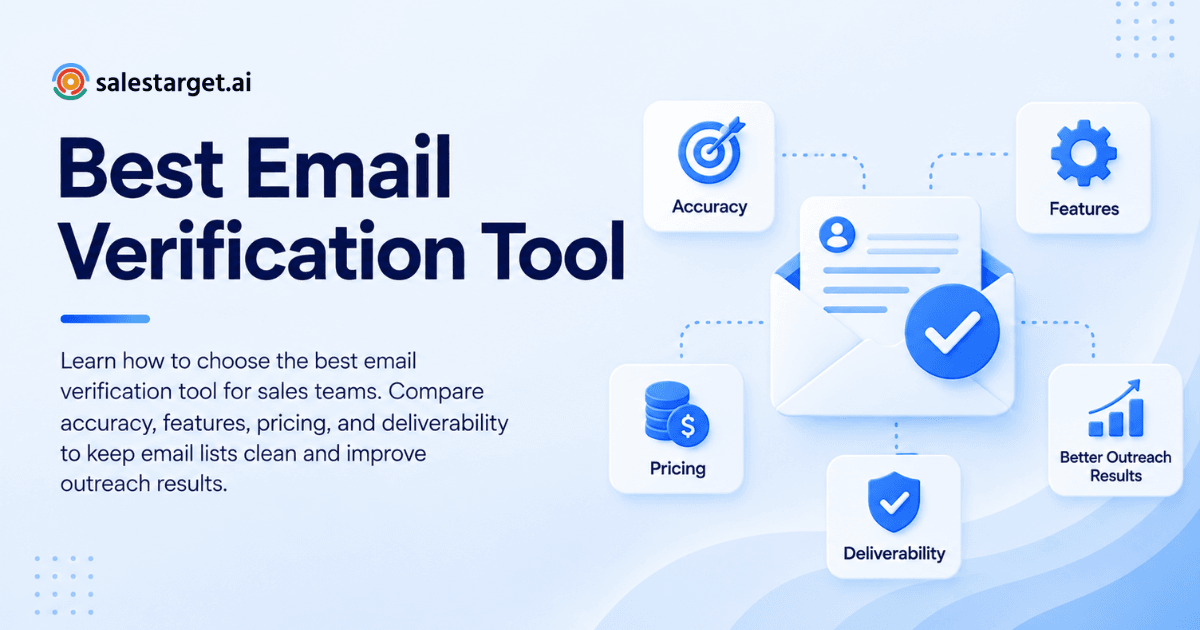
Weigh detection accuracy against monthly send volume, pricing structure, and how well the tool connects to the rest of the stack. A tool that scores high on accuracy but sits disconnected from the CRM still creates manual work every week.
Compare standalone verification with an all-in-one sales platform
A standalone verifier like ZeroBounce or NeverBounce checks addresses well and does nothing else. Platforms like Apollo add data and engagement without a built-in CRM, and Instantly, Smartlead, and Lemlist focus on cold email deliverability without a native prospecting database or LinkedIn automation. Weigh the cost of running four separate subscriptions against a platform that runs verification, prospecting, outreach, and CRM under one login.
Select a tool that supports your complete prospecting workflow
The right choice depends on where verification sits in the day-to-day process. A tool that only checks addresses after they're already imported adds a step, while one that checks at the point a lead is found and enriched removes one instead.
Conclusion: Choose an Email Verification Tool That Fits Your Sales Workflow
A verification tool that lives apart from the rest of the stack still leaves the same gap, a bad contact slipping through the seam between where a lead is found and where it gets sent to. SalesTarget.ai closes that gap by verifying contacts at the moment they're discovered through Lead Explorer, carrying that clean data straight into Email Outreach and LinkedIn Outreach, and logging every result inside a CRM built for outbound teams.
Read more on choosing the right email verification tool and what makes a verification tool accurate for B2B lists, or see how it works firsthand: tools for building and maintaining accurate outreach lists.
Start free with SalesTarget.ai and see verified data move straight from prospecting into a live campaign.