Monday: an SDR builds a 300-contact list. Wednesday: 40 emails have bounced, a handful of contacts have changed jobs, and the sending domain is already getting flagged. Nobody made a mistake except trusting the list.
A B2B prospect-verification analyst is the person who stops that from happening. They check that every prospect is real, reachable, in the right role, and at a company that fits your ideal customer profile (ICP). Only records that pass go into outreach. Teams that work this way send fewer emails to dead addresses, book more meetings from the same list, and protect their domain reputation.
The cost of skipping it is real. DealSignal reports that reps lose about 500 hours a year (62 working days) validating and correcting contact information. In most teams nobody owns that work, so it lands on reps. This guide covers the analyst's role, the verification process, the skills, and the practices that work, and it shows how SalesTarget.ai builds the verification step into prospecting so it becomes a habit instead of a headcount.
The Role of a B2B Prospect-Verification Analyst in Modern Sales
The analyst is the quality gate between raw prospect data and live outreach.
Core Responsibilities of a B2B Prospect-Verification Analyst
The analyst owns the accuracy of every prospect record before it reaches a rep. That means validating emails and phone numbers, confirming current employment and title, matching each company against ICP criteria, removing duplicates, and logging a verification status on the record. In smaller teams this is rarely a full-time seat. A RevOps manager and a senior SDR usually share it. The B2B prospect-verification analyst role and workflow shows how that split works in practice.
Prospect Data Checks Before Sales Outreach
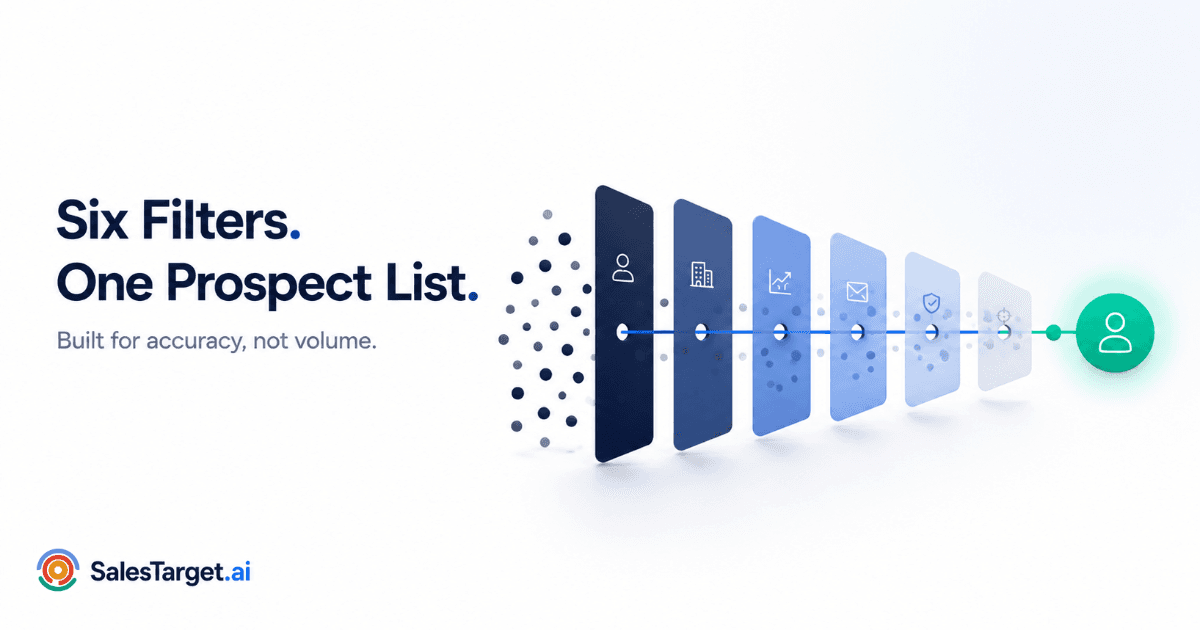
Five checks decide whether a prospect is outreach-ready: identity, contact, role, company, and freshness. Is the person matched to the right profile? Does the email pass MX and SMTP checks? Does the title map to a buying role? Does the company fit your ICP? When was the record last verified?
One edge case most teams miss: catch-all domains accept any address, so a "valid" result proves little. Treat those contacts as risky and send them in a separate, low-volume sequence.
The Difference Between Prospect Verification and Lead Qualification
Verification asks whether the data is true. Qualification asks whether the prospect is worth pursuing. Run them in that order. Scoring a lead whose email bounces, or whose title changed last quarter, gives you a confident number built on a wrong record. Verification protects the score. Qualification (fit, intent, timing) decides where the rep's hours go.
The B2B Prospect Verification Process From Data to Sales-Ready Leads
The process runs in five stages, and each one hands a cleaner record to the next.
Identifying Target Prospects and Companies
Start with the account, then find the person. Define your ICP by industry, company size, revenue, location, and tech stack, then pick the buying roles inside those accounts. In SalesTarget.ai, Lead Explorer lets you search in plain English or stack Business and People filters, including Bombora Intent Topics, so the list starts narrow instead of wide and messy.
Enriching Prospect and Company Information
Enrichment fills the gaps: verified email, phone, mobile, title, and company details. Timing matters more than most teams admit. Data enriched at the moment you find the lead is fresher than a file scraped months ago and sold as current. SalesTarget.ai enriches in the same click as discovery, so verification starts from live data.
Verifying Email, Phone, and Contact Details
Verification confirms the contact can actually be reached. For email, that means MX and SMTP checks, disposable-address detection, and risk scoring. For phone, confirm the number against its source and check that it belongs to the person, not a switchboard. Run this step last before sequencing, since a record verified last month has already started to decay. Want to see it on your own list? tart free and run a batch through the validator.
Checking Job Titles and Company Fit
A correct email on the wrong person is still a bad lead. Titles vary wildly: a Head of Growth at one company does the job of a VP Marketing at another. Check that the person owns the problem you solve, then confirm the company still matches your size, revenue, and tech criteria. Funding rounds, hiring spikes, and leadership changes can shift fit overnight.
Preparing Verified Prospects for Outreach
A sales-ready prospect carries a verification status and a date. Tag each record, split risky and catch-all contacts into their own list, and push the clean ones straight into a sequence or the CRM. Skip the CSV in the middle. Every file handoff is a chance for stale data to creep back in.
Why Prospect Data Accuracy Matters for Sales Teams
Accuracy decides whether outreach effort turns into pipeline or into noise.
Reducing Invalid and Outdated Prospect Records
Much purchased data is partly wrong on day one. IndustrySelect puts average B2B provider accuracy at only about 50%. Job changes push that lower the longer a list sits unused. Verification removes the dead weight before a rep touches it.
Improving B2B Lead Quality
Lead quality rises when every record is real, reachable, and relevant. Reps stop spending first touches on people who left, and more of your messages reach a human reader. The same list produces more conversations with no extra send volume.
Supporting More Relevant Sales Outreach
Verified role and company data lets reps write messages that fit. When you know the title is current and the company just hired five SDRs, the opener writes itself. A well-personalized email to the wrong role still reads as spam.
Maintaining Clean and Reliable CRM Data
A CRM full of unverified records makes every report suspect. Salesforce's State of Sales report finds reps spend only about 30% of their week selling, and bad data pushes that number lower. Store verification status and date as CRM fields so reps and managers can filter on them. Good CRM data quality starts at the point of entry.
Key Skills of an Effective B2B Prospect-Verification Analyst
The best analysts pair sharp research habits with data discipline.
Prospect Research and Data Validation
They confirm a person's current role from two independent sources. LinkedIn, the company site, press releases, and filings all count. One source is a guess. Two sources make a record.
Contact Data Verification
They read verification results instead of just running them. Valid, invalid, risky, catch-all, disposable, and role-based addresses (info@, sales@) each need a different route. A shared inbox is not a buyer.
Lead Enrichment and Qualification
They know which fields change outcomes. Title, seniority, department, company size, tech stack, and intent move reply rates. Fields nobody uses in a sequence are clutter.
Sales Intelligence and Data Analysis
They treat data quality as a metric. Track bounce rate, verified share of each list, reply rate by verification status, and days since last verification. Those numbers show which sources and filters produce clean records.
Using Lead Verification Tools
They pick tools that verify at the point of enrichment. Fewer exports and fewer tool handoffs mean fewer places for errors to enter. A sprawling stack is a data risk in itself.
How Prospect Verification Improves B2B Sales Outreach
Verification changes what reps send, to whom, and when.
Building Accurate Sales Prospect Lists
Verification turns a long list into a smaller, truer one. Say a 500-name list trims to 380 verified contacts. Those 380 outperform the full 500 because every send has a real recipient. A clear prospect verification workflow treats the trim as a win, not a loss.
Matching Verified Prospects With Outreach Campaigns
Match prospects to campaigns by role and trigger, not just industry. Group by confirmed title, seniority, and recent signal, then assign the sequence that speaks to that group. Verified fields make the grouping reliable.
Improving Email Deliverability and Contact Rates
Verified lists keep bounces low, and low bounces protect sender reputation. Every hard bounce counts against your domain. On the phone side, numbers confirmed to belong to the person lift connect rates. SalesTarget.ai reports that 90% of emails in Email Outreach are validated before sending.
Reducing Wasted Sales Effort
Every hour not spent chasing dead contacts goes back to calls and follow-ups. Reps who trust the list stop double-checking it. That trust is the real productivity gain.
Turning Verified Data Into Sales Opportunities
Verified contact data plus a live buying signal gives you timing. Lead Explorer surfaces funding rounds, hiring spikes, and leadership changes on a 30 to 90 day lookback. Reach a verified buyer while the signal is fresh and the first email has a reason to exist.
Best Practices for B2B Prospect Verification
Five habits separate clean pipelines from messy ones.
Set Clear Prospect and Account Criteria
Write your ICP down before anyone builds a list. Define industry, size, revenue, region, tech stack, and buying roles. Vague criteria force the analyst to guess, and guesses pass through as verified.
Verify Data Before Adding Prospects to Sequences
Make verification a gate, not a cleanup task. No record enters a sequence without a status and a recent date. Set a freshness limit (30 days works for many outbound teams) and re-verify anything older.
Combine Contact Verification With Lead Enrichment
Verify and enrich in one pass. Separate tools mean separate exports, and every export ages the data. When both happen at discovery, the record is complete and current. Start free to see both in one workflow.
Review Data Quality at Each Sales Stage
Check records again when they move. A lead that went quiet for 60 days and then replies needs a fresh look before a rep books a demo. Role changes happen mid-deal.
Keep Prospect Records Updated
Schedule re-verification instead of waiting for bounces. Set a recurring review for open pipeline and nurture lists, and archive contacts that fail twice. Clean lists stay clean only when someone owns the calendar.
Why Choose SalesTarget.ai
SalesTarget.ai gives an analyst, or a team without one, a single workspace for the whole verification workflow. It combines B2B lead data, validation, email and LinkedIn outreach, a built-in CRM, and an AI Copilot on one platform. Its own figures: 840M+ professional profiles, 146M+ business entities, 4,000+ intent signals, 50+ data sources, and 99% verified contact data.
Find and Enrich Prospects With Lead Explorer
Lead Explorer finds and enriches prospects in the same step. Search in plain English or stack filters for industry, role, seniority, department, company size, revenue, location, tech stack, and Intent Topics. One click unlocks verified professional email, personal email, phone, and mobile.
Verify Contact Data With Email Validator
Email Validator checks addresses before you send. It runs MX and SMTP checks, detects disposable emails, and scores risk, which cuts bounces and keeps domains off blacklists. It offers a real-time API and bulk list cleaning, and it connects across 60+ platforms.
Run Email and LinkedIn Outreach From One Platform
Verified prospects move straight into Email Outreach and LinkedIn Outreach with no CSV. Email sequences come with automatic warm-up, inbox rotation, and SPF, DKIM, and DMARC checks. LinkedIn sequences use rate limits and auto-pause safeguards. Both channels run in one coordinated flow, so context carries across.
Manage Verified Prospects in the Built-In CRM
Campaign leads land in the CRM automatically, with every email and call logged to the lead timeline. The built-in AI dialer takes call notes for you and saves them straight to the timeline. Reps keep a live, shared pipeline built on records that were verified at the start.
Use AI Copilot for Sales Tasks
AI Copilot handles the grunt work in plain language. Ask it to find leads across 840M+ profiles, draft personalized sequences by role and industry, or pull deals and tasks from the CRM. Strategy stays with your team.
Common B2B Prospect Verification Mistakes to Avoid
Most failures here come from skipping a step that felt optional.
Relying on Incomplete Prospect Data
A record with a name and an email is not a prospect. Missing title, company size, or phone leaves reps guessing. Enrich first, then verify what you enriched.
Confusing Contact Verification With Lead Qualification
A valid email does not mean a good lead. Verification proves reachability. It says nothing about fit or intent. Teams that merge the two end up sending polished emails to the wrong people.
Skipping Company and Role Validation
Email checks alone miss the most expensive error: the wrong person at the right company. Confirm title and department against two sources, and confirm the company still matches your ICP.
Sending Outreach Before Data Verification
One unverified batch can damage a domain for weeks. The rush to launch a campaign costs more time than the verification step it skipped. Make the gate non-negotiable, even for small lists.
Failing to Update Old Prospect Records
Old records are the quietest source of bounces. Contacts change jobs and addresses, and a list verified once is out of date by the next quarter. Put re-verification on the calendar for any record older than your freshness limit.
Conclusion: Build Better Sales Pipelines With Verified Prospect Data
The pain starts with a list nobody trusted: bounces, job-changers, and a domain under watch. A B2B prospect-verification analyst fixes it by making verification a gate, with checks on identity, contact, role, company, and freshness before any record enters a sequence.
SalesTarget.ai makes that gate practical. Lead Explorer enriches at discovery, Email Validator checks contacts before you send, Email Outreach and LinkedIn Outreach run verified prospects in one flow, and the built-in CRM keeps records, calls, and follow-ups in one place. You get the discipline of an analyst without stitching five tools together.
Ready to send to people who can actually reply? Start with SalesTarget.ai and build your next list on verified data.