Your SDRs spend the morning building a list. By lunch, half the emails bounce, three "decision-makers" left the company last year, and nobody can say which accounts are actually worth a call. The pipeline looks full. The reply rate says otherwise.
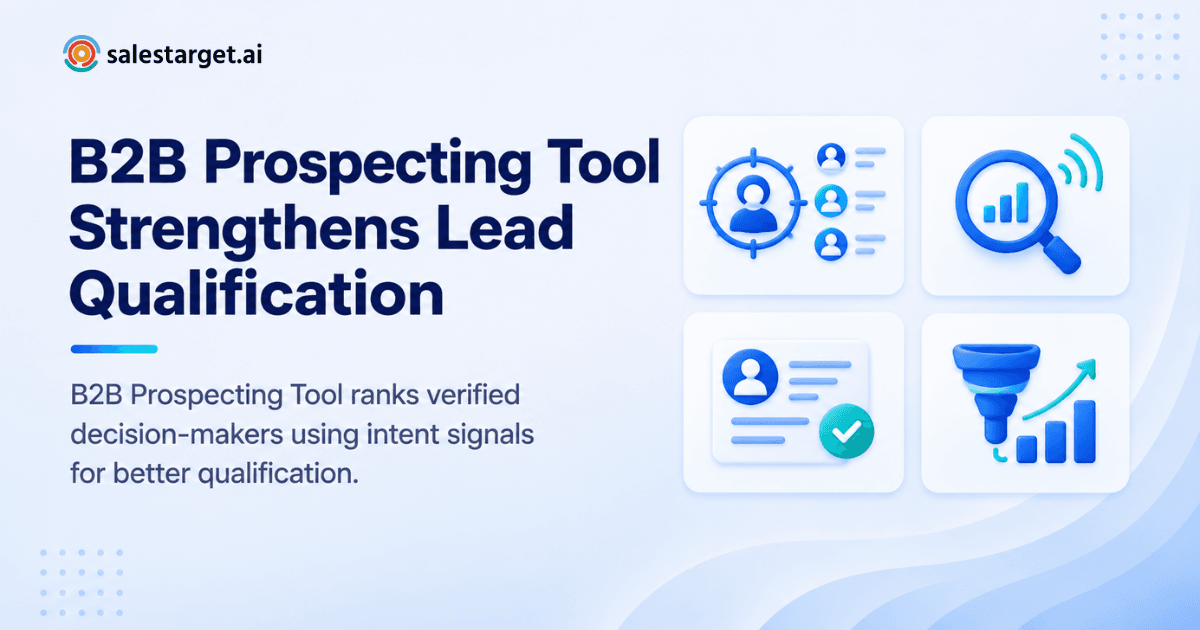
Here's the short answer: a B2B prospecting tool improves lead qualification by pulling verified contact and company data, decision-maker details, and buyer intent signals into one place, then scoring and ranking prospects so reps work the accounts most likely to buy first, instead of guessing from a spreadsheet. Good data in, good priority out. That's the whole mechanic.
The rest of this piece breaks down how that works, where most B2B prospecting tools for sales teams fall short, and what a practical qualification workflow looks like when the data and the outreach live in the same system.
The Role of B2B Prospecting Tools in Lead Qualification
Lead qualification is a filtering problem before it's a conversation problem. A rep can't judge fit, budget, or timing on a contact record with a dead email and a two-year-old job title. A B2B prospecting tool gives that filtering job structure: it defines who counts as a match, finds those accounts, confirms the contact details are current, and flags who's showing buying signals right now.
Without that layer, qualification turns into a manual audit reps do one contact at a time, usually after the outreach has already gone out and failed.
How B2B Prospecting Tools Support Lead Qualification
Defining ICP targeting before prospect research
Qualification starts before a single prospect gets touched. An ideal customer profile sets the industry, company size, revenue band, and tech stack that actually convert, so the tool searches inside those boundaries instead of pulling every contact with a matching job title.
Finding the right accounts with firmographic data
Firmographic filters, industry, headcount, revenue, location, narrow a database of hundreds of millions of companies down to the few thousand that fit. This is the step where most generic lists go wrong: broad titles without company context produce volume, not qualified accounts.
Identifying decision-makers within target companies
A qualified account still needs the right person. Prospecting tools map org structure by role, seniority, and department, so outreach lands with someone who can actually say yes, not a generalist inbox that forwards it nowhere.
Using buyer intent signals to identify high-intent prospects
Intent data (topic research spikes, funding rounds, hiring surges, leadership changes) tells you who's actively in-market, not just who fits the profile on paper. A prospect matching the ICP and showing intent in the same week is a different priority than one sitting cold for a year.
Enriching and verifying contact data
A match with no working email is a dead end. Enrichment fills in verified professional and personal emails and phone numbers at the point of discovery, not from a stale export sitting six months old.
The Impact of Better Prospect Qualification on Sales Performance
Higher-quality leads for SDRs and BDRs
Reps stop opening a list and guessing which ten names to call first. Qualified, scored prospects mean the first hour of the day goes to accounts with a real shot at converting.
Better lead prioritization across sales teams
When every rep works from the same scoring logic, managers can split territory and pipeline by actual priority, not by whoever grabbed the freshest-looking list first.
Less wasted outreach and research time
Gartner found that 73% of B2B buyers actively avoid suppliers who send irrelevant outreach. Bad targeting doesn't just waste rep hours, it burns the account for a second attempt later.
Stronger sales pipeline quality
Pipeline built on verified, scored prospects moves faster through each stage, because the deals entering it already match the profile that historically closes.
A Practical Lead Qualification Process With a B2B Prospecting Tool
Start with a defined ideal customer profile
Set the firmographic and behavioral criteria that describe your best current customers, not your broadest possible market.
Build targeted account and prospect lists
Search against that profile using layered filters (industry, role, company size, tech stack) rather than a single keyword.
Enrich missing prospect information
Fill gaps in contact data automatically as prospects get added, so reps never start outreach on an incomplete record.
Verify contact details before outreach
Run emails through validation before they touch a sequence. Skipping this step is how domains end up on blacklists over one bad send.
Prioritize prospects using intent and qualification signals
Rank the enriched, verified list by intent strength and ICP fit, so the first calls of the day go to the accounts most likely to answer.
Send qualified prospects into the sales workflow
Push the ranked list straight into outreach and CRM without a CSV export sitting in between. Every extra handoff is a place data goes stale or gets lost.
Key Features to Look for in B2B Prospecting Software
Verified B2B contact and company data
Look for a database with named coverage numbers (professional profiles, business entities) and a stated accuracy rate, not a vague claim of "millions of leads."
Advanced prospect and company filtering
Filtering by role, seniority, department, revenue, location, and tech stack matters more than raw database size. A huge database with weak filters just means more manual sorting.
Contact enrichment and verification
Enrichment and verification should happen in the same click a prospect gets added, not as a separate export-and-clean step days later.
Buyer intent and purchase intent signals
Intent topics plus business events (funding, hiring, leadership moves) on a recent lookback window give reps a reason to reach out now instead of a cold open.
Lead scoring and prospect prioritization
A scoring layer that combines fit and intent turns a flat list into a ranked queue, which is the difference between "here are 500 leads" and "call these 20 first."
Prospecting, outreach, and CRM in one workflow
A B2B prospecting tool for sales teams that also handles outreach and pipeline tracking removes the CSV hop between systems where most lead data quietly rots.
Why Choose SalesTarget.ai
SalesTarget.ai is built around this exact problem: finding, qualifying, and reaching the right prospect without stitching together four separate tools and a spreadsheet.
Find qualified prospects with AI-powered Lead Explorer
Lead Explorer searches over 840 million verified professional profiles and 146 million business entities using plain-English queries or stacked filters across industry, role, seniority, department, and tech stack.
Enrich and verify contacts before sales outreach
Enrichment happens the moment a prospect is found, unlocking verified professional email, personal email, and phone numbers in one click, not after a separate cleanup pass.
Connect prospecting with email and LinkedIn outreach
Qualified prospects move straight into Email Outreach or LinkedIn sequences, with AI-built multi-step messaging and personalization by role and industry.
Protect outreach quality with email validation and deliverability checks
The Email Validator runs MX and SMTP checks plus disposable-email detection before a send goes out, which protects sender reputation and inbox placement.
Manage qualified opportunities in the built-in CRM
The CRM logs every email and call to the lead timeline automatically, with a shared pipeline view and reports on open deals and pending tasks.
Use AI Copilot for faster prospecting and sales data access
AI Copilot lets reps chat to find leads, generate sequences, and check deal status in plain language, cutting the time spent switching between tabs to do basic prospecting work.
Common Lead Qualification Mistakes in B2B Prospecting
Building lists without clear ICP criteria
A list built on job title alone pulls in companies of every size and budget, which means qualification work starts from zero instead of from a filtered starting point.
Using incomplete or outdated prospect data
Contact records go stale fast: people change roles, companies get acquired, phone numbers get reassigned. Outreach built on old data reads as sloppy before the first word is read.
Giving every lead the same priority
Treating a cold ICP match the same as an account that just raised funding and started hiring wastes the reps' best hours on the wrong accounts.
Missing buyer intent signals
Skipping intent data means reaching a prospect at a random point instead of the window when they're actually researching a solution like yours.
Contacting prospects before data verification
Sending to unverified emails drives bounce rates up fast, and a high bounce rate puts a domain's whole deliverability at risk, not just that one message.
Managing prospecting and qualification across disconnected tools
Every handoff between a data tool, a CSV, an outreach platform, and a CRM is a place where a lead gets lost or a status goes stale. Salesforce's State of Sales research has repeatedly found reps spend a large share of the week on manual data work instead of selling, and disconnected tools are a big part of why.
Choosing the Best B2B Prospecting Tool for Lead Qualification
Data coverage and contact accuracy
Check the size of the database and the stated verification rate. A tool claiming millions of contacts without an accuracy figure is not one you can fully trust.
Prospecting and enrichment capabilities
Filtering depth and one-click enrichment matter more than raw list size. Look for enrichment that happens at the point of discovery, not as an afterthought.
Lead qualification and prioritization features
Scoring based on fit and intent, not just firmographic match, is what turns a database search into an actual qualification tool.
Outreach and deliverability capabilities
A prospecting tool without built-in email and LinkedIn outreach means exporting a qualified list into yet another platform, and losing context in the process.
CRM workflow and sales pipeline management
Look for automatic lead capture into the CRM with no manual import, so qualified prospects don't sit in a spreadsheet waiting to be entered somewhere.
Overall fit for the sales team's workflow
The best B2B prospecting tool is the one your team will actually use daily, not the one with the longest feature list on a comparison page.
Conclusion: Connecting Lead Priority With Consistent Follow-Up
The SDR staring at a half-dead list every morning isn't short on effort. The list is short on qualification. Bad data and flat priority turn a full pipeline into a slow one, no matter how many hours reps put in.
A B2B prospecting tool fixes the problem at the source: verified contacts, mapped decision-makers, live intent signals, and a scoring layer that tells reps who to call first. SalesTarget.ai keeps that whole process, prospecting, enrichment, verification, outreach, and CRM, in one workspace, so qualified leads move straight into a sequence instead of sitting in an export waiting to go stale.