Every high-performing B2B sales team runs on one thing: accurate prospect data. When contact details are wrong, outreach stalls. When emails bounce, sender reputation drops. When titles and companies are outdated, reps waste hours chasing the wrong people. This is the exact problem a B2B prospect-verification analyst is hired to solve.
The role sits quietly behind the scenes of most modern go-to-market teams, but its impact shows up everywhere - in open rates, reply rates, meetings booked, and pipeline generated. In this guide, we break down what a B2B prospect-verification analyst actually does, how the verification workflow works in practice, and where tools like email validation fit into the process.
What Is a B2B Prospect-Verification Analyst?
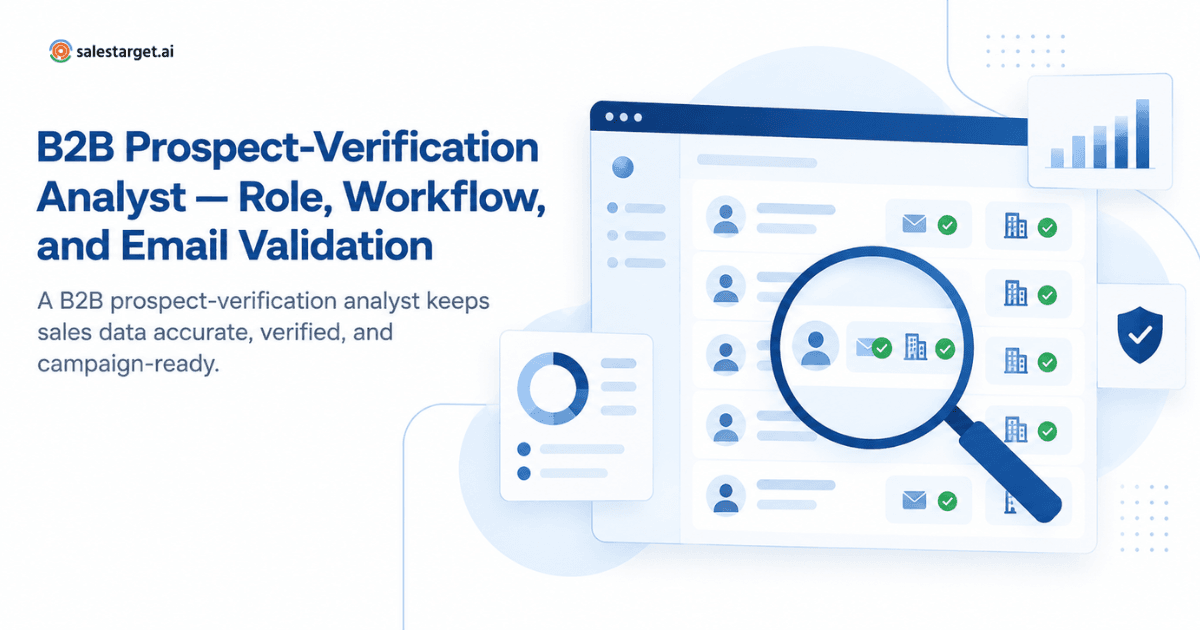
A B2B prospect-verification analyst is a data-focused specialist who checks the accuracy of prospect records before they enter a sales campaign. Their job is to confirm that each contact is real, reachable, current, and relevant to the ideal customer profile (ICP).
In practical terms, they validate email addresses, cross-check job titles, confirm company details, remove duplicates, and flag risky data — the kind of records that lead to bounces, spam complaints, or wasted rep time. Some organizations call this role a data quality analyst, sales data analyst, or lead verification specialist, but the responsibility is the same: make sure the data reps act on can be trusted.
What Does a B2B Prospect-Verification Analyst Do?
The day-to-day work is a mix of manual review, tooling, and process design. Typical responsibilities include:
- Verifying business email addresses and identifying invalid email addresses before they reach a campaign
- Confirming contact details such as name, job title, seniority, department, and LinkedIn URL
- Cross-checking company information: domain, industry, headcount range, headquarters, and revenue band
- Filtering out generic mailboxes (info@, sales@) and free email domains that are not appropriate for B2B outreach
- Removing duplicates across CRM, spreadsheets, and enrichment sources
- Flagging records that no longer match the ICP after job changes or company events
- Setting up rules for ongoing prospect data validation as new leads enter the funnel
- Reporting on lead data quality, coverage, and bounce metrics for sales and marketing leaders
Why Prospect Verification Matters in B2B Sales
Prospect verification is not just a data-hygiene chore. It directly affects revenue outcomes and sender reputation. A single campaign sent to a dirty list can damage domain health for months.
Here is what prospect verification protects against:
- Wasted rep hours calling or emailing prospects who no longer work at the company
- High bounce rates that trigger throttling or blocklisting by email providers
- Skewed reporting caused by inflated contact counts and unreachable records
- Missed opportunities when high-fit accounts are ignored due to bad routing data
- Compliance risks when outreach lands in inboxes that were never opted in or verified
When a dedicated analyst owns verification, the sales org gets a compounding benefit: cleaner lists lead to better deliverability, better deliverability leads to more replies, and more replies lead to a healthier pipeline.
Key Data Points That Need Verification
A strong verification process covers more than just email addresses. Analysts typically check the following fields on every B2B prospect record:
Contact-level data
- First and last name (spelling, formatting, correct case)
- Business email address (syntax, domain, mailbox validity)
- Direct or mobile phone (where applicable)
- Job title and seniority (current, not outdated)
- Department or function (matches the buyer persona)
- LinkedIn profile URL (active and matches the person)
Company-level data
- Legal company name and website domain
- Industry or vertical alignment with the ICP
- Employee count and revenue band
- Headquarters and target region
- Technology stack signals, if relevant to the offer
- Recent funding, hiring, or leadership changes that affect fit
The B2B Prospect Verification Workflow
Most analysts follow a repeatable lead verification process. It looks something like this:
- Ingest raw prospect data from list-building tools, purchased lists, event scans, or inbound forms.
- Standardize the data: fix casing, split full names, normalize company names, and clean formatting.
- De-duplicate against the CRM and any active outreach lists to avoid contacting the same person twice.
- Run email verification to catch invalid, risky, catch-all, or role-based addresses.
- Validate company and contact fit against the ICP checklist - industry, size, geography, seniority.
- Enrich missing fields where possible using trusted sources.
- Segment the cleaned list by persona, tier, or campaign track before handing it to sales.
- Log the verification date so records can be re-checked on a schedule.
The exact order can change, but the principle is the same: verify before you enrich, and enrich before you hand off. This prevents good data from being layered on top of bad data.
Common Problems With Unverified Prospect Data
Sales and marketing teams that skip verification tend to run into the same recurring issues:
- High email bounce rate that drags down sender reputation and inbox placement
- Reps burning time on prospects who left the company months ago
- Duplicate outreach that damages brand credibility with target accounts
- Free and personal email domains slipping into B2B campaigns
- CRM reports that look healthy on the surface but are full of unreachable contacts
- Sequences pausing or getting throttled by email service providers due to poor list quality
Most of these issues are preventable with a small amount of upfront work — which is why the analyst role exists in the first place.
How Email Verification Fits Into Prospect Verification
Email verification is the single highest-leverage step in the verification workflow. It answers a simple but critical question: will this email actually reach a real person at the target company?
Good B2B email verification typically checks:
- Syntax and formatting of the address
- MX records and mail server response for the domain
- Mailbox existence at the SMTP level
- Whether the domain is a catch-all, which can hide invalid mailboxes
- Whether the address is role-based (info@, contact@, sales@)
- Whether the domain is a free or personal provider rather than a business domain
That last point matters more than most teams realize. A prospect using a free provider is usually not a buyer at the account you think you are targeting. For a deeper look at spotting these addresses, this guide on free email domain detection for B2B prospecting explains how to identify and filter them out before they contaminate a campaign.
When email verification is done well, the downstream effects are immediate: bounce rates drop, deliverability improves, and reps get to spend their time on prospects who actually exist in the target account.
How to Build a Reliable B2B Prospect Verification Process
A reliable process is less about tools and more about clear rules. Here is a practical framework any team can adapt:
1. Define what "verified" means for your team
Write down the specific checks a record must pass: valid email, current title, ICP-matching company, no duplicates, no free domains, and a verification date within the last 90 days. If it is not written down, it will not be applied consistently.
2. Standardize inputs before verification
Fix name casing, normalize company names, and strip whitespace before running any checks. Clean inputs make every downstream step more accurate.
3. Verify emails early
Run email validation as one of the first steps, not the last. There is no point enriching a record that will bounce.
4. Score data confidence
Give each record a simple quality score - for example, high, medium, or low confidence - based on how many checks it passed. Reps can then prioritize high-confidence records first.
5. Re-verify on a schedule
B2B data decays quickly. Job changes, company pivots, and domain changes make even good records go stale. Re-check important segments every 60 to 90 days.
How Sales Teams Can Automate Prospect Verification
Manual verification does not scale past a few hundred records. Most teams eventually blend human review with automation. Common automation points include:
- Bulk email verification for uploaded lists and CRM exports
- API-based validation at the moment a form is submitted or a contact is created
- Scheduled re-verification jobs that flag stale records automatically
- Rules that block or quarantine records with free-domain, role-based, or catch-all emails
- Enrichment triggers that only run after a record passes the initial verification gate
Automation does not replace the analyst - it multiplies their impact. The analyst designs the rules, monitors the exceptions, and keeps the ICP definition sharp while the tooling handles volume.
Best Practices for Maintaining B2B Prospect Data Quality
- Treat data quality as an ongoing program, not a one-time cleanup project.
- Verify at the point of entry whenever possible - it is cheaper than fixing lists later.
- Keep a single source of truth (usually the CRM) and reconcile other lists against it.
- Track bounce rate, unsubscribe rate, and reply rate by data source to see which vendors deliver clean data.
- Document the ICP clearly so verification is measurable and not a matter of opinion.
- Review a random sample of verified records each week as a spot check.
- Retire records that repeatedly fail verification rather than letting them linger in the CRM.
How SalesTarget.ai Email Validator Can Help
The email-verification step of the workflow is where a dedicated tool saves the most time. This is where SalesTarget.ai Email Validator fits in.
SalesTarget.ai Email Validator is built to support the email-validation portion of a B2B prospect-verification process. It is designed to help sales, marketing, and RevOps teams check whether business email addresses are valid before those addresses are pushed into a campaign — reducing the risk of high bounce rates and improving list hygiene.
Used as part of a broader verification workflow, an email validator lets analysts focus their attention on the harder judgment calls — ICP fit, buying signals, and account prioritization — while automated checks handle the mechanical parts of validating addresses.
If email deliverability and clean prospect data are current priorities for your team, it is worth exploring the SalesTarget.ai Email Validator as part of your verification stack.