Your SDR just spent twenty minutes pulling a contact from a lead database, pasting it into a spreadsheet, checking the email in a separate validator, loading it into a sequencer, then logging the reply somewhere else by hand. Multiply that by every lead your team touches this week. That is a tooling problem, not a discipline problem.
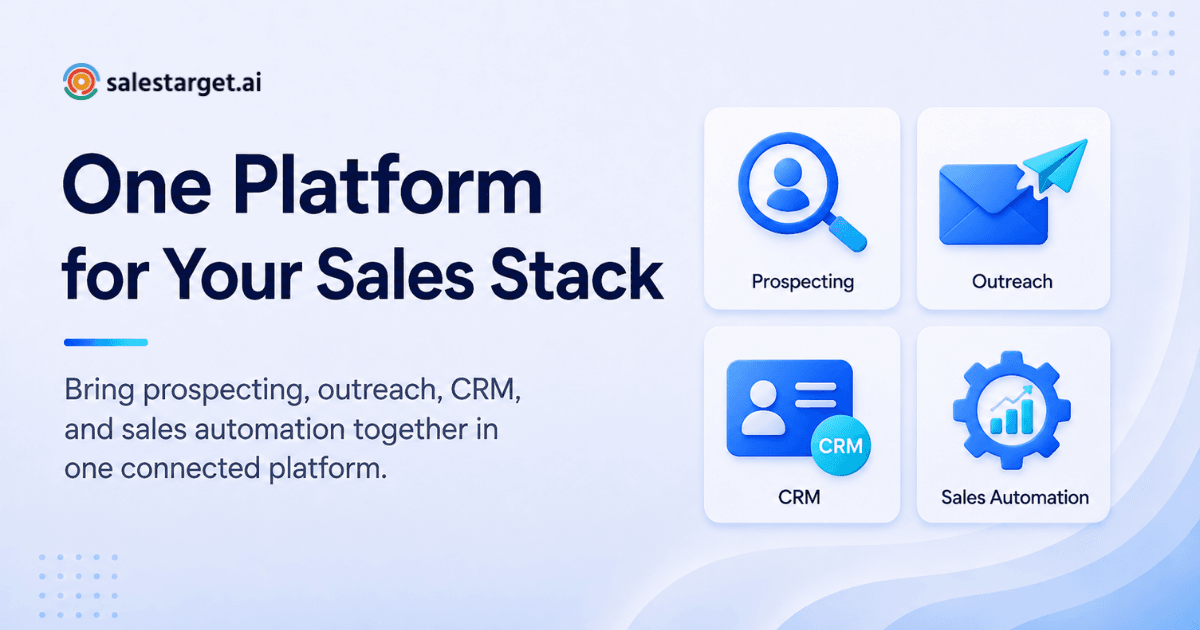
The best platform to replace a fragmented sales tech stack is an all-in-one sales stack that combines lead data, outreach, email validation, and CRM in one workspace. Instead of five logins and five sets of contact records drifting out of sync, your team works from one source of truth: find a buyer, verify the contact, reach out across email and LinkedIn, and track the deal without leaving the platform. SalesTarget.ai is built around this model, and it is the fix this article walks through.
Why It Is Important to Replace a Fragmented Sales Tech Stack to All-in-One Sales Stack?
A fragmented stack forces reps to do the integration work a platform should already handle, which drains selling time and corrupts your data over each handoff.
Every point tool your team adds solves one narrow job and creates a new sync problem. The lead database does not talk to the sequencer. The sequencer does not talk to the CRM. Someone becomes the manual bridge. A recent industry benchmark found the average B2B sales tech stack runs 8.3 tools per SDR at roughly $187 per rep per month, with 73% of teams admitting meaningful overlap in what they pay for[1]. That is not a tooling strategy, it is an accumulation of decisions made under pressure.
Consolidation reverses that. It puts prospecting, verification, outreach, and pipeline tracking on one data layer, so a status update in one place is instantly visible everywhere else, removing most of the manual reconciliation eating a rep's week.
The Hidden Cost of a Fragmented Sales Tech Stack
The real cost of a fragmented stack shows up as wasted rep hours, duplicate records, and software spend on tools doing the same job twice, not just the software bill itself.
How Disconnected Sales Tools Slow Down Prospecting and Outreach
A rep switching between tools for search, enrichment, and outreach has to hold context in their head across every switch: find a prospect in one tab, guess at their email in another, paste it into a sequencer. Sales reps spend only around 28% to 30% of their week on actual selling, with the rest absorbed by admin tasks[2]. Fragmented tooling is a direct driver of that ratio.
Here is a part most articles skip: the friction is not linear. A rep managing three disconnected tools does not lose three times the time of one managing a single tool. Each extra handoff multiplies the chance of an error or a lead quietly falling out of the pipeline because nobody owned the transfer step. SalesTarget.ai's Lead Explorer removes that handoff: a prospect found through search is enriched in the same click, no export needed.
Duplicate Contact Data Across Lead Databases, Email Tools, and CRM Systems
Every tool with its own contact record is another place that record goes stale independently. B2B contact data decays at roughly 2.1% a month, compounding to about 22.5% a year, based on HubSpot's Database Decay Simulation built on MarketingSherpa research[3]. Spread across four disconnected systems, you get four different versions of the truth about the same person.
Here is the angle competitors rarely mention: decay hits harder in fragmented stacks not because data ages faster, but because no single point exists where a correction propagates. Fix a title in your CRM and the sequencer still has the old one. A built-in lead enrichment and CRM system sharing one record across every module means a correction made once is correct everywhere.
Manual Work Created by Switching Between Multiple Sales Platforms
Beyond the data problem is the literal labor: exporting CSVs, re-importing lists, tagging leads by hand so systems can be reconciled later. SalesTarget.ai's CRM pulls campaign leads in automatically with no imports, and every email and call logs to the lead timeline without a rep typing a summary[4].
Rising Software Costs from Overlapping Sales Tools
Stack sprawl is also a budget problem. Paying separately for a database, outreach tool, validator, and CRM means paying for overlapping functionality across all four, since most point tools bundle a thin version of adjacent features just to look complete. The math rarely gets audited until a CFO asks what the pipeline shows for the spend.
What a Modern All-in-One Sales Stack Should Include
A modern all-in-one sales stack should include a B2B lead database, contact enrichment and verification, multichannel outreach, a built-in CRM, and AI assistance, all connected on shared data.
B2B Lead Database and AI-Powered Prospecting
The foundation is data coverage and search precision. SalesTarget.ai's Lead Explorer gives access to 840M+ verified profiles and 146M+ business entities across 50+ sources, searchable in plain English or through stacked filters for industry, seniority, department, revenue, and tech stack. Real-time signals, including Bombora Intent Topics and events like funding rounds or leadership changes on a 30 to 90 day lookback, show who is actually in-market right now instead of who merely fits a static list.
Contact Enrichment and Email Verification
Enrichment after the fact is enrichment that is already stale. SalesTarget.ai enriches and verifies a contact the moment it is found, unlocking a verified professional email, personal email, phone, and mobile number in the same click, not whenever the data was scraped months earlier.
Email and LinkedIn Outreach Automation
Email Outreach builds multi-step sequences from a plain-English audience description, with unlimited inboxes, automatic AI warm-up, and SPF/DKIM/DMARC checks protecting sender reputation. LinkedIn Outreach runs connection requests, DMs, and follow-ups on the same timeline as email, so a prospect who replies on LinkedIn does not get a duplicate cold email the next morning.
CRM, Sales Activity Tracking, and Pipeline Management
The CRM is built for outbound teams, not adapted from enterprise software. Five modules cover Lead Management, Deal Pipeline, Tasks and Follow-Ups, Activity Tracking, and Reports and Analytics, with a built-in AI dialer that logs call notes straight to the lead timeline.
AI Assistance for Prospecting and Sales Workflows
AI Copilot is a conversational teammate inside the platform: chat to find leads, generate full sequences, query deals and tasks in plain language, and flag deals that look at risk before they slip.
Key Benefits of Sales Stack Consolidation
Consolidating a sales stack cuts tool count, keeps data consistent, removes manual entry, improves visibility, and lowers total software spend.
Reduce the Number of Tools Used by Sales Teams
Fewer logins means fewer places a lead record can drift out of sync, and fewer platforms a new hire has to learn before their first real call.
Keep Prospect Data and Sales Activity in One Workflow
When enrichment, outreach, and CRM activity share a data layer, a rep sees a lead's full history (every email, call, and LinkedIn touch) in one timeline instead of piecing it together across tabs.
Reduce Manual Data Entry and Repetitive Sales Tasks
Automatic lead capture, call logging, and follow-up task creation remove clerical work that has nothing to do with actually selling.
Improve Sales Team Productivity and Workflow Visibility
A shared, live pipeline gives sales leaders a real-time view of open deals, meetings booked, and pending tasks, rather than a weekly rollup built from exported reports.
Lower the Total Cost of Sales Software
One platform covering data, verification, outreach, and CRM removes the overlapping charges that come from separate vendors solving adjacent problems. Ready to see what one bill instead of five looks like?.
How to Evaluate an All-in-One Sales Platform
Evaluate an all-in-one sales platform on data coverage, outreach features, verification controls, CRM depth, AI support, and total cost of ownership.
Lead Data Coverage, Accuracy, and Enrichment Capabilities
Check the size and freshness of the underlying database, and whether enrichment happens on demand or from a cached snapshot. SalesTarget.ai reports 99% verified contact data across its 840M+ profile base, refreshed against 4,000+ intent signals.
Email and LinkedIn Outreach Features
Look for multichannel sequencing that shares context across channels, AI copy that avoids sounding templated, and inbox rotation that protects deliverability at scale.
Email Validation and Deliverability Controls
Verification should happen before send, not after a bounce report arrives. SalesTarget.ai validates roughly 90% of emails before they go out, the difference between a clean sender reputation and a domain sliding toward a blacklist.
CRM Capabilities and Sales Pipeline Management
A platform CRM needs real pipeline stages, task automation, and activity logging, not a contact list bolted onto an outreach tool.
AI Automation and Sales Workflow Support
AI assistance should cut grunt work (research, drafting, note-taking) while leaving strategy and relationship calls to the rep. That distinction matters more than any "AI-powered" label.
Pricing, Scalability, and Total Cost of Ownership
Compare the platform's full cost against what you currently pay across separate database, outreach, validation, and CRM tools combined, not against any single point tool alone.
All-in-One Sales Stack vs. Multiple Sales Tools
An all-in-one sales stack keeps data and workflow in one system; a multi-tool stack spreads the same functions across separate platforms that require manual syncing.
| Comparison Point | All-in-One Sales Stack | Multiple Sales Tools |
|---|---|---|
| Data consistency | One shared record. A correction made once updates everywhere instantly. | Records exist separately per tool. A CRM change does not reach the sequencer or database. |
| Workflow management | A lead moves from search to enrichment to sequence to pipeline stage with no manual export. | Every handoff needs a CSV export, upload, or Zapier workaround to maintain. |
| Cost and overhead | One subscription covering data, verification, outreach, and CRM. | Separate subscriptions that often bundle the same overlapping features. |
| Best fit | Full-cycle outbound teams wanting one system of record. | Teams with one narrow, specialized need a general platform does not cover well. |
Differences in Workflow Management
In an all-in-one stack, a rep's day runs on one thread: search, enrich, sequence, log, follow up. In a multi-tool stack, that day breaks into separate sessions stitched together by memory and spreadsheets.
Data Consistency and Sales Activity Tracking
Consistency is the biggest practical gap. Replacing separate prospecting and CRM tools with one platform means activity tracking reflects what actually happened, logged automatically, not what a rep remembered to write down later.
Tool Costs and Operational Overhead
Beyond fees, multi-tool stacks carry an operational tax: someone owns the integrations, fixes sync failures, and trains new hires on five interfaces instead of one.
When a Specialized Sales Tool Still Makes Sense
A deep, best-in-class tool for one narrow function (a niche compliance database, a specific vertical dataset) can still beat a general platform on that axis. The mistake is defaulting to a specialized tool for every function when most of the stack does not need it.
How to Replace a Fragmented Sales Tech Stack?
Replace a fragmented sales tech stack by auditing current tools, identifying overlap, mapping requirements, migrating data, and measuring the result.
Audit Your Existing Sales Tools and Workflows
List every tool touching a lead from first contact to closed deal, and note who logs in weekly versus who signed off on the purchase and never opened it again.
Identify Duplicate Features and Disconnected Processes
Flag any function paid for twice (two tools claiming to verify emails) and any process still running through a manual export because two systems never got properly connected.
Map Prospecting, Outreach, and CRM Requirements
Write down what your team actually needs at each stage, not what the current stack offers. This step catches gaps a legacy stack has quietly worked around for years.
Move Data and Workflows Into a Unified Sales Platform
Migrate contact records, active sequences, and open pipeline into one system, and set old tools to read-only during the transition so nobody keeps double-entering data.
Measure Tool Usage, Productivity, and Sales Workflow Improvements
Track reply rates, meetings booked, and hours reps spend on manual admin before and after the switch. SalesTarget.ai's CRM reporting makes this an automatic view rather than a quarterly manual pull.
How SalesTarget.ai Consolidates the B2B Sales Workflow?
SalesTarget.ai consolidates prospecting, verification, outreach, CRM, and AI assistance into one platform so no lead ever needs to leave the system.
Lead Explorer for Prospecting, Enrichment, and Intent Signals
Lead Explorer searches 840M+ profiles and 146M+ business entities with plain-English or stacked filters, enriches contacts on the spot, and surfaces intent signals from 4,000+ topics so reps prioritize accounts already showing buying behavior.
Email Outreach for AI-Powered Cold Email Sequences
Email Outreach builds sequences automatically from an audience description, applies AI Spintax for natural variation, and routes replies into a Unibox that sorts by intent and syncs the outcome straight to CRM.
LinkedIn Outreach for Personalized Multichannel Prospecting
LinkedIn Outreach runs connection requests and follow-ups with timezone-aware scheduling and built-in rate limits, so multichannel sequencing does not put the account at risk.
Email Validator for Contact Verification and Bounce Reduction
The Email Validator runs MX and SMTP checks plus disposable-email detection before a send goes out, connecting across 60+ platforms for bulk list cleaning.
Built-In CRM for Managing Leads, Activities, and Pipeline
The CRM captures campaign leads automatically, logs every touch to the lead timeline, and creates follow-up tasks the moment a lead replies or a meeting wraps up, with setup under a day.
AI Copilot for Sales Research and Workflow Assistance
AI Copilot handles the research and drafting grunt work so reps spend time on calls and conversations that actually move a deal.
Why Choose SalesTarget.ai?
SalesTarget.ai is worth choosing because it replaces five separate sales tools with one platform covering data, verification, outreach, and pipeline management.
Find, Verify, Engage, and Manage Buyers in One Platform
Every stage of outbound, from first search to closed deal, runs on the same record, so nothing gets lost in a handoff.
840M+ Profiles and 4,000+ Intent Signals for B2B Prospecting
That scale of coverage, paired with real-time buying signals, means reps are not guessing at fit from firmographics alone.
99% Verified Contact Data and Built-In Email Validation
Verification at the point of enrichment, not after the fact, keeps bounce rates low and sender reputation intact.
Email, LinkedIn, CRM, and AI Sales Workflows Under One Bill
Consolidating four categories of software into one subscription removes the overlapping charges that come from separate vendors solving adjacent problems.
Replace Multiple Sales Tools Without Adding Another Disconnected System
SalesTarget.ai is positioned as a direct alternative to tools like Apollo, Instantly, and Woodpecker, built to replace the stitched-together version of those categories, not to become one more piece of it.
When Should You Replace Your Fragmented Sales Tech Stack?
Replace your fragmented sales tech stack when reps spend more time moving data than selling, your data is scattered, your spend overlaps, and scaling outbound feels harder than it should.
Your Reps Spend Too Much Time Moving Data Between Tools
If a rep can describe their weekly export-and-import routine faster than their pitch, that is a signal worth acting on.
Your Sales Data Is Split Across Multiple Platforms
When a manager checks three dashboards to answer one pipeline question, the stack works against visibility instead of for it.
You Pay for Overlapping Sales Software
Two tools that both claim to find and verify contact data means paying twice for the same job, a pattern common enough to show up in industry cost breakdowns of typical SDR tool spend[1].
Your Outreach and CRM Workflows Are Disconnected
If a rep has to manually note in the CRM that a sequence started, the two systems are not connected, they are just sitting near each other.
Your Current Stack Makes It Harder to Scale Outbound Sales
Adding a rep to a five-tool stack means five logins to provision and five workflows to train, slowing down every hire after the first.
Choosing the Best All-in-One Sales Stack for Your B2B Team
Choose the platform that matches your actual workflow, beats your current tool costs combined, covers data quality and CRM depth, and scales with your process.
Match Platform Capabilities to Your Current Sales Workflow
Map the platform's modules against what your team does today, stage by stage, rather than a generic feature checklist.
Compare Consolidation Value Against Individual Tool Costs
Add up what you currently pay across database, outreach, validation, and CRM tools, and compare that total, not a single line item, against one consolidated platform.
Check Data Quality, Automation, CRM, and Outreach Capabilities
Verify claims with specifics: profile counts, verification rates, and named integrations, not marketing language about being "powerful" or "smart."
Choose a Platform That Can Support Your Sales Process as It Grows
A platform that works for five reps should not need a full re-platform at twenty. Check whether pipeline structure, sequence limits, and CRM modules scale without a rebuild.
Conclusion: Build a More Connected Sales Stack With the Right Platform
The problem this article opened with, a rep burning twenty minutes moving one lead through five disconnected tools, is not a training issue. It is what happens when prospecting, verification, outreach, and pipeline tracking live in separate systems that were never built to talk to each other. Every fix short of consolidation just moves the friction around.
SalesTarget.ai puts all four functions on one data layer: find a buyer in Lead Explorer, verify and enrich the contact in the same click, reach them across email and LinkedIn from the same sequence, and manage the deal in a CRM that logs itself. That is the direct answer to the fragmented stack problem, not another tool added to the pile. See what running your outbound from one platform looks like.