You send 400 emails on Monday. By Friday you have a handful of replies, one meeting on the calendar, and no clean way to say which sequence produced it. Your CRM shows a deal came in "from outbound," but nobody can trace it to the campaign that started it. Your sales lead asks for a conversion rate by channel and you end up building a spreadsheet from three tools that do not agree.
That gap between activity and attribution is why outbound teams cannot tell leadership what works.
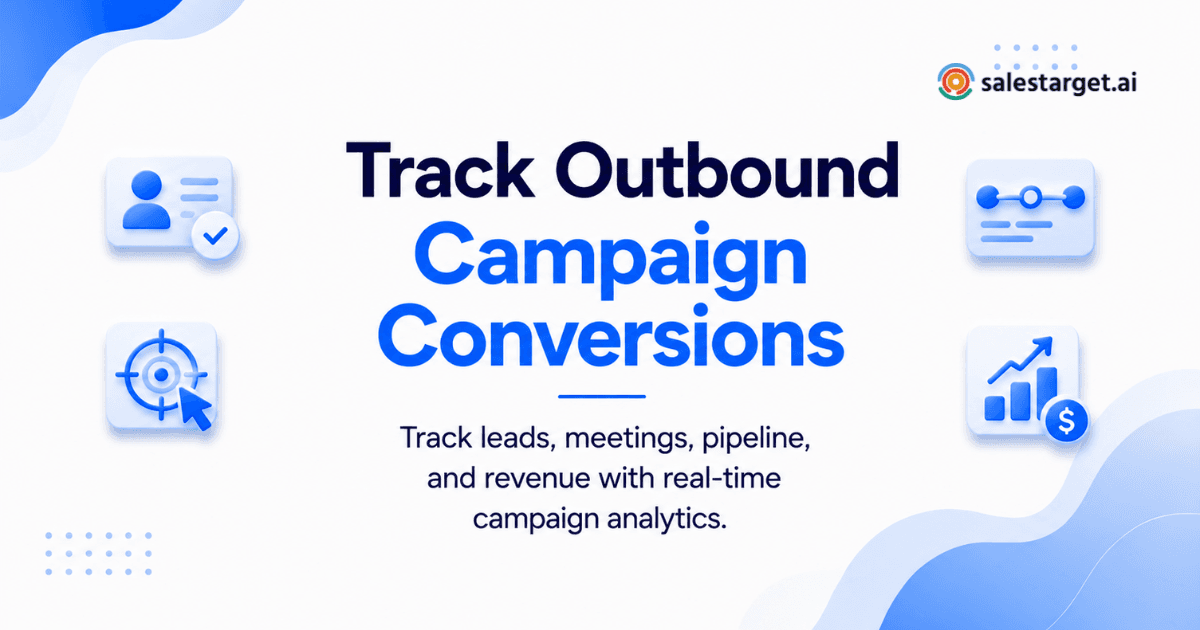
Here is the direct answer: real-time outbound campaign conversion tracking means using one connected system, not three disconnected ones, so every reply, meeting, and closed deal stays linked to the campaign and contact that produced it. These tools combine prospecting data, multichannel outreach, and a CRM in one workflow, so conversion data updates live instead of arriving days later through a manual export. SalesTarget.ai, Apollo, Instantly, Smartlead, and Woodpecker are the five platforms most outbound teams compare, and each handles the "campaign to closed deal" link differently.
How Do You Track Outbound Campaign Conversions in Real Time?
You track conversions in real time by connecting every touchpoint (email, LinkedIn message, call) to a single contact record, then watching it move through defined stages (reply, meeting, opportunity, closed deal) inside one system that updates as it happens, not on a delay.
A dashboard that refreshes once a night is not real time. A tool that counts opens and clicks but cannot show which opens turned into a booked meeting tracks engagement, not conversion. Real tracking means activity logs automatically, stage changes record the moment they happen, and reporting rolls up by campaign without manual field updates.
This is where most stacks break. A team running email in one tool, LinkedIn in another, and calls through a separate dialer ends up with three partial timelines and no single view of what a campaign produced. Fixing that means reducing the number of systems the data travels through, the idea behind tools for lead enrichment, outreach, and pipeline tracking.
Why Outbound Campaign Tracking Breaks Down as Campaigns Scale
Tracking that worked at 50 contacts a week falls apart at 500: more channels, reps, and manual CRM updates multiply the places conversion data can get lost.
Sales reps cannot link replies and meetings to the right campaign
A rep gets a reply three weeks after a sequence ended, or a prospect from two campaigns finally books a call. Without a system tying every reply to its campaign automatically, reps guess or skip attribution.
Multiple outreach channels create gaps in conversion reporting
Email lives in one tool, LinkedIn in another, calls in a dialer that talks to neither. A prospect touched by all three gets credited wherever a dashboard exists. Cross-channel attribution needs activity in one place, which is why running email and LinkedIn Outreach side by side, sharing the same contact record, produces cleaner numbers.
CRM updates make sales campaign performance tracking harder to trust
If a rep manually moves a lead from "contacted" to "meeting booked" to "opportunity," some updates lag or get skipped. Nobody updates a CRM by hand, consistently, for months straight. Manual entry turns tracking into an estimate, not a measurement.
Revenue teams need one view from prospecting to closed deal
Marketing sees sends. Sales sees pipeline. Leadership wants revenue per campaign. Three separate tools turn reconciling into a monthly project instead of a quick check.
What Should Outbound Campaign Tracking Software Measure?
It should measure activity at the contact and account level, every conversion event from reply through closed deal, the rate between stages, the pipeline and revenue tied to the campaign, and how long conversion takes.
Contact and account-level campaign activity
Every send, open, reply, and call needs to sit on the contact record and roll up to the account, since B2B deals rarely involve one person. Campaign-level activity alone hides which prospects are actually engaging.
Replies, positive responses, meetings, opportunities, and closed deals
"Not interested" and "let's talk" are both replies, but only one moves the deal forward. Good software separates positive replies from noise, then follows them through to closed deal.
Conversion rates between each outbound sales stage
Reply rate, meeting rate, and opportunity rate each tell a different story. A great reply rate paired with a poor meeting-to-opportunity rate signals a qualification problem, not an outreach problem.
Pipeline and revenue attributed to each campaign
This is the number that justifies the spend: pipeline value and closed revenue tied to a specific campaign turns "we sent a lot of emails" into "campaign X generated real pipeline."
Time-to-conversion and outbound campaign ROI
How long does a lead take from first touch to closed deal? Faster cycles free rep time sooner. Per McKinsey's research on B2B commercial excellence, strong performance management tracks velocity alongside raw conversion counts.
How to Measure Outbound Campaign Conversion Rates
Divide the number of contacts reaching one stage by the number that reached the stage before it, tracked separately for each transition: lead to reply, reply to meeting, meeting to opportunity, opportunity to customer.
Lead-to-reply and reply-to-meeting conversion rates
Lead-to-reply shows whether targeting and messaging land. Reply-to-meeting shows whether follow-up works once someone responds. Aggregated 2026 data puts healthy cold email reply rates in the 5 to 10% range, varying by industry and list quality. If your rate sits well under that with a verified list, the message is usually the problem, not the data.
Meeting-to-opportunity and opportunity-to-customer conversion rates
A booked meeting that never becomes a real opportunity is a scheduling win and a pipeline loss. Track how many convert to a qualified opportunity, then how many close, to expose where outbound is stalling.
Campaign-level conversion rate vs. rep-level performance
A campaign can perform well overall while one rep drags the average down, or the reverse. Separating these views stops you from killing a good campaign for weak execution.
How to separate activity volume from actual sales outcomes
This is one angle most articles skip. High send volume looks impressive weekly, but it is not revenue. A rep sending 300 emails for 2 meetings is not necessarily behind one sending 100 for 3, if accounts differ. Judge campaigns on stage-to-stage conversion and revenue per contact, which is exactly what conversion tracking software should help you see.
Start a free trial and connect your first campaign to CRM tracking the same day!
5 Best Platforms for Real-Time Outbound Campaign Conversion Tracking
SalesTarget.ai — Best for prospecting, outreach, and CRM tracking in one platform
SalesTarget.ai runs prospecting, email, LinkedIn, and calling through one workspace feeding a built-in CRM, so a reply logged Monday shows up as CRM activity the same moment. Leads are enriched and verified the moment they are found, so conversion data reflects contacts reachable at launch, not names from a stale list months old.
Apollo — Best for sales intelligence and outbound workflows
Apollo pairs a large contact database with sequencing, a dialer, and reporting, well suited to teams wanting prospecting and outreach in one subscription. Independent reviews note Apollo's sequence reporting turns less granular past roughly 50 reps, with deeper deal tracking usually needing a separate CRM.
Instantly — Best for cold email campaign analytics
Instantly focuses on cold email at volume, with warm-up infrastructure, inbox rotation, and reply-focused analytics. It handles email metrics well, but its CRM is a separate product, and LinkedIn or call tracking sit outside the core platform, per reviews of its feature scope.
Smartlead — Best for multi-account email outreach tracking
Smartlead is built for agencies running email across many domains at once, with strong deliverability and account-level reporting. Its tracking centers on email engagement across accounts, so pipeline and revenue reporting usually happens in a connected CRM instead.
Woodpecker — Best for cold email campaign reporting
Woodpecker suits smaller teams sending modest cold email volume who want simple A/B testing and reply tracking without a steep setup. It skips a prospect database, and its deliverability and variant reporting are more limited than Smartlead or Instantly at scale.
Which Tool Is Best for Tracking Outbound Campaign Conversions?
Best option for founders and small sales teams
A founder running sales alone needs prospecting, outreach, and a lightweight CRM without three logins, which is what SalesTarget.ai's under-a-day setup fits.
Best option for RevOps and larger outbound teams
Teams running a heavy CRM (Salesforce, HubSpot) who just need better sequencing on top may lean toward Apollo, since its tools slot into an existing stack.
Best option for agencies running campaigns for multiple clients
Agencies sending high volume across client domains lean toward Smartlead, given its focus on multi-account deliverability and per-account reporting.
Best option for teams that need outreach and CRM data in one place
If the goal is one view from first send to closed revenue with no export step, that points toward a shared contact record from the start, the problem SalesTarget.ai's CRM was built to solve.
Why Choose SalesTarget.ai for Outbound Campaign Conversion Tracking?
Track prospecting, email, LinkedIn, calls, and CRM activity in one workflow
Every channel writes to the same contact timeline. A LinkedIn reply, a call note, and an email open all land on one record, so a manager sees the full conversation instead of piecing it together across tabs.
Connect outbound campaign activity with meetings, opportunities, and deals
When a lead books a meeting through a connected calendar, the system creates a follow-up task and links it to the CRM's Deal Pipeline module automatically, so nobody has to remember to log it against the right campaign.
Use Lead Explorer to find and enrich prospects before outreach
Lead Explorer searches 840M+ professional profiles and 146M+ business entities, with one-click enrichment unlocking verified email, phone, and mobile the moment you find the contact. Real-time signals on a 30 to 90 day lookback help you build campaigns around companies that are active now, not a static list reused for months.
Run email and LinkedIn sequences with campaign-level visibility
Email Outreach builds multi-step sequences from a plain-English audience description, with automatic AI warm-up protecting deliverability, while the Unibox pulls every reply into one view sorted by intent. Paired with LinkedIn Outreach in the same flow, one campaign's data covers both channels instead of splitting across two tools with two definitions of "reply."
Use the built-in CRM to track conversion from outreach to closed deal
The CRM receives campaign leads automatically, logs every email and call to the lead timeline, and creates follow-up tasks the moment a lead replies or a meeting ends. The built-in AI dialer takes call notes automatically and saves them to the lead timeline, so reps skip rebuilding call history from memory. Teams using this workflow report 3.2X faster deal cycles and 91% follow-up completion.
Use SalesTarget.ai data points: 840M+ profiles and 99% verified contact data
Verified data matters more for conversion tracking than most teams realize: a campaign that looks like a poor reply rate might just be full of dead emails. SalesTarget.ai's 840M+ profiles and 99% verified contact data mean the reply rate you see reflects real delivery, not bounces counted as failures.
When an all-in-one sales platform makes more sense than separate tracking tools
If your stack is three tools with no shared contact ID, you are reconciling numbers manually every time someone asks for a conversion rate, which is the moment consolidation starts paying off. See how to choose the right B2B sales platform.
What Metrics Should You Review After an Outbound Campaign?
Conversion rate by campaign and channel
Break this down by campaign and by channel (email vs. LinkedIn vs. call), since a campaign that looks average overall might be strong on one channel and weak on another.
Positive reply and meeting-booked rates
Separate positive replies from total replies, then track meetings booked as a share of positive replies. This isolates whether follow-up converts interest into calendar time.
Opportunity and pipeline creation
Count how many meetings turn into a tracked opportunity with an assigned value, not a calendar event.
Revenue generated per campaign
Tie closed-won revenue back to the campaign that produced it so effort compares against dollars closed, the number leadership cares about.
Cost per meeting and cost per opportunity
Divide spend by meetings booked and opportunities created. This exposes high activity with few qualified outcomes.
Time from first touch to conversion
Track average days from first touch to each stage. A slower campaign can still be worth running if its deals are larger.
How to Improve Outbound Sales Conversion Tracking Accuracy?
Keep campaign names and stages consistent across channels
If email campaigns are named one way and LinkedIn sequences another, rolling up data by campaign becomes manual matching. Use one convention everywhere.
Connect every outreach activity to a contact and account
Activity not tied to a contact record cannot be attributed later. Confirm every contact has a proper record, not a loose email address in a spreadsheet.
Use verified contact data to reduce false campaign results
A campaign full of unverified emails shows an artificially low reply rate, since bounces count the same as reached contacts. Salesforce's research on B2B sales performance notes poor data hygiene is a common reason teams misjudge results.
Track conversion events inside the CRM instead of spreadsheets
Spreadsheets do not update when a reply lands at 9pm Friday. A CRM that logs the event automatically means Monday's numbers were true the moment it happened.
Review campaign performance by segment, channel, and sales rep
A blended average hides more than it reveals. Break performance down by segment, channel, and rep monthly, so one weak campaign does not drag down a strong one.
If your reporting still depends on manually pulling numbers from three tools weekly, see how a connected CRM changes the workflow.
Turn Outbound Campaign Data Into Better Sales Decisions
The problem you started with, replies and meetings that cannot be traced back to the campaign that produced them, comes down to one root cause: too many disconnected tools, each holding a piece of the story. Fixing it needs the activity, reply, and deal living in the same system from first touch to signed contract.
SalesTarget.ai was built around that idea: find the right accounts with Lead Explorer, reach them across email and LinkedIn with campaign-level visibility built in, and track every reply through to a closed deal inside a CRM that updates the moment something happens, not the next time someone remembers to log it. That turns "we think outbound is working" into a number you can defend in a pipeline review.
See how SalesTarget.ai tracks outbound conversions in real time.