Your reps are spending hours piecing together contact lists from LinkedIn searches and spreadsheet exports. By the time they track down a verified email and send the first message, a competitor who spotted the same buying signal three weeks earlier has already booked the demo. That timing gap is exactly what a B2B sales intelligence platform closes.
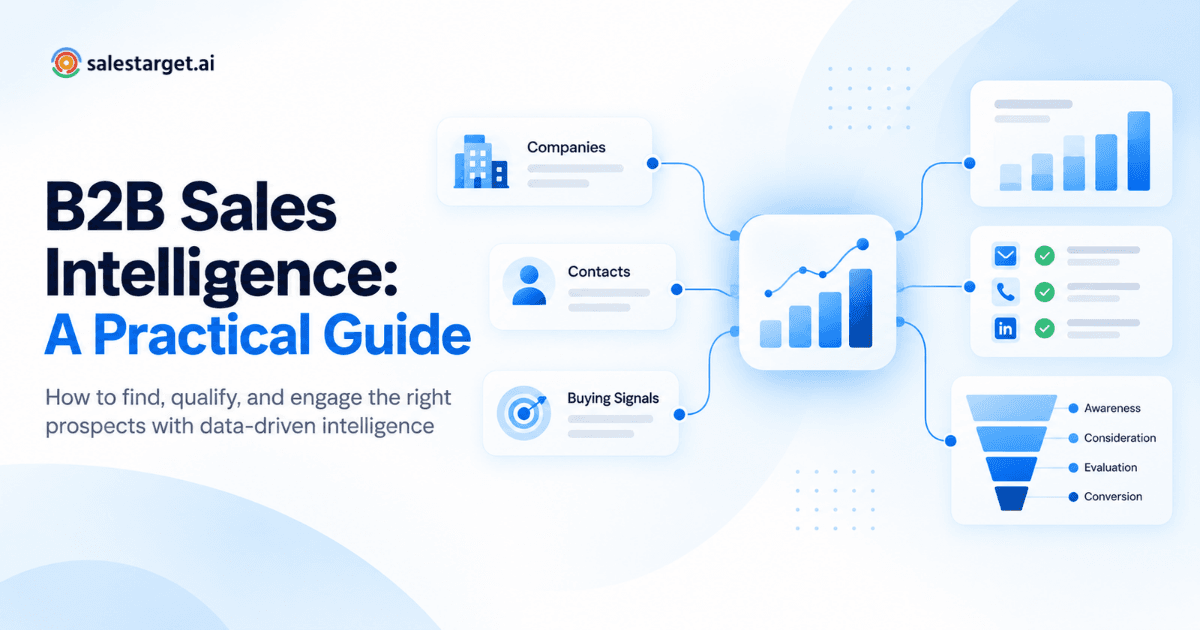
A B2B sales intelligence platform pulls together company data, contact records, and behavioral signals to show which accounts are in an active buying cycle and who inside those accounts is worth contacting. Rather than guessing who might buy, sales teams work from real evidence: funding rounds, hiring spikes, technology changes, and research behavior that points to an active evaluation. The result is faster outreach, sharper timing, and a pipeline built on fit and intent rather than sheer volume.
Why Sales Teams Struggle to Spot Buyer Intent Before Competitors Do?
B2B buyers complete most of their research long before they contact a vendor. Gartner research shows that B2B buying groups now average six to ten stakeholders per purchase decision, each researching independently. By the time a prospect surfaces through inbound, the shortlist is frequently already set.
Sales teams without access to buyer intent data default to guesswork. They prioritize accounts by job title and company size, not by evidence that a buying cycle is underway. The result is outreach going to companies with no immediate need and very little attention going to the accounts that are ready to act right now.
What Sales Teams Need to Know Before Starting Outreach
Before the first touch, a rep needs three things: confirmation the account fits the ICP, at least one signal that a buying window is open, and a verified contact who can actually move a deal forward. Most teams have none of these in place when they start dialing.
Sales intelligence tools for B2B contact data close that gap by combining account fit, intent signals, and verified contacts in a single workspace before outreach begins.
How Does a B2B Sales Intelligence Platform Identify Buyer Intent?
A B2B sales intelligence platform identifies buyer intent by aggregating data across firmographics, technology usage, behavioral patterns, and contact-level activity, then surfacing clusters that point to an active buying window.
Collecting Firmographic, Technographic, and Behavioral Data
Three data layers form the foundation. Firmographic data describes the company: size, revenue, industry, location, and structure. Technographic data shows what tools the company currently runs and what it recently replaced. Behavioral data captures which topics the company's employees are researching across B2B content networks.
Tracking Buyer Intent Signals Across Accounts and Contacts
Intent signals layer on top of that data. They cover hiring patterns, funding activity, leadership changes, and third-party research behavior tracked across millions of B2B content sources. A single signal is weak evidence. A cluster of signals from the same account over 30 to 60 days is a far stronger indicator.
Connecting Company Activity With Decision-Maker Data
Account-level intent only becomes useful when it connects to the person who owns the purchase decision. A platform links company activity to specific contacts with budget authority, the relevant title, and a verified way to reach them.
Turning Raw Prospect Data Into Useful Prospect Insights
Raw data points become actionable when the platform scores and prioritizes them. Reps get a clear reason to reach out, not a list of facts to interpret on their own before every call.
Which Buyer Intent Signals Matter Most in B2B Sales?
Not all signals carry equal weight. The most reliable ones tie to a concrete business event or a measurable shift in research behavior.
Company Growth, Hiring, and Leadership Changes
A hiring spike in the function you sell into, a new VP hired from a competitor, or a recent funding announcement are all events that tend to precede technology purchases. The action window on these is typically 30 to 90 days.
Technology Adoption and Changes in the Existing Tech Stack
When a company adds a new CRM, drops an older tool, or scales its data infrastructure, it is actively reworking its technology environment. Those transitions create adjacent purchase opportunities for the right vendor at the right moment.
Content Engagement, Research Activity, and Topic Interest
Third-party intent data tracks which topics a company's employees are researching across the broader web. A company whose team is reading content on outbound prospecting or sales automation is likely evaluating a solution in that category. A spike in research over two to three weeks is a stronger indicator than a single visit.
Contact-Level Activity From Key Decision-Makers
Account-level intent is a starting point. Contact-level signals are more precise. A VP of Sales at a target account actively engaging with content on sales intelligence software is a far more actionable signal than knowing the company fits your ICP profile in general.
Sales Triggers That Signal a Possible Buying Window
Triggers include funding rounds, new product launches, regulatory changes, mergers, and competitive displacements. Each one creates a credible reason to reach out and a natural hook for the opening message.
How Prospect Intelligence Helps Sales Teams Prioritize the Right Accounts
Ranking Target Accounts by Fit and Buying Intent
Prospect intelligence lets teams score accounts on two dimensions at once: how well the company fits the ICP and how actively it is showing buying behavior. High fit plus high intent is the tier that produces the most pipeline per hour of rep effort.
Using ICP Targeting to Reduce Low-Value Prospecting
Most outbound lists are too broad. ICP filters built on firmographic and technographic data narrow the list to companies worth pursuing, which cuts wasted touches and improves conversion rates across every step of the funnel.
Finding Decision-Makers Inside High-Intent Accounts
Once an account hits the high-intent threshold, the next step is finding the right person. A B2B sales intelligence platform surfaces decision-makers by role, seniority, and department, with verified contact data already attached.
Using Prospect Insights to Improve Account Prioritization
Prospect insights give reps a concrete reason to rank one account above another. Rather than working a list by company size or alphabetical order, reps sequence outreach by signal strength, timing, and contact readiness.
Moving Qualified Prospects Into the Sales Pipeline Faster
The faster a rep validates an account and reaches the right contact, the faster that account moves from a prospect list into an active deal. Sales intelligence shortens the research phase so reps spend more time in actual conversations.
How to Use Buyer Intent Data for B2B Prospecting
Define the ICP and Account Signals That Matter to Your Sales Motion
Start by defining what a good-fit account looks like and which signals are most predictive for your category. A CRM company may weight hiring signals in sales operations. A cybersecurity company may weight technology stack changes or compliance-related research. The signals that matter depend on what actually triggers purchases in your market.
Build Prospect Lists Around Fit, Intent, and Timing
Layer ICP criteria on top of intent data when building lists. Accounts that match both and show a recent trigger event go to the top of the working list. Accounts with strong fit but no current signals go into a watch list for the next cycle.
Enrich Contact Records With Verified B2B Contact Data
A list of companies is not a prospect list. Each account needs at least one verified contact with a working email and direct phone before outreach can start. Enrichment at the point of discovery is faster and more accurate than running a separate step afterward.
Segment Prospects by Buyer Behavior and Sales Triggers
Group prospects by the signal that surfaced them: hiring-triggered accounts in one segment, funding-triggered accounts in another, technology-change accounts in a third. Each segment has different context and warrants a different opening line.
Match Outreach Messages to Each Prospect's Intent Signal
A company that just raised a Series B has different priorities than one that just replaced its CRM. The outreach message should reflect what is actually happening at that account, not a generic pitch about your product category.
Track Replies, Meetings, and Pipeline Results by Intent Source
Close the loop by measuring which intent signals produce the most replies, meetings, and closed revenue. That data tells you which signals to prioritize in future list-building and which to pull back on.
How Sales Intelligence Improves B2B Prospecting and Lead Qualification
According to Salesforce's State of Sales, reps spend only 28% of their working week on direct selling activity. The rest goes to research, data entry, and manual admin. Sales intelligence software reduces that non-selling overhead significantly.
Spend Less Time Researching Accounts Manually
A B2B sales intelligence platform replaces hours of manual account research with a structured data view: company context, intent signals, and contact information in a single lookup. What takes an SDR an hour to piece together from LinkedIn and news searches takes under two minutes in a well-built platform.
Focus SDR and BDR Effort on Higher-Intent Prospects
SDRs working from intent-ranked lists reach the right conversations faster. Rather than cold-calling a broad volume list, they're reaching accounts where business events or research behavior point to an active need.
Give Account Executives More Context Before Outreach
AEs entering a conversation with recent account context, trigger events, and contact history are in a stronger position than reps relying on a quick LinkedIn scan before the call. Context produces better conversations. Better conversations produce more meetings.
Improve Lead Scoring With Account and Contact Signals
Lead scoring built on intent data and account signals is more predictive than scoring based on form fills and page visits alone. Combining both layers produces a more accurate ranking of which prospects deserve attention right now.
Help RevOps Teams Build More Useful Prospect Segments
RevOps teams can use intent data to build segments that reflect actual buying behavior rather than static firmographic cuts, making pipeline forecasting and coverage analysis more grounded in real account activity.
If your team is still scoring leads on website behavior alone, Lead Explorer's intent-based scoring is worth a closer look.
What Should You Look for in a B2B Sales Intelligence Platform?
Accurate Contact and Company Data
Contact data degrades fast. HubSpot estimates B2B contact data decays at roughly 22% per year. A platform that verifies contacts at the point of enrichment is more reliable than one running quarterly database refreshes.
Buyer Intent Data Tied to Real Accounts and Prospects
Intent data should map directly to named accounts in your target market, not broad topic trend summaries. The connection between a signal and a specific company and contact is what makes it worth acting on.
Data Enrichment and Verified Contact Information
Enrichment should happen at the moment of prospect discovery. Verified professional email, direct phone, and mobile should be accessible in a single click, not through a separate vendor or manual lookup.
Filters for Firmographic and Technographic Data
Granular filters produce precise lists. Industry, company size, revenue range, location, seniority, department, and technology stack are the filters that do the most work in ICP-aligned prospecting.
Contact Discovery for Decision-Makers and Buying Roles
The platform should surface the person who owns the budget, the problem, or both, not just any contact at the account sorted by job title.
Outreach Tools Connected to Prospect Intelligence
Separating prospect discovery from outreach creates friction and data loss. When both live in the same workspace, reps move from finding a prospect to sending a message without switching tabs or exporting files.
CRM Tracking From First Signal Through Closed Deal
The full deal history, from first intent signal through meetings, replies, and close, should sit in one place. Tracking revenue by intent source shows which signals are generating pipeline.
Why Choose SalesTarget.ai
Find and Enrich Prospects With Lead Explorer and 840M+ Verified Profiles
SalesTarget.ai's Lead Explorer searches across 840M+ verified professional profiles and 146M+ business entities. Reps search in plain English or stack filters for industry, role, seniority, revenue, location, and tech stack. One click enriches a profile with verified professional email, personal email, phone, and mobile. No separate enrichment vendor, no CSV export required.
Use 4,000+ Intent Signals to Identify Accounts Showing Buying Activity
The platform tracks 4,000+ intent signals across 50+ data sources, combining Bombora Intent Topics with real-time business events: funding rounds, hiring spikes, leadership changes, and company awards. Lookback windows run 30 to 90 days, so reps are working from current signal patterns, not data collected six months ago.
Run Email and LinkedIn Outreach From the Same Prospect Workflow
Enriched prospects push directly to an Email Outreach sequence or a LinkedIn outreach flow without a single export. Multichannel sequences run from the same workspace. Every reply lands in the Unibox, sorted by intent category: Interested, Follow-Up, or Not a Fit.
Check Email Validity With MX and SMTP Verification Before Sending
SalesTarget.ai runs MX and SMTP checks alongside disposable-email detection before any message goes out. This protects sender reputation, cuts bounce rates, and keeps domains off blacklists. 90% of emails in the platform are validated before sending.
Keep Prospect Activity, Replies, Deals, and Call Notes in the Built-In CRM
The built-in CRM automatically logs every email, call, and reply to the lead timeline. The AI dialer captures call notes during the conversation and saves them to the lead record without any manual input from the rep. Teams using this workflow report 3.2X faster deal cycles and roughly six hours saved per rep each week.
Use the Free AI Copilot for Prospect Research, List Building, and Sales Tasks
The AI Copilot is included free inside the platform. Reps ask it to find prospects, generate sequences, check pipeline status, or create tasks, all in plain language. It flags at-risk deals and recommends the next action based on real workspace activity.
Common Mistakes When Using Buyer Intent Data
Treating Every Intent Signal as a Sign That a Prospect Is Ready to Buy
An intent signal reflects research activity, not a confirmed budget or an approved evaluation. Treat it as the right moment to start outreach, not as proof the deal is close.
Ignoring ICP Fit When Ranking High-Intent Accounts
High intent from a company that does not fit your ICP is still a low-value prospect. Score intent alongside fit. An account that rates high on intent but low on ICP should rank below one that scores well on both.
Relying on Account-Level Intent Without Finding the Right Contact
Knowing a company is researching your category does not help if you are emailing the wrong person. Account-level intent must connect to specific contact discovery to be actionable.
Using Old Contact Data After Identifying an Active Account
Spotting a high-intent account and reaching out through a contact who left six months ago is a common failure mode. Verify contacts at the point of outreach, not when the account was first flagged.
Sending the Same Outreach Message to Every Intent Segment
A company that just raised a round needs a different message than one posting ten engineering jobs. Segment-specific messaging that reflects the actual trigger produces replies. Generic messaging produces silence.
Measuring Intent Volume Instead of Meetings and Pipeline Created
The metric that matters is not how many intent signals your platform collected. It is how many of those signals turned into conversations, meetings, and closed revenue. Measure pipeline by intent source to identify what is working.
Buyer Intent Signals Do Not Always Mean Purchase Intent
How Research Activity Can Create False Positives
A company researching your category might be a competitor doing market analysis, a journalist writing an industry piece, or an analyst benchmarking vendors. High topic-engagement scores from these sources inflate an account's apparent intent without any real purchase behind it.
Why Competitor Research and Job Seekers Can Distort Intent Data
Employees at a competitor studying your product category show up as intent activity on third-party platforms. Job seekers evaluating companies to apply to may research software categories relevant to your product with no buying intent at all. These are common and well-documented distortions in aggregated third-party intent data.
How Multiple Signals Can Give Stronger Prospect Context
Require at least two corroborating signals before elevating an account to high-intent status: a business event plus research activity, a technology change plus a relevant new hire, or a funding announcement plus topic engagement in the right category. Convergence is a more reliable indicator than any single signal alone.
When Sales Reps Should Research an Account Before Contacting It
When a platform surfaces a high-intent account, a rep should spend five minutes reviewing recent company news, open job listings, and any LinkedIn activity from key contacts before making contact. Intent data provides a starting point. It does not replace the judgment a rep applies before opening a real conversation.
Turn Buyer Intent and Prospect Insights Into Better Sales Conversations
The difference between a rep who sends a hundred cold emails and gets three replies and a rep who books fifteen meetings from thirty outreach touches comes down to timing and context. The first rep is working from a list. The second is working from intent data, verified contacts, and a message tied to something real happening at that account right now.
A B2B sales intelligence platform gives every rep on your team access to the kind of account insight that used to require a dedicated research analyst and multiple subscriptions running in parallel. SalesTarget.ai puts that insight together with verified contact data, multichannel outreach, and a CRM that tracks every interaction from first signal to closed deal, in one workspace.
If your team is still building lists manually and guessing at timing, that data gap is costing you pipeline every week. Start with SalesTarget.ai and see how quickly your reps can get to the right conversations.