Your SDRs are spending half their day building lists that go nowhere. Reps are sending cold emails that bounce, or worse, land in spam because the domain is half-burned. The leads coming in look right on paper but never pick up the phone, reply to emails, or match the deals you actually close. Sound familiar?
The real problem isn't effort. It's infrastructure. Most tech sales teams are running three to five disconnected tools: one for data, one for sequences, one for LinkedIn, one for email warm-up, one to verify contacts. Each tool has its own login, its own sync lag, and its own way of dropping context between handoffs. The result is pipeline that looks full but converts thin.
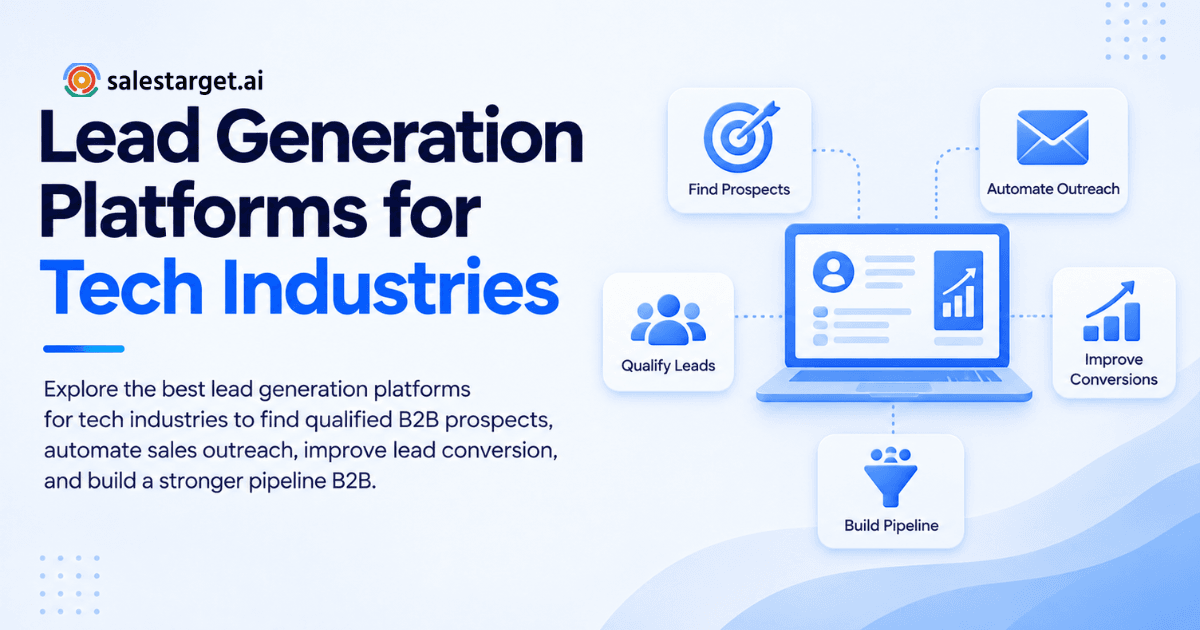
The best lead generation platforms for tech industries fix this by combining accurate B2B contact data, intent signals, multichannel outreach, and pipeline tracking in one connected system. The platforms reviewed below do exactly that. SalesTarget.ai leads because it brings prospecting, enrichment, email and LinkedIn outreach, email verification, and a built-in CRM into one workspace so nothing falls through the cracks between tools.
Best Lead Generation Platforms for Tech Industries
SalesTarget.ai
SalesTarget.ai is an all-in-one AI sales intelligence and outbound platform built specifically for B2B outbound teams. It covers the full cycle: find the right contacts in a database of 840M+ verified professional profiles, enrich and verify those contacts at the moment you find them, push them straight into multichannel sequences that run across email and LinkedIn, and close them in a built-in CRM without exporting a single CSV.
What sets it apart from most platforms is timing. Enrichment happens at the point of discovery, not days later when the data has drifted. Contacts are verified before they hit a sequence, not after a bounce damages your sender reputation. The AI Copilot lets reps search leads, write sequences, and query pipeline activity in plain English, cutting the time between "I need to prospect" and "sequence is live" from hours to minutes.
Explore SalesTarget.ai's Lead Explorer to see how this works in practice.
Apollo
Apollo combines a large B2B database with sequence automation and basic analytics. It covers a lot of ground, which is why it's a common starting point. The gap shows up when teams need stronger deliverability: Apollo does not include native email warm-up or intelligent inbox rotation, so reps typically bolt on Instantly or Smartlead to keep sender reputation healthy. CRM functionality exists but is lightweight, and many teams still run a separate CRM alongside it.
ZoomInfo
ZoomInfo is best known for data depth, particularly for enterprise accounts and intent data aggregated from its own publisher network. The trade-off is cost and complexity. Licensing is expensive, the platform requires onboarding investment, and smaller or mid-market tech teams often find they're paying for coverage they don't use. It's a strong fit for large enterprise GTM teams but can be overkill for fast-moving outbound operations.
Clay
Clay takes a different approach: it's a data enrichment and workflow automation tool that pulls from dozens of sources in a spreadsheet-style interface. Teams that love data flexibility and custom enrichment logic use it heavily. The trade-off is that Clay has no native outreach. It's a prospecting and enrichment layer that needs to connect to a separate email sequencing tool, a separate LinkedIn tool, and a separate CRM. For teams comfortable building and maintaining that stack, it's powerful. For teams that want less stitching, it adds complexity.
LinkedIn Sales Navigator
Sales Navigator is the go-to for account research and relationship mapping inside LinkedIn. Its filters for spotting job changes, company growth signals, and saved leads are genuinely useful for account-based prospecting. Where it falls short as a standalone lead generation platform: there's no contact email data, no outreach automation, and no pipeline management. It's a strong research and signal tool, but it needs other platforms around it to drive actual pipeline.
Instantly
Instantly is built for cold email at scale: inbox warming, rotation, and high-volume sending are its strengths. If deliverability and sending infrastructure are the only problems on your list, it solves them well. What it doesn't do: there's no native B2B database, no LinkedIn outreach, no lead enrichment, and no CRM. Teams using Instantly are still sourcing contacts elsewhere and managing replies and pipeline in other tools.
What Makes a Lead Generation Platform Effective for Tech Companies?
Accurate B2B Contact and Company Data
Data accuracy is where most lead generation efforts either hold up or fall apart. Tech companies deal with unusually high employee turnover, frequent role changes, and constant company restructuring. A contact verified six months ago may already be at a different company. Platforms that refresh their data regularly and verify at the point of enrichment, not at the time of initial scraping, give tech sales teams a meaningful accuracy advantage.
SalesTarget.ai indexes 840M+ profiles and 146M+ business entities across 50+ data sources, with verified professional emails, personal emails, phone, and mobile available on single-click enrichment.
Lead Enrichment and Contact Verification
Enrichment fills the gaps. A name and company from an inbound form becomes a complete prospect record with title, seniority, tech stack, company size, and verified contact details. Without enrichment, reps spend 20 to 30 minutes per account doing research that should take seconds.
Verification protects sender reputation. According to a Validity email deliverability benchmark report, bounce rates above 2% start to damage domain reputation with major mailbox providers. Platforms that verify before sending, not after bounces accumulate, keep campaigns out of spam folders and off blacklists.
Intent Signals for Identifying Active Buyers
Not every company that fits your ICP is in buying mode right now. Intent data surfaces the ones that are: companies actively researching topics tied to your category, hiring for roles that signal a buying cycle, or showing behavioral signals like funding rounds and tech stack changes. Targeting active buyers instead of cold accounts consistently produces higher reply rates and shorter sales cycles.
SalesTarget.ai surfaces real-time buying signals through 4,000+ intent topics via Bombora, plus business events like funding rounds, hiring spikes, leadership changes, and awards on a 30 to 90 day lookback window.
Email and LinkedIn Outreach Automation
Tech buyers get cold email constantly. A single channel rarely cuts through. Multichannel sequences that combine email with LinkedIn connection requests, DMs, and follow-ups create multiple touchpoints without hammering the same channel every time. The key is running both channels from a coordinated workflow so context carries across them, not two separate tools with no shared history.
CRM and Pipeline Management
Lead generation without pipeline tracking is just list building. A CRM that automatically logs every email sent, call made, and reply received gives sales leaders visibility into what's working and reps the context they need to follow up without manually updating records after every interaction.
How Lead Generation Platforms Support B2B Tech Sales
Finding Prospects That Match the Ideal Customer Profile
ICP-fit filtering at the search stage saves the hours that reps would otherwise spend manually disqualifying bad leads. Platforms that let teams stack filters on industry, company size, revenue, location, seniority, department, and tech stack return prospect lists that are already pre-qualified before a rep ever opens a record.
Building Targeted Prospect Lists
A targeted list built on clean data, then verified before sending, performs differently than a raw export of everyone who matches a job title. Tech sales teams targeting specific segments (SaaS companies at Series B, or manufacturing firms using a specific ERP) need filters precise enough to return lists that are actionable without needing a second round of manual cleanup.
Connecting Prospecting with Sales Outreach
The gap between "found a lead" and "in a sequence" is where most prospecting workflows lose momentum. Reps find leads in one tool, export a CSV, import it into a sequence tool, wait for enrichment to sync, verify separately, then launch. Every extra step is a place where leads go stale or fall out of the process.
SalesTarget.ai closes this gap by connecting Lead Explorer directly to Email Outreach and LinkedIn Outreach, so a rep can search, enrich, verify, and push a contact into an active sequence without leaving the platform.
If you're evaluating how different platforms handle this handoff, see this lead generation platform comparison for a side-by-side breakdown.
Tracking Leads From First Contact to Opportunity
Tracking matters beyond the first reply. Knowing which sequence generated a meeting, which accounts are stalling in the pipeline, and which reps are hitting follow-up tasks tells sales leaders where to focus coaching and where to adjust messaging. Platforms that connect outreach to pipeline in one system make that visibility automatic instead of a reporting project.
Key Benefits of Lead Generation Platforms for Technology Companies
Reduce Manual Prospecting Work
Manual prospecting is expensive in rep time. Research, list building, data cleanup, enrichment, verification, and sequence setup can consume the majority of an SDR's week before a single email goes out. A platform that automates or compresses these steps gives reps more time on actual conversations.
SalesTarget.ai's AI Copilot lets reps find leads, build sequences, and check pipeline in plain English. Reps spend time on decisions, not data entry.
Improve Lead Quality and Contact Accuracy
High-volume outreach to low-quality contacts is counterproductive. It burns sender reputation, wastes sequence capacity on dead contacts, and produces activity metrics that don't reflect real pipeline health. Better data in means better pipeline out.
Reach More Relevant Decision-Makers
Tech buying decisions typically involve multiple stakeholders: an IT leader, a business owner, a finance approver, and often a security reviewer. Lead generation platforms with deep people-level data make it possible to identify all the relevant contacts at a target account, not just the most obvious title.
Create a Consistent B2B Sales Pipeline
Pipeline consistency comes from process consistency. When prospecting, outreach, and CRM activity all happen inside one platform with standardized workflows, pipeline health is less dependent on individual rep habits and easier to replicate as the team grows.
Improve Sales Team Productivity
According to Salesforce's State of Sales report, sales reps spend less than 30% of their time actually selling. The rest goes to administrative tasks, data entry, and research. Platforms that compress the non-selling work directly improve the output from the same headcount.
How to Choose the Right Lead Generation Platform for a Tech Company
Choosing well here has more downstream impact than most teams expect. A poor choice means months of switching costs, data migration headaches, and reps reverting to their own ad-hoc workflows. For more on navigating this decision, this guide on how to choose the right lead generation platform for B2B sales teams covers the full evaluation framework.
Assess Database Size and Data Quality
Database size is a vanity metric if data accuracy is poor. Push vendors on their data freshness methodology: when was this contact last verified, how, and what's the bounce rate on contacts sourced from this database? Ask to test a sample against your known-good list before committing.
Compare Prospecting and Enrichment Capabilities
Can you filter by tech stack? Can you identify companies that just raised a Series B? Can you find the VP of Engineering at a 150-person SaaS company in Austin? Run your real ICP searches through a demo environment and see what comes back before evaluating demos on sample personas.
Review Email and LinkedIn Outreach Features
Check whether outreach is native to the platform or requires a third-party integration. Native multichannel sequences with shared contact context across email and LinkedIn perform better than two tools running in parallel with no shared history. Also check inbox warm-up, inbox rotation, and deliverability monitoring: these aren't optional extras for teams running any volume of cold email.
Check CRM and Workflow Capabilities
A CRM that requires manual data entry defeats the purpose. Look for automatic activity logging, auto-created follow-up tasks when leads reply or meetings end, and live pipeline visibility without requiring a full-time RevOps person to maintain the reports.
Compare Pricing and Total Sales Stack Costs
Don't price the platform in isolation. Price the full stack you'd need to run it effectively. A low-cost platform that requires four additional tools to function properly is rarely cheaper than a higher-priced all-in-one when you add up licensing, seat costs, and integration maintenance.
Lead Generation Platforms for SaaS and B2B Technology Companies
SaaS Prospecting and Account Targeting
SaaS prospecting has specific nuances. Target companies are often identified by tech stack (companies using a specific CRM or data warehouse), growth stage (Series A to C is a common sweet spot for many SaaS tools), or growth signals (rapid hiring in engineering or sales). Generic keyword searches don't surface this targeting precision. Platforms with tech stack filters and signal-based discovery do.
Finding Technology Decision-Makers
In technology companies, the buying decision for a new sales or marketing tool typically involves the CRO or VP Sales, RevOps, and sometimes IT or security depending on the contract size. Being able to identify all three stakeholder types at a target account at the prospecting stage, rather than discovering them mid-cycle, shortens sales cycles significantly.
Using Intent Data for High-Interest Accounts
Intent data is most valuable when it surfaces accounts that are in an active evaluation right now, not just those that broadly fit the ICP. Pairing high-fit accounts with high-intent signals creates a prioritized list of accounts where outreach timing is favorable, making every sequence more efficient.
Building Segmented Outbound Campaigns
Segmentation by vertical, company size, and tech stack produces meaningfully different messaging that converts better than one-size-fits-all sequences. Platforms that let you slice your prospect list by these dimensions and build separate sequences for each segment without rebuilding from scratch each time make segmentation a standard workflow rather than a special project.
Why Choose SalesTarget.ai
Find and Enrich Prospects With Lead Explorer
Lead Explorer is SalesTarget.ai's AI prospecting engine. Search in plain English or stack filters across industry, role, seniority, department, company size, revenue, location, tech stack, and intent topics. One-click enrichment unlocks verified professional email, personal email, phone, and mobile for each contact. Real-time intent signals and business events (funding rounds, hiring spikes, leadership changes) surface accounts in active buying cycles. Enrichment happens at the moment of discovery, so the contact data reps work with reflects current reality, not a stale scrape.
Combine Email and LinkedIn Outreach in One Workflow
SalesTarget.ai runs email and LinkedIn outreach from one coordinated platform. Email Outreach auto-builds multi-step sequences from a plain-English audience description, manages unlimited inboxes with automatic AI warm-up and intelligent rotation, and pulls every reply into a unified inbox sorted by intent. LinkedIn Outreach automates connection requests, DMs, and follow-ups with AI personalization that adapts to each profile, with built-in rate limits and safety logic to protect account health. Both channels run in one flow so context carries across them.
Verify Business Emails With Email Validator
Email Validator runs MX and SMTP checks, detects disposable addresses, and assigns risk scores before any contact hits a sequence. Reps can bulk-clean lists or verify contacts in real time via API. The result: fewer bounces, better inbox placement, and sender domains that stay off blacklists. SalesTarget.ai validates 90% of emails before sending, keeping campaigns out of spam and in inboxes.
Manage Leads in the Built-in CRM
The SalesTarget.ai CRM is built for outbound, not enterprise reporting requirements. Campaign leads land automatically with no imports. Every email, call, and reply logs to the lead timeline without rep input. Follow-up tasks are created automatically when a lead replies or a meeting ends. A built-in AI dialer captures call notes directly to the lead record so reps never write up call summaries manually. Teams using the CRM report 3.2X faster deal cycles and 91% follow-up completion. Setup takes less than a day.
Use AI Copilot for Sales Research and Prospecting
AI Copilot is a conversational sales assistant built directly into SalesTarget.ai. Reps chat to find leads, generate full personalized email sequences in seconds, check which campaigns are driving revenue, query deals and meetings in plain language, and create or assign tasks. It personalizes by role, industry, and company size, builds in A/B variations, and flags at-risk deals with a recommended next move. The strategy stays human. The manual work doesn't.
Common Mistakes Tech Companies Make When Choosing Lead Generation Platforms
Prioritizing Database Size Over Data Quality
A 900-million-record database means nothing if 30% of those records have bad emails. Tech sales teams get burned by this regularly: they choose the platform with the largest advertised database, launch sequences, and spend the first month managing bounces and spam complaints. Test data accuracy on your real ICP before you commit, not vendor-provided sample data on generic personas.
Using Too Many Disconnected Sales Tools
Five tools that half-work together produce worse results than two tools that work seamlessly. The hidden cost of a fragmented stack is context loss at every handoff: the signal that a prospect visited your pricing page doesn't make it into the sequence because the enrichment tool doesn't talk to the email tool in real time. Fewer, better-integrated tools consistently outperform larger stacks with weak integrations.
Ignoring Email Verification and Deliverability
Teams regularly skip email verification to save time at launch and pay for it over the following months as their domain reputation erodes. Once a domain lands on a blacklist, recovery takes weeks and the damage to open rates and reply rates affects every campaign, not just the one that caused the problem.
Focusing on Lead Volume Instead of Buyer Fit
Outbound that produces 500 conversations with poor-fit companies is less valuable than outbound that produces 50 conversations with buyers who match the ICP. Volume-focused thinking optimizes for activity metrics. Fit-focused thinking optimizes for pipeline. The distinction matters especially in tech, where sales cycles can be long and sales team bandwidth is limited.
Failing to Connect Lead Generation With Pipeline Results
If your lead generation platform can't tell you which sequences generated the meetings that became closed-won deals, you're optimizing blind. Connect prospecting activity to pipeline outcomes from the start. The teams that iterate fastest on outbound messaging are the ones with visibility into what's actually working downstream, not just open and reply rates.
Building a Lead Generation Workflow for Tech Sales Teams
Define the Ideal Customer Profile
Start with your closed-won data, not your intuition. Which company sizes, verticals, tech stacks, and roles appear most in your successful deals? Which buyer titles were involved in the final decision? ICP clarity at this stage determines the quality of every list you build afterward.
Identify Target Companies and Decision-Makers
With a clear ICP, use signal-based targeting to prioritize accounts showing active buying behavior: funding events, headcount growth in relevant departments, and intent topics matching your category. Then find the full stakeholder map at each account, not just the most obvious contact.
Enrich and Verify Prospect Information
Never push unverified contacts into a sequence. Enrich to fill gaps in job title, seniority, and contact data. Verify emails before they go into any sending tool. This step is where teams using SalesTarget.ai save the most time: enrichment and verification happen in the same click inside Lead Explorer.
Launch Personalized Email and LinkedIn Campaigns
Segmented by vertical, company size, or ICP tier, build sequences that speak to the specific context of each group. Use AI-generated personalization to vary messaging at scale without copying the same template to every contact. Coordinate email and LinkedIn so prospects see consistent, complementary outreach rather than repetitive identical messages on both channels.
Track Responses, Meetings, and Pipeline Activity
Monitor reply intent, not just reply rates. A high reply rate full of "not interested" responses tells a different story than a lower reply rate with a high percentage of interested or follow-up replies. Connect meetings booked back to the sequence that generated them. Track pipeline velocity from first touch to closed deal.
Choosing the Right Lead Generation Platform for Your Tech Sales Team
Most tech sales teams don't have a lead shortage. They have a data quality problem, a fragmentation problem, or both. Reps are prospecting in one tool, enriching in another, sequencing in a third, managing LinkedIn manually, and trying to track everything in a CRM that no one keeps updated. The result is pipeline that's hard to forecast and results that are hard to attribute.
SalesTarget.ai is built to close that gap. Find verified prospects with real-time intent signals in Lead Explorer. Enrich and verify in the same click. Push contacts into coordinated email and LinkedIn sequences without leaving the platform. Track every reply, call, and meeting automatically in a CRM that reps actually use because it doesn't require manual data entry. Run the whole operation from one workspace on one bill.
If your current stack is producing inconsistent pipeline or your reps are spending more time managing tools than talking to buyers, try SalesTarget.ai and see how much of that friction disappears when everything runs from one place.