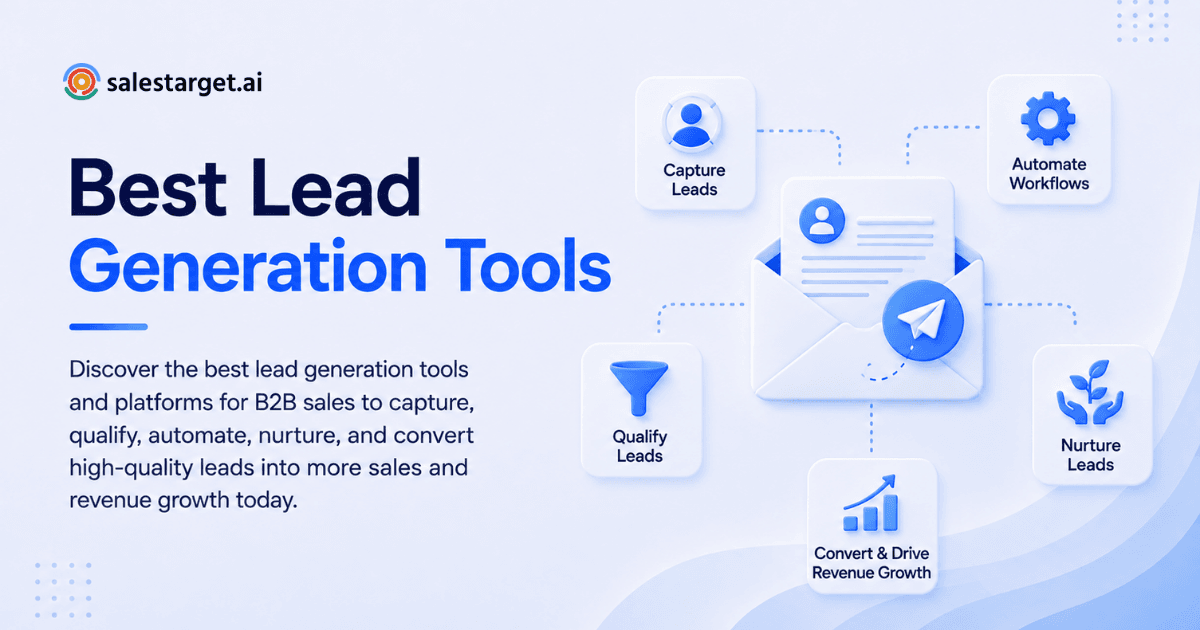
If you run outbound, own a quota, or sit in RevOps, you already know the real problem isn't traffic. It's that leads get captured in one system, qualified nowhere, and handed to sales three days too late. The right lead generation tools don't just pull in more names, they connect capture, qualification, and follow-up into one fast, traceable path.
This guide walks through the tool categories that actually move the pipeline, how they fit together, and how to pick a stack that matches your size and motion, whether that's founder-led outbound or a 10-person SDR team.
What Lead Generation Tools Actually Cover (and Why Stacks Fail)
"Lead generation tools" is a catch-all for very different jobs: capture (forms, pop-ups), conversion (landing pages), engagement (chatbots), scheduling, outreach automation, nurture, enrichment, scoring, and routing. Most lead generation platforms only own one or two of these.
Stacks break down in predictable ways:
- Leads get captured but never qualified.
- Leads get qualified but sit for days before anyone follows up.
- Leads get routed, but the rep has zero context on why they converted.
- Teams track raw lead volume instead of sales-accepted leads.
A stack that works is built on two things: fewer tools with tighter integrations, and a clear, written definition of what "qualified" means for your business. Everything else is downstream of those two decisions.
Start With Your Lead Flow, Not the Tool List
Before comparing lead generation software, map the path a visitor actually takes: offer, capture, enrichment, scoring, routing, follow-up. Buying tools in the wrong order is how teams end up with five point solutions that don't talk to each other.
What Is a Lead Magnet?
A lead magnet is a specific, high-value asset or offer a visitor trades their contact information for because it solves an immediate problem. Strong examples include ROI calculators, benchmark reports, comparison guides, and short interactive assessments. Match the offer to the funnel stage: checklists and benchmarks at the top, webinars and case studies in the middle, ROI tools and audits at the bottom.
Best Software for Capturing Leads
Capture is where most of the low-hanging fruit lives, a 0.5-point lift in form conversion often beats months of additional SEO work. Look for fast, mobile-first forms, progressive profiling, built-in routing rules, and native integrations or solid webhooks over yet another manual export.
Pop-Up Forms That Convert Without Annoying Visitors
Pop-ups work when they're timed and specific:
- Trigger on exit-intent on desktop, not on page load.
- Delay until the visitor has scrolled or spent real time on the page.
- Offer an actual quick win ("Get the ROI calculator"), not "subscribe to our newsletter."
- Cap frequency so returning visitors aren't hit every session.
Test two or three capture tools on one high-traffic page and compare view-to-submit rate, sales-accepted lead rate, and time to first response, not just raw submissions.
Landing Page Builders That Actually Convert
A dedicated landing page builder lets campaigns move without waiting on developer time, which matters because conversion benchmarks vary wildly by execution. First Page Sage's 2026 B2B analysis puts the median landing page conversion rate around 2.9% to 3.6%, with top performers pulling well ahead through tighter message matches and shorter forms, so the gap between average and good is mostly a build-and-test problem, not a budget problem.
A layout that consistently converts follows a simple pattern: an outcome-led headline, three bullets on who the offer is for, one strong proof point, a single primary call to action, and an FAQ section that handles objections around security, pricing, and time commitment.
Chatbots and Scheduling: Removing Friction After the Click
A chatbot earns its place on pricing and high-intent ad-landing pages, where visitors have specific questions a static form can't answer. A good flow asks for work email, role, primary problem, and timeline, then routes immediately when intent is high ("need a quote," "looking to switch").
Once someone is qualified, speed matters more than almost anything else in the funnel. Research cited by Kixie found that responding within 60 seconds can lift conversion by up to 391%, and Harvard Business Review has reported that the odds of qualifying a lead drop by roughly 80% after the first five minutes. Appointment scheduling tools close that gap by showing available times the moment someone qualifies, via form, bot, or SDR call, rather than starting an email back-and-forth.
Email and Multichannel Outreach Automation
For outbound, an email outreach automation tool needs to support personalization, deliverability, and team-wide visibility, not just send volume. Look for sequence branching on opens/clicks/replies, personalization variables, domain health controls, and automatic stop-on-reply so no one double-emails a prospect.
Deliverability discipline still decides most outcomes. Instantly's 2026 cold email benchmark report puts the average B2B reply rate at 3.43%, with top-quartile senders clearing 10%, the difference usually comes down to list quality and follow-up cadence, not clever copy. Coordinating email with LinkedIn outreach compounds that further: one analysis of B2B outbound campaigns found that pairing email and LinkedIn touches at the same volume lifted reply rates 30-50% over email alone.
If you want the fuller breakdown of sourcing and sequencing tools for outbound-led pipelines, see this guide to active prospecting tools for lead generation.
Marketing Automation and Lifecycle Nurturing
Marketing automation tools carry the leads who aren't sales-ready today. At minimum, they should support lifecycle stages (subscriber, lead, MQL, SQL), behavior-triggered sends, persona-based segmentation, and clean CRM integration for marketing so sales sees the same record marketing does.
The plays that actually drive pipeline are simple: a second pricing-page visit triggers a case study and demo invite; an ROI calculator download triggers a short nurture series ending in a scheduling link; a webinar attendee gets a follow-up tied to what they watched, not a generic newsletter.
Lead Management Software: Where Leads Go to Live or Die
Capture and nurture don't matter if leads stall once they land. Lead management software needs to handle deduplication, clear ownership, routing rules, and SLA tracking for speed-to-lead. Warning signs it's broken: nobody can say who owns a lead, multiple reps contact the same person, leads sit untouched for days, and marketing and sales report different numbers from the same funnel.
A CRM built for outbound teams closes most of these gaps by logging every call and email to a shared timeline and auto-creating follow-up tasks, so context survives the handoff between marketing, SDRs, and closers.
Lead Scoring and Enrichment: Turning Contacts Into Context
Good lead scoring tools combine two signals: fit (industry, company size, title, region) and intent (pricing visits, demo requests, repeat visits, email engagement). A simple model might add 20 points for a pricing-page visit, 15 for a demo request, 8 for an ICP-matched company size, and subtract 10 for a competitor or student domain, then route anything above 40 to sales immediately.
Lead enrichment tools make that scoring possible by filling in company size, tech stack, seniority, and location before a rep ever picks up the phone. Lead Explorer handles this at the sourcing stage, while a lead and email validator confirms deliverability before a contact ever enters a sequence, catching bounces and disposable addresses that would otherwise tank sender reputation. For a deeper look at where enrichment providers fit into an SDR or BDR workflow, see this comparison of B2B contact data providers for SDR and BDR teams.
Choosing Sales Lead Tools and Prospecting Databases
Before committing to any prospecting database, check coverage in your specific niche, data accuracy and refresh rate, compliance posture across regions, and match rate into your CRM. Teams selling into life sciences, biopharma, biotech, CROs, CDMOs, face an added wrinkle: generic databases often miss subsidiary structures, therapeutic-area focus, and site-level decision-makers, so role taxonomy and hierarchy mapping matter more than raw record count. If outbound is a growth lever for your team, this guide to B2B prospecting tools and reverse prospecting is worth a closer read.
If you're weighing an all-in-one platform against a modular stack, compare on form and automation flexibility, funnel and attribution reporting, sales handoff features, and total cost at your actual contact volume, not just sticker price.
Best Lead Generation Tools and Platforms
Choosing the right lead generation platform depends on your sales goals, target market, and workflow. The following tools cover key areas such as B2B prospecting, contact data, lead enrichment, CRM, and sales outreach.
-
SalesTarget.ai
SalesTarget.ai is a B2B lead generation and sales prospecting platform designed to help teams find relevant prospects, build targeted lead lists, and streamline outreach. It can be useful for sales teams looking to combine prospecting and lead-generation activities in a more connected workflow.
-
Apollo.io
Apollo.io combines B2B contact and company data with prospecting and sales engagement features. Teams can use it to discover prospects, build targeted lists, and manage outbound sales activities.
-
HubSpot
HubSpot provides CRM, lead capture, marketing automation, and sales tools in one platform. It is particularly useful for teams that want to manage inbound leads, nurture prospects, and track their customer journey.
-
ZoomInfo
ZoomInfo focuses on B2B business intelligence, contact data, company information, and buying signals. Sales teams can use it to identify potential accounts and gather information for targeted prospecting.
-
Clay
Clay is designed for prospect research, data enrichment, and automated lead-generation workflows. It can help teams combine information from different sources and create more detailed prospect profiles.
-
Instantly.ai
Instantly.ai focuses on cold email outreach and sales engagement. It can help teams create email campaigns, manage follow-ups, and scale outbound prospecting while monitoring campaign performance.
-
Lemlist
Lemlist is an outreach platform focused on personalized email and multichannel sales campaigns. It can help sales teams create personalized sequences and manage follow-ups across different outreach channels.
How to Choose the Right Lead Generation Tool
The best tool depends on the bottleneck in your lead-generation process. If you need prospecting and targeted B2B data, consider a prospecting or data platform. If your priority is inbound lead management, CRM and marketing automation may be more important. For outbound teams, prioritize accurate data, personalization, deliverability, automation, and CRM integration.
Before choosing a platform, compare data quality, integrations, automation capabilities, pricing, scalability, and how well the tool fits your existing sales workflow.
Why Choose SalesTarget.ai for Lead Generation
Most teams end up stitching together a data provider, an email tool, a LinkedIn automation app, and a separate CRM, then losing context every time a lead moves between them. SalesTarget.ai keeps the entire path in one workspace: find a lead, enrich and verify it in the same click, push it into a coordinated email and LinkedIn sequence, and manage the deal in a built-in CRM.
Lead Explorer draws on 840M+ verified professional profiles, 146M+ business entities, and 4,000+ intent signals across 50+ data sources, with 99% verified contact data on enrichment. On the outreach side, teams see 35% faster campaign creation and 90% of emails validated before send, directly addressing the deliverability gap described above. Once a reply comes in, the CRM logs it automatically: customers see 3.2X faster deal cycles, 91% follow-up completion, roughly six hours saved per rep per week, and 2.4X more meetings from the same lead volume.
The AI Copilot sits on top of all of it as a free conversational layer, ask it to find a segment of leads, draft a sequence, or pull campaign performance in plain language, without switching tools to get an answer. For teams trying to consolidate a five-tool stack into something a single rep can actually run, that combination is the practical case for SalesTarget.ai over stitching together point solutions.
How to Qualify Inbound Leads Without Killing Conversion
Qualifying leads well means balancing signals against friction. A practical sequence:
- Ask less upfront. Start with a work email, name, and one qualifying field, company size or use case is usually enough.
- Enrich and infer the rest. Fill in industry, seniority, and tech stack after capture instead of asking for it on the form.
- Qualify with behavior. Weight pricing visits, product-page depth, and demo requests more heavily than a single form fill.
- Route by fit and intent together. High fit and high intent go to sales now; high fit with low intent goes to nurture with a light SDR touch; low fit with high intent gets triaged, it may be a partner, student, or competitor.
Building Your Stack: Four Blueprints by Maturity
- Starter inbound: forms, landing pages, basic email automation, a CRM, and scheduling, enough to prove messaging and ICP.
- Growth inbound: adds A/B-tested forms, a dedicated landing page builder, a chatbot on high-intent pages, and enrichment for routing and personalization.
- Outbound and account targeting: a prospecting database, an outreach automation tool, verification, and lead management software built for routing at volume.
- Full-funnel revenue system: multi-channel capture, advanced scoring, intent data, SLA-driven routing, and lifecycle attribution reporting across every channel.
Pick based on your actual bottleneck. Traffic without conversion means fixing capture and landing pages first. Leads without sales efficiency means fixing qualification and routing. Needing pipeline now means adding outbound and better sales lead tools.
Tool Selection Checklist
Before signing a contract for any lead generation software, confirm the basics that are easy to skip in a demo:
Integration and data
- Does it push UTM/source data and a single deduplicated lead record into your CRM?
- Does enrichment happen automatically, or does someone have to trigger it manually?
Conversion and UX
- Can you run A/B tests, or clone pages fast enough to test informally?
- Are forms multi-step with conditional logic, and genuinely fast on mobile?
Automation and operations
- Are routing rules and SLA alerts configurable without engineering help?
- Can sequences trigger off behavior, not just a form submission?
Security and governance
- Does it support SSO, audit logs, and role-based permissions if you're selling into enterprise or regulated buyers?
A tool that scores well on capture but fails on routing and SLA tracking will still leak pipeline, test the full handoff, not just the intake form, before you commit.
Bringing It Together
The best B2B lead generation tools aren't the ones with the biggest brand names, they're the ones that keep a single lead moving from capture to close without losing context at every handoff. Start with your bottleneck, keep the stack as tight as your process allows, and measure sales-accepted leads rather than raw volume.
If you'd rather run capture, enrichment, outreach, and CRM from one workspace instead of stitching five tools together, you can start free with SalesTarget.ai and see the workflow end to end.