You built the list. You wrote the sequence. Your SDR hit send on 400 contacts. Two days later: a 19% bounce rate, a warning flag from Google Workspace, and a sending domain that is starting to look suspicious to inbox providers. The prospect names were real. The email addresses were not.
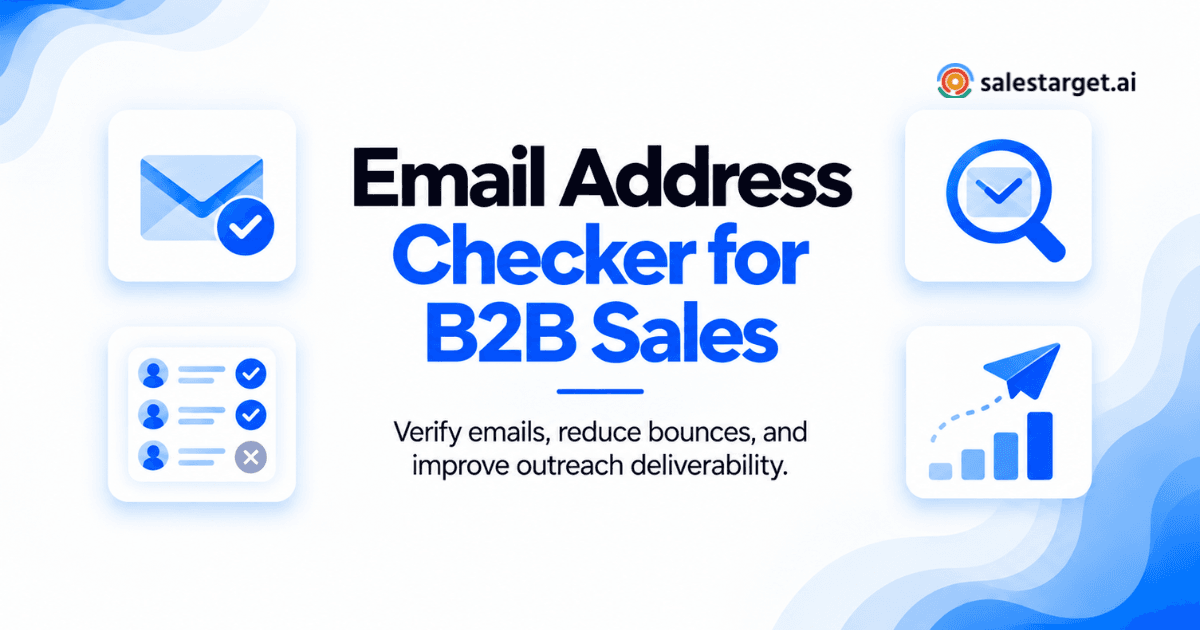
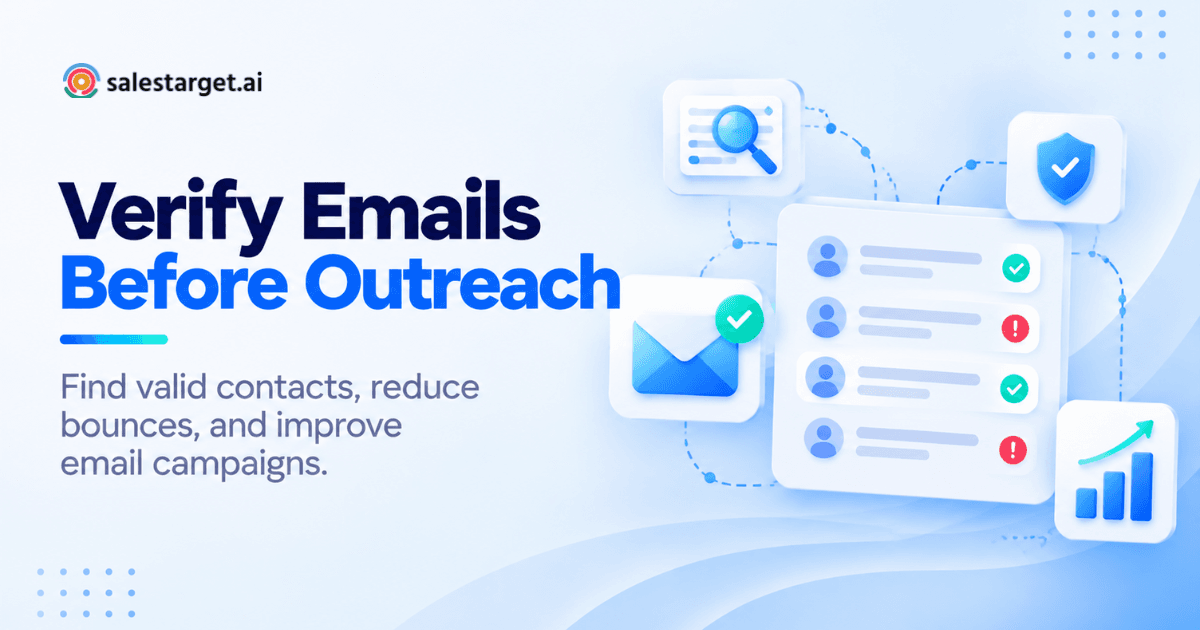
An email address checker tool confirms whether an email address exists, is active, and can receive mail before you send anything. It checks address formatting, DNS records, mail server configuration, and the specific mailbox itself. The result is clean data, lower bounce rates, and campaigns that reach the inbox instead of the void. For B2B sales teams running outbound at any real volume, this is not optional. It is the floor.
What Is an Email Address Checker and How Does It Work?
An email address checker is a tool that runs a series of technical validations on an email address to confirm it is real and deliverable. It does not send a test email. It queries the domain's mail server infrastructure silently and returns a status: valid, invalid, risky, disposable, or catch-all.
The check takes seconds per address. Batch tools handle thousands at once. The output gives sales reps and ops managers enough signal to decide which contacts enter a sequence and which ones get removed before they do any damage.
How Email Address Checker Tools Validate Email Accuracy Before Outreach
Validation happens in three stages. First, the tool parses the address syntax. Then it queries the domain's DNS records to confirm the domain exists and has mail exchange records. Finally, it initiates a server-level handshake with the receiving mail server to check whether the specific inbox is active.
Where most articles stop, the real complexity starts: catch-all domains that accept every address regardless of whether the inbox exists, mail servers that rate-limit or block verification attempts, and role-based addresses like admin@ or hello@ that pass every technical check but will never convert into a meeting. A strong email verification tool surfaces these distinctions. A basic one does not, and you find out the difference when your bounce report comes in.
Key Checks Performed by an Email Verifier: Syntax, Domain, MX Record, and SMTP Verification
A complete email verifier runs four layers of checks:
- Syntax check: Validates that the address follows correct formatting rules. Catches typos, missing "@" characters, invalid special characters.
- Domain check: Confirms the domain exists and is active on the public internet.
- MX record check: Verifies the domain has Mail Exchange records configured, meaning it is set up to receive email at all.
- SMTP verification: Connects to the mail server and attempts a mailbox-level handshake to confirm the inbox exists, without delivering an actual message.
Beyond these four, a quality email verification service also flags disposable email providers, identifies spam traps, scores overall risk, and separates catch-all responses from confirmed valid addresses. These additional signals are what separate an email accuracy checker that actually protects your deliverability from one that just filters out obvious typos.
Why Email Address Verification Matters for B2B Sales Outreach
Reduce Email Bounce Rates with Accurate Contact Data
A hard bounce rate above 2% is enough for major inbox providers to start throttling or blacklisting your sending domain. According to HubSpot's marketing data benchmarks, B2B contact data decays at roughly 22% per year, which means any list that has not been re-verified in 12 months is carrying a significant load of dead addresses. Running email address verification before each campaign is the most direct way to stay below the 2% threshold.
Protect Sender Reputation with Email List Cleaning Tools
Inbox providers score every sending domain continuously. Once that score drops, recovery takes weeks. Email list cleaning tools remove invalid, risky, and disposable addresses before they reach your sending queue. For teams running outbound at volume across multiple inboxes, this is what keeps deliverability stable over time rather than spiking and crashing campaign by campaign.
Improve Cold Email Deliverability with Verified Business Contacts
Inbox placement is the ceiling for every other metric in a cold email campaign. A message that never lands in the inbox produces zero opens, zero replies, and zero meetings, regardless of how good the copy is. B2B email verification raises that ceiling by confirming each address is real and active before it enters any sequence.
How Inaccurate Emails Impact Sales Pipeline and Outreach Performance
Here is the point most email verification content skips entirely: bad email data does not just hurt deliverability. It corrupts your pipeline math.
When a rep sends 300 emails and 50 bounce silently (soft bounces do not always surface cleanly in reporting), the open and reply rate data are now calculated against 250 actual deliveries, not 300. Your sequence looks worse than it is. Or worse, it looks average when it is actually performing well on real contacts. Teams make sequencing and copy decisions based on metrics that have a flawed denominator. Verified contact data gives you an accurate denominator, which is what honest pipeline measurement depends on.
How to Check If an Email Address Is Valid Before Sending Emails
Verify Email Address Syntax and Domain Details
Start at the most basic layer: confirm the address format is correct and the domain is live. This catches the low-hanging errors before anything else runs. The SalesTarget.ai Email Verifier handles this automatically at the point of lead enrichment, so reps are not doing a separate verification step after the fact.
Detect Invalid, Disposable, and Risky Email Addresses
Disposable email addresses inflate list size with contacts that will never convert. They are created in seconds, used once, and often expire. Any email checker tool worth using maintains an updated list of disposable email providers and flags them before they enter a sequence.
Identify Catch-All Emails and Improve Prospect Data Validation
Catch-all domains are configured to accept all incoming mail at the server level, regardless of whether a specific mailbox exists. A standard SMTP check returns "valid" even when the inbox does not exist. This is a known gap in basic verifiers.
Good email validation software scores catch-all addresses separately, giving sales teams a clear signal: these contacts are worth a lower-priority send or should be removed from primary campaigns. Free tools typically return "valid" and move on.
Use Email Verification Software for Bulk Email Checking
For real outbound campaigns, single-address lookup is too slow. Bulk email verification processes thousands of records in one run, returns a clean file with verification statuses, and in better tools, connects directly to your CRM or outreach platform via API so verified contacts flow into sequences without a CSV round-trip.
Key Features to Look for in an Email Address Checker Tool
Email Validation Software with SMTP Verification and MX Record Checks
Any tool worth paying for runs SMTP verification and MX record checks as a baseline. These two checks confirm whether a specific mailbox exists on an active mail server. Without both, you are working from assumptions rather than confirmed data.
Bulk Email Verification for Large Prospect Lists
At campaign scale, speed and integration matter as much as accuracy. Look for bulk email verification that handles 10,000+ records per run, integrates with your outreach stack via native connection or API, and returns enough detail beyond valid/invalid to make real segmentation decisions.
Email Quality Checker Features for Better Sales Prospecting Accuracy
A strong email quality checker returns risk scores, role-based address flags, domain age signals, and confidence ratings per contact. This gives ops teams and SDRs enough information to segment their lists rather than treating every "valid" address the same.
Contact Data Verification and B2B Database Hygiene Capabilities
Email verification alone is not enough for a clean B2B database. A person changes jobs, and their old work email stays "technically valid" for months while bouncing. Contact data verification that pairs email checks with professional profile signals, like job change detection, keeps your database more accurate over time rather than just accurate at import.
How Email Address Checker Tools Improve B2B Sales Results
Build Cleaner Prospect Lists for Outbound Campaigns
Verified lists mean your sequences start with real addresses from email one. That translates into higher open rates, better reply rates, and less time chasing contacts that cannot receive your message.
Improve Email Deliverability and Inbox Placement
Deliverability is a function of sender reputation plus message quality. Verification handles the reputation side by keeping bounce rates low and removing spam traps before they register against your domain score.
Reduce Wasted Outreach Efforts on Invalid Contacts
An SDR sending 60 emails per day to a list with 15% invalid addresses is working a shorter effective day without realizing it. Email verification software gives reps back their full capacity by confirming every contact before the sequence runs.
Maintain a Reliable B2B Contact Database for Sales Teams
A one-time verification at import is not a strategy. Data decays constantly. Teams that build re-verification into a recurring schedule, monthly or quarterly for active lists, maintain significantly stronger data quality than teams that verify once and assume the data stays clean.
Why Choose SalesTarget.ai
Find and Verify Prospect Data with Lead Explorer
SalesTarget.ai's Lead Explorer provides access to 840M+ professional profiles and 146M+ business entities, with verification built into the enrichment step. When a rep unlocks a contact, the email address is checked and scored in the same action. No separate upload to a third-party verifier. No delay between finding a lead and knowing the address is clean and safe to contact.
Combine Verified Contacts with Email and LinkedIn Outreach Workflows
From Lead Explorer, verified contacts push directly into Email Outreach or LinkedIn Outreach sequences. No CSV export. No reimport. The contact is verified, enriched, and sequenced in one connected flow. That eliminates one of the most common points of friction in outbound ops: the gap between identifying a lead and actually reaching them.
If you want to see this in action, request a free demo to walk through a live prospecting workflow.
Improve Deliverability with Email Validator Checks
SalesTarget.ai's Email Validator runs MX record checks, SMTP verification, disposable email detection, and risk scoring across contacts. The platform validates 90% of emails before sending across active campaigns, and the validator connects to 60+ external platforms including CRMs, ESPs, and website builders. For a broader look at how email checker services compare, the best email checker services guide breaks down what to look for across tools.
Manage Follow-Ups and Deals in a Built-in CRM
SalesTarget.ai's CRM logs every email, call, and reply to the lead timeline automatically. Follow-up tasks are created when a lead responds or a meeting ends, so nothing falls through. Platform data shows 91% follow-up completion rates and deal cycles that close 3.2x faster for teams using the built-in CRM alongside outreach, compared to teams managing pipeline in a separate tool.
Use AI Copilot for Prospect Research and Sales Workflows
AI Copilot handles prospect research, email sequence generation, deal risk flagging, and pipeline queries in plain language. It is included inside the platform, not a separate subscription. Strategy stays human. Admin does not.
Common Email Verification Mistakes Sales Teams Should Avoid
Sending Campaigns Without Checking Email Accuracy
Sending to an unverified list is the most common and most expensive mistake in outbound. A single campaign to a dirty list can cause deliverability damage that takes weeks to repair. Verification before sending is the baseline, not a best practice.
Relying Only on Free Email Checker Tools for B2B Outreach
Free tools typically skip SMTP verification or run incomplete checks. For one-off lookups, they work fine. For a 5,000-contact outbound campaign, they pass risky addresses through and give you false confidence in your list quality before launch.
Ignoring Risky Emails, Spam Traps, and Disposable Addresses
"Valid" does not mean "safe." Spam traps are technically valid email addresses. Disposable addresses pass format checks. Role-based inboxes exist on the server. None of them belong in a cold email sequence. Any email accuracy checker that returns only valid or invalid is not giving your team enough signal to make good decisions.
Failing to Maintain Clean Email Lists Over Time
A list that is 95% valid at import is, statistically, somewhere around 73% valid a year later if left untouched. According to Salesforce's State of Sales research, data quality is consistently cited as a top barrier to sales productivity. Building re-verification into a regular cadence, not just at onboarding, is what keeps deliverability consistent over time.
Email Address Checker vs Email Validator: What Is the Difference?
| Feature | Email Address Checker | Email Validator |
|---|---|---|
| Primary function | Checks if a specific address is real and active | Scores address quality, risk, and deliverability fitness |
| Typical use case | One-off lookups during prospecting | Bulk list cleaning before campaign launch |
| Depth of checks | Syntax and basic domain check | Syntax, domain, MX, SMTP, disposable detection, risk scoring |
| Output format | Valid / Invalid | Valid, Invalid, Risky, Catch-All, Disposable, Role-Based |
| Integration depth | Often standalone | Connects to CRMs, ESPs, and outreach platforms |
| B2B sales fit | Useful for individual contact research | Built for campaign-level quality control |
How Email Checker Tools Compare with Email Validation Platforms
A basic email checker tool answers one question: is this address correctly formatted and does the domain exist? An email validation platform answers a different question: should I send to this address, and what is the likelihood it reaches the inbox without hurting my sender score? The second question is the one that matters for outbound sales.
Which Option Works Better for Sales and Marketing Teams?
For active outbound campaigns, a validation platform with risk scoring, catch-all detection, and bulk processing is the right fit. For quick one-off lookups while prospecting, a fast checker does the job. The strongest outbound setups use both: a checker embedded at the point of contact discovery and a validator running across the full list before any campaign launches.
When to Use an Email Verification Service for Outreach Campaigns
Use a dedicated email verification service when launching a new campaign against more than a few hundred contacts, when a list has not been re-verified in 90 days or more, or when onboarding contacts from a third-party data source. These are the three highest-risk moments for deliverability, and upfront verification is far less costly than recovering from a blacklisted domain.
Conclusion: Choose the Right Email Address Checker for Better B2B Outreach
Bad email data is a tax on every outbound campaign you run. It shows up as rep time wasted, bounce rates that trigger warnings, sender reputation that erodes quietly, and pipeline metrics built on a flawed denominator.
The right email verification tool eliminates that tax before it starts. It does not just flag invalid addresses. It gives your team clean, risk-scored contact data before a single message goes out, and it keeps that data accurate over time rather than letting it decay in silence.
SalesTarget.ai builds verification directly into the point of lead discovery. From the first search in Lead Explorer to a live email sequence, every contact that enters your pipeline has already been verified, enriched, and pushed into an outreach workflow with no extra steps. That is what an all-in-one outbound platform should do.
Stop stitching a verifier, a data provider, and an outreach tool together on three separate bills. Start with SalesTarget.ai and run your next campaign on contact data you can actually trust.