Your lead list is huge, yet many of your emails bounce. Your sales reps spend valuable time copying social profiles into a spreadsheet by hand. Your account executives have no idea that a prospect opened your message multiple times, because that data is stuck in a separate tool. Reply rates drop, and your CRM still says that the contact was never reached.
This is not a talent problem. It is a software problem. Most outbound teams use a separate app to find leads, another to send emails, another for social messages, another to check if an inbox works, and a CRM that only updates when someone types notes manually. These apps do not talk to each other, so your reps waste time moving data back and forth.
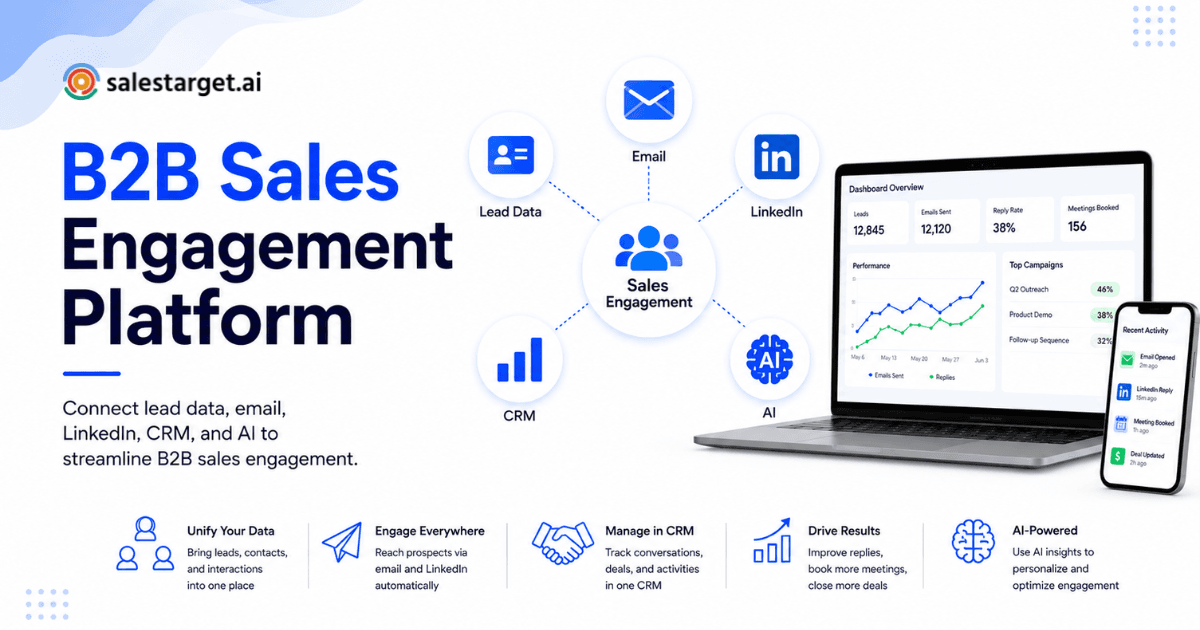
The best B2B sales engagement platform combines lead data, email and LinkedIn outreach, email verification, and CRM tracking in a unified workspace. Reps work from a single source of truth instead of jumping between disconnected apps. Salestarget.ai brings everything together so you can find verified prospects, reach them across channels, and track deals until they close, all in a single place on a single bill.
What Is a B2B Sales Engagement Platform and How Does It Work?
A B2B sales engagement platform is software that helps revenue teams find prospects, contact them across email and LinkedIn, and track every conversation in a single system. It replaces the messy collection of separate tools that teams often stitch together for prospecting, outreach, and pipeline tracking.
Real engagement is not about sending more messages. It means acting on helpful signals, such as when a prospect opens an email, clicks a link, changes jobs, or announces new funding. A great platform connects who you target, how you reach them, and what happens after they reply.
The Best B2B Sales Engagement Platform Connects the Full Sales Workflow
Why fragmented sales tools slow down outbound teams
A standard sales process often feels broken. Reps download a list of leads, save it as a file, upload it into an email tool, run it through another verification tool, look up names on LinkedIn by hand, and copy replies into a CRM. Every handoff creates a chance for data to get lost or become outdated.
Recent industry research reveals that many sellers feel added software tools have not improved their daily output. The problem is not the sellers. The problem is the painful gap between disconnected apps.
What modern sales teams need from a unified engagement platform
Teams that run active outreach need key capabilities working together smoothly. They need accurate contact data, simple ways to reach prospects on multiple channels, tools to make sure emails land in the inbox, and clear records of every interaction. Splitting these tasks across separate vendors turns sales into a constant technical headache.
The core difference between point tools and connected sales workflows
A point tool only handles a single job well. Some platforms provide contact data, but they lack inbox safety tools or a built-in CRM. Other platforms are great for sending cold emails, but they lack contact databases, social outreach steps, or deal tracking. On Salestarget.ai, a lead found in Lead Explorer is enriched and verified right away. You can then launch email and LinkedIn steps without saving or moving files. This helpful guide on what actually replaces a fragmented sales stack explains these key differences.
How a B2B Sales Engagement Platform Works?
A B2B sales engagement platform guides prospects through a smooth journey. It helps you discover verified contacts, start conversations across email and LinkedIn, send automated follow-ups based on real behavior, and log all activity into a shared CRM.
Prospect discovery and contact enrichment
Discovery lets you filter people by role, company size, industry, technology, and buying signals like leadership changes. Enrichment provides verified business emails and phone numbers for those contacts. A frequent mistake is splitting discovery and enrichment across different days, which causes contact details to go stale before you even reach out.
Email and LinkedIn outreach in a unified workflow
Once you verify a contact, outreach should begin from the exact same screen. A connected platform allows reps to build combined email and LinkedIn campaigns that share the same context, so your message stays consistent across every channel.
Automated follow-ups and prospect engagement
Smart follow-ups trigger based on what a prospect actually does. They send when someone opens an email but does not reply, or when a prospect accepts a connection request. Rigid schedules send robotic messages that ignore prospect actions. Recent sales studies show that sending messages in the early afternoon in the recipient local time zone creates the strongest reply rates.
CRM activity tracking and pipeline updates
Every email, call, and response should log to your CRM automatically. When reps have to enter data by hand, records quickly become incomplete. With Salestarget.ai, campaign leads land directly in the CRM without manual entry, and every touchpoint appears on the lead timeline instantly.
AI support across prospecting and sales execution
Artificial intelligence assists at every step of the journey. It spots accounts that show interest, drafts personal introductory messages, summarizes phone calls, and flags deals that need attention. Real AI features work directly inside your daily screen instead of forcing you to copy text between different tools.
Why Sales Engagement Platforms Matter for B2B Revenue Teams?
Sales engagement platforms save reps from hours of tedious research and app switching. They keep customer data accurate and give leaders a clear view of what drives revenue instead of relying on messy spreadsheets.
Reduce manual work across prospecting and outreach
Manual list building and research consume a huge part of a seller week. Surfacing verified leads inside the same system that sends your messages removes tedious file exports. Teams using Email Outreach build and launch campaigns much faster without extra effort.
Keep prospect data and engagement activity connected
When prospect data lives in a separate tool from sales activity, nobody sees the full picture. A rep might message someone who asked to be removed during an earlier campaign. Having a single shared history prevents embarrassing mistakes and keeps outreach polite.
Give sales leaders better visibility into outbound performance
Sales leaders need to know which messages, channels, and reps generate real meetings. A shared dashboard provides quick insights without manual calculations. Modern revenue leaders often explore the best revenue intelligence platforms to turn this conversation data into clear forecasts and pipeline insights.
Help SDRs, AEs, and RevOps teams work from the same system
Sales handoffs break down when prospecting tools do not sync with the main CRM. When your pipeline is unified, an account executive can view a qualified lead right away, complete with the entire conversation history from the prospecting stage.
Core Features to Look for in B2B Sales Engagement Software
Verified B2B lead data and enrichment
Choose a platform with an extensive database that verifies contact info the moment you request it. Salestarget.ai Lead Explorer draws on a massive database of verified professional profiles and business records across many trusted sources, checking each email at the moment you unlock the record.
Email outreach automation and sequence management
Your campaign builder should create multi-step email journeys with ease. Features like automated inbox warm-up and account rotation protect your sender reputation so your messages land in the inbox instead of the spam folder.
LinkedIn outreach automation for multichannel engagement
Social outreach requires smart safety limits, gradual warm-ups, and natural delays to keep your profile secure. LinkedIn Outreach manages connection requests and messages using smart logic that pauses when a prospect responds. It syncs with email steps so prospects receive a smooth, connected story.
Email validation and deliverability controls
Teams often overlook email health until their domain gets blocked. Live mailbox checks, domain tests, and risk scores identify risky addresses before you hit send. The built-in Email Validator runs these tests automatically, ensuring your messages reach real people.
Built-in CRM and sales activity tracking
A modern CRM logs calls and emails automatically and creates reminders as soon as a lead responds. The Salestarget.ai CRM includes an AI dialer that takes call notes and adds them directly to the lead timeline.
AI sales assistance for research and outreach
Helpful AI works right inside your workflow. It finds ideal leads through chat, writes campaign steps, and alerts you when a deal stalls. The built-in AI Copilot does all of this directly inside the platform without extra fees.
How to Choose the Best B2B Sales Engagement Platform?
Picking the right platform starts with checking data quality. From there, evaluate whether outreach, verification, and deal tracking work together smoothly as a single product.
Assess data quality before comparing automation features
Automating outreach with outdated data only sends bad emails faster. Review how a platform gathers and verifies contacts, and make sure records update regularly before you compare flashy features.
Compare email, LinkedIn, and multichannel workflows
Recent studies on sales technology show that smart outreach tools significantly expand lead volume and reduce costs. The biggest gains come from connected multichannel workflows rather than single-channel blasts.
Review deliverability and email validation capabilities
Check whether the software validates email addresses at the moment of sending. A list checked long ago often decays quickly, which leads to high bounce rates.
Check CRM integration and activity tracking
Ensure that sales activities log automatically rather than needing manual entry. Look for native connections to your daily tools, such as your calendar and team chat apps.
Compare pricing against the cost of your current sales stack
Calculate the total amount you spend across separate subscriptions for data, email, social outreach, list cleaning, and CRM seats. That combined expense is almost always higher than a unified platform.
Test the platform against your actual outbound workflow
A sales demo shows the interface, but a live trial reveals whether it fits your daily routine. Run a real campaign with your team before making a long-term commitment.
Best B2B Sales Engagement Platform by Team Type
Sales engagement software for founders and small teams
Founders who handle sales need speed and simplicity. They need to find prospects, verify details, and start conversations without juggling multiple software bills or hiring technical administrators.
Sales engagement platforms for SDR and BDR teams
Outbound teams need dependable automation that protects sender reputation while keeping message volume strong. They also need a shared dashboard so managers can review progress without gathering separate reports.
Sales engagement software for RevOps and GTM teams
Revenue operations teams require clean data between prospecting, outreach, and pipeline tracking. Consolidating your tools reduces technical errors and keeps reporting accurate.
Outbound sales engagement platforms for agencies
Agencies that run campaigns for multiple clients must adapt quickly to different target markets. Natural language search and rapid campaign creation eliminate repetitive list building. This guide on sales prospecting and lead generation tools for sales teams shares practical tips for agency workflows.
AI sales engagement platforms for growing sales teams
Growing sales teams need software that expands alongside them. Built-in AI that drafts messages, finds buying signals, and summarizes calls saves more time as your team grows.
Why Choose SalesTarget.ai?
Find and enrich prospects with Lead Explorer
Lead Explorer lets you search an extensive collection of business profiles using simple search terms or detailed filters. You can filter by industry, job role, seniority, and technology. Contact details and emails get verified instantly without exporting files.
Run personalized email and LinkedIn outreach together
Email Outreach and LinkedIn Outreach operate in harmony so that prospect details carry over across channels. Smart personalization tailors your message to the prospect company and industry automatically.
Protect email campaigns with validation and deliverability checks
Automated mailbox tests and risk scoring run before messages go out, stopping bounces before they hurt your domain reputation. Built-in inbox warm-up and technical checks protect your deliverability behind the scenes.
Manage prospect activity in a built-in CRM
The built-in CRM tracks emails and calls automatically, creating follow-up reminders the moment a prospect replies. Teams using it move deals forward much faster and complete their follow-up tasks on schedule.
Use AI Copilot for sales research and execution
AI Copilot is a conversational assistant included directly inside the platform. It helps you uncover leads, write outreach campaigns, analyze revenue drivers, and identify deals that risk going cold.
Replace multiple sales tools with a unified platform
Instead of paying separate vendors for contact data, email sending, social outreach, email cleaning, and CRM management, Salestarget.ai handles your entire sales process in a single workspace. Reps save hours each week that used to be lost to administrative tasks. Starting a free trial lets you experience the difference firsthand.
Common B2B Sales Engagement Platform Mistakes
Choosing a platform based only on database size
A large database full of outdated contacts creates high bounce rates rather than quality sales conversations.
Adding automation without fixing poor prospect data
Automation simply multiplies your existing process. Reaching out with inaccurate data damages your domain reputation at a much faster rate.
Using separate tools that do not share engagement data
When contact data, outreach software, and your CRM remain disconnected, reps must update everything manually, leading to missed deals and outdated records.
Ignoring email validation and deliverability
Sending emails to unverified contacts can quickly get your domain blocklisted. Recovering a damaged sender score requires considerable time and effort.
Over-automating outreach without personalization
Sales data confirms that combining relevant buying signals with genuine context produces far better response rates than blasting generic messages.
Missing the total cost of a fragmented sales stack
Teams often underestimate the true cost of managing multiple software subscriptions until they compare them against a unified solution.
Building a Scalable B2B Sales Engagement Workflow
Define target accounts, buyers, and sales triggers
Identify your ideal buyer profile by focusing on industry, team size, job roles, and key events like funding rounds or leadership updates. Specific targeting creates higher reply rates and better sales conversations.
Build verified prospect lists
Gather prospects that match your target audience and verify their email addresses right away. Contact lists that sit untouched for weeks decay quickly.
Create coordinated email and LinkedIn sequences
Design campaigns where social touches and email messages complement each other. Prospects should experience a coherent, professional introduction rather than disconnected messages.
Automate follow-ups based on prospect activity
Set follow-up actions based on how prospects interact with your messages, such as opening an email or accepting a connection request, instead of sticking to a rigid calendar schedule.
Track replies, calls, and opportunities in the CRM
Ensure that replies, calls, and pipeline changes record automatically. Updating deal stages manually leaves your revenue pipeline behind real life.
Measure campaign performance and refine targeting
Monitor positive reply rates, booked meetings, and new opportunities across different buyer groups. Review these metrics on a regular basis to refine your messaging as market trends shift.
Final Takeaway: Choosing the Right Sales Engagement Platform
Low outreach results are rarely caused by a lack of seller effort. In most cases, disconnected tools make every step harder than necessary, leading to stale data, missed follow-ups, and incomplete CRM records.
The best B2B sales engagement platform solves this challenge directly. Salestarget.ai uncovers verified leads, starts coordinated outreach across email and LinkedIn, safeguards email deliverability, and records every interaction in a shared CRM. If your sales process currently relies on manual spreadsheets and multiple browser tabs, unifying your workflow is the best step forward.
See how Salestarget.ai runs the full outbound workflow in a single platform