What Is Lead Scoring?
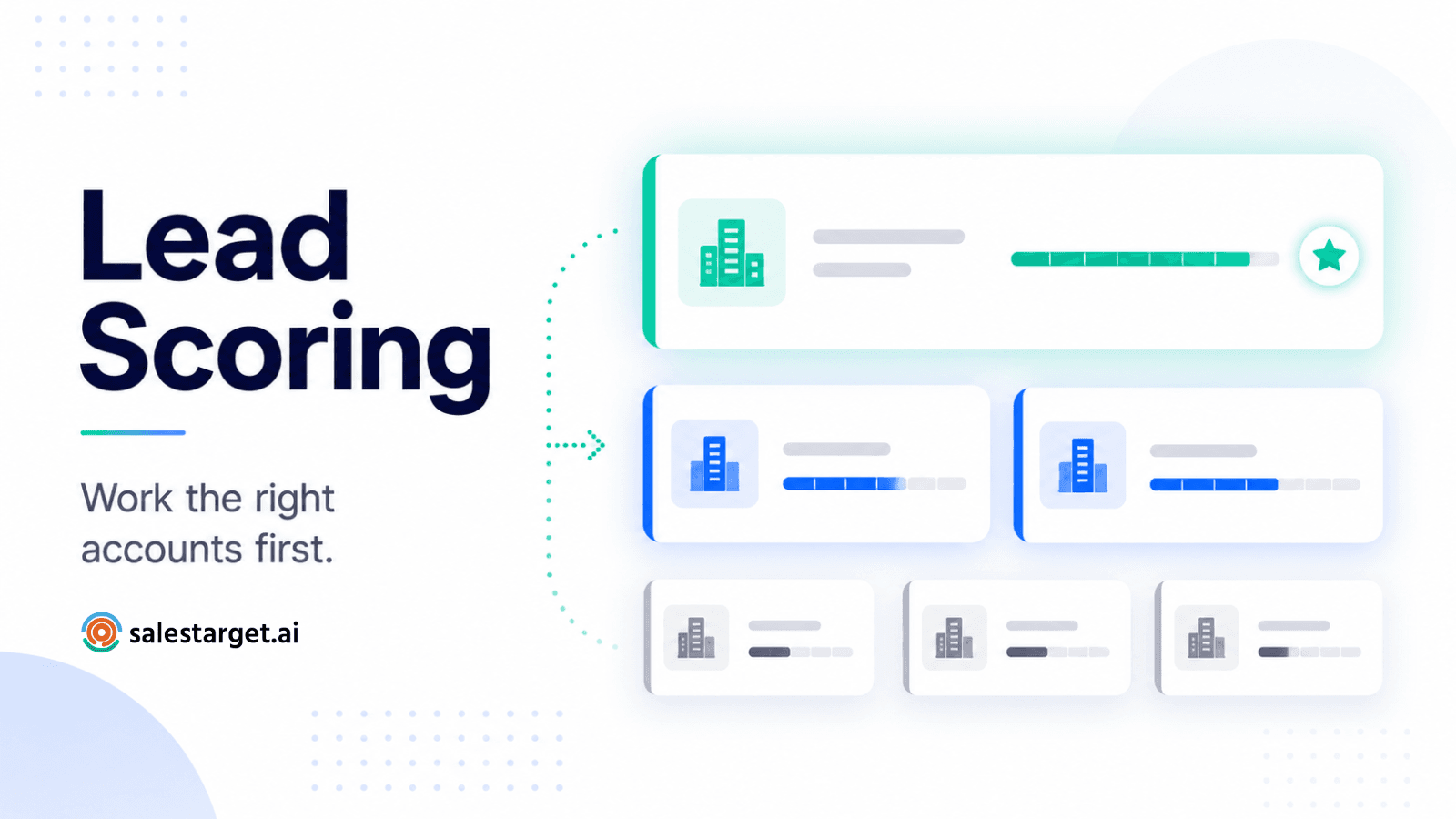
Lead scoring is the process of assigning a numerical value to each prospect based on how likely they are to buy so your sales team knows which leads to contact first, which to nurture, and which to deprioritise entirely.
The score is built from signals. A company in your target industry with the right headcount, actively researching your product category, and running a competitor tool you can displace gets a high score. A company that superficially matches your ICP but has no budget signals, no intent activity, and no operational gap gets a low one.
Lead scoring does not change who is on your list. It changes the order in which your SDRs work through it — and in B2B outbound, that order matters enormously. The first seller to reach a prospect in an active buying window is 5x more likely to win the deal (Corporate Visions research). Lead scoring is how you find those prospects at the top of the list every morning, not buried on page 8 of a spreadsheet.
Simple definition
Lead scoring = ranking your prospect list by likelihood to buy, so your SDRs always work the highest-value accounts first.
Lead Scoring vs Intent Data: What's the Difference?
These two concepts are related but distinct. Understanding the difference helps you use both correctly.
Intent data is a specific type of signal — behavioural data that shows a company is actively researching topics relevant to your product right now. Bombora monitors content consumption across 5,000+ B2B publisher sites and flags companies showing above-normal research activity on specific topics. Intent data tells you when a company is in a buying window.
Lead scoring is the framework that combines intent data with other signals — firmographic fit, technographic match, engagement history, and trigger events — into a single composite score. Intent data is one input into the score. It is a particularly powerful input, but the score itself is broader.
| Intent data | Lead scoring | |
|---|---|---|
| What it is | Behavioural signal — research activity on specific topics | Composite score combining multiple signal types |
| What it tells you | This company is researching your category right now | This company is your highest-priority prospect right now |
| Used for | Timing outreach to the active research window | Prioritising which accounts to contact first |
| Relationship | One of the inputs into a lead score | Synthesises intent data alongside other qualification signals |
For a deeper explanation of how Bombora intent data works and how to use it in outbound, see our B2B intent data guide.
The 4 Factors Most B2B Teams Use to Score Leads
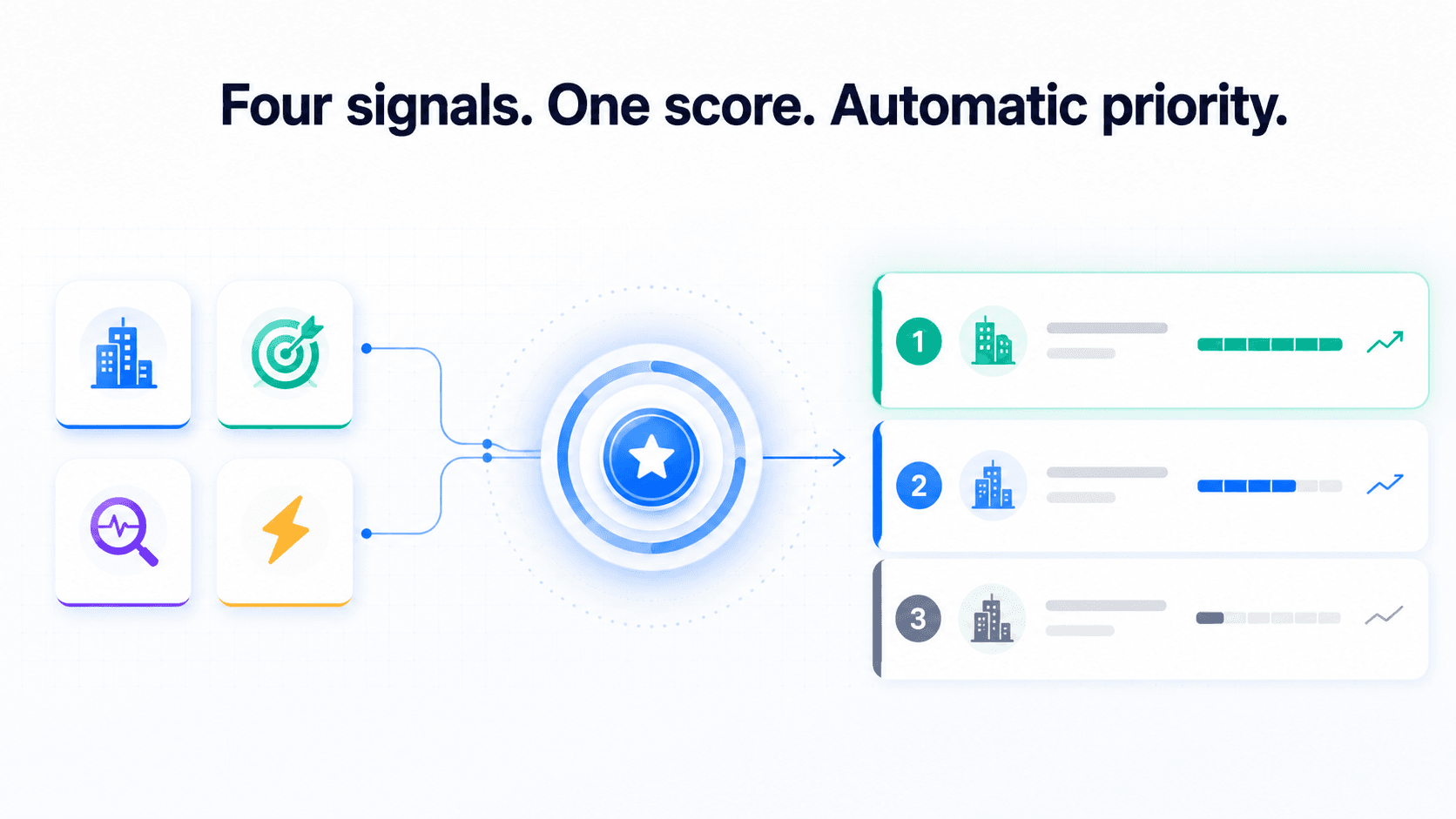
A practical lead scoring model does not need to be complex. The teams that get the most value from lead scoring tend to use four factors consistently, weighted by what matters most for their specific product and sales motion.
1. Firmographic fit. Does the company match your ICP on the fundamental dimensions — industry, headcount, revenue, geography, company stage? This is the baseline qualifier. A company that fails the firmographic fit check should not enter the scoring pipeline at all, regardless of how strong their intent signals are.
2. ICP match depth. Beyond the baseline, how closely does this company match the profile of your best existing customers? A company in your exact target vertical, at the precise headcount range, with the revenue bracket that correlates with your highest-retention customers scores higher than a company that merely passes the broad ICP filter. The ICP Builder inside SalesTarget.ai assigns match depth scores based on how many ICP dimensions a company satisfies simultaneously.
3. Intent signals. Is the company showing active research behaviour relevant to your product category? Bombora intent surges on specific topics are the clearest available signal that a company is in an active buying window. A company in your ICP with a live Bombora surge on a directly relevant topic is significantly more likely to be receptive to outreach than a company with identical firmographic fit but no intent activity.
4. Trigger events. Has the company experienced a recent event that typically precedes a purchase decision? Funding rounds, leadership changes, and hiring spikes in relevant departments all indicate that the operational context has shifted — creating needs that may not have existed three months ago. Trigger events function as score multipliers: an ICP-fit company with a recent funding round and a hiring spike in Sales scores significantly higher than the same company without those triggers.
| Factor | What it measures | Weight in practice |
|---|---|---|
| Firmographic fit | Does the company match ICP on industry, size, revenue, geography? | Qualifier — fails this = excluded from scoring |
| ICP match depth | How closely does the company resemble best customers? | High — 30–40% of composite score |
| Intent signals (Bombora) | Is the company actively researching relevant topics now? | High — 30–40%; most time-sensitive factor |
| Trigger events | Has a recent event created a likely purchase window? | Medium — 20–30%; functions as score multiplier |
Why Manual Lead Scoring Fails at Scale
Manual lead scoring works adequately for teams prospecting to small lists of 50–100 accounts. It breaks down quickly above that threshold.
The first problem is consistency. Different SDRs weight factors differently. One rep prioritises funding signals. Another prioritises intent. A third defaults to the order the list was imported. The result: identical accounts receive different priority levels depending on who is working them — and the highest-scoring accounts are not reliably contacted first.
The second problem is recency. A Bombora intent surge on a high-priority account fires today. The account sits at position 240 on a list sorted by company name. The SDR working that list reaches them in week 3, when the intent window has already closed. Manual scoring has no mechanism for surfacing real-time signals automatically.
The third problem is volume. At 500–1,000 contacts per month, manual review of each prospect for scoring is not a realistic operational expectation. It either does not happen, happens inconsistently, or consumes time the team should be spending on outreach.
How Automated Lead Scoring Works in SalesTarget.ai
SalesTarget.ai's intent-based lead scoring automates the scoring process inside Lead Explorer, combining all four scoring factors — firmographic fit, ICP match depth, Bombora intent signals, and trigger events — into a composite score that surfaces automatically for every account in your search.
When you run a search in Lead Explorer with your ICP filters applied, the resulting accounts are ranked by their composite lead score. The highest-scoring accounts appear at the top. You do not need to review each account manually to determine priority.
- Firmographic and ICP match: your ICP Builder profile defines the baseline. Lead scoring measures how closely each account matches the full five-dimension ICP — not just the broad filter.
- Bombora intent scoring: intent topic surges add directly to the account's score. A company surging on topics directly relevant to your product scores higher than a company with identical firmographic fit but no intent activity.
- Signal Discovery integration: trigger events detected by Real-Time Signal Discovery — funding rounds, hiring spikes, leadership changes — are factored into the score automatically.
- Dynamic updating: scores update as new signals are detected. A company that was mid-priority yesterday can become Tier 1 today if a new VP of Sales joins or a Bombora surge fires.
The result: a prospect list always sorted by current buying probability — not by import order, alphabetical company name, or manual SDR judgment.
How lead scoring connects to enrichment
Lead scoring in SalesTarget.ai operates before enrichment credits are spent. You see the scored, ranked list first — then choose which accounts to enrich based on their score. The Has Email toggle works alongside scoring: filter for contacts with verified email available on your highest-scored accounts, then enrich only those. No credits spent on low-scoring accounts or contacts without verified data.
What to Do With Your Scored Leads: A Simple Prioritisation Workflow
Lead scoring is only useful if it changes how your team operates. The simplest prioritisation framework is a three-tier system:
| Tier | Score profile | Action | Timing |
|---|---|---|---|
| Tier 1 — Act now | Strong ICP + active Bombora intent + recent trigger event | Immediate personal outreach — signal-specific messaging | Within 24–48 hours |
| Tier 2 — Act this week | Strong ICP + one signal (intent or trigger, not both) | Sequence launch — personalised, not signal-specific | Within 1 week |
| Tier 3 — Nurture | Reasonable ICP match — no current intent or trigger | Longer nurture sequence or hold for signal upgrade | No urgency — monitor |
The practical workflow in SalesTarget.ai: run your ICP search, review the scored list, enable the Has Email filter, enrich the top Tier 1 and Tier 2 accounts, and launch sequences with messaging matched to each tier's signal profile. Tier 3 accounts stay in the database and automatically surface when their score increases.
Lead Scoring Is How You Stop Working the Wrong Accounts
Most B2B outbound teams have the same problem: a list of hundreds or thousands of accounts that all look similar on the surface, no reliable way to know which ones are actually in a buying cycle, and SDRs working them in whatever order they were imported. Lead scoring fixes this at the source.
A scored list means the accounts most likely to buy right now are at the top — not buried under 300 contacts with no current intent or trigger activity. SalesTarget.ai's intent-based lead scoring builds that scored list automatically, combining Bombora intent signals, trigger events, and ICP match depth into a composite score that updates as new signals are detected.
Score your leads automatically — free to try.
SalesTarget.ai's intent-based lead scoring ranks every lead by ICP fit and Bombora intent — automatically, inside Lead Explorer.
50 credits · 7-day free trial · No credit card required