B2B Intent Data: A Complete Guide
TL;DR
- B2B intent data tells you which companies are actively researching topics related to your product — before they ever fill out a form
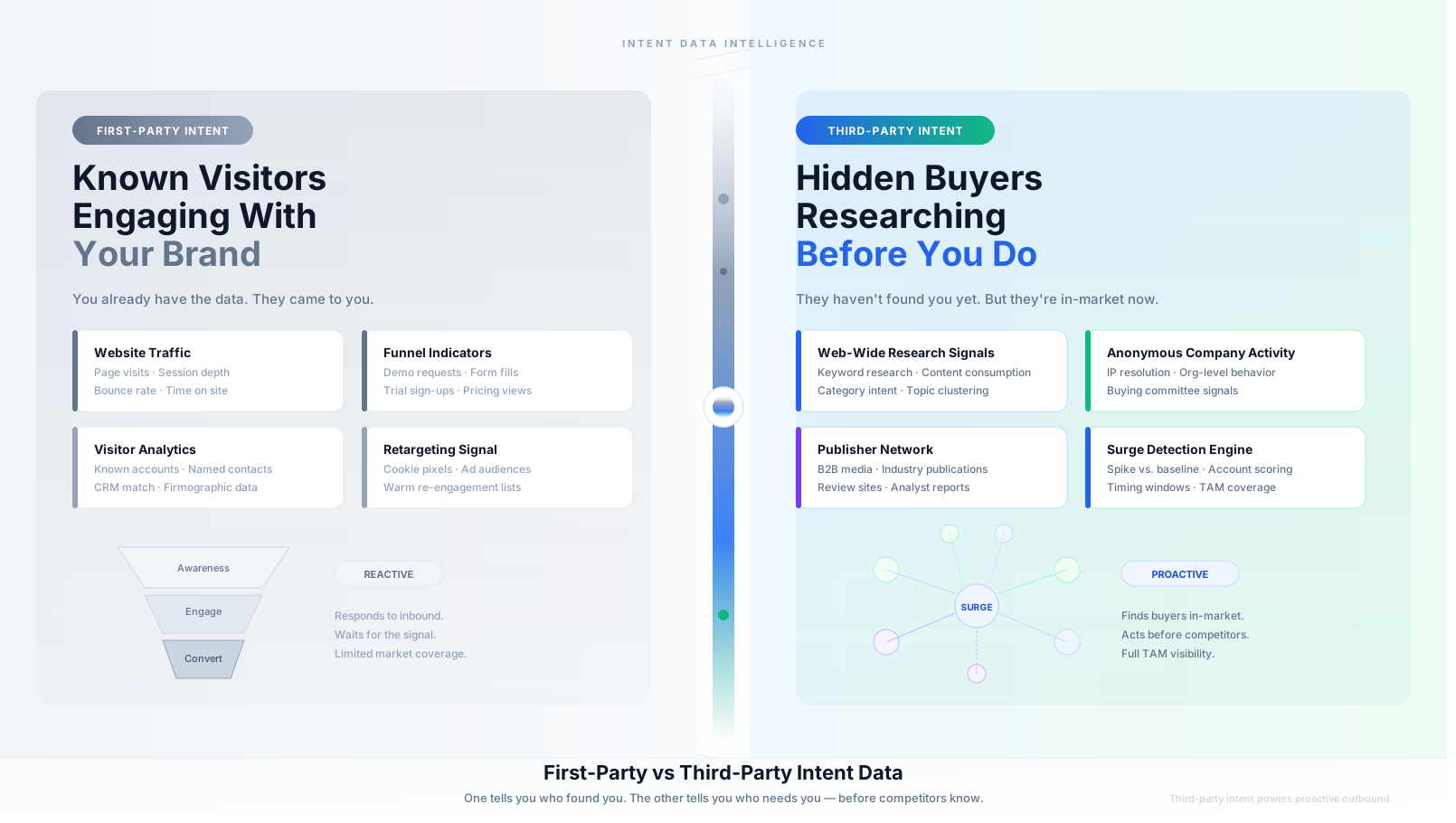
- First-party intent = signals from your own website. Third-party intent = signals from across the broader B2B web
- Bombora is the gold standard for third-party B2B intent data — it powers intent signals inside ZoomInfo, 6sense, and SalesTarget.ai
- Enterprise tools (6sense, ZoomInfo) charge $15K–$100K+/year for intent data. SalesTarget.ai includes Bombora intent at $49/mo
- Intent data is only useful when combined with ICP filters — a high surge score on the wrong company is still the wrong company
- Practical use: filter by intent topic, sort by surge score, contact Tier 1 accounts (60+) first
What Is B2B Intent Data?
Imagine you could see inside a company's research process before they ever reached out to you. You'd know which companies are actively reading about 'CRM software for sales teams,' which just downloaded three whitepapers on 'cold email automation,' and which have five people searching 'best outbound tools' in the same week.
That is what B2B intent data does.
Intent data is behavioural signal data that shows which companies are actively researching topics related to your product or service — gathered from their content consumption across the web. Instead of waiting for a prospect to fill out a form, intent data tells you who is in research mode right now, so your team can reach out at the exact moment buying interest is high.
Core Insight: Research shows that B2B buyers complete up to 57% of their purchase decision before talking to any vendor. Intent data lets you identify them during that invisible research window — before your competitors do.
In practical terms, intent data answers the most valuable question in outbound sales: who is actually ready to buy right now? Not in six months. Not someday. This week.
First-Party vs. Third-Party Intent Data
| First-Party Intent | Third-Party Intent | |
|---|---|---|
| Source | Your own website and properties | Across the broader B2B web |
| What it captures | Who visited your site, what pages they read | Which companies are researching relevant topics on other sites |
| When it fires | After they already found you | Before they know you exist |
| Coverage | Narrow — only your traffic | Broad — millions of research events |
| Best for | Re-engaging warm leads, retargeting | Cold outbound, prioritising new accounts |
| Example provider | Your own analytics / Clearbit Reveal | Bombora (powers SalesTarget.ai) |
For outbound prospecting, third-party intent data is the one that matters. It catches companies doing research you would never see otherwise, because they haven't visited your site yet.
How Bombora Actually Works
Bombora is the company that invented the B2B intent data category — named a Leader in the Forrester Wave for B2B Intent Data Providers in Q1 2025. Bombora's data powers the intent signals inside ZoomInfo, 6sense, and SalesTarget.ai's Lead Explorer.
| Step | What happens | Why it matters |
|---|---|---|
| 1 — Data Collection | A tag on 5,000+ B2B publisher sites captures content consumption events — page views, downloads, time-on-page, all consent-based | 16.6 billion research interactions captured per month across exclusive Co-op members |
| 2 — Topic Mapping | BERT-based ML maps each piece of content to one of 20,100+ B2B topics (e.g. 'CRM software,' 'sales automation') | Content is categorised by meaning, not just keywords — reducing false signals |
| 3 — Company ID | Activity is resolved to a company domain using IP-to-company and deterministic matching — not individual tracking | Privacy-compliant: you know the company is researching, not which person |
| 4 — Baseline Set | Bombora tracks each company's normal research volume per topic over time to establish a personal baseline | Prevents high-volume companies from always appearing as 'surging' |
| 5 — Surge Score | When research spikes significantly above baseline, Company Surge® fires — a 0–100 score reflecting intensity vs. normal | Measures change, not just volume — a true signal that something has changed |
Scale Check: Bombora's Co-op captures 16.6 billion research interactions per month across 5,000+ sites. More than 86% of those publisher sites are exclusive to Bombora — meaning this data is not available anywhere else. That exclusivity is why it powers the intent layer inside most major sales intelligence platforms.
What a Surge Score Actually Means — and When to Act
| Surge Score | What it means | What to do |
|---|---|---|
| 60–100 | Significant spike above baseline — company is actively in-market for this topic | Prioritise immediately. These are your Tier 1 accounts |
| 40–59 | Moderate uplift — early research signals, not yet peak intent | Add to nurture sequence. Watch for score to climb |
| 20–39 | Slight above-baseline activity — could be ambient noise | Monitor. Do not act yet |
| 0–19 | Normal baseline activity — no meaningful buying signal | Deprioritise unless ICP fit is exceptional |
Important Limitation: Bombora tells you which company is researching, not which individual. You know a company's team is reading heavily about CRM automation — but not whether it's the VP of Sales, Head of RevOps, or SDR manager. Intent data works best as a list filter combined with enrichment to find and verify the right contact inside the surging company.
The Enterprise Problem: Why Intent Data Has Been Out of Reach for SMBs
The tools that have historically included intent data are built for enterprise budgets. Here's how the market actually looks:
| Platform | Price | What's included | The problem |
|---|---|---|---|
| 6sense | $60K–$250K/year | Bombora + keyword intent, predictive buying stages, ABM advertising | Months to implement, requires RevOps team, no outbound sequencing built in |
| ZoomInfo | $15K–$40K/year | Bombora intent included, large contact database, strong integrations | Intent is add-on cost on top of base, annual contract required, complex onboarding |
| SalesTarget.ai | $49/month | Bombora intent built into Lead Explorer, ICP Builder, enrichment, email + LinkedIn outreach | None — set up in minutes, no contract, all features included from day one |
The Positioning Gap: SalesTarget.ai is currently the only outbound platform that puts Bombora intent data — the same data powering 6sense and ZoomInfo — directly into a prospecting workflow at an SMB price point. The data is identical. The price is not.
SalesTarget.ai's Intent Topics Filter: How It Works in Practice
Inside SalesTarget.ai's Lead Explorer, Bombora intent data is surfaced through the Intent Topics filter. Here is the exact workflow:
- Step 1 — Set your ICP first: Before touching intent filters, define your ICP using the ICP Builder — industry, company size, revenue range, geography. Intent data without ICP filters produces noise, not signal.
- Step 2 — Open the Intent Topics filter: In Lead Explorer, select Intent Topics. Search for topics relevant to what you sell — e.g. 'CRM software,' 'sales automation,' 'cold email tools.'
- Step 3 — Stack 2–4 related topics: A company surging on both 'sales automation' and 'cold email outreach' is a much stronger signal than either alone.
- Step 4 — Review surfaced accounts: Results show only companies matching your ICP that are currently surging on your selected topics.
- Step 5 — Enrich and act in one step: Use built-in lead enrichment to unlock verified contacts, tech stack, and firmographics — then push to CRM. No exports, no tab switching.
Pro Tip — Topic Stacking: Don't just pick the most obvious topic. Think about the research trail a buyer takes before they reach you. If you sell outbound tools, a buyer might be searching 'SDR productivity' or 'pipeline generation' weeks before they search your category. Stacking adjacent topics surfaces earlier-stage buyers your competitors aren't reaching yet.
How to Use Intent Data in Your Sales Workflow
The Daily Intent-Driven Prospecting Routine
| Time | Action | Tool |
|---|---|---|
| 9:00am | Open Lead Explorer, filter by ICP + Intent Topics | Lead Explorer |
| 9:10am | Sort results by surge score (highest first) | Intent Topics filter |
| 9:20am | Enrich top 15–20 accounts — unlock verified contacts and tech stack | Lead Enrichment |
| 9:35am | Identify the right contact at each account | Enriched contact data |
| 9:50am | Personalise outreach using the intent topic as context | Email / LinkedIn sequence |
| 10:30am | Push to CRM, tag as intent-sourced | CRM integration |
Writing Outreach That References Intent — Without Being Creepy
| Intent Signal | Wrong Approach | Right Approach |
|---|---|---|
| Surging on 'CRM software' | I see you've been researching CRM tools... | Most [industry] teams we speak to right now are rethinking their CRM setup — is that on your radar at [Company]? |
| Surging on 'sales automation' | We noticed your company is evaluating sales automation... | SDR productivity is the conversation we keep having with [industry] sales leaders — is scaling outbound something you're working on? |
| Surging on 'cold email tools' | Our data shows [Company] is interested in email outreach... | Are you building out a cold email program at [Company]? We've helped teams like yours cut ramp time by 60%. |
The intent data tells you what to talk about. Your message should feel like sharp, well-timed relevance — not data surveillance.
Intent Data + Lead Scoring: The Combination That Actually Works
Intent data on its own is incomplete. A company surging on your topic that has 10 employees and is in the wrong industry is still the wrong company. This is the model that drives intent-based lead scoring inside SalesTarget.ai:
| Tier | ICP Fit | Intent (Bombora) | Priority | Action |
|---|---|---|---|---|
| Tier 1 | Strong match | Score 60+ | Highest | Contact same day. Personalise heavily. |
| Tier 2 | Strong match | Score 40–59 | High | Add to sequence this week. Watch score. |
| Tier 3 | Partial match | Score 60+ | Medium | Monitor. Intent strong but fit is loose. |
| Tier 4 | Weak match | Any score | Skip | Deprioritise entirely. Move on. |
Common Mistakes When Using Intent Data
| Mistake | Why it fails | What to do instead |
|---|---|---|
| Acting on intent without ICP filter | Wastes time on companies that will never convert regardless of interest level | Always layer ICP criteria on top of intent signals |
| Picking only one intent topic | Too narrow — misses adjacent research trails | Stack 2–4 related topics to cast a wider but still relevant net |
| Treating any score as a green light | Scores below 60 are often ambient noise, not buying signals | Focus outreach on 60+ scores. Use 40–59 for nurture, not cold reach |
| Referencing the intent data in outreach | Feels like surveillance. Destroys trust immediately | Use intent to know what to talk about, not to cite as proof you're watching |
| Checking intent data once a month | Intent signals peak and fade within 2–4 weeks | Run intent-filtered searches at least weekly. Daily for high-velocity teams |
| Using intent data without verified contacts | You know who to call but can't reach them | Pair intent signals with enriched, verified contact data in one workflow |