Your SDR got a reply: "interesting, but not this quarter." Three months later, that company signed with a competitor, and nobody on your team followed up in between. The lead was good. The follow-through was missing. That long stretch between first interest and a buyer ready to talk budget is where most B2B pipeline leaks.
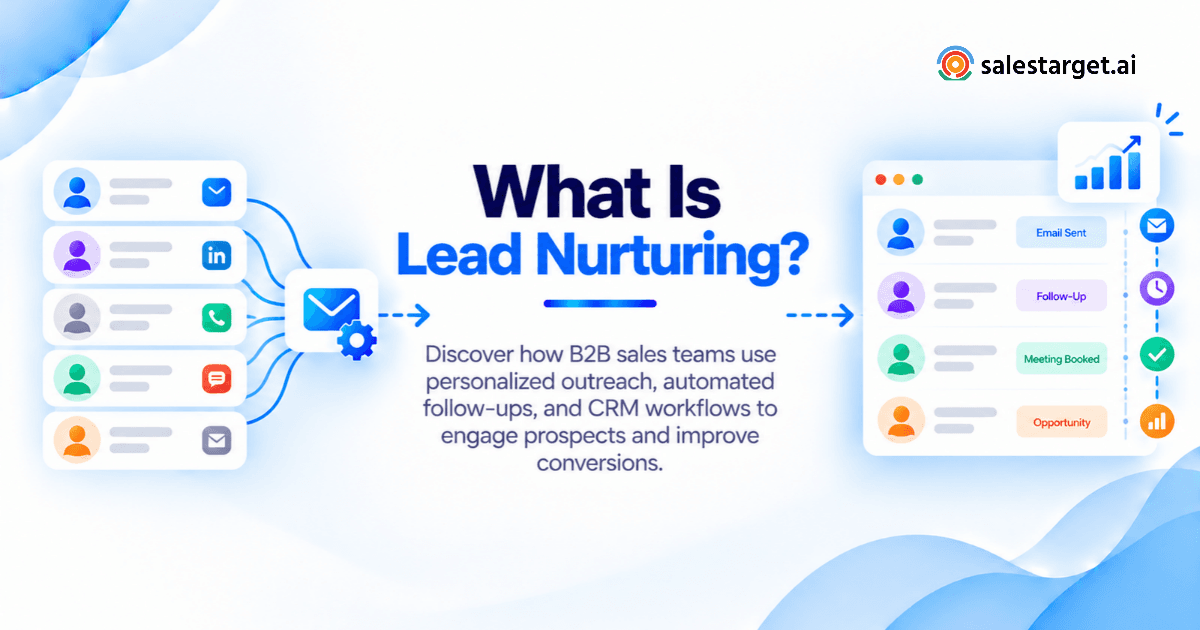
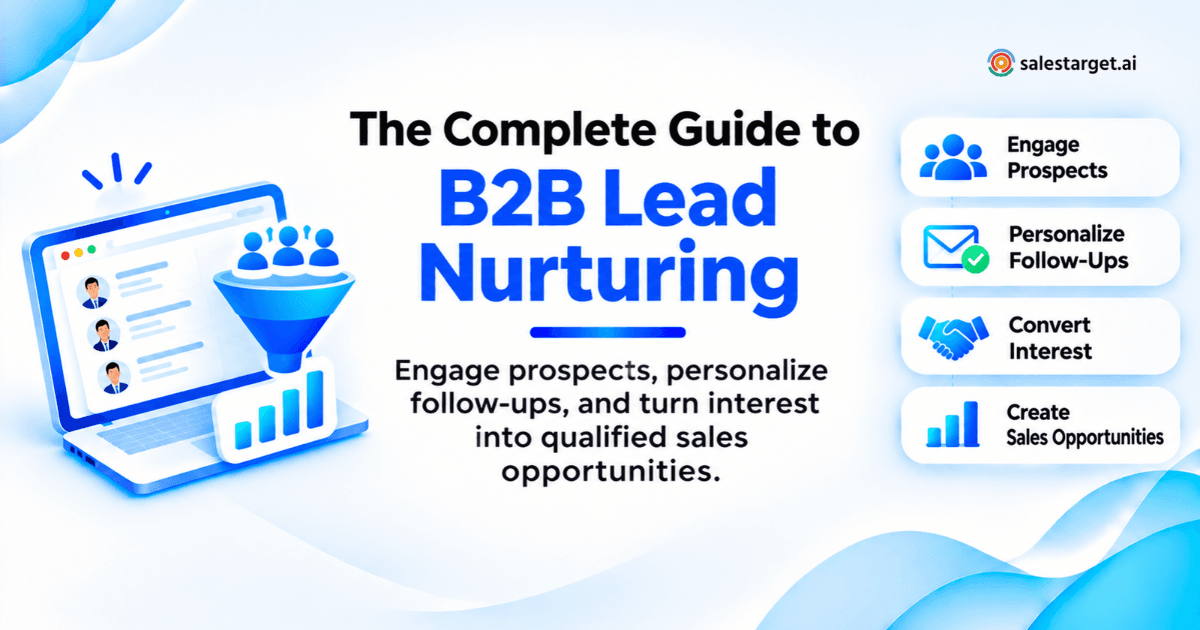
What is lead nurturing? Lead nurturing means staying in useful contact with a prospect who showed interest but is not ready to buy. You send the right information at the right time, by email, LinkedIn, or phone, until the buyer is ready for a sales conversation. Good B2B lead nurturing gives every lead an owner, a next step, and a clear rule for when sales takes over.
The Lead Nurturing Gap Between First Interest and Sales Readiness
The gap is time. 6sense's 2026 Global B2B Buyer Experience Report found sellers join about 59% of the way through a 10.3-month buying cycle, and the vendor buyers favored before first contact wins 82% of purchases. Nurturing keeps you on that favorite list.
Interested Prospects With No Owner or Next Action
A prospect replies "maybe later," then sits in a shared inbox. Marketing assumes sales has it; sales assumes the opposite. Every interested contact needs a named owner, a next action, and a date in the CRM the day interest appears.
Follow-Ups That Miss the Buyer's Needs and Purchase Timing
Gartner's 2025 survey of 632 B2B buyers found 73% actively avoid suppliers who send irrelevant outreach. If the buyer said budget opens in March, a "just checking in" email in December burns goodwill. Reference their stated problem and their stated timing.
Lead Nurturing Explained: Its Role Between Lead Generation and Sales Qualification
Lead generation creates interest. Sales qualification confirms an opportunity. Lead nurturing is the work in between. For the basics, start with what lead nurturing is.
The Lead Nurturing Process From Initial Interest to Sales Handoff
- Capture the signal: reply, download, intent spike, or demo.
- Check fit against your ICP.
- Assign an owner and a track.
- Nurture with stage-matched content across channels.
- Hand off when fit and intent cross an agreed threshold.
Lead Nurturing, Lead Scoring, and Drip Campaigns Compared
| Term | What it does |
|---|---|
| Lead nurturing | Moves the buyer forward with relevant touches |
| Lead scoring | Ranks leads by fit and intent to decide sales readiness |
| Drip campaign | Sends a fixed email series on a timer |
A drip is one tool inside a nurture program. Scoring decides when nurturing ends.
Sales and Marketing Responsibilities Across the Nurture Cycle
Marketing owns content and early-stage tracks. SDRs own replies and qualification. AEs own late objections. Write down the edges: who answers a positive reply and how fast, and who owns a lead that goes quiet after a demo. Alignment breaks on undefined edges.
The Lead Nurturing Funnel: TOFU, MOFU, and BOFU
The lead nurturing funnel matches content to how close the buyer is to a decision.
TOFU: Problem Guides, Checklists, and Educational Follow-Ups
The buyer is not shopping yet. Send problem guides, audit checklists, and benchmarks, with no demo ask. Teach one thing they can act on this week.
MOFU: Workflow Guides, Case Studies, and Solution Comparisons
The buyer is weighing options. Send workflow guides, before-and-after process examples, and honest build-versus-buy comparisons.
BOFU: Product Demos, ROI Evidence, and Purchase Support
The buyer is building a business case. Send demo recordings, ROI models using their numbers, and security answers. Forrester's State of Business Buying, 2026 reports procurement is a decision-maker in 53% of buying cycles, so BOFU content must convince finance too.
Content Mapping by Buying Stage, Stakeholder, and Next Action
| Stage | Stakeholder | Content | Next action |
|---|---|---|---|
| TOFU | SDR manager | Reply-rate benchmark | Share their numbers |
| MOFU | RevOps lead | Outbound workflow guide | Book a process review |
| BOFU | CRO and finance | ROI model on their volumes | Group demo |
Forrester puts the average buying group at 13 internal stakeholders plus 9 external influencers. Map content by role, not just by stage.
B2B Lead Nurturing Strategies: Building the Campaign Plan
A B2B lead nurturing strategy is a written plan: who you nurture, the sales outcome you want, and the rules that move leads in or out. For more ideas, see our B2B lead nurturing strategies guide.
Define the Target Segment and Sales Outcome
"Series A SaaS, 50 to 200 employees, Head of Sales, goal: qualified discovery call" is a plan. "Nurture all leads" is not. The outcome should be a meeting or opportunity, never an open rate.
Segment Leads by Source, Company Fit, Role, and Buying Stage
In Salestarget.ai's Lead Explorer, you stack Business and People filters (industry, headcount, revenue, tech stack, seniority) with Bombora Intent Topics, then enrich and verify each contact in one click. Segments start on fresh, verified data.
Build Separate Tracks for Inbound, Outbound, and Recycled Leads
Inbound leads raised a hand and get direct follow-up. Outbound replies should continue the same thread. Recycled leads (closed-lost or stalled) need a track keyed to why they left: budget, timing, competitor, or no decision.
Choose Content That Addresses the Segment's Main Buying Objections
List the three objections reps hear most and assign one asset to each. If agency owners say "clients won't fund another tool," send a margin breakdown, not a feature tour.
Coordinate Email, LinkedIn, and Sales Call Touchpoints
Give each channel one job: email carries detail, LinkedIn builds familiarity, calls handle objections. Salestarget.ai runs email and LinkedIn in one flow with conditional steps that branch on replies, so context carries between channels.
Assign Campaign Ownership, Entry Criteria, and Exit Rules
One owner per campaign. Entry: a positive reply tagged "Follow-Up" plus a passing fit score. Exit: booked meeting, opt-out, hard bounce, or 45 days of silence.
Lead Nurturing Campaigns, Email Examples, and Reusable Templates
Five lead nurturing campaigns with short templates. Fill the brackets with CRM context.
Content Download Campaign: From Resource Interest to a Relevant Conversation
A download signals topic interest, and the form-filler may not be the buyer: 6sense found only 35.2% of buyers use their own contact details on forms. Nurture the account, not one email address.
Subject: The [checklist] step most teams skip
[First name], step 4 trips up most [role]s: [issue]. Want the 15-minute version of how [peer type] fixed it?
Positive Outbound Reply: From Initial Interest to a Qualified Meeting
Answer within hours, in the same thread, with two time slots. Salestarget.ai's Unibox sorts replies by intent (Interested, Follow-Up, Not a Fit), assigns an owner, and syncs to the CRM.
Subject: Re: [original subject]
Thanks, [First name]. I'll bring [account insight]. Tuesday 11:00 or Thursday 15:00?
Demo Follow-Up Campaign: Address Objections and Confirm Next Steps
Recap within 24 hours: their problem, the matching feature, the open objection, the dated next step.
Subject: Recap and the [integration] question
[First name], [stakeholder] asked about [objection]. Answer attached. Still on for [date]?
Budget-Delayed Campaign: Follow Up Around the Buyer's Review Date
Log the review date and schedule the key follow-up two to three weeks before it. Until then, one useful touch a month.
Subject: Ahead of your [month] review
[First name], here's a one-page business case for your planning doc. Want it sized to your team?
Inactive Lead Campaign: Reconnect With New Value and Updated Context
Re-verify the contact first. Then open with something new from Lead Explorer's business event signals: funding, hiring spikes, or leadership changes.
Subject: Saw [company] is hiring [X] SDRs
[First name], fast SDR growth tends to break list quality first. On your radar?
A Complete B2B Lead Nurturing Sequence From First Reply to Sales Handoff
One full sequence for the most common outbound case: "interesting, but not right now."
Campaign Brief: Buyer Profile, Starting Context, and Conversion Goal
Buyer: Head of Sales, B2B SaaS, 50 to 200 employees. Context: replied "revisit next quarter." Goal: qualified discovery call within 60 days. Owner: the SDR who got the reply.
Sequence Table: Timing, Channel, Message, CTA, and Owner
| Day | Channel | Message | CTA | Owner |
|---|---|---|---|---|
| 0 | Thanks, confirm timing | Confirm month | SDR | |
| 2 | Connect, no pitch | Accept | SDR | |
| 10 | Team-size benchmark | Reply | SDR | |
| 21 | DM on new signal | Reply | SDR | |
| 35 | Objection guide | Reply | SDR | |
| 50 | Call and email | Pre-review check | Book call | SDR, AE |
Annotated Lead Nurturing Emails and LinkedIn Follow-Ups
Day 0: "Thanks, [First name]. I'll check back in [month]. Is the review about tooling, headcount, or both?" One question captures buying context.
Day 21 DM: "Saw [company] opened [X] sales roles. Want our one-page ramp checklist?" The signal makes it timely; the offer asks nothing.
Day 50: "Your [month] review is close. 20 minutes Tuesday?" The ask ties to their date.
Response Paths for Interest, Delay, Objections, and No Reply
- Interest: stop the sequence, book the call.
- Delay: update the date, restart at the matching step.
- Objection: route to the AE, remove from automation.
- No reply: move to a quarterly long-cycle track.
CRM Updates and Exit Rules at Each Decision Point
Log reply category, review date, objection, and next task at every decision. Salestarget.ai's built-in CRM logs each email and call to the lead timeline and creates follow-up tasks when a lead replies or a meeting ends. Exit on meeting, opt-out, bounce, or job change.
Lead Nurturing Automation and Multichannel Workflow Design
Lead nurturing automation handles timing and routing. People handle judgment.
Enrollment Triggers and Required CRM Data
Enroll only when a trigger fires and verified email, role, company size, source, and stage exist. Missing fields produce wrong personalization.
Behavior-Based Follow-Ups and Scheduled Follow-Ups
Behavioral triggers (a reply, a product page visit, a new intent signal) catch buying moments. Scheduled steps prevent long silences. Run both.
Contact Limits and Coordination Across Active Campaigns
Cap touches at three per contact per week across all campaigns. Set priority: an active sales conversation beats outbound, which beats marketing nurture.
Pause and Exit Rules for Replies, Meetings, and Opt-Outs
Any reply pauses all automation for that contact. A meeting exits every track. Opt-outs must be global: Gmail and Yahoo require bulk senders to process one-click unsubscribes within two days, and Microsoft began enforcing bulk sender rules for Outlook.com in May 2025.
Human Review of AI Messages and Campaign Changes
Salestarget.ai's AI Copilot drafts personalized sequences with A/B variations. A rep approves anything referencing a real conversation, and one owner signs off on segment and exit rule changes.
Lead Scoring and Sales Handoff Rules
Lead scoring decides when nurturing stops and selling starts.
Separate Company Fit From Engagement and Purchase Intent
Fit is stable: industry, size, tech stack, role. Intent moves: replies, meetings, topic surges. A perfect-fit account with no intent stays in nurture. A poor-fit lead never reaches sales, no matter how many clicks.
Set Qualification Thresholds and Reduce Scores as Signals Age
Write MQL and SQL thresholds, then decay points. Lead Explorer surfaces business events on a 30 to 90 day lookback, a sensible decay window for most B2B cycles.
Define the Context Sales Receives With Each Qualified Lead
Every handoff includes why the lead qualified, content consumed, reply history, timing, stakeholders, and open objections. If the AE asks "what did they say?", the handoff failed.
Return Premature Opportunities to the Right Nurture Track
Returned leads carry a reason code: no budget, wrong timing, wrong contact, or no project. "Wrong contact" should trigger a search for the right buyer at that account.
Lead Nurturing Metrics, Campaign Testing, and Pipeline ROI
Judge nurturing by pipeline, not email activity.
Measure Qualified Replies, Meetings, and Opportunity Conversion
Track qualified reply rate, meetings booked, and meeting-to-opportunity conversion. Apple Mail Privacy Protection inflates opens, and security scanners inflate clicks.
Track Time to Opportunity and Progress Between Buying Stages
Measure days from first interest to opportunity and find where leads stall. Fixing the slowest stage lifts pipeline velocity most.
Separate Pipeline Created From Pipeline Influenced
Created means nurture sourced the deal. Influenced means it touched a deal sourced elsewhere. For a clean read, hold 10% of a segment out of nurture and compare opportunity rates after 90 days.
Calculate Nurturing ROI With Stated Costs and Attribution Limits
ROI = (sourced pipeline × win rate minus program cost) ÷ program cost. Count rep hours, content, data, and tools, and state your attribution model.
Compare Campaign Variations Using Consistent Segments and Time Periods
Test one variable, on one segment, in the same period. A Q4 test against a Q1 test with a different ICP proves nothing.
Lead Nurturing Mistakes That Keep Good-Fit Leads Stuck
These five mistakes show up in almost every nurture audit, and each has a simple rule that fixes it.
Sending Every Lead the Same Content and Demo Request
A CFO and an SDR manager need different emails. Demo asks push early-stage buyers away.
Treating Email Opens and Clicks as Sales Qualification
Privacy proxies and bot clicks inflate both. Qualify on replies, meetings, and first-party intent.
Contacting Several Stakeholders With Conflicting Messages
Gartner found 69% of B2B buyers report inconsistencies between a vendor's website and what its sellers say. Run one account-level message plan.
Continuing Automated Follow-Ups During an Active Sales Conversation
An automated "just checking in" the day after discovery kills trust. Sync meetings to the CRM so they pause automation.
Reusing Stale Contact Data or Ignoring Changed Purchase Timing
People change jobs. Re-verify before every re-engagement, and update purchase timing each time the buyer mentions it.
Choosing Lead Nurturing Software for Your Sales Process
The right lead nurturing software runs your main workflows without tool switching.
Match Software Capabilities to Your Main Nurture Workflows
List every step of your top two workflows and confirm the tool handles each without a Zapier chain.
Assess Segmentation, Workflow Controls, and Channel Coordination
Check segmentation by fit, role, stage, and intent, reply branching, and email plus LinkedIn in one sequence. Many cold email tools cover email only.
Review CRM Visibility, Lead Ownership, and Sales Handoffs
Every reply, call, and email should land on one lead timeline with a clear owner.
Check Data Quality, Email Validation, and Sending Controls
Look for pre-send verification, warm-up, inbox rotation, and SPF, DKIM, and DMARC checks. An email validator with MX and SMTP checks keeps aging nurture lists from hurting your domain.
Compare Reporting, Integrations, Team Access, and Total Cost
Reporting should tie campaigns to pipeline. For total cost, count every separate tool: data, enrichment, validation, sending, LinkedIn, and CRM.
Run a Pilot With One Segment and Defined Success Criteria
Pilot one segment for 30 days with set targets: qualified meetings, bounce rate under 2%, and rep hours saved. Start free with Salestarget.ai and run that pilot from search to CRM in one workspace.
Why Choose SalesTarget.ai
Salestarget.ai is an all-in-one AI sales intelligence and outbound platform that combines B2B lead data, email and LinkedIn outreach, email validation, a built-in CRM, and an AI Copilot in one workspace. The lead you find is the lead you nurture and close, with no CSV exports in between.
Lead Data and Enrichment for Relevant Nurture Segments
Lead Explorer covers 840M+ verified profiles, 146M+ businesses, and 4,000+ intent signals from 50+ sources. Contacts are verified when you enrich them, not when data was first scraped.
Email and LinkedIn Outreach for Coordinated Follow-Ups
Email Outreach builds sequences from a plain-English audience description with AI warm-up and inbox rotation. LinkedIn Outreach adds connection requests, DMs, and reply-based branching in the same flow.
Email Validation and Sending Controls for Deliverability Management
The Email Validator runs MX and SMTP checks, disposable-email detection, and risk scoring before send, protecting sender reputation across long nurture cycles.
Built-In CRM for Lead History, Deal Progress, and Follow-Up Tasks
Campaign leads land in the Salestarget.ai CRM automatically, with every touch on one timeline. Salestarget.ai reports 91% follow-up completion and about 6 hours saved per rep per week.
AI Copilot for Sequence Drafts and Campaign Review
Ask AI Copilot to draft a nurture sequence by role, show which campaigns drive meetings, or flag at-risk deals. Strategy stays human.
A 30-Day Plan to Launch Your First Lead Nurturing Campaign
One segment, one goal, and four weeks are enough to launch a working campaign.
Week 1: Audit Leads, Select a Segment, and Define the Goal
Pull interested leads with no open opportunity, verify contacts, pick one good-fit segment, and set a meeting target.
Week 2: Prepare Content, Messages, and CRM Ownership
Map assets to the top three objections, draft the sequence, and set owner, entry, and exit rules.
Week 3: Test the Workflow and Launch the Pilot
Run test contacts through every branch: reply, opt-out, meeting, silence. Then launch.
Week 4: Review Conversations, Fix Gaps, and Plan the Next Test
Read every reply, fix the drop-off step, and pick one variable to test next.
Turn Stalled Follow-Ups Into a Clear Nurturing Plan With SalesTarget.ai
The "not this quarter" lead was never the problem. The missing owner, generic follow-up, and disconnected tools were. Lead nurturing works when one system owns the lead from first reply to closed deal. Salestarget.ai fixes all three in one place: find and verify the buyer, nurture across email and LinkedIn, and track every reply in the built-in CRM. Build your first nurture campaign with Salestarget.ai.