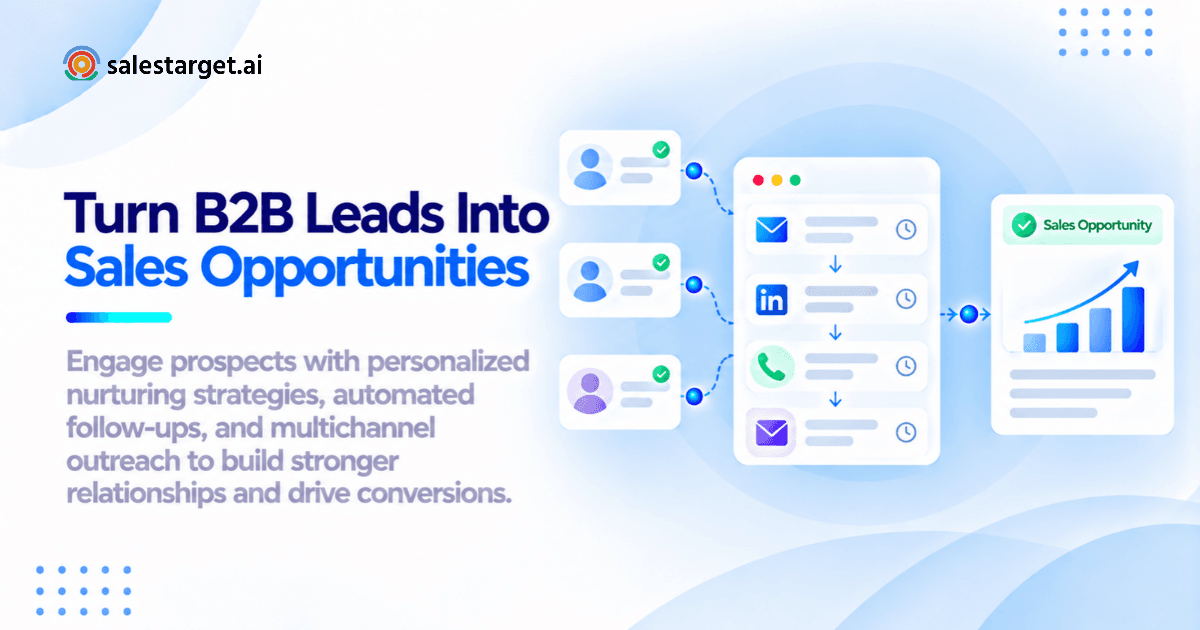
You built a list. You ran outreach. A few prospects replied, showed interest, then went quiet. Now those leads sit in your CRM, untouched, slowly going cold.
This is the most common and most expensive problem in B2B sales, and most teams treat it as an outreach problem when it's actually a nurturing problem.
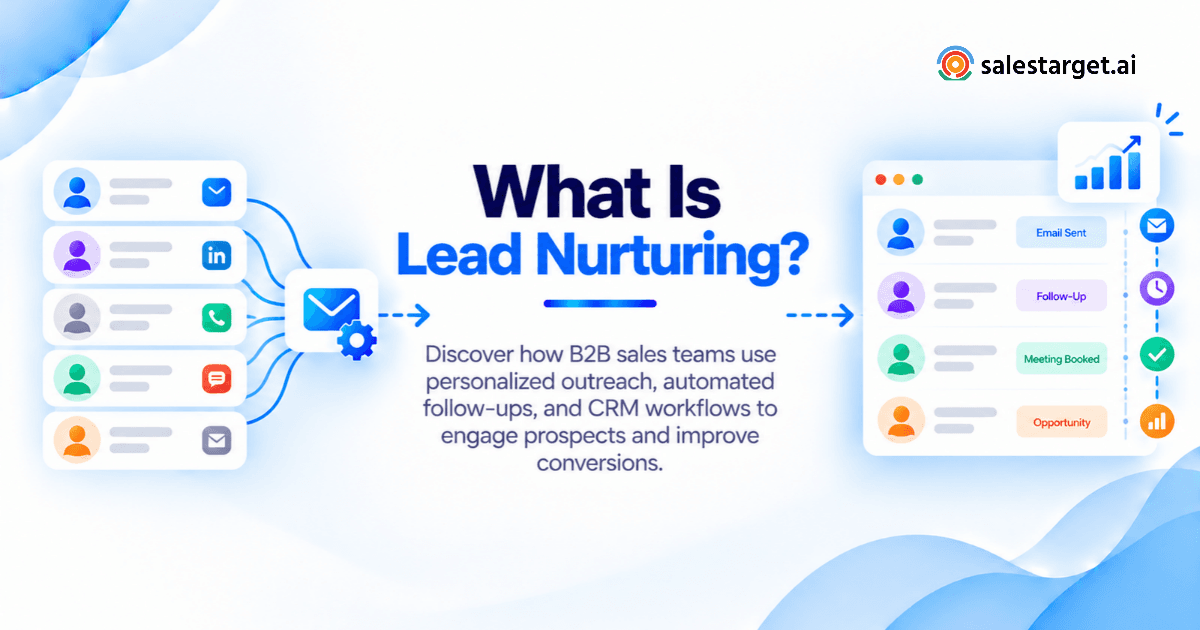
Lead nurturing is the process of building relationships with prospects over time by delivering relevant, timely communication at each stage of their buying journey, until they are ready to buy, re-engage, or disqualify themselves.
In B2B sales, where deals take weeks or months and multiple stakeholders are involved, nurturing is what keeps your pipeline from stalling. Done well, it closes the gap between initial interest and a signed contract. Done poorly, or skipped entirely, it hands deals to competitors who stayed top of mind.
This guide covers the entire lead nurturing process for B2B teams: what it is, how to build a strategy, which channels and sequences actually work, how to automate without losing the human touch, and how to measure results that connect directly to pipeline.
The Hidden Cost of B2B Leads That Never Reach a Sales Conversation
Why Interested Prospects Go Silent After Initial Outreach
Most prospects who go quiet are not uninterested. They are busy, in a buying cycle that does not match your sequence cadence, or waiting for an internal trigger: budget approval, a board meeting, a contract renewal. When your follow-up arrives at the wrong moment with the wrong message, it gets ignored. When nothing follows at all, the prospect moves on.
The core problem: most outbound sequences are built for conversion, not continuity. They run for three to five steps, stop when there's no reply, and treat silence as rejection. In B2B sales, silence is usually timing.
The Gap Between Lead Generation, Follow-Ups, and Sales Conversion
Lead generation gets the attention. Sales conversion gets the credit. The space between them, where most revenue is actually won or lost, gets almost no process investment.
A prospect downloads a whitepaper, attends a webinar, or replies to a cold email with "maybe later." That is a warm signal. Without a structured nurturing path, that signal decays fast. Two weeks later, the rep who should be following up has moved to a new list and the prospect has forgotten the conversation entirely.
This gap between lead generation and sales conversion is where bad pipeline hygiene starts. Contacts accumulate in CRMs with no status, no owner, and no scheduled next step.
How Poor Lead Nurturing Affects Pipeline Quality and Sales Cycles
Poor nurturing does not just lose deals. It inflates pipeline. Stalled leads with no follow-up plan get listed as active opportunities because no one has officially disqualified them. This makes forecast accuracy unreliable and gives sales leaders a false read on actual pipeline health.
It also extends sales cycles. A prospect who needed four touchpoints to make a decision now needs eight, because the first four were inconsistent and lost context. Each unnecessary sales cycle extension has a direct cost in rep time and customer acquisition expense.
Lead Nurturing in B2B Sales: Meaning, Goals, and Business Impact
Lead Nurturing Definition and Core Objectives
Lead nurturing is the structured practice of keeping qualified prospects engaged through consistent, relevant communication until they reach a buying decision. It is not the same as follow-up. Follow-up is reactive. Nurturing is a planned sequence of touchpoints designed to move a prospect through a defined path.
Core objectives of a B2B lead nurturing program: build awareness and trust with early-stage prospects, maintain visibility with mid-funnel leads who are evaluating options, accelerate buying decisions for late-stage accounts, and re-engage dormant contacts who showed prior intent.
Lead Generation vs. Lead Nurturing vs. Lead Management
These three terms get used interchangeably, which creates real process confusion inside revenue teams.
Lead generation is the activity of identifying and capturing new prospects through inbound channels (content, SEO, ads) or outbound channels (cold email, LinkedIn, calling). Its output is a lead: a contact with basic qualification data.
Lead nurturing is what happens after generation. It is the process of educating, engaging, and warming that lead until they are ready for a sales conversation.
Lead management is the operational layer that connects the two. It covers how leads are captured, assigned, tracked, scored, and handed off across systems. Without it, nurturing has no structure and generation has no destination.
The Role of Lead Nurturing in Longer B2B Sales Cycles
B2B purchase decisions involve multiple stakeholders, internal approval processes, and evaluation cycles that can run from weeks to over a year. A prospect who is not ready to buy today may be the best opportunity in your pipeline three months from now.
Nurturing keeps your brand and product visible during this gap. It delivers useful content, demonstrates product value, and reduces the friction of re-engagement when the prospect does enter an active buying cycle. Teams that nurture consistently report shorter time-to-close, because the prospect arrives at the sales conversation already educated and partially convinced.
Inbound vs. Outbound Lead Nurturing: Key Differences
Inbound nurturing targets leads who have already engaged: form fills, content downloads, free trial signups, webinar registrations. These contacts have shown interest. Nurturing them means deepening that interest through targeted email sequences, educational content, and product proof.
Outbound nurturing targets prospects who have not yet engaged with your brand. These are cold leads identified through prospecting tools, intent data, or list building. Nurturing them requires more patience, more personalization, and sequences built to create awareness before they can build interest.
The channel mix differs too. Inbound nurturing leans heavily on marketing automation and email. Outbound nurturing typically combines email, LinkedIn, and direct sales outreach, with each channel reinforcing the others.
The B2B Lead Nurturing Process: From New Prospects to Sales-Ready Leads
Lead Capture, Contact Verification, and Initial Qualification
Every nurturing sequence starts with data quality. A lead captured with an unverified email, a misspelled company name, or a generic role title is going to produce poor results from step one. Bounced emails signal to providers that your sender reputation is unreliable. That compounds over time.
Initial qualification filters out contacts who do not fit your ICP before they enter any sequence. This saves rep time and keeps nurturing resources focused on accounts with actual conversion potential.
Lead Segmentation Based on ICP Fit, Engagement, and Buyer Intent
Not every lead should receive the same outreach. Segmentation allows you to run targeted sequences that match the prospect's actual situation rather than sending identical messages to your entire list.
Useful B2B segmentation dimensions: company size and revenue band, industry vertical, buyer role and seniority, stage of engagement (first-touch vs. re-engagement), and intent signal strength (active research vs. passive fit). A VP of Sales at a 200-person SaaS company who visited your pricing page twice last week needs different messaging than a Marketing Manager at a 20-person agency who downloaded a blog.
Prospect Engagement Across the B2B Sales Funnel
Top-of-funnel engagement focuses on building awareness and establishing credibility. Content here tends to be educational: benchmark data, how-to guides, category comparisons. The goal is not to sell. It is to be seen as a credible resource when the prospect is ready to look for solutions.
Mid-funnel engagement is where differentiation happens. Prospects at this stage are comparing options. They respond to case studies, ROI calculators, product walkthroughs, and specific proof points tied to their industry or use case.
Bottom-of-funnel engagement is direct sales support. This is where personalized outreach, demo invitations, competitive comparisons, and contract terms matter. Nurturing at this stage should be tightly coordinated between marketing sequences and direct rep activity.
Lead Scoring and Marketing-to-Sales Qualification
Lead scoring assigns a point value to prospect actions and firmographic attributes. Opening three emails, visiting the pricing page, and matching your ICP on company size and role all add points. Unsubscribing, visiting the careers page, or being outside your target geography subtract them.
The threshold at which a lead becomes sales-qualified should be defined by both marketing and sales, not decided unilaterally by either. When the threshold is reached, the lead should trigger an automatic notification to the assigned rep and transition out of automated nurturing.
Sales Handoff, Pipeline Entry, and Lead Re-Engagement
A clean handoff is not optional. When a nurtured lead crosses the SQL threshold, the rep needs context: which sequence the prospect was in, what they opened and clicked, any reply history, and their lead score breakdown. Without this, the rep starts the conversation blind.
For leads that do not convert during an active nurturing cycle, a re-engagement path keeps them in play. A six-week pause followed by a fresh, contextually relevant message often restarts conversations that went cold for timing reasons, not lack of interest.
Building an Effective B2B Lead Nurturing Strategy Step by Step
Define Nurturing Goals and Lead-to-Customer Conversion Targets
Start with the metric that matters most to your business: the percentage of nurtured leads that convert to paying customers. Work backward from there. If you know your current lead-to-customer rate is 3% and your target is 6%, you can calculate how many leads need to enter nurturing, what conversion rate each funnel stage needs to hit, and where the biggest drop-off points are today.
Goals should also include intermediate metrics: MQL-to-SQL rate, SQL-to-opportunity rate, and average time-to-conversion by segment. These give you leading indicators before the lagging revenue numbers arrive.
Identify Buyer Personas and Segment Prospects by Sales Readiness
B2B buying decisions rarely sit with one person. A deal may involve a champion (the day-to-day user), an economic buyer (who approves budget), and a blocker (legal, IT, or procurement). Each role needs a different message and a different level of detail.
Group prospects by sales readiness first: not ready (early research), evaluating (comparing vendors), and decision-ready (have budget and a timeline). Run different nurturing tracks for each group rather than putting all three through the same sequence.
Map Content and Messaging to Each Stage of the Buying Process
Content mapping is the process of matching specific assets or messages to specific stages of the buyer journey. At the awareness stage, prospects need education. At the consideration stage, they need comparison and proof. At the decision stage, they need confidence.
A common mistake is jumping to product messaging too early. A prospect who is still defining the problem they need to solve does not want a product demo email. They want data that confirms their diagnosis. Sequence content that matches their current question, and save the product pitch for when they are actively evaluating.
Select Outreach Channels, Contact Frequency, and Follow-Up Timing
Channel selection depends on where your buyers spend time and how they prefer to receive information. In B2B, email is still the primary nurturing channel for volume. LinkedIn outreach adds visibility and a human face to the communication. Phone adds urgency for high-priority accounts.
Frequency matters as much as channel. Over-contacting prospects who are not yet ready to buy kills deals before they start. A general guideline: early-stage prospects benefit from light-touch outreach every 10 to 14 days. Mid-funnel prospects can handle weekly. Late-stage contacts should be managed by a rep, not an automation.
Establish Lead Scoring, Ownership, and Sales Handoff Rules
Lead scoring without handoff rules is just data. Define exactly what happens when a lead hits a specific score threshold: which rep gets notified, within what time frame they need to act, and what happens if they don't. Ownership ambiguity at handoff is one of the top reasons warm leads go cold.
Connect Nurturing Activities With CRM and Pipeline Management
Every nurturing touch should be logged to the lead's CRM record, automatically. If reps have to manually update the CRM after each outreach, it doesn't get done consistently. Pipeline visibility requires complete activity data, and complete activity data requires system integration, not manual entry.
B2B Lead Nurturing Strategies for Different Prospect Segments
Cold Lead Nurturing Through Personalized Outbound Engagement
Cold leads have no prior relationship with your brand. Nurturing them starts with awareness, not a pitch. The first two or three touches should focus on a relevant problem, a specific insight, or a business event tied to their company, not on your product features.
Personalization at this stage means more than using their first name. Reference the prospect's industry, their company's growth stage, or a signal like a recent funding round or leadership change. Specificity signals that you did your research. Generic openers signal that you didn't.
Email Lead Nurturing for Early-Stage and Mid-Funnel Prospects
Email outreach automation is the most scalable nurturing channel in B2B. For early-stage prospects, focus email content on education: category-level insights, benchmark data, and common problems your ICP faces. Avoid product-first messaging until the prospect has shown engagement signals.
For mid-funnel prospects who have opened multiple emails or clicked a link, shift content toward differentiation: case studies, specific features relevant to their role, or a short product walkthrough. The click is a buying signal. Respond to it with more targeted content.
Multichannel Lead Nurturing Using Email and LinkedIn Outreach
Multichannel nurturing increases reply rates because it meets prospects where they are, not where you are. A prospect who ignores your email may respond to a LinkedIn connection request with a personalized note. A connection who goes quiet on LinkedIn may resurface after a well-timed email follow-up.
The key to effective multichannel nurturing is message continuity. Each channel should reference the prior touch, not start a parallel conversation. If your email mentioned a specific pain point, your LinkedIn message should build on it, not repeat it from scratch.
Intent-Based Nurturing for High-Priority B2B Accounts
Intent data identifies accounts that are actively researching a category or topic relevant to your product, right now. Prospects showing intent signals warrant faster follow-up and more personalized messaging than prospects with no active research behavior.
For intent-based nurturing, sequence timing matters more than volume. A prospect who just started researching your category needs to hear from you within days, not weeks. The opportunity window for intent-triggered leads is shorter and more competitive.
Account-Based Nurturing Across Multiple Decision-Makers
In enterprise deals, a single lead is rarely enough. Nurturing needs to reach multiple stakeholders across the same account: the economic buyer, the technical evaluator, and the internal champion. Each contact needs messaging that speaks to their specific concerns, but the overall communication should feel coordinated, not contradictory.
Running parallel sequences to multiple contacts at the same account requires careful suppression rules. If one contact replies or books a meeting, the other contacts at that account should exit their automated sequences immediately.
Lead Re-Engagement Strategies for Stalled and Inactive Opportunities
A prospect who went cold is not a lost prospect. They are a delayed one. Re-engagement sequences should acknowledge the gap, offer something new (a product update, a relevant piece of content, a timely business insight), and make it easy to respond without pressure.
Avoid reopening with "just checking in." That phrase signals no new value and gets ignored. Instead, open with something specific: a feature release relevant to their role, a case study from their industry, or a news item about their company that creates a natural conversation starter.
Lead Nurturing Campaign Examples and Practical B2B Sequences
Email Nurturing Sequence for New Inbound Leads
Day 1 (immediate): Welcome email confirming the action they took (download, signup, form fill). Include the promised asset. No pitch. Day 3: Follow-up with a related resource or insight that expands on the topic they engaged with. One short question at the end: what specific challenge are they trying to solve? Day 7: A short case study or use case relevant to their industry or role. One clear CTA: book a 20-minute call. Day 14: A product-specific email focused on one feature tied to the pain point in your initial content. Link to a demo or a walkthrough. Day 21: A soft re-engagement email offering a new angle. If still no response, move to a lower-frequency track or mark as passive.
Email and LinkedIn Follow-Up Sequence for Cold B2B Prospects
Day 1: Cold email, subject line tied to a business pain or recent company event. Under 100 words. No attachments. Day 3: LinkedIn connection request with a two-sentence personalized note referencing the email. Day 6: LinkedIn follow-up message (after connection accepted) adding a specific data point or insight. Day 9: Second email. Reference the LinkedIn connection. New angle, not a copy-paste of the first email. Day 15: Third email. Short. Acknowledge you've reached out a few times and offer a clear path: reply with a yes, a no, or a not-yet. Day 21: Final email. One line. A breakup message that leaves the door open.
This sequence generates replies on steps 5 and 6 at a disproportionate rate. The breakup message especially tends to re-activate prospects who were considering a reply but had not acted.
Post-Demo Nurturing Campaign for Undecided Buyers
A prospect who attended a demo but has not committed is not lost. They are in evaluation mode. The nurturing goal at this stage is to reduce perceived risk and address the specific objection or concern that is slowing the decision.
Day 1 (post-demo): Same-day summary email recapping what was covered and the key value points relevant to their stated pain. Day 3: A relevant case study or ROI example from a similar company. Day 7: Address the most common objection for their segment (price, integration, timeline) proactively. Day 14: A stakeholder-specific email if you know there are other decision-makers involved. Day 21: A direct follow-up from the rep with a simple "where do things stand?" message.
SaaS Trial Nurturing Campaign Focused on Product Adoption
SaaS trial nurturing is not about selling. It is about getting the user to their first meaningful outcome inside the product. Users who activate, complete a core action, and see a result are far more likely to convert than users who signed up and never logged in a second time.
Day 1 (signup): Welcome email with a single setup step, not a feature tour. Day 3: A tip focused on the most-used feature for their stated use case. Day 7: Check-in: have they hit X result yet? Offer help if not. Day 10: A case study from a similar user who got results within the trial window. Day 13 (pre-expiry): Urgency email with one clear conversion CTA.
Re-Engagement Sequence for Prospects With Delayed Purchase Plans
Month 1 (post-stall): Resume contact with a relevant product update or industry insight. Acknowledge the time gap without drawing attention to it. Month 2: Share a relevant case study or outcome data tied to their industry. Month 3: Direct outreach from the rep. A short, personal message asking if priorities have shifted. Month 4: A new angle: a comparison resource, a new feature, or a competitive data point. Month 6: Final re-engagement. Offer a fresh demo or a "here's what's changed" product update email. If still no response, mark as long-term nurture and reduce frequency.
Lead Nurturing Automation: Building Workflows That Support Sales Conversion
Automated Lead Nurturing Workflows Based on Prospect Segments
An automated nurturing workflow is a pre-built sequence of actions (emails, LinkedIn messages, tasks, notifications) triggered by a specific lead status, score threshold, or behavioral event. The workflow runs without manual intervention but should be designed with human handoff points built in.
Build separate workflows for each major segment: inbound leads, cold outbound prospects, post-demo follow-ups, and re-engagement targets. Lumping these into one universal sequence guarantees misaligned messaging for at least two of the four groups.
Behavioral Triggers for Email Sequences and Follow-Up Tasks
Behavioral triggers fire when a prospect takes a specific action: opens a link, clicks through to the pricing page, replies to an email, or visits a specific feature page on your site. These actions are higher-intent signals than passive opens, and they should trigger a different response than silence does.
Common B2B behavioral triggers and their appropriate responses:
- Pricing page visit: immediate rep notification and a same-day personal email
- Case study click: follow-up with a related case study or a demo invite
- Email reply (any content): exit automated sequence, assign to a rep, create a follow-up task
- Meeting booked: exit sequence, send confirmation, trigger post-meeting nurture path
Lead Scoring Rules and Automated Sales Notifications
Lead scoring in a nurturing workflow should be dynamic. Points accumulate as prospects engage and decay when they go inactive. A lead that scored 80 three months ago but hasn't opened an email since should not carry the same weight as a lead that just hit 80 through recent, consistent engagement.
Automated sales notifications should fire at defined thresholds. When a lead crosses from MQL to SQL, the assigned rep should get an instant alert with a summary of the lead's activity history, current score, and last engagement point. Response time matters: leads contacted within an hour of a high-intent action convert at a significantly higher rate than those contacted the next business day.
CRM-Based Workflow Branching for Replies, Meetings, and Lead Status
Branching logic allows your workflow to respond differently based on what a prospect does. If they reply, the automated sequence stops and a rep task is created. If they book a meeting, all other active sequences for that contact are suppressed. If they hit a specific lead score without engaging, they move to a different sequence with a new angle.
Without branching, automated sequences continue regardless of what the prospect has done. The result: a rep books a meeting on Monday, and the prospect receives an automated cold follow-up on Tuesday. That signals poor coordination and erodes trust before the deal even starts.
Sequence Exit Rules, Contact Suppression, and Human Sales Handoffs
Every automated sequence needs clear exit rules: the conditions under which a contact is removed from automation and handed to a rep. Standard exit triggers: any positive reply, a meeting booking, reaching the SQL threshold, opting out of email, or being flagged as a lost opportunity.
Contact suppression lists prevent prospects who have already converted, opted out, or been disqualified from re-entering sequences when a new campaign launches. Maintaining these lists is not optional. Emailing a prospect who already became a customer, or one who explicitly asked to be removed, creates legal and reputational risk.
AI Lead Nurturing and Personalization for B2B Sales Teams
Using Prospect Data and Buyer Signals to Personalize Follow-Ups
AI-powered personalization in lead nurturing goes beyond inserting a first name. It uses structured prospect data (role, industry, company size, tech stack) and behavioral signals (content engagement, intent topic activity, buying stage) to generate outreach that matches the prospect's current situation.
The data inputs matter more than the AI itself. A well-trained model working with rich, current prospect data will produce far more relevant follow-ups than a generic AI tool working from a flat contact list. This is why contact enrichment at the point of prospecting, not days later from a stale database, produces better nurturing outcomes.
With SalesTarget.ai's Lead Explorer, enrichment happens at the moment you find a prospect: verified email, role, company data, and real-time buying signals like funding rounds, leadership changes, and Bombora intent topics. That data feeds directly into personalized sequences without a manual export step.
AI-Assisted Email Sequences and Prospect Re-Engagement Messages
Generating a five-step email sequence manually for each prospect segment takes hours. AI sequence generation reduces this to minutes. A well-prompted AI tool can draft a complete cold outreach sequence, a post-demo follow-up series, or a re-engagement track from a plain-language description of the target audience and the desired outcome.
The quality floor has risen: AI-generated sequences are now the baseline, not the exception. The advantage belongs to teams that use AI to move faster AND review outputs before sending. A sequence approved without review is just automation with extra steps.
SalesTarget.ai's AI Copilot generates full personalized email sequences from a plain-English description of your audience. It builds A/B variations, adapts messaging by role and industry, and flags at-risk deals in your pipeline so reps know where to focus human attention.
Balancing AI Automation With Human Review and Sales Context
The teams that get the best results from AI nurturing are not the ones who automate the most. They are the ones who automate the right things and keep humans in the loop for the decisions that require judgment: which leads to prioritize today, how to handle a sensitive reply, when to skip a scheduled email because a deal is close to closing.
AI handles the volume. Reps handle the relationships. Nurturing strategy should be built around this division of labor, not try to eliminate the human element entirely.
Lead Nurturing Best Practices for Better Engagement and Conversion
Match Outreach Frequency to Buyer Readiness and Sales Cycle Length
Frequency is a function of where the buyer is, not where you want them to be. Early-stage prospects with no active buying trigger need light-touch outreach: once every two weeks is appropriate. Prospects in an active evaluation need more frequent contact, but it should be rep-led, not fully automated.
For long B2B sales cycles (90+ days), over-nurturing is a real risk. Too many touches with no new value signal desperation and damage the relationship. Space out outreach and make sure each touch adds something the prospect hasn't seen before.
Build Trust With Relevant Content, Case Studies, and Product Information
Trust in B2B sales comes from relevance, specificity, and consistency. A prospect who receives three emails in a row that are clearly generic feels like a number on a list. A prospect who receives three emails that each address a specific pain relevant to their role and industry feels like you understand their business.
Case studies from companies similar in size, industry, or challenge to the prospect are the highest-trust content in a nurturing sequence. They demonstrate real outcomes with verifiable context, not claims.
Maintain Email List Quality and Sender Reputation
Sender reputation is a compounding asset. A clean list with high delivery rates builds authority over time. A dirty list with frequent bounces erodes it fast, often permanently for a domain.
Before any nurturing campaign, verify contacts using MX and SMTP checks. Remove hard bounces immediately and monitor soft bounce rates across campaigns. An email bounce rate above 2% signals a list quality problem that needs attention before you scale any nurturing activity.
Coordinate Sales and Marketing Touchpoints Across Channels
A prospect receiving a generic marketing email on the same day their assigned rep sends a personalized follow-up creates a disconnect that signals poor internal coordination. Sales and marketing nurturing touchpoints need to be visible to each other, ideally in a shared CRM view.
This is not just a tool problem. It requires an agreed SLA between marketing and sales on which accounts are in active rep contact, which are in automated nurturing, and how handoffs are signaled between systems.
Prioritize Meaningful Buying Signals Over Email Opens Alone
Email open rates are one of the most over-weighted metrics in nurturing programs. Open tracking is unreliable (many clients pre-load images, triggering false opens), and an open with no follow-on action is a weak signal at best.
Prioritize behavioral signals that indicate active intent: link clicks to product pages, reply rates, meeting bookings, and return visits to pricing or feature pages. These actions indicate buying behavior, not just inbox curiosity.
Measuring Lead Nurturing Performance and Pipeline Conversion
Lead Engagement Metrics: Positive Replies, Meetings, and Meaningful Interactions
The most reliable engagement metrics in B2B nurturing are the ones that require a real human action: a positive reply, a meeting booking, a content download after a sequence email, or a return visit to a high-intent page.
Track these separately from passive metrics (opens, unsubscribe rates) and report them as your primary engagement KPIs. A campaign with a 1.5% reply rate and 12 meetings booked is performing better than one with a 40% open rate and zero replies.
Funnel Conversion Metrics: MQL-to-SQL and Lead-to-Customer Rates
Funnel conversion metrics measure how effectively nurturing is moving leads from one stage to the next. The key rates to track: percentage of MQLs that reach SQL status, percentage of SQLs that become sales opportunities, and percentage of opportunities that close.
These rates should be tracked by segment and by sequence type. If cold outbound leads convert to SQL at 4% but inbound leads convert at 18%, that tells you where to focus nurturing investment and how to set realistic pipeline projections.
Pipeline Metrics: Opportunities Created, Deal Velocity, and Revenue Contribution
Nurturing's ultimate measure is pipeline contribution. How many deals in the current pipeline originated from a nurtured lead? What is the average deal size of nurtured vs. non-nurtured leads? What is the average time-to-close?
Deal velocity (the speed at which a lead moves from first touch to close) is one of the clearest indicators of nurturing effectiveness. Teams with structured nurturing programs consistently report faster deal cycles because prospects arrive at sales conversations already educated, with fewer objections and clearer expectations.
Comparing Nurtured and Non-Nurtured Leads
This comparison is the simplest proof point for nurturing ROI. Pull a cohort of leads that went through a structured nurturing sequence and a cohort that received no nurturing beyond the initial touch. Compare their close rates, deal sizes, and time-to-close.
In most B2B environments, nurtured leads close at a higher rate, at a higher average deal value, and in a shorter time frame. That delta is the measurable value of your nurturing program.
Using CRM Reports to Refine Lead Nurturing Campaigns
Your CRM is the ground truth for nurturing performance. Activity logs show which sequence steps generated replies. Pipeline stages show where nurtured leads stall. Deal timelines show whether nurturing is actually accelerating cycles or just adding more touchpoints.
Review CRM data by sequence, by segment, and by rep on a monthly basis. Look for sequence steps that consistently produce no replies, stages where nurtured leads stall unexpectedly, and segments where the conversion rate from nurturing is significantly higher than average. Those are the signals that tell you where to optimize next.
Choosing Lead Nurturing Software for B2B Sales Teams
Contact Data, Segmentation, and Email Verification Capabilities
Any nurturing tool is only as good as the data feeding it. Before evaluating features, evaluate the data layer: where does contact data come from, how recent is it, and is it verified before you send?
Tools that pull from static databases scraped months ago will deliver higher bounce rates and lower reply rates than tools that verify contacts at the point of enrichment. Email verification should include MX record checks, SMTP validation, and disposable-email detection, not just a syntax check.
Multichannel Outreach Automation and Campaign Management
A nurturing tool should support email and LinkedIn in a single coordinated workflow, not as separate products that require manual synchronization. When a prospect replies on LinkedIn, the email sequence should pause. When an email bounces, the LinkedIn sequence should adjust.
Campaign management capabilities matter too: sequence branching based on prospect actions, A/B testing for subject lines and message copy, and inbox rotation to protect sender reputation across multiple sending domains.
Built-In CRM, Prospect Tracking, and Sales Pipeline Visibility
The biggest operational cost in point-tool stacks is the data gap between your outreach tool and your CRM. When these systems are separate, activity data gets lost, handoffs get missed, and pipeline visibility is always slightly out of date.
A built-in CRM that automatically logs every outreach touch, creates follow-up tasks from replies, and gives the rep a complete lead timeline in one view eliminates this gap. It also reduces the admin burden that causes reps to avoid CRM updates in the first place.
AI Assistance, Reporting, and Workflow Controls
For most B2B teams, AI in a nurturing tool is most valuable in three places: sequence generation (drafting multi-step sequences from a plain-language prompt), lead prioritization (surfacing which prospects are most likely to convert based on engagement and intent data), and reporting (answering "which campaigns are driving pipeline?" in plain language without custom SQL).
Workflow controls matter as much as AI features. The ability to set exit rules, suppress contacts, define handoff thresholds, and set working-hour limits on automated outreach determines whether the tool scales safely or creates compliance and reputation problems as volume grows.
Why Choose SalesTarget.ai
SalesTarget.ai is an all-in-one outbound platform built specifically for B2B teams running lead nurturing at scale. It brings together the tools that most teams are currently stitching together across multiple vendors, at multiple costs, with multiple sync problems.
Find and Segment B2B Prospects With Lead Explorer
Lead Explorer gives you access to 840M+ verified professional profiles and 146M+ business entities. Search with plain-language AI prompts or stack filters by industry, role, seniority, company size, revenue band, tech stack, location, and intent topic. Enrichment happens at the point of discovery: one click unlocks verified professional email, personal email, phone, and mobile for each contact.
Buying signals update on a 30-to-90-day lookback through Bombora intent topics and business events (funding rounds, leadership changes, hiring spikes, awards). This means you are not just finding prospects who fit your ICP. You are finding prospects who are showing signs of active buying intent, right now.
Validate Prospect Email Addresses Before Nurturing Campaigns
The Email Validator runs MX record checks, SMTP validation, disposable-email detection, and risk scoring before any sequence starts. It keeps bounce rates low, protects sender reputation, and prevents your sending domains from ending up on blacklists. It also connects across 60+ platforms for bulk list cleaning, so existing contact lists can be verified before being loaded into a campaign.
Run Personalized Email and LinkedIn Outreach Campaigns
Email and LinkedIn outreach run as a single coordinated campaign, not two separate tools. The Email Outreach module auto-builds multi-step sequences with AI, handles inbox warm-up and rotation for unlimited sending addresses, and pulls all replies into a Unibox that sorts them by intent: Interested, Follow-Up, or Not a Fit.
LinkedIn Outreach automation runs connection requests, DMs, and follow-ups with AI-personalized copy adapted to each profile. Conditional branching adjusts the sequence based on what the prospect does. Both channels share context, so a LinkedIn touch that follows an email references the prior conversation rather than starting fresh.
Manage Prospect Follow-Ups, Tasks, and Opportunities With the Built-In CRM
Every lead from a campaign lands in the CRM automatically. No CSV imports. Email exchanges and calls are logged to the lead timeline without manual entry. Follow-up tasks are created automatically when a lead replies or when a meeting ends.
The built-in pipeline gives the whole team visibility into where each nurtured lead stands: email stats, open deals, pending tasks, and upcoming meetings, all in one shared dashboard. The CRM also includes a built-in dialer for direct click-to-call from the lead record. It connects with Google Calendar, Calendly, HubSpot, Salesforce, Slack, and Zapier.
Use AI Copilot for Outreach Sequence Creation and Campaign Analysis
AI Copilot is a conversational AI assistant built into the platform. Use it to find and filter leads from the 840M+ profile database, generate complete personalized email sequences from a plain-English audience description, query your CRM data in natural language ("how many deals closed last quarter from outbound?"), and flag at-risk opportunities before they go cold. It personalizes by role, industry, and company size, and builds A/B variations automatically. Strategy stays with your team. Execution velocity improves significantly.
Common Lead Nurturing Mistakes That Reduce B2B Conversions
Sending Generic Follow-Ups Without Buyer Context
The most common mistake in B2B nurturing is treating every prospect the same. A generic follow-up that ignores the prospect's role, their company's stage, and where they are in the buying process performs at a fraction of the rate of a contextual, specific message. Mass personalization through mail merge fields does not solve this. Real personalization requires understanding what the prospect actually cares about.
Treating All Leads as Ready for a Sales Conversation
Pushing early-stage leads to a sales conversation before they are ready is one of the fastest ways to lose a deal that could have closed in six weeks with proper nurturing. A prospect who is told "let's hop on a quick call" when they are still in problem-definition mode feels pressured, not helped.
Qualify sales readiness before escalating to direct outreach. Use behavioral signals and lead scoring to determine when a prospect is ready to talk to a rep, not just when they arrived in the CRM.
Relying on Fixed Email Sequences Without Reviewing Engagement
A fixed email sequence that runs for 90 days without review will inevitably continue emailing prospects who have already made a purchasing decision, signed with a competitor, or changed roles entirely. Sequences need to be reviewed at regular intervals: at minimum monthly, ideally every two weeks during active campaigns.
Review sequence step performance (reply rates, click rates, opt-outs) and remove or replace steps that consistently underperform. A five-step sequence where step 2 gets zero replies should have step 2 rewritten or removed, not preserved because it was part of the original plan.
Continuing Automated Outreach After Replies or Sales Handoffs
This is the most technically avoidable mistake in nurturing, and it's still widespread. When a prospect replies to a nurturing email or books a meeting with a rep, any active automated sequences to that contact should stop immediately. Sending an automated cold follow-up to someone who just booked a meeting signals that the left hand doesn't know what the right hand is doing.
This requires sequence exit rules tied to CRM status and reply detection, not manual removal. If a team relies on reps to manually remove leads from sequences after they respond, prospects will continue to receive automated messages during live sales conversations.
Ignoring Inactive Leads, Unqualified Contacts, and CRM Data Quality
CRM hygiene is not a quarterly task. It is a continuous process. Inactive leads that have received six or more touches with no response should be moved to a long-term nurture or removed from active campaigns entirely. Keeping them in active sequences wastes budget and drags down engagement metrics.
Unqualified contacts that slipped through initial qualification (wrong role, company outside ICP, no budget authority) should be disqualified and removed from nurturing workflows. Nurturing unqualified contacts creates false pipeline signal and dilutes the performance data used to optimize campaigns.
A 30-Day Action Plan for Launching B2B Lead Nurturing
Week 1: Audit Lead Data, Define Segments, and Set Conversion Goals
Pull your current lead database. Identify how many contacts have verified emails, which are missing role or company data, and which have received no outreach in the past 60 days. Define your ICP segments (by industry, company size, and role) and set a baseline conversion target for each. Establish your lead scoring criteria: which actions add points, which subtract, and what threshold marks an SQL.
Week 2: Build Email and LinkedIn Sequences With Clear Workflow Rules
Build one sequence per segment rather than a universal template. Each sequence should have a clear goal, a defined number of steps, specific behavioral triggers (what happens when a prospect replies or clicks a link), and explicit exit rules (when automated outreach stops and a rep takes over). Map each sequence to the content assets that match the prospect's funnel stage.
Week 3: Launch a Controlled Campaign and Review Prospect Responses
Launch with a controlled group, not your entire database. Start with 100 to 300 contacts per segment. Review response data after the first seven days: reply rates by step, bounce rates by segment, and any patterns in when and how prospects are engaging. Adjust sequence timing or copy for any step with significantly lower performance than the others.
Week 4: Measure Pipeline Results and Improve Nurturing Workflows
At the end of week four, run a conversion report: how many leads entered each sequence, how many replied, how many booked meetings, and how many entered the sales pipeline. Compare these numbers against your baseline targets from week one. Identify the one or two sequence steps or segments that underperformed and rewrite them before expanding to a larger campaign volume.
At this point, you have a working lead nurturing program: segmented, automated, with clear handoff rules and performance data to optimize from. The next step is scale.
Turn B2B Lead Nurturing Into a Repeatable Sales Conversion Process
This guide opened with a specific problem: leads that showed interest and then went cold. The answer is not more outreach volume. It is a structured nurturing process that keeps the right prospects engaged with the right message at the right stage, until they are ready to buy.
Lead nurturing in B2B is not a marketing function or a sales function in isolation. It is the connective tissue between the two, and it runs on data quality, sequence design, behavioral logic, and consistent CRM discipline. Teams that get this right create a repeatable path from prospect to customer that shortens sales cycles and improves pipeline predictability.
The challenge for most B2B teams is that building this process across multiple point tools creates as many problems as it solves: data gaps, sync delays, missed handoffs, and rep time wasted on CRM admin instead of conversations.
SalesTarget.ai solves this by keeping every part of the nurturing process in one place. Find and enrich verified prospects in Lead Explorer. Validate emails before they enter a sequence. Run coordinated email and LinkedIn outreach with AI-built sequences. Manage follow-ups, tasks, and pipeline in a CRM that logs everything automatically. Use AI Copilot to generate sequences, query pipeline, and surface the deals that need attention today.
If the leads you are generating are not consistently converting into pipeline, the nurturing process is where to look first. See how SalesTarget.ai works and build a process that turns consistent outreach into consistent revenue.