Your pipeline is rarely short of leads. It is short of leads someone actually followed up with. A prospect replies "not this quarter," the record goes quiet in the CRM, and six months later a competitor closes that account. At the same time, an automated sequence is still firing at three people who already answered.
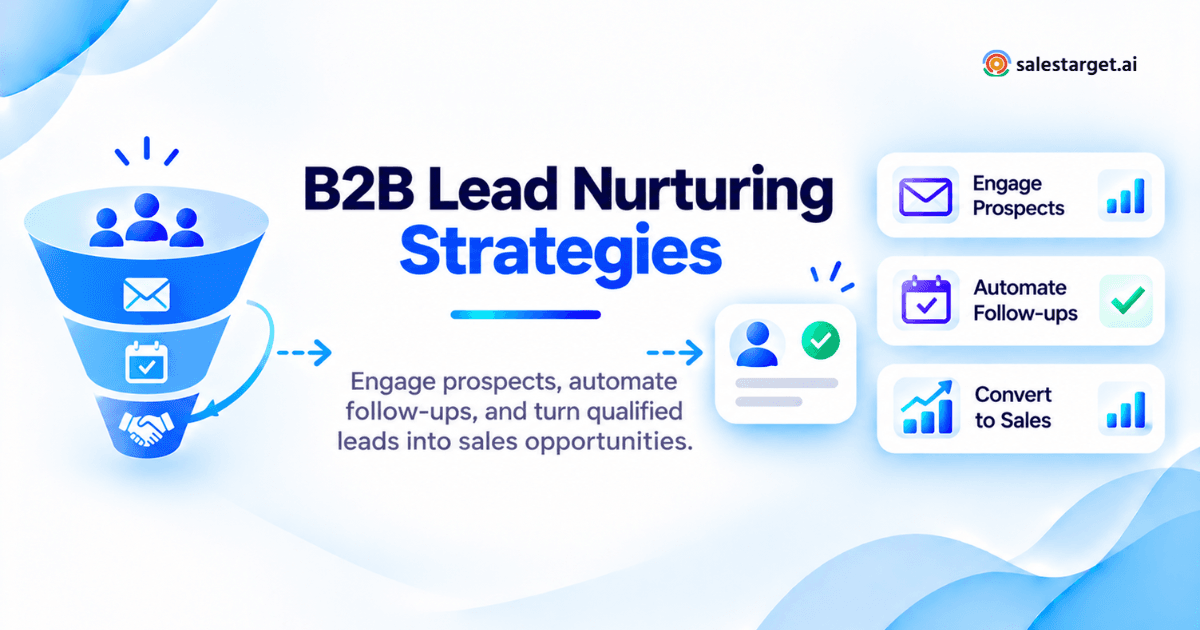
B2B lead nurturing strategies are the repeatable ways a sales team stays useful to a qualified prospect between the first conversation and the buying moment. You group leads by fit and intent, send each group messages about problems they recognize, follow up across email and LinkedIn on a set rhythm, and stop the moment someone replies. The aim is not more touches. It is being the first vendor they contact when budget opens.
What follows is the full process: funnel stages, ten strategies that survive long sales cycles, sequence templates, automation rules, scoring, metrics, and a method for picking software. If you want the plain definition first, start with what lead nurturing means in B2B.
The B2B Lead Nurturing Gap: Why Qualified Prospects Fail to Become Sales Opportunities
Most qualified leads do not say no. They go quiet, and the follow-up stops before the buying window opens.
The Hidden Cost of Leads That Never Receive Relevant Follow-Ups
Every untouched lead is money already spent. You paid for the data, the sending infrastructure, and the rep hour that produced the first reply. John Dawes of the Ehrenberg-Bass Institute, in work published by LinkedIn's B2B Institute, estimated that roughly 5% of buyers in a category are in-market at any moment. Drop the other 95%, and you are rebuying the same audience next quarter at full price.
Why Traditional Email Drip Campaigns Fail to Maintain Buyer Interest
A drip campaign runs on a calendar. A buyer runs on a trigger: a new hire, a funding round, a tool that broke. Five scheduled emails about the same feature set will not match any of those moments, and by email three the prospect has learned the messages are not about them.
The Shift From Repeated Follow-Ups to Buyer-Focused Sales Engagement
The fix is not a longer cadence. It is changing what triggers the next message. Engagement-led nurturing watches for a reply, a role change, a hiring spike, or an intent topic, then sends something that references the change. Fewer sends, better timing, higher reply quality.
B2B Lead Nurturing Explained: From First Contact to Sales-Ready Opportunities
Lead nurturing is the work between "we know who they are" and "they are ready to talk price."
Lead Generation vs. Lead Nurturing vs. Sales Follow-Up
Lead generation finds and verifies the contact. Lead nurturing keeps a qualified contact engaged until their timing changes. Sales follow-up is the single next action on an active conversation. Teams that merge all three into one sequence end up sending closing language to people who are still scoping the problem.
The B2B Lead Nurturing Process Across the Sales Funnel
The process runs in five moves: segment by fit and intent, match a message to each segment, send across email and LinkedIn, score the response, then route to a rep or recycle. Each move has an owner and a CRM record. A nurturing process with no owner is a mailing list.
The Role of Lead Nurturing in Long B2B Sales Cycles
In a nine-month cycle, the deal is decided in rooms you are not in. Gartner's buying research puts supplier meetings at about 17% of total buying time, and that 17% is split across every vendor on the shortlist. Nurturing content is what argues your case during the other 83%.
Sales and Marketing Responsibilities Across the Nurturing Process
Marketing owns the content, the segments, and the top-of-funnel tracks. Sales owns the named accounts, the reply handling, and the pipeline record. The handoff rule that prevents most fights: whoever sent the last message owns the next action until the CRM says otherwise.
The B2B Lead Nurturing Framework Across ToFu, MoFu, and BoFu
Three stages, three different jobs. Sending BoFu language to a ToFu lead is the most common reason reply rates collapse.
ToFu: Educating New Prospects and Building Early Interest
The lead fits your ICP and has shown no buying behavior. Your job is recognition: name the problem in their words, cite something they can verify, ask nothing bigger than a reply. No demo links at this stage.
MoFu: Engaging Qualified Leads With Relevant Content and Conversations
The lead has replied, opened a comparison page, or changed roles into a buying seat. Your job is proof: how a similar team solved the same problem, what the rollout looked like, what it replaced. Ask for a conversation, not a contract.
BoFu: Converting High-Intent Prospects Into Sales Meetings and Opportunities
The lead is evaluating vendors and pulling other stakeholders in. Your job is risk removal: migration steps, security answers, a side-by-side against the tool they already pay for, a calendar link.
Matching Buyer Intent Signals, Content, and Outreach to Each Funnel Stage
| Stage | Signal that puts them here | Content that fits | Outreach move |
|---|---|---|---|
| ToFu | ICP match, no activity | Problem framing, benchmark data | Short email, LinkedIn connect |
| MoFu | Reply, repeat opens, role change, hiring spike | Workflow walkthrough, customer story | Email thread plus LinkedIn DM |
| BoFu | Pricing page visit, intent topic spike, second stakeholder engaged | Comparison, migration plan, security brief | Direct meeting ask, multi-contact outreach |
Salestarget.ai reads those stage signals from the data layer, not from guesswork. Lead Explorer tracks 4,000+ intent and buyer signals plus business events (funding rounds, hiring spikes, leadership changes) on a 30 to 90 day lookback, so a lead moves from ToFu to MoFu when something real changed at the account.
10 B2B Lead Nurturing Strategies That Build a Qualified Sales Pipeline
These are the ten that hold up when the sales cycle runs past a quarter.
1. Segment B2B Prospects by Buyer Fit, Intent, and Sales Readiness
Run two axes, not one: fit (industry, size, tech stack, revenue) and intent (what they did recently). Four buckets come out of it. The high-fit, low-intent bucket is where nurturing earns its money, and it is the bucket most teams delete.
2. Use Accurate Contact Data to Reach the Right Decision-Makers
A nurturing sequence aimed at a stale contact teaches your domain's reputation a bad lesson. Verify at the moment you pull the lead, not whenever the record was first scraped. Enrichment that runs at discovery is the difference between a 2% bounce rate and a blacklisted domain.
3. Personalize Nurturing Messages Around Industry and Buyer Pain Points
Personalization is not a first name token. It is naming the operational problem that role has this quarter. A RevOps manager cares about routing rules and attribution; a founder cares about cost per meeting. Same product, two different emails.
4. Build Targeted Email Sequences for Different Prospect Segments
One sequence per segment, three to five steps each. Keep the first touch under 90 words and make step two a different angle rather than a reminder. Email Outreach builds the multi-step sequence from a plain-English description of the audience, then varies the copy with spintax so 500 sends do not look like one template.
5. Combine LinkedIn and Email for Multichannel Lead Nurturing
Email gets ignored; a profile view plus a connection request gets noticed. Run them as one flow: connect on LinkedIn, let the email land two days later, reference neither. LinkedIn Outreach coordinates both channels in a single sequence so context carries across without two reps touching the same person.
6. Use Buyer Behavior and Company Signals to Guide Follow-Up Timing
Funding rounds, hiring spikes, and leadership changes reset a buying window. A VP who started six weeks ago is replacing tools; a VP in year four is defending them. Time the send to the event, not to day seven of a cadence.
7. Share Relevant Content, Product Evidence, and Customer Stories
Send the artifact a buyer can forward. Remember that most of the selling happens without you in the room, so a one-page comparison or a 90-second workflow clip does more than a long deck. Forwardability is a feature.
8. Engage Multiple Stakeholders Within High-Value B2B Accounts
Gartner puts a complex B2B buying group at six to ten decision-makers. Nurturing one contact in a ten-person committee is a single point of failure, and when that person leaves, the deal leaves. Add two more contacts per target account with different messaging for each role.
9. Re-Engage Cold Leads With New Information and Relevant Offers
A re-engagement email needs one new thing: a shipped feature, a fresh benchmark, a change at their company. "Just checking in" is not new information. Set a 90-day timer on every closed-lost and not-now lead, then re-enter them with the new thing attached.
10. Connect Sales Conversations, Follow-Up Ownership, and CRM Pipeline Tracking
The nurturing strategy dies at the CRM boundary when replies live in one tool and deals in another. Keep the reply, the owner, the task, and the deal stage on one timeline. Salestarget.ai's built-in CRM creates the follow-up task automatically when a lead replies or a meeting ends, which is how teams reach a 91% follow-up completion rate instead of relying on memory.
Building a B2B Lead Nurturing Campaign From Strategy to Execution
A campaign is a segment, a message set, a cadence, and an exit rule. Missing any one of the four turns it into spam.
Define Campaign Goals, Target Accounts, and Lead Qualification Criteria
Pick one outcome per campaign: meetings booked, stage-two opportunities, or reactivated accounts. Write the disqualification rule before you write the first email. If you cannot say who should leave the campaign, you have not defined who belongs in it.
Create Separate Nurturing Tracks for Inbound, Outbound, and Recycled Leads
An inbound lead already knows your name. An outbound lead does not. A recycled lead told you no once and remembers. Three tracks, three opening lines, never one shared sequence.
Develop Buyer-Focused Content for Each Nurturing Stage
You need fewer assets than you think: one problem piece, one workflow piece, one proof piece, one comparison piece per segment. Four assets cover a 21-day cadence. Build the comparison piece first, since it is the one that gets forwarded.
Set Follow-Up Cadences Based on Prospect Engagement and Sales Timing
Start at three to four days between touches, stretch to seven after step three, and move to monthly once a lead says not now. Compress only on a live signal. Engagement should shorten the gap; silence should lengthen it.
Establish Campaign Entry, Exit, and Suppression Rules
Write these as hard rules: a reply exits the sequence, an opt-out suppresses the domain, an open opportunity blocks new campaign entry, and a disqualified lead never re-enters without a new signal. Suppression lists matter more than copy.
Assign Sales Ownership and Document Next Actions in CRM
Every live conversation gets a named owner and a dated next action inside the hour. Unibox sorts replies by intent (Interested, Follow-Up, Not a Fit), assigns an owner, and syncs the deal to CRM, so ownership is set at the reply rather than at the weekly pipeline review.
B2B Lead Nurturing Examples, Email Sequences, and Campaign Templates
Five sequences cover almost every nurturing situation a B2B team faces.
Educational Nurturing Sequence for New B2B Leads
Four steps over 12 days. Open with the problem and one data point. Step two shows how peer teams handle it. Step three offers a short resource with no form. Step four asks a single question that is easy to answer in one line.
Multichannel Email and LinkedIn Sequence for Interested Prospects
Day 1 connection request with no pitch. Day 3 email referencing the trigger that qualified them. Day 6 LinkedIn DM with the proof asset. Day 10 email with a meeting ask and two concrete time slots.
Follow-Up Sequence for Prospects Who Are Not Ready to Buy
Acknowledge the timing, ask when the review period opens, then set a dated task for that month. One useful message every four to six weeks until the date arrives. Nothing in between, which is the part most reps get wrong in the other direction.
Re-Engagement Campaign for Cold and Inactive B2B Leads
Three steps. Lead with what changed on your side or theirs, offer a low-friction next step, and close with a permission question that makes "no" easy. A clean no is worth more than a silent record.
Post-Demo Follow-Up Sequence for High-Intent Sales Opportunities
Same-day recap with the three things they asked about. Day 2, send the forwardable one-pager addressed to the stakeholder who was not on the call. Day 5, a direct question about the decision process. Day 9, a timeline check with a specific date.
Sample 21-Day B2B Lead Nurturing Campaign With Messaging, Timing, and Next Actions
| Day | Channel | Message focus | Next action if no reply |
|---|---|---|---|
| 1 | Connection request, no pitch | Continue to email | |
| 2 | Problem framing plus one benchmark | Hold | |
| 5 | Workflow walkthrough for their role | Hold | |
| 8 | DM with customer story | Add second stakeholder | |
| 12 | Comparison asset against incumbent tool | Hold | |
| 16 | Meeting ask with two time slots | Route to AE if opened twice | |
| 21 | Permission close, offer quarterly check-in | Move to 90-day recycle |
Any reply at any point ends the sequence and creates an owned task. That single rule prevents the most visible nurturing failure: an automated follow-up landing after a prospect already said yes.
Lead Nurturing Automation: Building Workflows That Respond to Buyer Activity
Automation should decide timing and drafting. Reps should decide judgment calls. Mixing those up is how teams end up apologizing to prospects.
Time-Based vs. Behavior-Based Lead Nurturing Workflows
Time-based workflows fire on a schedule and work for cold ToFu volume. Behavior-based workflows fire on an action and belong in MoFu and BoFu. Run both, and let any behavior trigger override the calendar.
Triggering Follow-Ups From Replies, Content Engagement, and Buying Signals
The triggers worth wiring: a reply of any sentiment, two opens on the comparison asset, a profile view back, a new intent topic on the account, and a leadership change. Each one should change the next message, not just the send time.
Using AI to Draft Personalized Nurturing Messages and Email Sequences
AI is good at the first draft and the variant set, weak at knowing which account matters. AI Copilot generates full personalized sequences in seconds, adapts them by role, industry, and company size, and builds A/B variations, which is where the 35% faster campaign creation comes from. A rep still picks the account and approves the ask.
Coordinating Automated Email Outreach and LinkedIn Engagement
Run one sequence across both channels with conditional branching on replies and actions. Timezone-aware scheduling, working-hour limits, and human-like delays keep LinkedIn activity inside safe rate limits while email continues on its own pacing.
Pausing Automated Sequences When Prospects Reply or Change Status
Auto-pause on reply is non-negotiable, and it should also pause sibling sequences the same contact sits in. Add auto-pause on deal creation and on opt-out. One contact in three active sequences is a deliverability problem and a credibility problem at once.
Connecting Automated Outreach to CRM Tasks and Sales Follow-Ups
The workflow is only finished when the reply becomes a task with an owner and a date. Campaign leads should land in the CRM without imports, every email and call logged to the lead timeline, and a follow-up task created automatically when a meeting ends. Start a campaign, and the pipeline record builds itself. Try it free.
Lead Scoring, Buyer Intent, and Sales Qualification
Scoring exists to answer one question: who gets a rep's next hour?
Building a Lead Scoring Model Around Buyer Fit and Engagement
Score fit and engagement separately and never add them into one number. A perfect-fit account with zero activity needs nurturing; a poor-fit account with heavy activity needs disqualifying. A single blended score hides both cases.
Identifying High-Intent Actions That Deserve Sales Attention
The actions that predict a meeting: a reply with a question in it, a second contact from the same domain engaging, a pricing or comparison page visit, and an accepted connection followed by a profile view back. Opens and clicks rank far below all four.
Separating Marketing Qualified Leads From Sales Qualified Leads
An MQL matched your criteria. An SQL has a named problem, a rough timeline, and someone willing to take a call. Write the SQL definition as three checkboxes a rep can tick in ten seconds, or the handoff argument never ends.
Creating Lead Routing Rules for SDRs, BDRs, and Account Executives
Route by account value and signal type, not round robin. High-intent enterprise signals go to an AE the same day. Mid-market replies go to the SDR who owns the sequence. Anything with no signal stays in nurturing and never enters a rep's queue.
Managing Lead Handoffs, Rejected Leads, and Recycled Opportunities
Rejected leads need a reason code and an automatic return path. Tag the rejection (wrong role, no budget, no timeline), send it back to the matching nurturing track, and set the recycle date. Recycled leads close at a better rate than fresh cold leads, since the fit question is already answered.
Measuring B2B Lead Nurturing Performance and Pipeline Impact
If a nurturing report leads with open rates, it is measuring activity rather than revenue.
Lead Engagement Metrics: Replies, Positive Responses, and Meetings
Track reply rate, positive reply rate, and meetings booked per 100 contacted. Positive reply rate is the honest one: it separates "you reached a real inbox" from "you said something worth answering."
Lead-to-Opportunity Conversion Rate and Sales Acceptance Rate
Measure what share of nurtured leads become opportunities, and what share of routed leads a rep accepts. A high conversion rate with a low acceptance rate means your scoring model is too generous and reps have stopped trusting the queue.
Sales Cycle Length, Pipeline Velocity, and Opportunity Progression
Compare cycle length for nurtured leads against cold-start deals. Nurtured deals should enter at a later stage and move faster, since the education happened before the first call. Teams using an outbound-native CRM report deal cycles moving 3.2X faster once the timeline lives in one place.
Measuring Pipeline Created and Revenue Influenced by Nurturing
Report two numbers to leadership: pipeline value sourced by nurturing campaigns, and pipeline value touched by at least one nurturing message before close. The second number is bigger and more honest about how committee buying works.
Identifying Campaign Drop-Off Points and Improving Nurturing Performance
Find the step where replies stop. Drop-off at step one is a targeting or data problem. Drop-off at step three is a relevance problem. Drop-off after a meeting is a qualification problem. Fix the stage that broke, not the subject line.
Common B2B Lead Nurturing Mistakes That Reduce Sales Conversions
Six failures account for most lost nurturing pipeline.
Sending Generic Content to Prospects With Different Buying Needs
One asset sent to every segment teaches the whole list to ignore you at once. Segment first, write second.
Following Up Without Considering Buyer Timing and Intent
A perfectly written email sent in a dead quarter still fails. Watch for the event that changes the timing, then send.
Confusing Email Opens With Meaningful Sales Interest
Opens have become close to meaningless as a signal since privacy proxies started pre-fetching images. Score replies, page visits, and second-stakeholder activity instead, and stop routing leads to reps on open counts alone.
Ignoring Multiple Decision-Makers During Long Sales Cycles
Single-threaded deals die when your contact changes jobs. Add a second and third contact at every account that reaches MoFu, each with messaging written for their role.
Losing Conversation History Between Email, LinkedIn, and CRM
When a rep has to check three tools to see what was already said, the follow-up gets vaguer each time. A unified reply inbox and a single lead timeline fix more pipeline leakage than better copy does.
Continuing Outreach After Opt-Outs, Negative Replies, or Disqualification
This is the one that costs domains. Suppress at the domain level, not just the address, and audit the suppression list monthly. One ignored opt-out can undo a quarter of deliverability work.
Choosing B2B Lead Nurturing Software for Sales Teams
Score vendors on where your data breaks, not on feature counts. Run every shortlisted tool through the same six checks below with one real segment of 50 leads.
B2B Lead Discovery, Contact Enrichment, and Data Quality
Ask when the contact was last verified, not how many records the database holds. Enrichment at the moment of discovery beats a larger list refreshed on an unknown schedule. Salestarget.ai covers 840M+ verified professional profiles and 146M+ business entities across 50+ data sources, with verification happening at the point of enrichment.
Email Outreach Automation and LinkedIn Engagement Features
Check whether the two channels share one sequence and one reply view. Most cold email platforms have no LinkedIn automation at all, which means a second tool and a second version of the truth about every conversation.
Email Verification, Sending Controls, and Deliverability Support
Look for MX and SMTP checks, disposable-domain detection, inbox rotation, warm-up, and SPF, DKIM, and DMARC validation. Email validation that runs before sending is what keeps 90% of emails validated pre-send and keeps domains off blacklists.
CRM Integration, Contact Ownership, and Pipeline Management
Decide whether you want a CRM integration or a CRM. Integrations sync fields; a native CRM keeps the reply, the call, the task, and the deal stage on one timeline without a mapping layer to maintain.
AI Assistance, Workflow Management, and Reporting Capabilities
Test the AI on a real segment and read the output as a buyer would. Useful AI drafts sequences, flags at-risk deals, and answers plain-language questions about your pipeline. Decorative AI rewrites subject lines.
Comparing All-in-One Sales Platforms With Separate Nurturing Tools
The honest comparison method: count the handoffs, not the features. For each tool, write down how a lead travels from discovery to closed deal and mark every CSV export, every manual sync, and every place ownership can be lost. Apollo gives data and engagement but leaves deliverability and CRM to other vendors. Instantly, Smartlead, and Lemlist handle cold email and deliverability with no native B2B database, no LinkedIn automation, and no real CRM. A stack with four handoffs will lose leads at all four, regardless of how good each tool is on its own.
Why Choose Salestarget.ai for B2B Lead Nurturing?
Salestarget.ai runs lead discovery, multichannel outreach, validation, and pipeline tracking in one workspace, so a nurtured lead never leaves the system to get to the next step.
Find Relevant B2B Decision-Makers With Lead Explorer
Search 840M+ profiles in plain English or stack filters for industry, role, seniority, department, company size, revenue, location, tech stack, and intent topics. One-click enrichment unlocks the verified professional email, personal email, phone, and mobile at the moment you find the lead.
Create Personalized Email Campaigns and Automated Follow-Up Sequences
Describe the audience in plain English and the platform builds the multi-step sequence with first touch, follow-ups, and pacing. Unlimited inboxes, automatic AI warm-up, and intelligent inbox rotation carry the volume without burning sender reputation.
Build Professional Relationships Through LinkedIn Outreach
Connection requests, DMs, follow-ups, and engagement actions run on conditional branches that react to replies and actions. Built-in rate limits, warm-up logic, and auto-pause safeguards protect the account doing the outreach.
Improve Contact Quality With Email Validation
Every address passes MX and SMTP checks, disposable-domain detection, and risk scoring before a sequence sends. Real-time API verification and bulk list cleaning connect across 60+ platforms, including CRMs and ESPs.
Manage Prospect Replies and Team Follow-Ups With Unibox and CRM
Unibox pulls every reply into one view, sorts by intent, assigns an owner, and syncs the deal. Inside the CRM, campaign leads land without imports, calls route through a built-in dialer with automatic logging, and follow-up tasks appear when a lead replies or a meeting ends.
Use AI Copilot to Create Campaigns and Analyze Sales Engagement
Ask Copilot to find leads, write a sequence, flag at-risk deals, or answer a question about this month's meetings in plain language. Its Memory feature can pull your website content so replies stay on-brand, and workspace data stays private.
Connect Lead Discovery, Outreach, and Pipeline Management in One Workspace
The handoff count drops to zero: find a lead, verify it in the same click, push it into an email and LinkedIn sequence, and close it in the built-in CRM. Teams running this way report around six hours saved per rep per week and 2.4X more meetings from the same lead volume. See how it works.
A 30-Day B2B Lead Nurturing Implementation Plan
One month is enough to get a working nurturing motion live, provided you start with the leads you already have.
Week 1: Audit Existing Leads, Define Segments, and Set Campaign Goals
Pull every lead touched in the last 12 months that never reached an opportunity. Split them into inbound, outbound, and recycled, then score each on fit and intent. Pick one goal: meetings booked from dormant leads.
Week 2: Prepare Contact Data, Outreach Messages, and Nurturing Sequences
Re-verify the whole list before a single send, since a 12-month-old record has likely decayed. Write four assets per segment and build one sequence per track. Set the suppression list and the exit rules at the same time.
Week 3: Launch Campaigns and Monitor Prospect Engagement
Launch to 20% of the list first. Watch bounce rate, positive reply rate, and which step produces replies. Hold the remaining 80% until the first cohort gives you a readable signal, usually by day five.
Week 4: Review Lead Quality, Optimize Follow-Ups, and Track Sales Opportunities
Check sales acceptance rate on routed leads, kill the sequences with zero positive replies, and rewrite the step where drop-off peaked. Then set the 90-day recycle date on everyone who stayed quiet, so month two starts with a queue rather than a blank list.
B2B Lead Nurturing FAQ
What Is B2B Lead Nurturing?
B2B lead nurturing is the process of keeping a qualified prospect engaged with relevant messages between the first contact and the moment they are ready to buy. It combines segmentation, personalized email and LinkedIn outreach, timing based on buyer signals, and CRM ownership of every reply.
How Long Should a B2B Lead Nurturing Sequence Be?
Four to seven touches over 21 days for an active segment, then monthly for leads who said not now. Length matters less than the exit rule: any reply should end the sequence immediately.
How Often Should You Follow Up With B2B Leads?
Every three to four days early in a sequence, stretching to weekly after the third touch, and monthly once a prospect gives a timeline. Shorten the gap only when a real signal appears, such as a funding round or a new hire in the buying role.
What Is the Difference Between Lead Nurturing and Lead Generation?
Lead generation finds and verifies new contacts. Lead nurturing keeps already-qualified contacts engaged until their timing changes. Generation fills the list; nurturing decides how much of that list ever becomes pipeline.
Can B2B Lead Nurturing Be Fully Automated?
The drafting, sending, timing, and task creation can be automated. Account selection, qualification calls, and negotiation stay human. Salestarget.ai automates the first set and keeps reps in control of the second.
From Prospect Engagement to Predictable B2B Sales Opportunities
The problem you started with was never a shortage of leads. It was qualified prospects going quiet, follow-ups stopping at step two, and conversations scattered across an inbox, a LinkedIn account, and a CRM that nobody updated. That gap is an operations problem, and no amount of better copy closes it.
Salestarget.ai closes it by removing the handoffs. Lead Explorer finds the decision-maker and verifies the contact in the same click. Email and LinkedIn run as one sequence that pauses the moment someone replies. Unibox sorts the reply by intent and assigns an owner. The CRM creates the follow-up task and keeps every email, call, and deal stage on one timeline. Nothing drops between tools, since there are no gaps between tools to drop into.
Start with the dormant leads already sitting in your pipeline, run one 21-day nurturing campaign against them, and measure positive replies rather than opens. Start free with Salestarget.ai.