Every SDR, marketer, and bootstrapped founder eventually asks the same question before their next cold campaign: can I get away with a free email verifier instead of paying for a full validation platform? The appeal is obvious. Free tools promise instant list cleaning, no credit card, and just enough features to look like a real solution. For a team burning budget on ad spend, LinkedIn Sales Navigator, and enrichment data, cutting one line item feels like a small win.
The problem is that email deliverability is unforgiving. A bounced list does not just waste sends — it damages sender reputation, tanks open rates, and can pull an entire domain into spam folders for months. This guide breaks down where free email validation genuinely works, where it silently costs you more than a paid tool ever would, and how to pick a AI-powered email validation solution that matches how you actually run outbound.
The Real Value of Email Verification for Outbound Teams
Inbox providers have quietly rewritten the rules of cold outreach. Google and Yahoo now enforce stricter sender requirements for anyone sending more than 5,000 messages a day, including authenticated DMARC, one-click unsubscribe, and a hard bounce-rate ceiling. Google's sender guidelines specifically call out keeping spam complaint rates below 0.3% — a threshold most uncleaned lists will breach within a single send.
The financial stakes are just as real. Validity's 2024 Email Deliverability Benchmark found that roughly 1 in 6 legitimate marketing emails never reach the inbox, and poor list hygiene remains the leading contributor. In a cold outbound context — where you are often unknown to the receiving mail server — that ratio gets worse. Every bounce is a signal to filters that you may be a scraped-list sender, and reputation, once damaged, takes weeks to rebuild.
That is why free email verification has moved from a nice-to-have to a baseline check. Even a rough pre-send scrub is better than none, because the alternative is training Gmail and Outlook to distrust your domain.
Key Validation Features of a Free Email Verifier
Most free email validation tools run a similar sequence of checks. Understanding what happens under the hood makes it easier to judge whether the results you're getting are trustworthy.
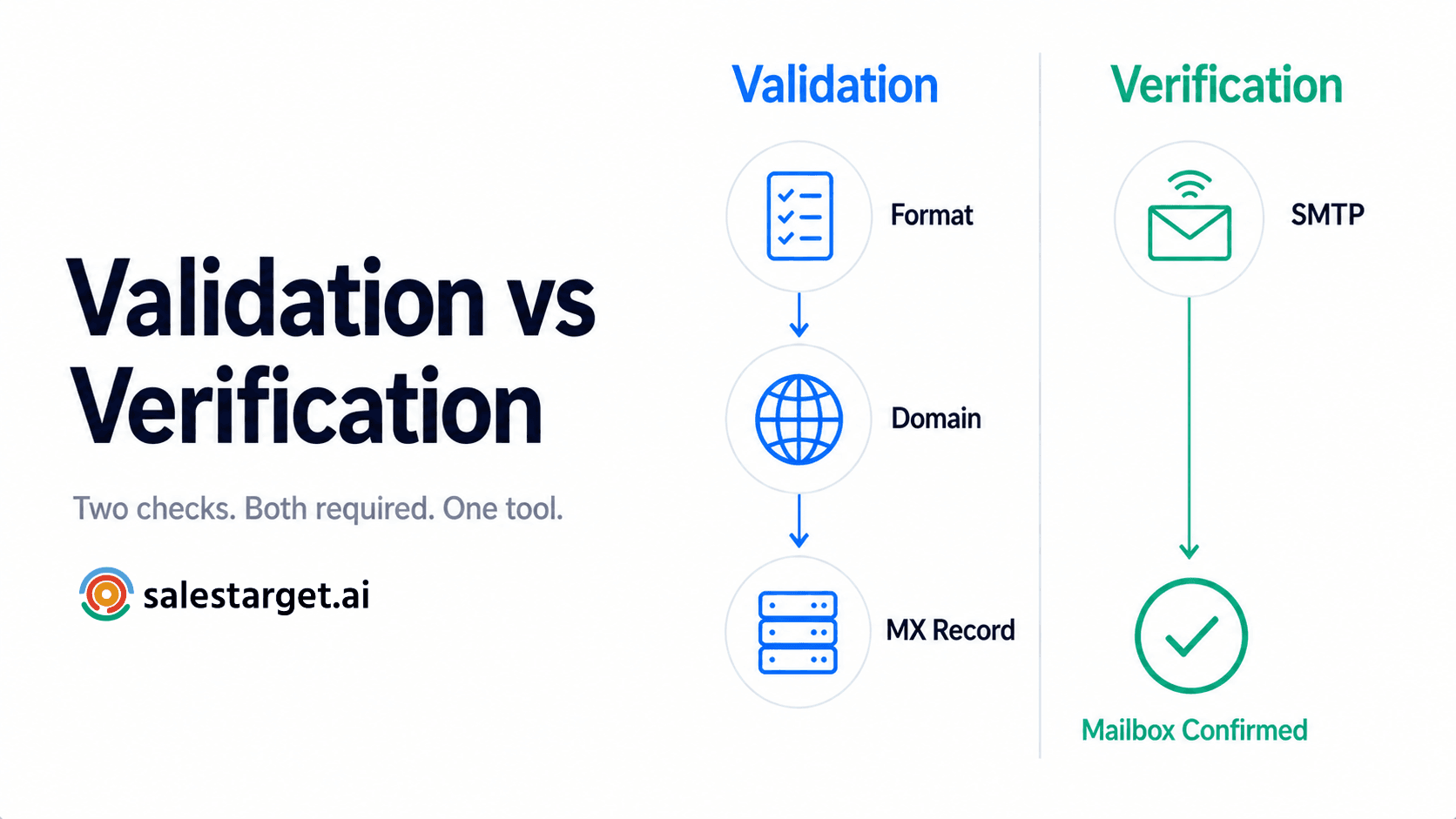
- Syntax validation — Confirms the address follows RFC 5321/5322 formatting rules.
- MX record lookup — Verifies the domain has mail exchange servers configured.
- Disposable domain detection — Flags temporary inbox services often used to sidestep signups.
- Catch-all detection — Identifies domains that accept every address, which inflate false positives.
- Role-based flags — Warns on info@, support@, sales@ addresses that hurt engagement.
- SMTP verification — Opens a handshake with the mail server to test whether the mailbox exists.
A solid email verifier online should handle all six. The gap between free and paid usually shows up in step four and step six — catch-all and SMTP — where accuracy is expensive to maintain at scale.
The Hidden Costs of Free Email Verifiers
Free never really means free once you are running outbound at any real volume. The hidden costs of free verifier tools show up in three places: the numbers they let through, the numbers they mislabel, and the time your team spends working around their limits.
- Verification caps — Free email verification limits typically sit between 50 and 500 checks per day, forcing manual batching.
- Outdated databases — Disposable-domain and blocklist databases often lag weeks behind the paid equivalents.
- Weak SMTP handling — Many free tools cannot handle greylisting, tempfails, or Microsoft 365 accept-all responses correctly.
- No bulk verification — CSV upload is either missing or capped to a few hundred rows.
- Limited API access — Without a real API, you cannot verify at the point of capture inside your forms or CRM.
- Slower processing — Shared infrastructure means a 10K list can take hours instead of minutes.
Freemium verifier accuracy also tends to plateau around 85–92%. That sounds close to enterprise-grade — until you realize a 10% error rate on a 20,000-lead list means 2,000 bounces headed straight at your sender reputation.
⚠ Common Mistakes When Using Free Verifiers
Trusting a single tool's verdict on catch-all domains — always cross-check high-value catch-alls before sending.
Uploading the same list twice to bypass daily caps — most providers deduplicate silently, wasting your quota.
Skipping SPF, DKIM, and DMARC setup because "the list is clean" — verification only handles one side of deliverability.
Verifying at send time only, not at signup — bad addresses keep re-entering your database.
Free vs Paid Email Checker: A Practical Comparison
Here is how the two categories actually compare on the criteria that matter for outbound sales. The free vs paid email checker gap widens sharply once you move past casual, low-volume use into any kind of repeatable pipeline motion. If you are still evaluating the email verifier free tier of most providers, this table should make the trade-offs concrete.
| Criteria | Free Email Verifier | Paid / Enterprise Verifier |
|---|---|---|
| Accuracy | 80–92% on average | 97–99%+ with confidence scoring |
| Daily Limits | 50–500 checks/day | Unlimited or plan-based, in millions |
| API Access | Rarely available | Full REST API with SDKs |
| Integrations | None or one-off | CRM, ESP, Zapier, custom webhooks |
| Bulk Verification | Small CSVs only | Multi-million lists, parallel processing |
| Catch-all Detection | Basic or missing | Advanced probabilistic detection |
| Support | Community forums | Priority chat, email, dedicated CSM |
| Reporting | Basic pass/fail | Deliverability scores, risk tiers, logs |
| Automation | Manual only | Real-time API, scheduled cleaning |
| Compliance | Unclear GDPR posture | GDPR, SOC 2, encryption at rest |
The pattern is consistent across a free vs enterprise verifier comparison: free tools are optimized for one-off checks, paid tools are optimized for continuous list health. If you send more than a few hundred cold emails a week, the second column is where you'll live.
💡 Expert Tip From the Trenches
Before switching verifiers, run the same 500-email sample through both tools and compare results against your actual bounce logs from the next send. Vendors will always claim 98%+ accuracy — your bounce rate is the only number that tells the truth. Pair verification with free email domain detection to separate personal Gmail hits from real B2B mailboxes before you even start verifying.
When a Free Email Verifier Is Enough
Not every use case demands enterprise validation. A free email verifier is a perfectly reasonable choice when:
- You are a student or job seeker checking a handful of contact addresses.
- You are a freelancer sending fewer than 100 cold emails a month.
- You are running a one-off event invite or announcement to a small vetted list.
- You are testing a new provider before committing to a paid plan.
In these scenarios, the accuracy trade-off is minor and the volume is low enough that a bad send won't wreck your sender reputation for a quarter.
The Advantages of Paid Email Verification Solutions
Once outbound becomes a repeatable channel, the math flips. SDR teams sending 50–500 emails per rep per day, agencies managing client domains, and startups scaling multi-inbox sequences cannot afford a 10% error margin. A single bounce spike above 4–5% can put a domain on Microsoft's or Google's filtering radar for weeks.
Paid verification pays for itself the moment it protects one warmed-up inbox. Add CRM sync, real-time API validation at form fill, and bulk cleaning of enrichment exports, and you're saving hours of manual work per week — plus the far larger cost of lost meetings from emails that never landed. This is also where why email finder accuracy affects deliverability becomes non-negotiable: verification is only as strong as the source data feeding into it.
Free email verifiers are not scams — they are simply built for a different job. They shine on small, occasional lists and fail quietly at outbound scale. The hidden cost is almost never the verifier itself; it is the deliverability damage, the wasted sends, and the meetings that never got booked because your domain landed in Promotions or Junk.
Balance budget with reputation. Start free if the volume genuinely justifies it, upgrade the moment your outbound becomes a real channel, and never let a saved subscription line turn into a burned sending domain. Your future pipeline will thank you.