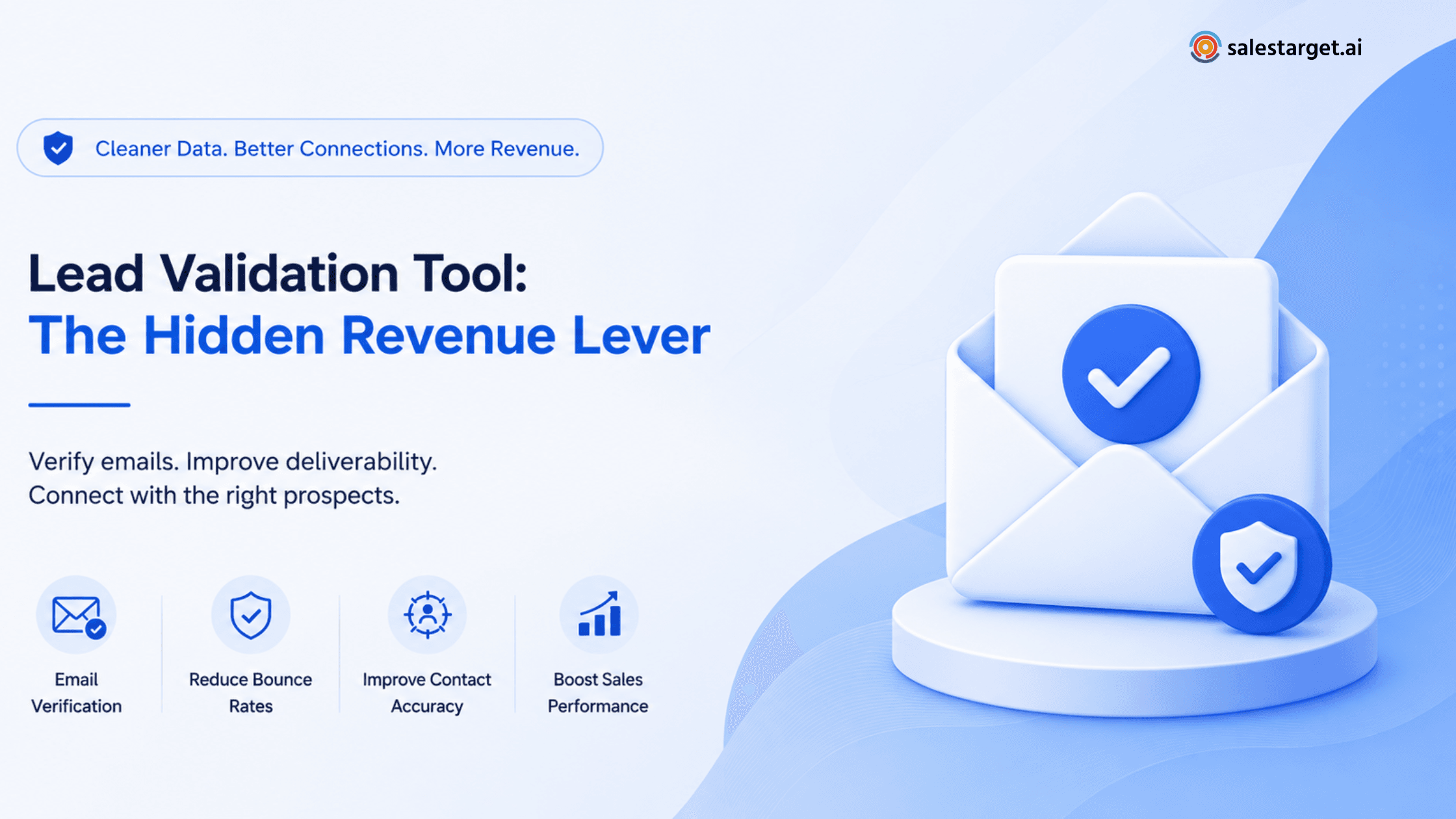
A lead validation tool is software that checks whether the contact data in your CRM or outbound list is accurate and usable before you send a single email. For most B2B sales teams, this means verifying email addresses to confirm they exist, are properly formatted, and are unlikely to bounce.
It matters for revenue because bad email data silently destroys campaign performance. When sales reps send to invalid addresses, bounce rates climb, sender reputation suffers, and fewer real prospects ever see your message. A lead validation tool stops that waste before it starts.
At its core, lead validation through email verification is about making sure every outreach dollar reaches someone real — not a dead inbox, a typo, or a deactivated account.
What Is a Lead Validation Tool?
If you've spent any time researching ways to improve outbound results, you've likely come across the term. But what is lead validation, exactly?
In the context of email-based outreach, a lead validation tool is a system that runs your contact list through a series of checks to confirm whether each email address is valid and deliverable. It identifies malformed addresses, catches common typos, flags role-based emails like info@ or noreply@, and detects addresses tied to inactive or non-existent domains.
The result is a clean, verified list your team can actually use — rather than a spreadsheet full of emails you hope are real.
This is more than a hygiene task. It's foundational to every outbound motion your team runs.
Why Bad Email Data Costs More Than Most Teams Realize
Here's a scenario most sales leaders know all too well: a rep fires off a sequence to 500 contacts. Bounce notifications pile up. Email open rates look dismal. A few weeks later, your domain lands on a blocklist.
The culprit? Bad email data.
According to research from HubSpot, B2B contact databases decay at a rate of roughly 22% per year. That means if you built your list twelve months ago and haven't verified it since, more than one in five contacts may already be unreachable.
The problem compounds quickly. High bounce rates signal to email providers like Google and Microsoft that your domain sends to invalid addresses — a flag associated with spam behaviour. Once your sender reputation takes a hit, even your legitimate emails start landing in junk folders. And at that point, you're not just losing a campaign. You're losing access to your prospects' inboxes entirely.
Original Insight
An internal review of outbound workflows at SalesTarget.ai found that teams reducing invalid emails by even 15–20% saw measurable improvements in deliverability and reply rates within a single campaign cycle. The math is simple: cleaner lists mean more emails land, more emails land means more replies, and more replies means more pipeline.
How Email Verification Improves Contact Accuracy
Email verification is the mechanism behind effective lead validation. When you run a list through an email verification tool, each address is evaluated against several criteria:
- Syntax checks catch obvious formatting errors — addresses missing the @ symbol, domains without a TLD, or other structural problems that would guarantee a bounce.
- Domain validation confirms the domain actually exists and has active mail exchange (MX) records. An address at a real-looking but inactive domain will fail here.
- Mailbox verification pings the receiving mail server to check whether the specific mailbox exists, without sending an actual email.
- Disposable and role-based detection flags temporary email addresses or generic inboxes like info@ or noreply@ that rarely convert into real conversations.
The output is typically a clean/valid, risky, or invalid classification for each record. Your team acts on the clean list. Simple.
What's notable is how this single step ripples outward. Better contact accuracy means higher deliverability. Higher deliverability means better domain health. Better domain health means your future campaigns perform better too — not just the current one.
The Revenue Impact of Better Email Data
Let's connect this to numbers. If your sales team sends 1,000 emails per week and 20% are going to invalid addresses, you're burning 200 touches per week on contacts who will never receive your message. That's 10,400 wasted outreach attempts per year.
More importantly, it's 10,400 opportunities to damage your sender score.
Understanding how lead validation reduces email bounce rates is key to quantifying the ROI. Reducing invalid emails directly lowers your bounce rate, which protects deliverability, which ensures more of your messages reach the inbox. Each of those improvements compounds.
Sales teams that invest in email verification before running campaigns consistently see higher open rates, better response rates, and more meetings booked — not because the copy improved, but because more of the right people are actually receiving the emails.
Key Features to Look for in a Lead Validation Tool
Not all email verification tools are built the same. When evaluating options, here's what matters:
- Real-time verification: Check emails as they enter your CRM, not just in bulk after the fact.
- Bulk list processing: Upload large CSVs and get results quickly — especially important before campaign launches.
- Catch-all domain detection: Some domains accept all incoming mail regardless of whether the mailbox exists. Good tools flag these as risky rather than clean.
- Deliverability scoring: Beyond valid/invalid, a quality score helps prioritize which contacts to engage first.
- Integration-ready output: Results should be easy to export back into your CRM or sequencing tool.
One nuance worth understanding: the terms validation and verification are often used interchangeably, but they aren't identical. If you're unsure of the distinction, the breakdown of email validation vs email verification is worth reading before you choose a tool.
How SalesTarget.ai Helps Verify Emails Before Outreach
SalesTarget.ai's email verification product at salestarget.ai/email-validator is built for B2B sales teams who want to clean their contact lists quickly and confidently.
The tool checks each email address for syntax errors, domain validity, and mailbox existence — giving your team a clear picture of which contacts are worth reaching out to before any emails go out. It handles both bulk verification for existing lists and can be used to spot-check individual addresses on the fly.
The focus is narrow and intentional: catch the bad emails before they catch you. No overcomplicated dashboards, no feature bloat — just clean data you can act on.
For teams running regular outbound sequences, running lists through verification before every campaign is a straightforward habit that pays off consistently.
Your sales team's outbound performance isn't just a function of how good your copy is or how well you've segmented your audience. It depends on whether the emails you send actually land in front of real people.
A lead validation tool — built on email verification — is the unglamorous but essential step that most teams skip. They focus on the message. They ignore the list. And then they wonder why results plateau.
If your CRM is feeding your sequences with unverified data, you're working harder than you need to for results that are smaller than they should be. Verification doesn't just clean your list. It cleans up your entire outbound motion.
Start with your next campaign. Verify the list before it goes out. See what changes.