Every sales team has lived through the same frustration. An SDR builds a prospect list on Monday, launches outreach on Tuesday, and by Wednesday half the emails have bounced, the phone numbers ring to disconnected lines, and the 'decision-maker' job title moved to a new company six months ago. The sequence looks productive on paper, but the pipeline numbers tell a different story.
That failure almost never traces back to the sequence, the copy, or the SDR. It traces back to the data.
The best B2B contact data sales intelligence tools solve this at the source: they combine deep, verified contact records with signals that tell you who to talk to and when. SalesTarget.ai is an AI-powered B2B sales platform built around this exact idea - pairing a verified contact database with Lead Explorer so prospecting and outreach stay connected inside one workflow.
This guide gives you a data-first framework for comparing tools in this category — the things that actually determine whether your pipeline grows, not the feature checklists that make demos look impressive.
Why B2B Contact Data Quality Decides the Outcome of Your Sales Motion
Sales intelligence software is only as useful as the data underneath it. A beautifully designed interface, elegant filters, and a slick CRM integration all collapse the moment the underlying contact records are stale, incomplete, or wrong.
The business cost of poor data compounds quickly. Bounced emails damage sender reputation, which drops future deliverability for the clean addresses too. Phone outreach to disconnected lines eats SDR capacity. Outreach that targets the wrong persona creates negative brand impressions with the people you most want to convert later. And forecasting built on bad firmographic data produces territory plans that aim at empty space.
The best contact data sales intelligence tools treat this as a continuous engineering problem — not a one-time scrape. They re-verify records, retire stale ones, and prioritize sources that reflect real-world movement: job changes, funding events, hiring patterns, technology installs.
Contact Database vs. Sales Intelligence Tool: What's the Difference?
These two terms get used interchangeably, but they describe different things, and the difference matters when you evaluate vendors.
A B2B contact database
A structured collection of business contact records - names, titles, emails, phone numbers, company affiliations. It answers the question 'who exists?' Think of it as the raw map.
A sales intelligence tool
Adds a layer of signals and context on top of the database - intent data, technographics, hiring activity, funding, org charts, buying triggers. It answers the question 'who should I talk to right now, and why?' Think of it as the map plus live traffic conditions.
The best tools in this category combine both. A pure database leaves you guessing about timing. A pure signals product without strong underlying contact records leaves you with great timing but no one to actually email.
How Reliable Contact Data Powers Sales Intelligence
Signals are only valuable if you can act on them. An intent spike at a target account is useless if the contact record for the right buyer is missing or wrong. For a broader view of how platforms layer intelligence on top of contact data, see our deeper breakdown of the sales intelligence platform for B2B sales teams.
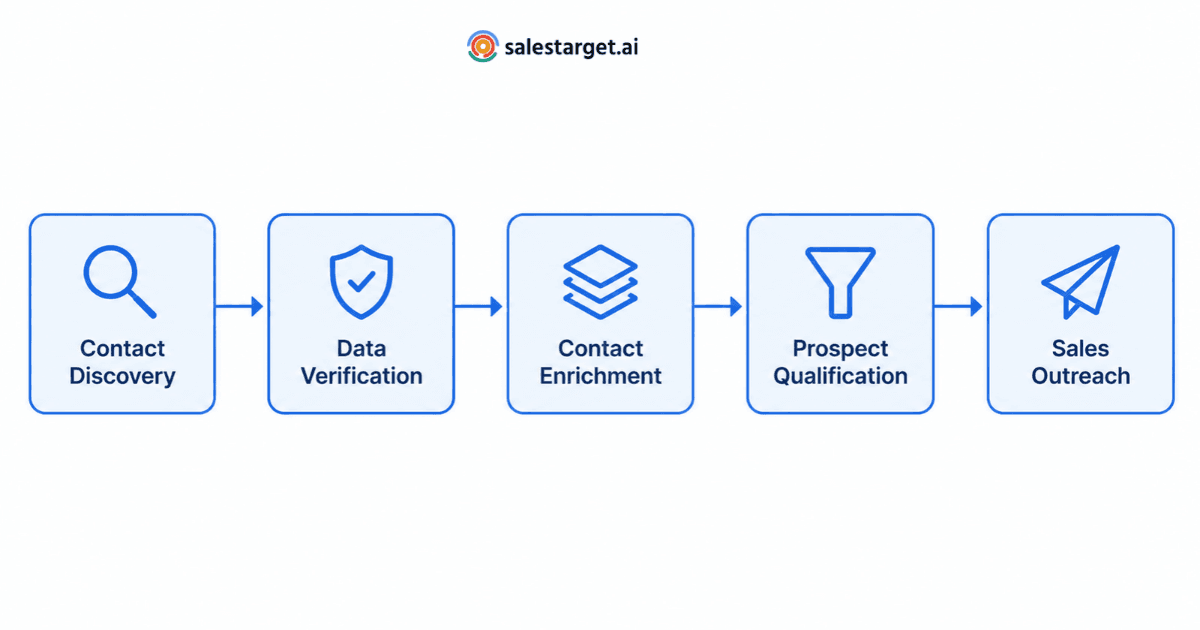
The practical workflow looks like this: contact discovery surfaces the right people, data verification confirms they are reachable, enrichment adds the context your reps need to personalize, qualification filters the list down to high-fit prospects, and outreach finally activates the sequence. Each stage depends on the one before it. Weak contact data breaks the whole chain.
The Nine Evaluation Criteria That Actually Matter
When comparing tools in this category, score each vendor against these nine dimensions. Vendors that cannot answer any of them clearly during a demo are usually ones to avoid.
1. Contact Accuracy and Verification Method
Ask how emails and phone numbers are verified, how often records are re-checked, and whether the vendor publishes a bounce-rate commitment. Multi-signal verification (SMTP checks, source cross-referencing, behavioral confirmation) beats single-signal validation.
2. Data Freshness
A record verified eighteen months ago is a liability. Ask the vendor how frequently their database is refreshed and whether they track job changes in near-real time. Freshness is the single biggest predictor of outreach performance.
3. Completeness of the Contact Profile
A usable record includes at minimum: verified professional email, direct business phone, current job title, current employer, department, and seniority. Mobile numbers, LinkedIn URLs, and historical role data are a strong bonus.
4. Firmographic Coverage
Can you filter by industry (with multiple classification systems), company size by revenue and headcount, geography down to a useful level, founding year, and ownership type? Shallow firmographic filters force you to post-process lists in a spreadsheet, which defeats the point of a platform.
5. Technographic Signals
Knowing what tools a company runs helps you prioritize accounts where your solution displaces or complements something known. Good platforms detect dozens of technology categories and update installs regularly.
6. Buyer Intent Data
Intent signals surface accounts researching topics related to your product. The question to ask: where does the intent data come from, how is it normalized, and how recent is it? Opaque 'intent' with no sourcing is a red flag.
7. Decision-Maker Identification
The platform should make it easy to find the actual buyer, not just a name at the right company. Org chart views, role hierarchies, and reports-to data distinguish strong platforms from generic contact lists.
8. CRM and Workflow Integration
The tool must push verified records and intent signals into Salesforce, HubSpot, or whatever your team already uses — without duplicates, overwrites, or manual cleanup. Native integrations beat Zapier bridges for anything you plan to use daily.
9. Coverage for Your Specific Market
A vendor can have a huge global database but thin coverage in your target geography, industry, or company-size segment. Always validate coverage against your own ideal customer profile with a sample list before committing.
A Practical Comparison Framework
Use this scoring template when evaluating any tool. Score each vendor from 1 (poor) to 5 (excellent) on each dimension. A total below 30 is a serious concern. A total above 38 is a strong candidate.
| Dimension | What to Verify | Weight |
|---|---|---|
| Accuracy | Published bounce-rate commitment; verification method | High |
| Freshness | Refresh cadence; job-change detection speed | High |
| Completeness | Email + phone + title + company + seniority present | High |
| Firmographics | Depth of industry, size, geo, and ownership filters | Medium |
| Technographics | Breadth of tracked tools; update cadence | Medium |
| Intent Data | Source transparency; recency; topic breadth | High |
| Decision-Maker ID | Org chart depth; reports-to data | Medium |
| Integrations | Native CRM sync; no duplicates on push | High |
| Market Coverage | Validated against your own ICP sample | High |
Common Mistakes When Choosing a B2B Contact Data Tool
Buying on database size alone
Total record count is a vanity metric. 500 million unverified records are worth less than 20 million verified, enriched ones.
Skipping the sample-list validation
Never commit without pulling a sample list that matches your actual ICP and manually verifying a sample of records. Vendor claims and your reality often diverge.
Ignoring workflow fit
A platform that doesn't integrate smoothly with your CRM, sequencer, and sales motion will quietly become shelfware.
Treating intent data as a black box
If a vendor cannot explain where their intent signals come from or how they are refreshed, assume they are low quality.
Confusing contact enrichment with contact discovery
Enriching a list you already have is different from building a new list from filters. Confirm the tool does the one you actually need — ideally both.
The Buyer's Checklist
Before signing with any vendor in this category, confirm:
- You have tested a sample list against your real ICP.
- You have reviewed bounce rates on a live sequence, not a vendor dashboard.
- Your CRM admin has reviewed the integration mapping.
- Intent-data sourcing has been explained in writing.
- Coverage in your top three target geographies and industries is strong.
- The platform supports both prospect discovery and record enrichment.
- The signals you care about (intent, hiring, funding, tech installs) are actually present and current.
How SalesTarget.ai Approaches B2B Contact Data and Sales Intelligence
SalesTarget.ai is built as an AI-powered B2B sales platform that connects prospect discovery with outreach inside one workflow. Lead Explorer, its contact discovery module, lets teams search verified contact records, apply firmographic and intent-based filters, and move qualified prospects directly into their outreach workflows without the usual export-import friction.
The platform's design reflects the data-first philosophy this guide recommends: verified contact records, prospect search, company-level filters, and intent-based discovery all sit in one place, so SDRs and demand-gen teams spend their time talking to the right people rather than reconciling spreadsheets.
For teams evaluating this category, SalesTarget.ai is worth testing against the nine-criteria framework above using a sample list from your own ICP.
Choosing the Right Tool: Final Takeaway
The best B2B contact data sales intelligence tools are not necessarily the ones with the biggest marketing budgets or the longest feature lists. They are the ones that give your team verified records, meaningful signals, and a workflow that pushes those into action without manual overhead.
Compare vendors on the dimensions that actually drive pipeline — accuracy, freshness, completeness, coverage, intent clarity, and integration quality — and validate every claim against your own sample data. A thirty-minute sample validation saves twelve months of underperforming outreach.