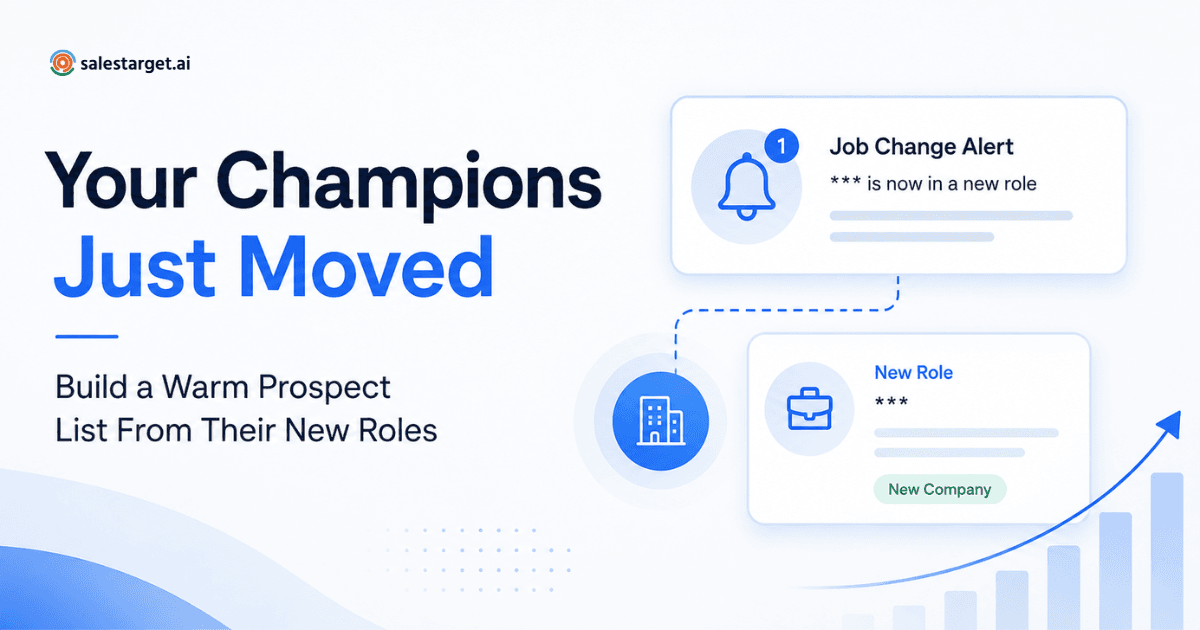
When a former champion leaves one company for another, most sales teams treat it as a lost contact. The record goes stale. The old email bounces. And a relationship that took months to build quietly disappears from the pipeline. That pattern is a missed opportunity. A well-maintained b2b contact database can catch these transitions before they slip away, turning a departing champion into a warm prospect at a brand-new account.
The problem is straightforward: traditional prospecting workflows focus on finding new people, not tracking the movement of people you already know. Job change alerts flip that priority. Instead of starting cold, you start with a person who already understands your product, your category, or the problem you solve. That context makes the first conversation easier, the sales cycle shorter, and the relationship warmer from the start.
Why Job Changes Are One of the Most Valuable Prospecting Signals
A person moving to a new company carries everything they learned at the old one. If they used your product, they remember what it did. If they championed your deal internally, they know how to sell the value to a new buying committee. That existing familiarity is difficult to replicate through cold outreach.
Job changes also introduce a timing advantage. New hires often review their tech stack, evaluate vendors, and bring in tools they trusted before. According to LinkedIn's research on buyer behavior, decision-makers are most receptive during their first 90 days in a new role. That window matters. If your b2b contact data is accurate enough to flag the transition early, you can reach out while the person is still forming opinions and budgets at their new company.
Beyond timing, job changes reveal new buying influence. A director-level user at their former company might now be a VP at a larger firm. That shift in seniority can open access to bigger budgets, broader teams, and faster purchasing authority. Accurate business contact data helps you understand not just where someone went, but what their new role actually means for your pipeline.
What Makes a Former Champion a Warm Prospect?
Not every former contact is a champion. In B2B sales, a champion is someone who actively advocated for your product or solution inside their previous organization. They pushed for the purchase, defended the budget, or convinced their peers the investment was worth it.
It helps to distinguish between different types of former contacts:
- A former customer used your product but may not have driven the purchase decision.
- A product user engaged with the tool regularly but might not have had buying authority.
- An internal champion actively sold your value to their own organization.
- A decision-maker signed off on the deal.
- An evaluator assessed your product during a competitive review.
Each type carries different levels of warmth. The strongest signal comes from someone who both used the product and influenced the buying process. When that person moves to a company that fits your ideal customer profile, the new opportunity is worth prioritizing. If you need a clear framework for evaluating that fit, understanding the difference between a buyer persona vs. ICP helps structure that assessment.
Build the Job-Change Workflow
Turning job-change signals into pipeline opportunities works best as a repeatable process, not an ad-hoc reaction. Here is a practical workflow:
- Detect the job change. Use alerts from your CRM, b2b prospecting tools, or a dedicated tracking system to flag when a known contact updates their role.
- Identify the new employer. Confirm the company name, industry, and size.
- Verify the person's current role. Job titles can be ambiguous. Confirm seniority, department, and function.
- Check whether the new company matches your ICP. Not every move lands someone at a company you should pursue.
- Enrich missing information. A lead enrichment tool can fill in direct contact details, company firmographics, and tech-stack data you do not already have.
- Review the person's likely responsibilities. A VP of Sales at a 50-person startup has different needs than the same title at a 5,000-person enterprise.
- Prioritize the opportunity based on relationship strength, company fit, and role relevance.
- Personalize the outreach. Reference the relationship or shared context, not just the job change.
- Add qualified prospects to an ongoing warm-prospect list for continued tracking.
Use Your B2B Contact Database as the Starting Point
A high-quality b2b contact database does more than store names and email addresses. It maintains current records so you can identify when a contact's company or title changes. Simply keeping an old company name and a previous job title on file does not help. You need fields that reflect the present.
The most useful records for job-change prospecting include:
- Current company and current title
- Seniority level and department
- Industry and company size
- Location and direct contact information
- Previous company and role
- Approximate timing of the job change
This is where a b2b sales leads database with strong data-refresh capabilities becomes valuable. If the data is six months old, you are already behind. SalesTarget AI's Lead Explorer, for instance, allows sales teams to define their ICP criteria, then surface contacts and companies that match those parameters, helping narrow a large dataset into a focused list of relevant opportunities.
Illustrative Example (not industry research):
If a sales team monitors 500 existing contacts in their database and approximately 8% change jobs within a 12-month period, that yields roughly 40 job-change signals to review. If even a quarter of those land at companies matching the team's ICP, that produces 10 warm, qualified opportunities from people who already know the product. The 8% estimate is based on a simple calculation using publicly available U.S. Bureau of Labor Statistics data on annual job-separation rates, which consistently show monthly total separations in the range of 3–4% across all nonfarm industries.
Score the New Opportunity Before You Reach Out
Not every job change is worth an immediate email. Before reaching out, run each signal through a quick qualification check:
- Relationship strength: Did you work directly with this person, or are they a name in your CRM you never spoke to?
- New-company ICP fit: Does the new employer match your target industry, size, and geography?
- Role relevance: Is the person in a function and seniority level that aligns with your typical buyer?
- Buying influence: Can this person influence or approve a purchase at their new company?
- Timing: How recent is the move? The first 90 days tend to be the most receptive window.
- Problem relevance: Does the new company likely face the problem your product addresses?
A simple three-tier system works well: high priority (strong relationship + ICP fit + relevant role), medium priority (partial fit on two dimensions), and low priority (weak match, worth monitoring but not immediate outreach). This keeps your team focused on the warmest signals instead of chasing every LinkedIn update.
Turn Job Changes Into Better Outreach
Messaging a former champion should feel different from a cold email. You have shared context. Use it, but use it carefully.
A few principles:
- Acknowledge the new role without sounding like you are surveilling their career.
- Reference the previous relationship only if it was genuine and substantive.
- Connect their new responsibilities to a relevant problem rather than pitching features.
- Avoid over-personalization that feels invasive.
- Give a useful reason to reconnect, not just congratulations.
Example message:
"Hi Sarah, saw you joined Graystone as Head of Revenue Ops - congrats on the move. When we worked together at Kelton, you mentioned that getting clean pipeline data into forecasting was always the hardest part of the quarter. If that challenge followed you to the new team, happy to share how a few other Rev Ops leaders have approached it recently. No pressure either way - just wanted to reconnect."
Notice what that message does not do: it does not pitch a demo, name-drop the product, or open with a generic congratulations followed by a calendar link.
Where B2B Prospecting Tools Fit Into the Workflow
Modern b2b prospecting tools, lead enrichment platforms, and CRM integrations can remove a significant amount of manual research from this workflow. A b2b lead generation tool can help you detect job changes, enrich new records, and push qualified contacts into your sequencing or CRM system without copying data between spreadsheets. Platforms that offer B2B lead generation platforms with CRM integration make that handoff smoother.
But here is the important distinction: tools should reduce the research and data-maintenance burden. They should not replace the judgment that separates a thoughtful, relationship-based email from a mass-blast sequence. The workflow above works because it combines data with human context. Automate the data layer. Keep the relationship layer personal.
Build a Living Warm Prospect List
Job-change prospecting should not be a one-time campaign. It works best as an ongoing, living list that your team reviews regularly. Consider maintaining segments such as:
- Champions who changed companies in the last 90 days
- Former customers now at ICP-matched accounts
- Former product users who moved into decision-making roles
- Champions who moved into senior leadership
- Prospects whose new companies meet high-value ICP criteria
Reviewing this list monthly keeps your b2b lead generation grounded in real relationships rather than purely cold outreach. Over time, it also creates a compounding advantage: the longer you track your network of former champions, the larger the pool of warm re-engagement opportunities becomes.
Ready to Start?
Define your ideal customer profile, find contacts who match, and build your warm prospect list.