How do you find B2B leads worth your team's time? Stop relying on cold LinkedIn scrolling and purchased lists full of dead emails. The fastest path combines buyer intent signals, firmographic targeting, verified contact data, and AI-driven prospecting tools. Modern outbound teams build qualified pipelines by filtering prospects by company size, tech stack, and buying signals—then reaching decision-makers with relevant messaging.
What Exactly Are B2B Leads (And Why Definitions Matter)?
A B2B lead is any company or individual who could become a paying customer for your product or service. That sounds basic—but here's where most sales orgs go wrong: they treat every name in a spreadsheet like a lead.
Not all leads carry equal weight. A marketing director at a 200-person SaaS company actively researching your category is a fundamentally different prospect than a random contact scraped from a web directory. Understanding what is a lead generation platform and how qualified leads differ from raw contacts is the first step toward building pipeline that converts.
Why Finding Quality B2B Leads Feels Harder Than Ever ?
After managing outbound programs for over a decade, here's what I keep seeing: available data has exploded, but lead quality hasn't kept pace. Three forces make B2B lead generation tougher right now:
- Data decay: Contact databases lose roughly 30% accuracy annually as people change roles, companies restructure, and emails go stale.
- Buyer fatigue: Decision-makers receive 50–100+ sales emails weekly. Generic outreach gets deleted.
- Fragmented buying committees: According to Gartner, the typical B2B purchase now involves 6 to 10 stakeholders.
Traditional vs. Modern B2B Lead Generation
The playbook has changed. Here's a side-by-side look at what's shifted:
| Factor | Traditional Approach | Modern Approach |
|---|---|---|
| Data Source | Purchased lists, directories | Intent-enriched B2B leads databases |
| Targeting | Industry + job title only | Firmographics + technographics + intent |
| Outreach | Batch-and-blast email | Personalized, multi-channel sequences |
| Verification | Minimal; high bounce rates | Real-time email/phone verification |
| Speed | Days to build a list | Minutes with AI-powered filters |
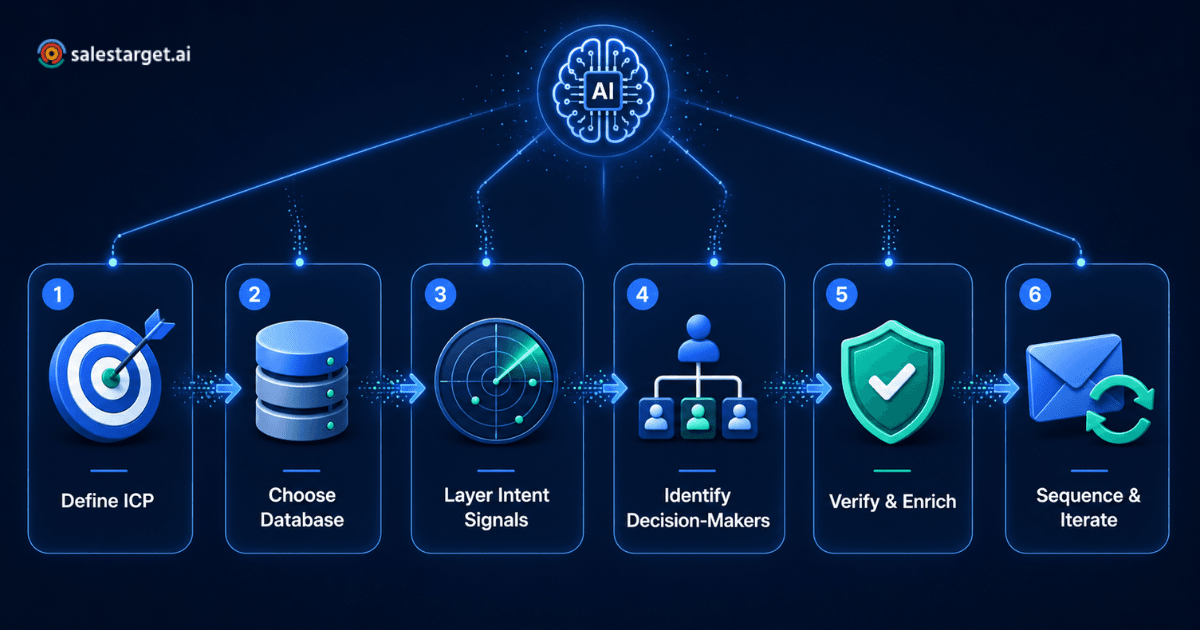
A Step-by-Step Process to Find B2B Leads That Convert
Here's the process I recommend to anyone asking how to generate B2B leads consistently.
1. Define Your Ideal Customer Profile (ICP)
Get specific. Industry, company size, revenue range, geography, tech stack, growth signals. Vague ICPs produce vague pipelines.
2. Choose a Reliable Lead Generation Database
Your B2B leads database is the foundation. Look for platforms offering verified contacts, firmographic filters, and intent data—not just raw email lists. Understanding how B2B data providers improve prospecting will help you evaluate vendors more effectively.
3. Layer in Intent Signals
Intent data tells you which companies are actively researching solutions like yours.
Illustrative benchmark: Based on common B2B outbound benchmarks, teams using intent-based targeting typically see 2–3x higher reply rates and pipeline velocity improvements of 30–50% compared to static list outreach.
4. Identify the Right Decision-Makers
Don't just find companies—find the people who sign contracts. Map the buying committee: economic buyer, technical evaluator, end user, and internal champion.
5. Verify and Enrich Contact Data
Verify every email and phone number before outreach. Enrichment adds context—funding round, recent hires, tech stack changes—that fuels personalized messaging.
6. Build Sequences, Test, and Iterate
Create multi-touch sequences across email, phone, and LinkedIn. Measure open rates, reply rates, and meetings booked. Adjust your ICP and messaging based on what the data tells you.
Where to Find B2B Leads: The Best Sources ?
Not every channel delivers the same quality. Here are the most effective sources for B2B prospecting in 2026:
- Lead generation databases with firmographic and intent filters (the fastest route for outbound teams)
- LinkedIn Sales Navigator for account-based research and warm introductions
- Industry events and conferences for high-intent, relationship-driven leads
- Inbound content and SEO for attracting buyers already in research mode (HubSpot's State of Marketing report consistently ranks content as a top lead source)
- Referrals and partner networks for the highest close rates, though lowest volume
If you're evaluating tools, reviewing lead generation software for sales teams can help you compare capabilities across platforms.
How AI Changes B2B Prospecting ?(And Where It Actually Helps)
AI prospecting isn't about replacing your SDR team—it's about eliminating the hours they spend on manual research, list building, and data cleanup. The practical applications are straightforward:
- Smart filtering: AI can parse millions of company records and surface prospects matching complex ICP criteria in seconds.
- Contact enrichment: Automated enrichment pulls in job changes, org chart data, and technographic details without manual research.
- Intent scoring: Machine learning models analyze web activity and content consumption patterns to flag accounts showing buying intent.
- Prospect prioritization: AI ranks leads by likelihood to convert, so reps focus on high-value opportunities first.
Tools like SalesTarget Lead Explorer apply this approach by combining AI-powered Smart Prospect Search with verified B2B contact data, intent signals, and firmographic filters—letting teams discover companies, identify decision-makers, and build targeted lists without toggling between six different tabs.
→ Want to see how intent-driven prospecting works in practice? Explore SalesTarget Lead Explorer and see how your team can build qualified prospect lists in minutes, not days.
5 Common Mistakes Sales Teams Make When Finding Leads
- Skipping ICP definition. Prospecting without a clear ICP is expensive guesswork.
- Prioritizing quantity over quality. A list of 10,000 unverified contacts wastes more time than 500 verified, intent-matched leads.
- Ignoring data hygiene. Old emails and wrong phone numbers tank deliverability and burn sender reputation.
- Using a single channel. Email-only outreach misses buyers who respond better to phone or LinkedIn.
- Not measuring what matters. Track meetings booked and pipeline created—not just emails sent.
Your B2B Lead Generation Checklist
Use this before launching any outbound campaign:
- ✔ ICP documented with firmographic and technographic criteria
- ✔ Lead generation database selected with intent data and verification
- ✔ Buying committee mapped (minimum 3 contacts per target account)
- ✔ Contact data verified within the last 30 days
- ✔ Multi-channel outreach sequence built (email + phone + LinkedIn)
- ✔ Personalization variables added to templates
- ✔ Reporting dashboard tracking reply rates, meetings, and pipeline value
- ✔ Weekly ICP and messaging review scheduled
Best Practices for Sustained Lead Generation
Teams that consistently generate quality B2B leads share a few habits:
- Revisit and tighten ICP quarterly based on closed-won analysis.
- Treat the lead generation database as a living asset—clean, enrich, and segment continuously.
- Align sales and marketing on lead qualification criteria before campaigns launch.
- Invest in tools that reduce manual effort so reps spend more time selling.
Knowing how to find B2B leads isn't about the biggest database or the most emails. It's about precision: right company, right person, right time, right message. Combine a tight ICP, a reliable lead generation database, intent signals, and disciplined execution—and pipeline becomes a repeatable system, not a guessing game.