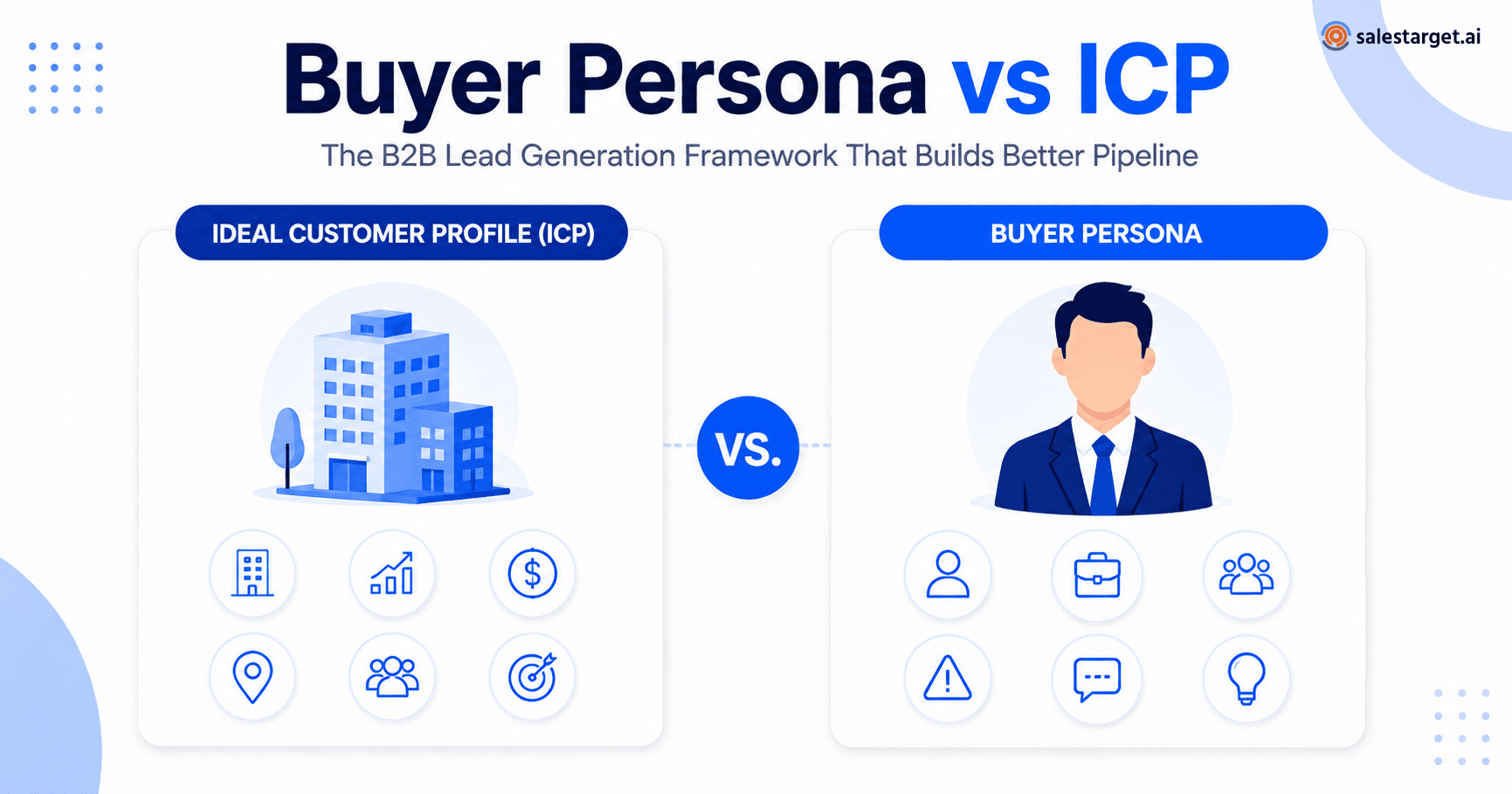
An Ideal Customer Profile (ICP) defines which companies to target. A Buyer Persona defines which people to engage and how to speak to them. For effective B2B lead generation, ICP should guide account selection first, while Buyer Personas sharpen contact targeting and messaging. Both matter—but they solve different problems.
Most sales and marketing teams have heard both terms tossed around in strategy meetings. But when it comes to actually building pipeline, the distinction between a Buyer Persona and an Ideal Customer Profile matters more than many teams realize. The two frameworks aren't interchangeable. They answer different questions, inform different decisions, and serve different stages of the prospecting process. Getting clear on the difference is one of the most practical things a B2B team can do to improve how they generate and qualify leads.
Buyer Persona vs ICP: What Is the Difference?
At the highest level, an ICP is about companies, and a Buyer Persona is about people. An ICP describes the type of organization most likely to become a valuable, long-term customer. A Buyer Persona describes the individuals within those companies who influence or make the buying decision.
Think of it this way: your ICP tells you where to look. Your Buyer Persona tells you who to talk to and what to say once you get there. Conflating the two leads to unfocused outreach—casting a wide net at the company level but missing the mark on messaging, or crafting great personalized emails sent to companies that were never a good fit in the first place.
Teams evaluating B2B lead generation campaign providers will find that the best results come from layering both frameworks together—but using them at the right stage.
What Is an Ideal Customer Profile?
An ICP is a description of the company that represents your best-fit customer. It's built from firmographic and behavioral attributes that indicate a strong likelihood of buying your product, getting value from it, and staying long-term. Typical ICP attributes include:
Industry, company size (headcount or revenue), geographic region, technology stack, business model, growth stage, buying signals, and account-level pain points. For example, a B2B SaaS company selling sales intelligence software might define its ICP as mid-market SaaS companies (50–500 employees) in North America, currently using a CRM but lacking a dedicated prospecting tool, actively hiring sales roles.
The ICP isn't aspirational - it should reflect the profile of customers who've already succeeded with your product. According to Gartner's research on B2B buying journeys, buying groups typically involve multiple stakeholders, but the account itself needs to be the right fit before individual relationships matter.
What Is a Buyer Persona?
A Buyer Persona is a semi-fictional profile of the individual involved in the purchase. It captures job title, responsibilities, professional goals, pain points, motivations, common objections, buying influence (champion, decision-maker, blocker), and preferred communication style.
A company can - and usually does - have multiple Buyer Personas. In a typical B2B deal, you might be engaging a VP of Sales (the economic buyer), a Sales Operations Manager (the evaluator), and a CRO (the final sign-off). Each person cares about different outcomes and responds to different messaging. The VP wants pipeline numbers. The Ops Manager wants ease of implementation. The CRO wants revenue impact.
HubSpot's guide on creating Buyer Personas offers a useful framework, but the key point is this: Buyer Personas are about empathy and relevance at the contact level. They don't tell you which companies to pursue—they tell you how to communicate once you've already identified the right accounts.
Buyer Persona vs ICP: Side-by-Side Comparison
| Dimension | Ideal Customer Profile (ICP) | Buyer Persona |
|---|---|---|
| Focus | Company / Account | Individual / Contact |
| Level | Organization-level attributes | Person-level characteristics |
| Key Question | Which companies should we target? | Who do we talk to and how? |
| Used By | Sales, marketing, RevOps | Marketing, SDRs, content teams |
| Prospecting Role | Account selection and prioritization | Contact targeting and outreach |
| Messaging Role | Segment-level value propositions | Personalized, role-specific messaging |
| Example | Series B SaaS, 100–500 employees, North America | VP of Sales, focused on quota attainment, skeptical of new tools |
| Best For | List building, territory planning, lead qualification | Email copy, LinkedIn outreach, sales conversations |
Which One Matters More for B2B Lead Generation?
Here's the direct answer: for pipeline generation, the ICP does more of the heavy lifting upfront. It determines account prioritization, shapes prospecting lists, guides lead qualification, and informs sales territory planning. Without a clear ICP, teams burn time chasing accounts that will never close—or worse, close and churn quickly.
Practical benchmark: If a sales team starts with 1,000 broad accounts and applies a well-defined ICP to narrow the list to 200 high-fit accounts, the team can concentrate its research, outreach, and follow-up effort on the accounts most aligned with its commercial strategy—potentially improving conversion rates and shortening deal cycles significantly.
But Buyer Personas remain essential for everything that happens after account selection. Outreach messaging, email personalization, LinkedIn connection requests, content strategy, and navigating multi-stakeholder buying committees all depend on understanding the people inside those target accounts. Without Buyer Personas, even perfectly targeted outreach falls flat because the message doesn't resonate with the reader.
The honest answer? You need both. But if you had to choose a starting point, define your ICP first.
How ICP and Buyer Personas Work Together
The strongest B2B prospecting workflows follow a clear sequence:
ICP → Target Accounts → Buying Roles → Buyer Personas → Prospecting → Personalized Outreach → Qualified Pipeline
For a marketing team, this means building campaign targeting around ICP firmographics first, then tailoring content and ad copy for specific personas. For a sales manager, it means assigning territories based on ICP fit, then coaching reps to adjust their pitch depending on whether they're speaking to a CFO or a Head of Procurement. For a startup team wearing multiple hats, it means resisting the urge to message everyone - pick the account profile that's worked before, then figure out the right contact and the right angle.
How Prospecting Tools Turn ICPs Into Action
Having a well-defined ICP on paper is a good start, but it only creates value when teams can act on it. This is where B2B prospecting tools and lead generation platforms come in. Modern B2B lead generation software allows teams to filter companies and contacts by the exact attributes in their ICP - industry, headcount, geography, tech stack, hiring activity, funding stage - and surface relevant prospects without hours of manual research.
SalesTarget Lead Explorer is one example of a B2B lead generation tool designed for this workflow. Rather than leaving the ICP as a static strategy document, Lead Explorer lets teams translate ICP criteria into search filters and discover companies and contacts that match - turning the framework into an actionable prospecting list. For teams evaluating B2B sales prospecting software or sales prospecting platforms, the key question isn't just data volume; it's how well the tool maps to your specific ICP definition.
When Should You Use ICP vs Buyer Persona?
Different tasks call for different frameworks. Here's a practical guide:
| Scenario | Framework to Use |
|---|---|
| Building a new target account list | ICP |
| Finding decision-makers at target accounts | Buyer Persona |
| Creating outbound campaigns | Both (ICP for targeting, Persona for copy) |
| Launching account-based marketing | ICP first |
| Writing personalized sales emails | Buyer Persona |
| Qualifying inbound leads | ICP + Buyer Persona |
The Best Approach for Modern B2B Prospecting
If you want a repeatable system, here's a five-step framework that works across team sizes:
- Define your ICP. Analyze your best existing customers. What do they have in common? Industry, size, pain point, buying trigger—document it.
- Identify high-fit accounts. Use your ICP to build or filter a target account list. This is where the best lead generation software earns its value—automated filtering saves weeks of manual work.
- Map the buying committee. For each account, identify the relevant roles involved in the purchase decision. Don't default to "the CEO"—map the actual stakeholders.
- Build Buyer Personas for each role. Capture what each person cares about, what they're measured on, and what objections they're likely to raise.
- Personalize outreach based on role and intent. Craft messaging that speaks to each persona's priorities. Reference the account's situation, not just their job title.
This workflow connects ICP-driven account selection with persona-driven messaging—the combination that produces qualified pipeline rather than just activity.
Turn Your ICP Into a Real Prospecting List
Stop keeping your ICP locked in a spreadsheet. Use SalesTarget Lead Explorer to find prospects that match your target criteria and start building a sharper, more focused pipeline.
Buyer Personas and Ideal Customer Profiles aren't competing frameworks—they're complementary layers. The ICP tells you where the opportunity sits: which accounts are worth your team's finite time and energy. The Buyer Persona tells you who to reach inside those accounts and what will actually get their attention.
For scalable B2B lead generation, use both. But start with the ICP. Get the account targeting right, then invest in understanding the people. That's the order that builds pipeline—not just a list of names.