A rep opens the CRM Monday morning to 40 fresh leads. By Thursday, 30 of them are dead ends: wrong title, wrong company size, an email that bounced on the first send. The list looked full. The pipeline stayed empty. That gap between "leads in the system" and "leads worth calling" is where most outbound teams bleed hours and quota.
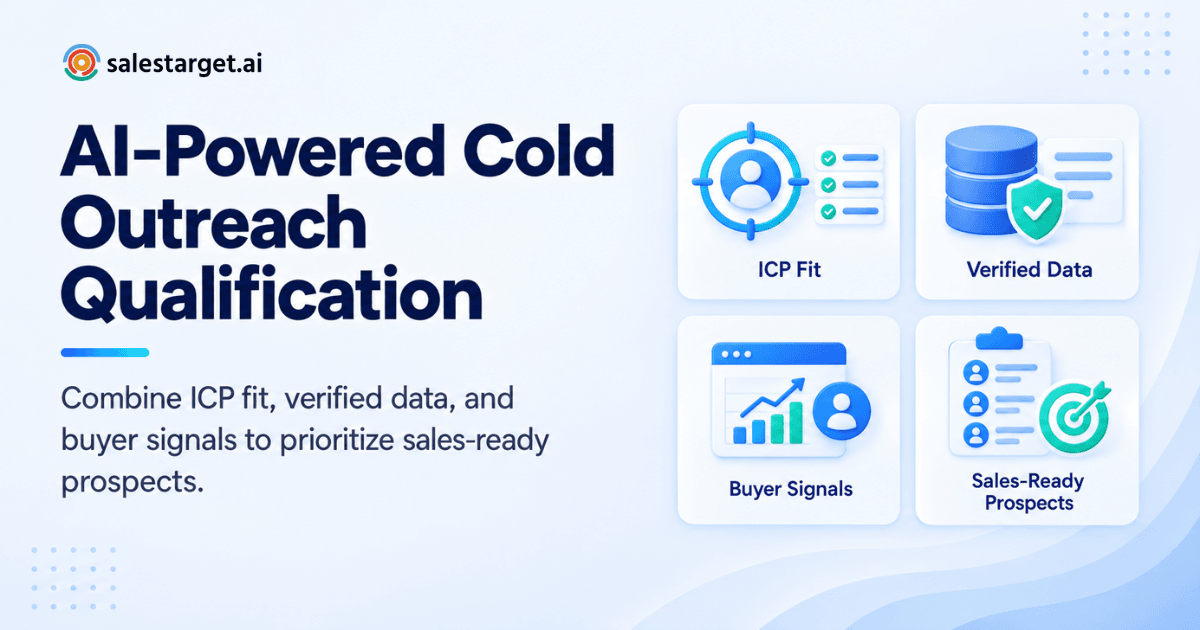
AI-powered cold outreach tools fix this by qualifying prospects before a message ever goes out, not after a rep has already spent 20 minutes researching a dead-end account. They pull verified contact data, score fit against your ideal customer profile, flag active buying signals, and personalize outreach automatically, so reps spend their time talking to people who can actually buy. Platforms like Salestarget.ai combine prospecting, enrichment, verification, and outreach in one workspace instead of five separate tools that never quite agree on the data.
B2B Prospect Qualification Challenges in Modern Cold Outreach
Qualification breaks down long before a sequence starts sending. Most teams are still working from static lists pulled once a quarter, so by the time outreach begins, a chunk of the contacts have changed jobs or the account has stopped hiring for the role that made it a fit in the first place.
Reps sell for less than a third of their week. Salesforce's State of Sales report found reps spend just 28% of their time actually selling, with the rest lost to research, data entry, and admin work, and 48% of sellers say they lack the bandwidth to do adequate cold outreach on top of everything else on their plate. A lot of that missing time goes into manually checking whether a lead is even worth pursuing.
There's a trust problem sitting underneath the data problem too. Gartner research has found that bad prospecting actively damages relationships with potential customers, and many B2B buyers feel overwhelmed by the outreach they receive from sellers and their organizations. Send a generic pitch to someone who isn't a fit, and you haven't just wasted a touch, you've made the next rep's job harder when that account gets contacted again.
Manual qualification doesn't scale with buying committees, either. A deal today can involve six to ten stakeholders, and roughly 70 to 80% of the buyer's journey wraps up before sales even gets a conversation, according to research from Gartner and Forrester. Qualifying one contact isn't enough anymore. Teams need account-level signal across a whole buying group, and that's a data problem no spreadsheet solves cleanly.
AI-Powered Cold Outreach Tools for B2B Prospect Qualification
AI prospecting for ICP-based account selection
AI prospecting tools search massive contact and company databases against your ideal customer profile instead of a rep guessing which titles to filter for. Lead Explorer lets a rep type a plain-English description of the target account, or stack filters across industry, seniority, department, company size, revenue, and tech stack, and pull a list that actually matches the ICP instead of a loose approximation of it.
Prospect enrichment for stronger qualification data
A name and a job title tell you almost nothing about whether someone can buy. Enrichment adds verified emails, phone numbers, company firmographics, and recent business events, the details that turn a name on a list into a qualified account. Lead Explorer enriches a contact the moment it's found, pulling from 840M+ verified professional profiles and 146M+ business entities in one click, so a rep isn't jumping between four browser tabs to piece together a profile.
Buyer intent signals for identifying active prospects
Fit alone doesn't tell you timing, and LinkedIn signals help close that gap alongside firmographic data. Intent data does the rest. Tools that track Bombora Intent Topics, funding announcements, hiring spikes, and leadership changes flag which accounts are actively researching a category right now, not six months from now. Salestarget.ai runs on 4,000+ intent and buyer signals with a 30 to 90 day lookback window, which is the difference between a cold email and one that lands the week a prospect actually started looking.
Prospect scoring based on fit and buying activity
Scoring combines ICP fit with activity data so reps know which of 200 enriched leads to call first. A prospect who matches every firmographic filter but shows zero engagement scores differently than one with a partial fit and three intent signals firing this month. Intent-based lead scoring inside Lead Explorer ranks accounts on both axes at once, instead of forcing a rep to eyeball a spreadsheet and guess.
AI personalization based on prospect-level information
Generic templates get generic reply rates. AI personalization pulls role, industry, and company-specific detail into outreach copy automatically, so the first line of an email references something true about the account instead of a mail-merge token. Email Outreach's AI Content Generator builds that personalization into sequences at send volume, which is the only way this works once a team is sending to hundreds of accounts a week instead of ten.
The Role of AI in the B2B Prospect Qualification Process
Account and contact data collection
Qualification starts with knowing who exists inside a target account, not just the one contact a rep happened to find on LinkedIn. AI prospecting tools map the buying committee, economic buyer, technical evaluator, day-to-day user, from one search instead of five separate lookups.
ICP targeting and prospect segmentation
Once accounts are collected, AI sorts them against defined ICP criteria automatically. That's the difference between "we sell to mid-market SaaS companies" as a mission statement and an actual filtered list a rep can start working today.
Contact verification and data quality checks
A qualified prospect with a dead email address isn't qualified. AI-driven verification checks MX records, SMTP responses, and disposable-email patterns before a contact ever enters a sequence, catching the bad data before it costs deliverability. The Email Validator runs this check at the point of enrichment rather than relying on data that might have been scraped and gone stale months earlier.
Intent and engagement signal analysis
AI tools continuously watch for signals that a qualified-on-paper account is turning into a qualified-in-practice one: a website visit, a content download, a job posting tied to your product category. That ongoing layer separates a list built once from a qualification process that stays current.
Lead prioritization before sales outreach
With fit, verification, and intent data in one place, AI ranks prospects so reps work the highest-probability accounts first instead of working top to bottom on an alphabetized list. This is the single biggest lever in prospect qualification: not finding more leads, but deciding in what order to work the leads already found.
AI Cold Outreach Workflows for Qualified B2B Prospects
Build prospect lists around defined ICP criteria
Start with the account attributes that actually predict a closed deal, not just "company size over 50." Vague ICP criteria produce vague lists, and vague lists are where qualification problems start.
Enrich decision-maker profiles with relevant sales data
Pull verified contact info and firmographic context for every stakeholder in the account at once, not one contact at a time as objections come up mid-cycle.
Verify contact information before campaign enrollment
Run every contact through validation before it hits a sequence. This single step prevents the bounce-rate spiral that gets a sending domain flagged, which then tanks deliverability for every campaign after it.
Create personalized email and LinkedIn sequences
Build sequences that reference the enrichment and intent data already collected, so the first touch doesn't read like it was written for anyone. LinkedIn Outreach runs alongside email in one coordinated flow, so a prospect who replies on LinkedIn doesn't get a redundant cold email the same week.
Track engagement to identify sales-ready prospects
Watch opens, replies, and click activity to catch the moment a prospect shifts from "in the sequence" to "worth a real conversation." A Unibox-style unified inbox sorts replies by intent automatically, so a rep sees "Interested" leads first instead of scrolling past auto-replies to find them.
Route qualified prospects into the sales pipeline
Once a prospect shows real intent, move them into CRM follow-up without a manual handoff. Campaign leads landing automatically in a CRM closes the gap where qualified prospects used to sit in an outreach tool for days before anyone noticed they'd replied.
Key Capabilities of AI-Powered Cold Outreach Tools
AI prospecting and sales intelligence
The foundation layer: finding accounts and contacts that match a defined ICP, backed by a large, current database rather than a static export.
Prospect scoring and buyer intent data
Ranking prospects by fit and activity so reps aren't guessing which of a hundred qualified leads to call first.
Verified B2B contact data and enrichment
Turning a bare name and title into a usable record with verified email, phone, and company context, checked at the moment it's pulled.
AI cold email automation and deliverability controls
Sequence building, AI-generated copy, inbox warm-up, and SPF/DKIM/DMARC checks that keep campaigns landing in the inbox instead of spam.
Multichannel email and LinkedIn outreach
Coordinating touches across channels so activity on one platform informs what happens on the other, instead of two disconnected campaigns running in parallel.
Sales workflow automation and CRM tracking
Automatic task creation, activity logging, and pipeline tracking once a prospect responds, so qualification data doesn't die in the outreach tool.
Prospect Qualification Metrics for AI Cold Outreach Campaigns
Qualified prospect rate
The share of enriched leads that actually clear your ICP and intent thresholds. A low rate here points to targeting filters that need tightening, not a smaller market than expected.
Positive response rate
Replies that indicate real interest, separated from auto-replies and outright declines. This is the number that tells you whether personalization and targeting are actually working together.
Meeting conversion rate
How many positive responses turn into a booked call. A gap between reply rate and meeting rate signals weak follow-through after the first response, not a targeting problem.
Sales-ready lead rate
The percentage of qualified prospects that reach a stage where an AE, not an SDR, should be driving the conversation. Tracking this separately from raw qualification rate keeps reps from pushing leads forward too early.
Pipeline conversion from outbound prospects
The ultimate test: how many outbound-sourced prospects turn into real pipeline value. Everything upstream, targeting, enrichment, verification, scoring, only matters if it moves this number, which is also where AI sales tools tend to earn their keep.
Why Choose SalesTarget.ai
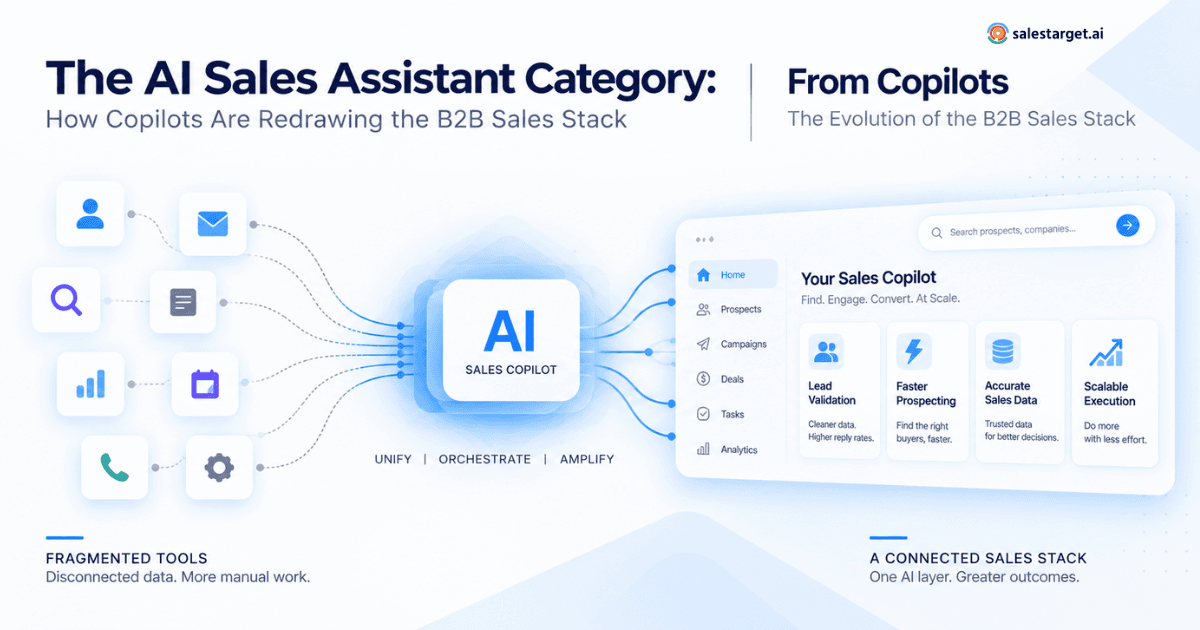
Most cold outreach stacks require stitching together a data provider, a deliverability tool, and a separate CRM, then hoping the handoffs between them don't lose data along the way. Salestarget.ai keeps prospecting, enrichment, verification, outreach, and CRM follow-up in one workspace on one bill.
AI-powered prospecting with enrichment and intent signals
Search 840M+ verified professional profiles and 146M+ business entities in plain English, with enrichment and 4,000+ intent signals attached at the point a lead is found, not bolted on afterward.
Email and LinkedIn outreach in one workflow
Run coordinated multichannel sequences instead of managing email and LinkedIn as two separate campaigns that don't talk to each other. 90% of emails get validated before sending, which keeps bounce rates and sender reputation intact.
Contact verification and email deliverability controls
MX and SMTP checks, disposable-email detection, and SPF/DKIM/DMARC monitoring run in the background so a qualified list doesn't quietly degrade into a deliverability problem.
Built-in CRM for qualified prospect follow-up
Qualified leads land in the CRM automatically, with every email and call logged to the lead timeline and follow-up tasks created without a rep having to remember to set them. Teams using it see 3.2X faster deal cycles and about 6 hours saved per rep each week.
AI Copilot for prospect research and sales workflows
The AI Copilot is a conversational assistant that finds leads, drafts personalized sequences, and flags at-risk deals on request, so reps spend less time context-switching between five different screens to answer one question about a prospect. If a qualification workflow feels heavier than it should be, start a free trial and see what changes when the data, outreach, and follow-up live in one place.
Common Qualification Mistakes in AI Cold Outreach
Using job titles without checking account fit
A VP of Sales at a 10-person startup and a VP of Sales at a 5,000-person enterprise are not the same buyer. Title alone tells you almost nothing about budget, authority, or timeline.
Treating engagement as a direct buying signal
An open or a click means curiosity, not intent to purchase. Teams that route every engaged lead straight to an AE end up burning AE time on prospects who were just reading a subject line, not evaluating a purchase.
Automating outreach without relevant prospect data
Sending AI-generated messages at scale without enrichment behind them just produces faster generic email, not better email. Personalization needs real data to personalize with, or it's automation without qualification.
Skipping contact verification before sending
This is the mistake competitors' content rarely calls out directly: unverified sends don't just waste one email, they raise the bounce rate on the whole domain, which then throttles deliverability for every other campaign running from it, qualified or not.
Failing to refine qualification criteria from campaign data
Most teams set ICP filters once and never revisit them, even after months of campaign data show which attributes actually predict a reply or a closed deal. The scoring model should update based on what's converting, not stay frozen at the assumptions made on day one.
Building a More Targeted B2B Outbound Qualification Workflow
Combine ICP fit with buyer intent signals
Fit tells you who could buy. Intent tells you who's looking now. Qualification criteria built on fit alone misses timing, and criteria built on intent alone can chase noise from accounts that were never going to be a good fit regardless.
Connect prospect research with personalized outreach
Enrichment data should feed directly into sequence copy instead of sitting in a CRM field nobody references when writing the actual email. If a rep has to manually copy a detail from one tool into another, that's a step where qualification data gets lost.
Use engagement data for ongoing lead prioritization
Scoring shouldn't be static. A prospect who ranked low last month but has since visited the pricing page three times deserves a second look, and the system should surface that shift without a rep having to notice it manually.
Move qualified prospects into CRM follow-up
Once a prospect clears the qualification bar, the handoff into pipeline tracking needs to happen automatically. Manual handoffs are where sales-ready leads sit untouched for days, everyone assuming someone else is on it.
Conclusion: Turning AI Outreach Signals Into Better-Qualified Sales Opportunities
The lead list that looked full on Monday and empty by Thursday isn't a volume problem, it's a qualification problem. Bad data, guessed-at fit, and outreach sent before verification compound into the same result: reps spending hours on accounts that were never going to convert.
AI-powered cold outreach tools fix this at the source, qualifying prospects with verified data and real buying signals before a message sends, not after the afternoon is already gone. Salestarget.ai puts prospecting, enrichment, verification, multichannel outreach, and CRM follow-up in one workspace, so qualification data doesn't get lost between five different tools. See what a qualified pipeline looks like with Salestarget.ai.