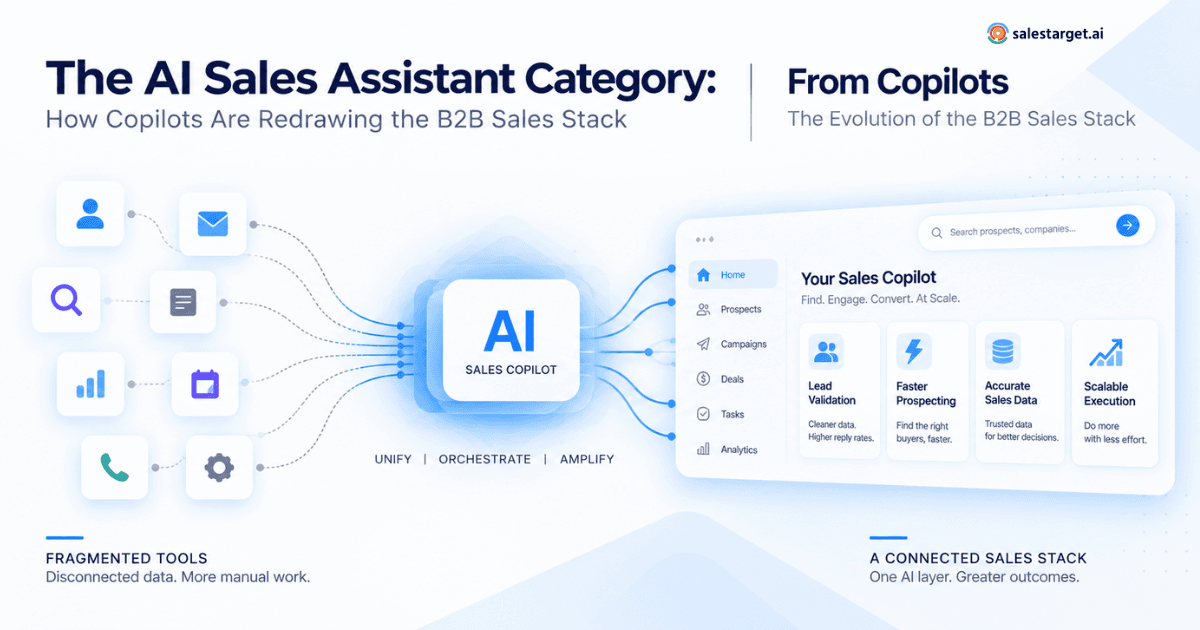
Ten years ago, a B2B revenue team could get by with a CRM, an email tool, and a spreadsheet of leads. Today, most mid-market sales orgs juggle a dozen or more platforms: prospecting databases, enrichment services, engagement suites, dialers, sequencers, conversation intelligence, forecasting, and CPQ. Each promises to fix a slice of the funnel. Together, they create tab fatigue and a growing tax on rep attention.
This is why AI sales assistant software has moved from novelty to serious category conversation. Instead of adding another isolated tool, AI sales assistants sit across the existing stack and take on the connective work reps used to do manually - pulling account context, checking data freshness, drafting outreach, updating records. The category is still early, but the direction is clear: fragmentation is giving way to orchestration.
What Is the AI Sales Assistant Category?
An AI sales assistant is software that uses large language models and workflow automation to help sales reps research, qualify, and engage prospects with less manual effort. The AI sales assistant category groups these tools together, but it helps to separate the terms people often use interchangeably.
- Traditional sales automation runs scripted sequences — send email A on day one, task on day three. It does not reason about context.
- AI sales assistants support the rep with research, summaries, drafting, and suggestions, usually inside an existing workflow.
- AI copilots are a specific form of assistant that stays present across tasks and connects multiple tools.
- AI SDRs go further, taking ownership of outbound activities like sourcing prospects and running first-touch sequences.
- AI-native sales tools are products built from the ground up around AI models, rather than adding an "AI" tab to a legacy interface.
These categories overlap in practice, but the distinction matters when evaluating vendors.
From Point Tools to AI Copilots for the Sales Stack
AI copilots for sales stack workflows are less about replacing any single tool and more about reducing the switching cost between them. A copilot might, in one flow, identify accounts fitting an ICP, pull firmographic and technographic context, validate contact records, draft a personalized outreach message, log activity in the CRM, and surface a follow-up recommendation. Watching that sequence unfold in one place — instead of across six tabs — is the point. For a closer look at how these workflows actually play out day to day, see how AI copilots help sales reps with real workflows.
Common workflows a copilot can support:
- Prospect discovery and account research
- Contact enrichment
- Lead validation
- Personalized outreach drafting
- Meeting prep briefings
- Post-call summaries and CRM updates
- Next-best-action recommendations
Why Lead Quality Still Matters ?
Here is the uncomfortable truth about AI-powered selling: an AI assistant is only as sharp as the data it reasons over. A well-written outbound email sent to an outdated address never lands. A perfectly personalized message aimed at someone who left the company six months ago wastes reply capacity and damages sender reputation.
Poor lead data creates familiar pain:
- Invalid or bounced email addresses
- Stale job titles and missed role changes
- Duplicate records across systems
- Wrong-fit accounts included in ICP lists
- Deliverability damage from repeated bounces
- SDR hours spent scrubbing lists instead of selling
Salesforce's State of Sales research has consistently found that reps spend the majority of their week on tasks other than active selling, with data hygiene and administrative work among the biggest culprits. That gap is exactly where lead validation earns its keep - cleaning the inputs before AI amplifies them.
The Rise of the AI SDR
An AI SDR refers to software that automates parts of the sales development role - sourcing prospects, enriching them, validating contact data, and often running first-touch sequences with light personalization. A traditional SDR does all of that plus the human work: reading a lukewarm reply and deciding whether it is worth a second try, catching a signal in a discovery call, judging when a lead deserves an exception to the playbook.
The useful framing is not "AI SDR replaces human SDR." It is that AI SDRs absorb the mechanical portion - list building, initial enrichment, template variation, follow-up cadence - so human SDRs can spend more time on conversations that actually move deals. Teams that treat the two as substitutes usually get disappointing results. Teams that split the work by what each does well tend to see the calendar fill up faster.
What Makes AI-Native Sales Tools Different?
The phrase AI-native sales tools describes products designed around AI models from day one, rather than legacy platforms with a chatbot bolted on. Practically, that difference shows up in a few places. If you want a deeper walk-through of the concept, this practical guide to AI copilots for modern B2B sales teams is worth a read.
Traits that tend to separate AI-native tools from AI-retrofitted ones:
- Context awareness — the tool understands account, contact, and pipeline state without being told each time.
- Natural-language interaction — reps ask questions or request tasks in plain English instead of clicking through menus.
- Workflow orchestration — actions span multiple systems, not only the vendor's own interface.
- Automated research — the tool gathers signals from public data and internal systems before drafting.
- Human-in-the-loop design — recommendations rather than blind execution, with the rep approving key steps.
- Transparency — the tool shows where data came from and why it made a recommendation.
How the AI Sales Tech Landscape Is Changing ?
The AI sales tech landscape is quietly consolidating around a smaller number of categories that talk to each other. Sales intelligence, enrichment, validation, engagement, CRM, and analytics used to be sold as separate products with separate contracts. AI copilots are collapsing that boundary by acting as the interface reps live in - pulling data from wherever it sits and pushing structured updates back.
McKinsey's research on generative AI in commercial functions estimates that generative AI could add between $0.8 and $1.2 trillion in annual value across marketing and sales globally, with a meaningful share tied to lead identification, qualification, and personalized outreach. That is a strategic signal, not a forecast to bet a single quarter on, but it does explain why every major sales platform is now positioning around AI. For buyers, the practical consequence is that categories will keep blurring, and evaluating tools on isolated features will matter less than evaluating how well they fit into a broader workflow.
What Sales Teams Should Look for in an AI Sales Assistant ?
A useful evaluation framework for sales leaders looking at this category:
- Data quality — where does the prospect data come from, and how fresh is it?
- Lead validation — does the tool verify emails and contact accuracy before outreach?
- Workflow integration — does it fit the CRM and engagement tools already in place?
- Accuracy and transparency — can the tool show why it recommended something?
- Human oversight — can reps review and edit before anything is sent?
- Ease of use — how quickly do reps actually adopt it?
- Scalability — does it hold up as territory or team size grows?
- Actionable recommendations — are outputs specific enough to act on?
- Reduction of repetitive work — measurable hours saved on admin?
- Cross-workflow reach — does it operate across the sales workflow, not only one step?
For a concrete view of the shape these workflows take in practice, this breakdown of how an AI sales copilot works and where teams can use it is worth a look.
Where the Category Goes Next
The next chapter of sales technology is less about launching another point tool and more about assembling intelligent systems that carry a lead from identification to qualified conversation with far less manual handling. The winners in this category will be the ones that combine reliable prospect data, honest lead validation, and workflow-aware AI in a single experience - because any one of those without the others produces the same fragmented outcome teams already have.
That is the direction SalesTarget.ai Copilot is built around: bringing prospecting intelligence, lead validation, and sales execution into one workflow so revenue teams spend less time cleaning lists and more time on conversations that close.
Turn Better Data Into Faster Selling
See how SalesTarget.ai Copilot can help your team validate leads, reduce manual prospecting work, and move from sales research to action faster.