Your reps are spending hours building lists. They send 200 emails. Twelve bounce. Three go to people who left the company six months ago. Two more hit inboxes for roles that have nothing to do with the buying decision. That is not a pipeline problem; it is a data problem, and it kills quota attainment before a single conversation starts.
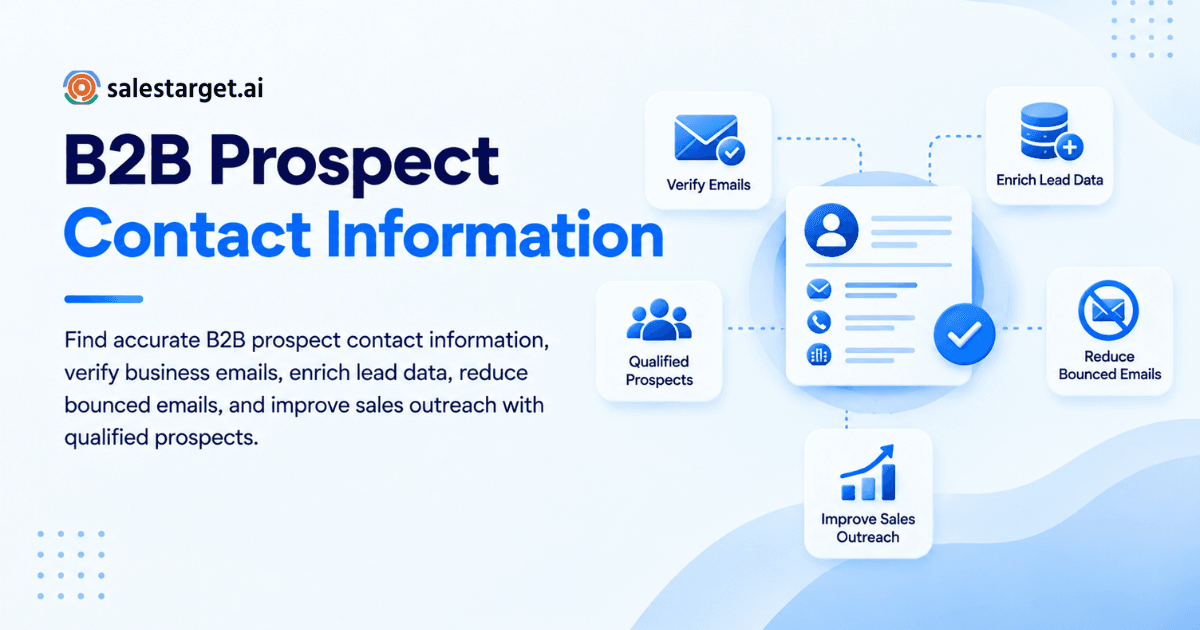
Accurate B2B prospect contact information is the foundation of every outbound motion that actually works. Without it, personalization falls flat, email deliverability tanks, and your sales team burns its most valuable resource: time. This guide covers where to find reliable contact data, how to verify it, what to watch for when building a contact database, and how modern platforms have collapsed what used to be a multi-tool mess into a single, faster workflow.
The Importance of Accurate B2B Prospect Contact Information
The Role of Reliable Contact Data in B2B Sales
Every outbound sequence starts with a name, a title, an email, and a company. If any one of those is wrong, the rest of the work collapses. Reliable contact data lets reps open conversations with the right person, in the right company, at the right time. It is the difference between a list that produces meetings and one that produces bounce notifications.
Prospecting is not just a top-of-funnel activity. Contact data flows downstream into account management, deal tracking, and follow-up. Stale or inaccurate records corrupt the CRM, make forecasting unreliable, and slow down every rep who touches a bad record later.
How Inaccurate Data Affects Outreach and Lead Quality
The costs are direct and measurable. According to Salesforce research, sales reps spend roughly 28% of their week on administrative tasks, and a significant portion of that goes to cleaning up bad data and tracking down correct contact details. Poor data does not just waste time; it actively damages sender reputation when bounced emails pile up, leading to domain blacklisting and lost inbox placement for the entire team.
Beyond deliverability, reaching the wrong contact at the right company still fails. Sending a VP-level pitch to an entry-level coordinator, or sending a technical product walkthrough to a CFO, produces silence. Bad targeting is a data quality failure, not a messaging failure.
Key Contact Details Sales Teams Need
A useful B2B contact record is more than a first name and a work email. Sales teams doing serious outbound work need:
- Verified business email address and direct phone number or mobile
- Full name, current job title, seniority level, and department
- Company name, industry, employee count, and annual revenue
- LinkedIn profile URL for multichannel outreach
- Buying intent signals: recent funding, headcount growth, tech stack changes, leadership transitions
The last category separates a contact from a lead. Intent signals tell you not just who to reach, but when. That timing difference is where reply rates move.
Types of B2B Prospect Contact Information
Business Email Addresses and Phone Numbers
These are the bare minimum. A valid, deliverable business email is non-negotiable. Direct dials and mobile numbers matter more than main switchboards; most decision-makers do not answer company main lines. When a platform claims "verified contact data," press on what that actually means. Real-time MX and SMTP validation is a different standard than a scrape that ran last quarter.
Decision-Maker and Professional Information
Job title alone is not enough. The same title means different things across company sizes. A "Head of Sales" at a 12-person startup may own budget decisions that a Sales Director at a 2,000-person company does not touch. Useful prospect data includes seniority level, reporting structure hints, department, and how long the person has been in the role. Tenure matters because new department heads typically evaluate new vendors in their first six months.
Company and Firmographic Data
Firmographic filters help reps prioritize before they reach out, not after they waste time on discovery calls. Company size, geography, industry vertical, revenue band, and technology stack all feed ICP matching. A company running Salesforce plus a specific marketing automation stack signals budget and maturity in a way that raw headcount does not.
Intent and Prospect Engagement Signals
Intent data is the layer most manual research cannot replicate. Platforms like Salestarget.ai surface real-time buying signals through Bombora Intent Topics, alongside business events like funding rounds, hiring spikes, and leadership changes on a 30 to 90-day lookback. When a target company just raised a Series B and is hiring five SDRs, the timing window for a sales tool conversation is obvious. Most reps never see that signal because they are working from a static list built three months ago.
Sources for Finding B2B Prospect Contact Information
B2B Contact Databases
Dedicated B2B databases are the primary source for scale. They vary significantly in coverage, freshness, and verification standards. Salestarget.ai's Lead Explorer draws on 840M+ verified professional profiles and 146M+ business entities across 50+ data sources, with continuous verification rather than periodic batch updates. That distinction matters: a contact scraped and verified eight months ago may already be wrong.
Company Websites and Professional Networks
Company pages, "About" sections, and LinkedIn are useful for individual account research, especially when verifying a contact or filling in context before an outreach. They are slow and impractical for list-building at scale, but experienced reps use them to add specificity to templated outreach, not as a primary data source.
B2B Prospecting and Lead Generation Platforms
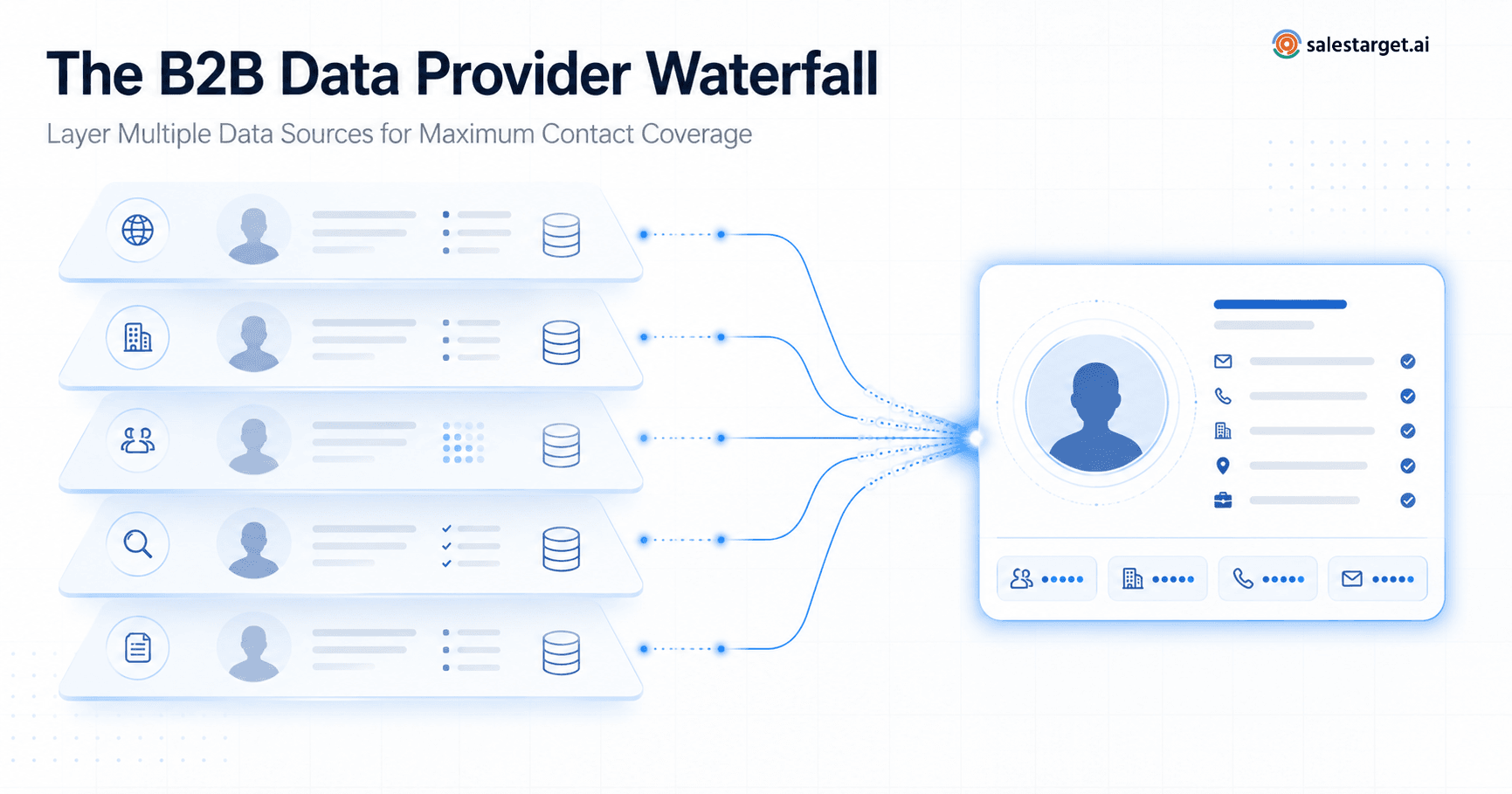
Platforms built for outbound combine search, enrichment, verification, and sequencing. This is where most modern sales teams operate. The question is whether those functions live in one tool or five, and what the handoff cost is between each. The best sales prospecting tools put data and outreach in the same workflow so reps can act on a prospect the moment they find one, not after exporting a CSV and importing it somewhere else.
Manual Prospect Research and Data Collection
Manual research still has a place: for high-value enterprise accounts where personalization depth matters more than speed, or for verticals with limited database coverage. But manual research cannot scale, and it introduces inconsistency. The data quality depends on who is doing the research and how carefully they verify what they find. Most reps stop at the email address and skip the verification step.
How to Find Accurate B2B Prospect Contact Information
Define Your Ideal Customer Profile and Target Roles
Before any search, nail down the ICP parameters: industry, company size, revenue range, geography, and technology indicators. Then define the roles. Not just titles, but seniority levels, departments, and typical decision rights. Salestarget.ai's ICP Builder formalizes this so every search starts from the same criteria rather than each rep building their own version of the target profile.
Build a Focused List of Relevant Prospects
Search narrow before you go wide. A list of 200 precisely matched prospects outperforms a list of 2,000 loosely targeted ones. Use stacked filters: industry + company size + role + seniority + tech stack + intent signal. In Salestarget.ai's Lead Explorer, this can be done with plain-English AI search or through layered Business and People filters, with 4,000+ intent and buyer signals available for real-time scoring.
Verify Business Email Addresses and Phone Numbers
Verification is a step many teams skip because it requires a separate tool. That shortcut destroys sender reputation over time. Salestarget.ai validates contact data at the point of enrichment, running MX and SMTP checks, disposable-email detection, and risk scoring before a contact ever enters a sequence. That is a different standard than buying a list and hoping it is clean.
Enrich Missing Prospect and Company Data
Enrichment closes the gaps that searches leave open. A name and company with no email, a company name with no contact, or a contact with no phone are all incomplete records that stall outreach. One-click enrichment in Salestarget.ai's Lead Explorer unlocks verified professional email, personal email, phone, and mobile from a partial record, without leaving the platform or manually cross-referencing sources.
Review Contact Data Before Starting Outreach
Do a final pass before launching any sequence. Check for duplicates, verify that titles match the campaign targeting, and flag any contacts that look like they may have changed roles. A five-minute review before sending saves hours of follow-up on misdirected emails and protects deliverability for everyone else in the campaign.
B2B Contact Data Verification and Enrichment
Email Verification and Deliverability Checks
Hard bounces above 2% signal a data quality problem and accelerate domain blacklisting. Salestarget.ai's Email Validator runs MX record checks, SMTP handshakes, and disposable-email detection, and connects to 60+ platforms for bulk list cleaning or real-time API verification. If 90% of emails in your database are validated before sending, as Salestarget.ai's own metrics show is achievable, hard bounces drop to a level that does not threaten the sending domain.
Contact Data Accuracy and Freshness
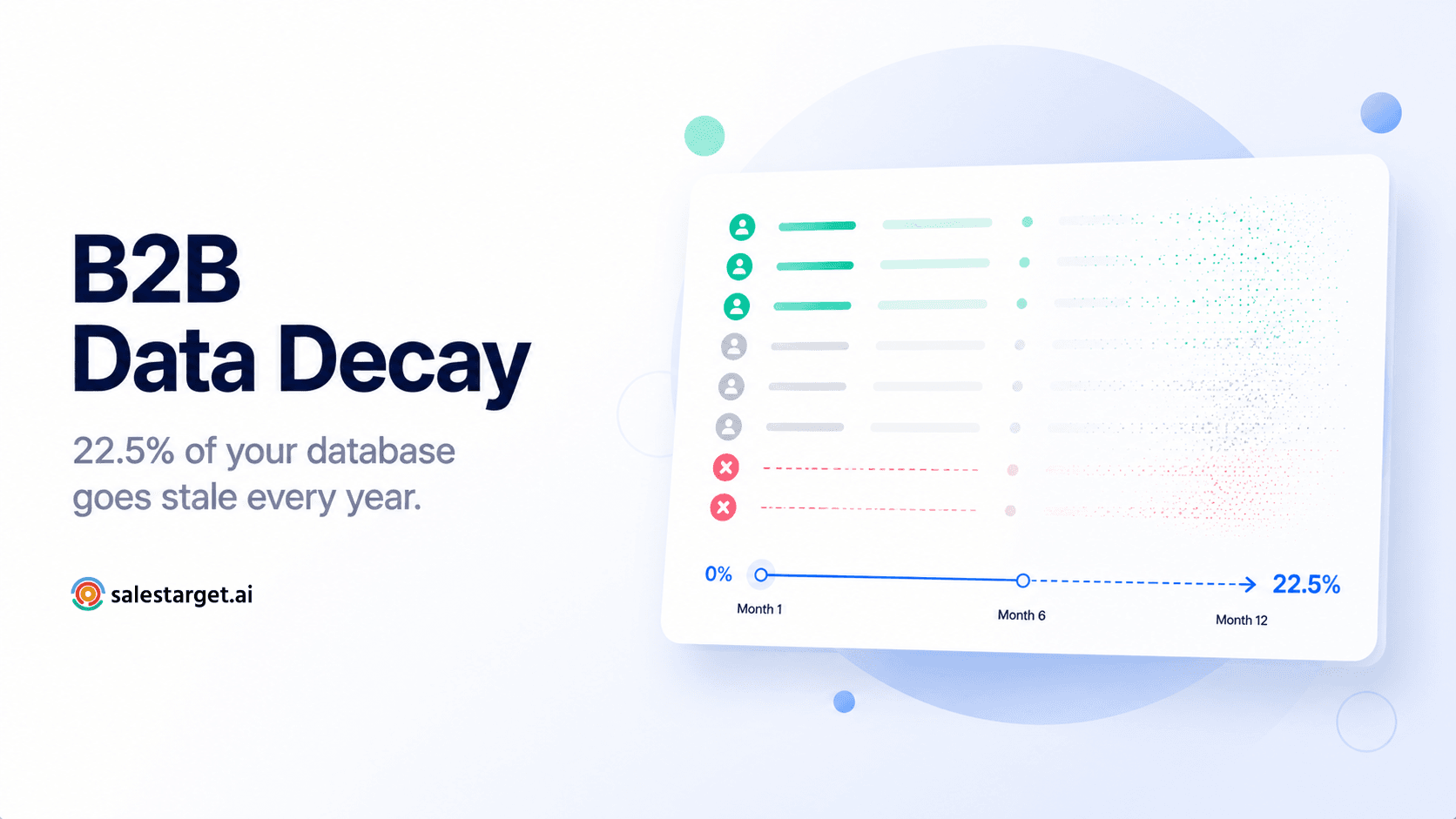
Data decays fast. Studies from HubSpot and others put average B2B data decay at 22% to 30% per year, which means a list built at the start of the year may already have one in four bad records by Q4. Freshness depends on when the data was last verified, not when it was first collected. Platforms that re-verify on enrichment rather than on a fixed schedule maintain higher accuracy across the board.
Duplicate and Incomplete Record Management
Duplicate contacts inflate list size, skew engagement metrics, and occasionally get the same prospect contacted twice from the same rep. Incomplete records are worse because they create the illusion of a full list while leaving gaps that only surface during outreach. Salestarget.ai's CRM logs every contact interaction to the lead timeline, making duplicates and gaps visible before they cause problems downstream.
Keeping Prospect Information Updated
Contact records degrade the moment you stop maintaining them. Build a review cadence into the workflow, not just a one-time cleanup. Flag contacts who have not been engaged in 90 days for re-verification before reuse. LinkedIn outreach combined with email often surfaces updated contact information organically; a LinkedIn connection acceptance sometimes reveals a new title or company before a database catches the change.
Key Factors for Choosing a B2B Contact Database
Data Coverage and Accuracy
Coverage without accuracy is noise. Accuracy without coverage means you will miss targets outside the database. Salestarget.ai indexes 840M+ professional profiles across 146M+ businesses with a stated 99% verified contact data standard. That combination of breadth and verification standard is the relevant measure, not raw profile count alone.
Verification Methods and Data Freshness
Ask vendors whether verification runs at the point of enrichment or on a batch schedule. Batch verification means contact data is valid as of the last update cycle, not right now. Real-time verification at enrichment is the higher standard, and the one that matters for outbound teams working at speed.
Search and Filtering Capabilities
A database with poor search wastes the data inside it. Useful search includes job title, seniority, department, company size, industry, geography, tech stack, and intent signals. Salestarget.ai's Smart Prospect Search supports both plain-English AI queries and stacked filter combinations, so reps with different research styles can both work effectively without needing to learn a complex Boolean syntax.
CRM and Sales Workflow Integration
A contact database that requires CSV exports to connect with the rest of the sales stack creates manual work and data lag. Salestarget.ai pushes enriched leads straight to sequences or the built-in CRM with no export step. For teams using HubSpot, Salesforce, or Zoho, native integrations carry the same data over without duplication.
Why Choose SalesTarget.ai
Find and Enrich Prospects with Lead Explorer
Lead Explorer is the prospecting engine inside Salestarget.ai. Search 840M+ verified profiles in plain English or through stacked filters, enrich contacts with verified email and phone in one click, and surface real-time buying signals through Bombora intent data and business events. The ICP Builder standardizes targeting criteria across the team, so every rep starts from the same profile rather than guessing. Enriched leads go straight to sequences or the CRM, with no manual handoff.
Verify Contact Data with Email Validator
Email Validator runs MX record checks, SMTP validation, and disposable-email detection before contacts enter any campaign. It works as a real-time API for single-contact verification and as a bulk cleaning tool for existing lists. It connects to 60+ platforms so verification fits into whatever stack the team is already using, not the other way around.
Run Email and LinkedIn Outreach in One Workflow
Most outbound stacks separate email and LinkedIn outreach into different tools with different logins, different sequence builders, and no shared context. Salestarget.ai runs both channels from the same workflow, so a contact who does not respond to email can receive a LinkedIn connection request without any manual coordination. The Unibox unified inbox pulls every reply into one view, sorts by intent, and syncs to the CRM automatically.
Manage Prospects with the Built-in CRM
The Salestarget.ai CRM is built for outbound, not retrofitted from an enterprise platform. Campaign leads land automatically, every email and call logs to the lead timeline without manual entry, and follow-up tasks are created automatically when a lead replies or a meeting ends. The built-in AI dialer handles click-to-call and saves call notes straight to the lead record. Teams using it report 3.2X faster deal cycles and 91% follow-up completion, which reflects what happens when the CRM is designed for the reps actually doing the work.
Speed Up Prospecting with AI Copilot
AI Copilot lets reps find leads, generate sequences, and query CRM data in plain language without switching between tools. Ask it to find VP-level contacts at Series B SaaS companies with headcount growth in the last 60 days, and it searches across 840M+ profiles and returns a result. Ask it to draft an outreach sequence for that segment, and it generates multi-step copy with built-in A/B variations. It flags at-risk deals, recommends next steps, and handles the administrative work so reps focus on conversations.
Common B2B Prospect Contact Data Mistakes
Using Outdated or Unverified Contact Lists
Purchased lists age quickly. Teams that buy a contact database and use it for 18 months without re-verification are sending to contacts who have left companies, changed titles, or moved to roles outside the ICP. Re-verify before every campaign run, not just when bounces spike.
Targeting Contacts Without Checking Their Roles
Title matches are not role matches. A "Director of Marketing" at a 15-person company may own the tech stack and the budget. The same title at an enterprise may sit three levels below the decision. Seniority level, reporting structure, and company size all matter for targeting precision, and most reps only look at the title.
Skipping Email Verification Before Outreach
This is the most expensive shortcut in outbound. Every hard bounce chips away at sender reputation. Once a domain lands on a blacklist, getting off it takes weeks and affects every rep sending from that domain. Verification before sending is not optional for teams that rely on email as a primary channel.
Failing to Update Prospect Records
A contact record is not permanent. People change jobs, get promoted, and leave companies constantly. Build a review process into the prospecting workflow: flag records that have not been re-verified in 90 days, cross-check against LinkedIn signals, and update titles and companies when they change. A CRM that logs engagement automatically, like Salestarget.ai's, makes it easier to spot stale records before they cause problems.
Turning Accurate B2B Prospect Data Into Effective Sales Outreach
Segmenting Prospects Based on Relevant Criteria
A single outreach campaign sent to a mixed list of titles, industries, and company sizes performs poorly for everyone in it. Segment before you sequence: group by vertical, by seniority, by company size, or by intent signal. Each segment gets messaging built for its specific situation. The data that enabled the segment now makes the outreach sharper.
Personalizing Outreach with Enriched Contact Data
Enriched data gives reps something to work with beyond first name and company name. A contact at a company that just raised a Series B, is hiring a sales team, and is using a competitor's tool has a context that generic cold email cannot address. Reference what is true and current about the prospect's situation. That specificity is what separates a reply-generating cold email from one that gets archived.
Prioritizing Qualified B2B Leads
Not all leads on a list deserve equal attention. Intent signals, firmographic fit, and engagement behavior all indicate where rep time is most likely to convert. Sort the list before the campaign starts, put the highest-signal contacts in the first wave, and reserve manual follow-up for the accounts most likely to close. Salestarget.ai's intent-based lead scoring helps surface this priority order automatically.
Tracking Prospect Engagement and Sales Activity
Contact data does not stop being useful after the first email. Engagement signals, open rates, link clicks, reply intent, and call outcomes all add context to the record. A prospect who opened the email three times but did not reply is a different conversation than one who never opened it. Salestarget.ai logs all of this to the lead timeline automatically, so the next rep touch starts with the full picture, not a blank slate.
Conclusion: Build a Reliable B2B Prospecting Process
Bad contact data is not a minor inconvenience. It is the single biggest reason outbound programs underperform. Bounced emails, misdirected pitches, hours spent manually cleaning lists, and domain reputation damage all trace back to the same root cause: data that was never verified or went stale before it was used.
Salestarget.ai builds the fix into the workflow itself. Find verified contacts from 840M+ profiles, enrich and validate them in the same click, run coordinated email and LinkedIn sequences from one workspace, and manage every deal in a CRM that updates itself. No CSV exports, no bolt-on tools, no data that sits around decaying between systems.
If your current prospecting process involves more than two tools and a manual hand-off, the overhead is costing you pipeline. Start with Salestarget.ai and run your first verified, enriched, multichannel campaign from a single workspace.