TL;DR
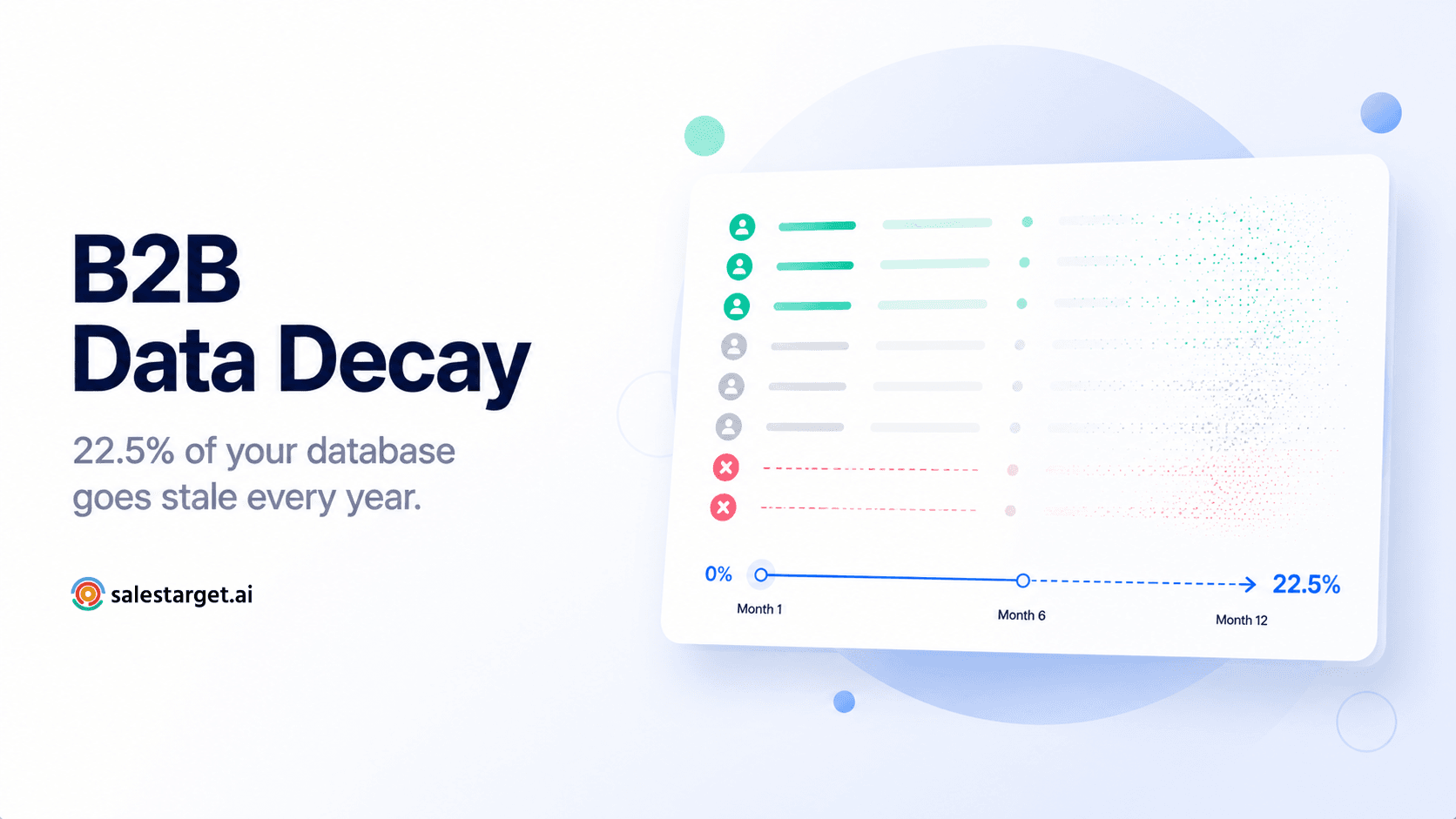
- B2B data decay is the rate at which contact records become inaccurate — 22.5% of your database goes stale every year, or 2.1% every month (Dun & Bradstreet / Cleanlist 2026)
- 30% of B2B contact records go stale within 12 months, costing sales teams an average of 546 hours per year in lost productivity (SignalHire research, March 2026)
- Poor data quality costs organisations $12.9M annually on average (Gartner) — and companies lose roughly 15% of revenue from inaccurate contact data
- Most tools verify when they collect data — not when you use it. That gap produces 15–27% bounce rates on historical verification databases
- Point-of-discovery enrichment means the contact is verified live at the exact moment you unlock it — not when it was originally added to the database
- SalesTarget.ai verifies every contact at the moment of enrichment — targeting under 5% bounce rates vs. 15–27% from static databases
The List Your SDRs Are Working From Right Now Is Partially Wrong
B2B contact data decays at 2.1% per month — compounding to 22.5% of your entire database going stale every 12 months (Dun & Bradstreet, cited in Cleanlist 2026 benchmark). In high-turnover industries like technology, the figure reaches 25–35% annually. For VC-backed startups, it can hit 30–40%.
That means right now, before your SDRs launch their next sequence, roughly one in four contacts in your database is pointing at a wrong email address, an old job title, or a person who left the company months ago.
The consequence is not just missed emails. It is 546 hours per SDR per year lost to chasing contacts that have moved, bounced emails that never delivered, and sequences built on a foundation of bad data (SignalHire research, March 2026). At a 10-person SDR team, that is over 5,000 person-hours per year — productive selling time turned into invisible waste.
📊 The data decay cost in numbers
- 22.5% annual decay rate: 2.1% of your database goes stale every month — Dun & Bradstreet / Cleanlist 2026
- 546 hours per year: average SDR productivity lost to bad contact data — SignalHire March 2026
- $12.9M annual cost: average organisational cost of poor data quality — Gartner research
- 15% revenue loss: companies lose roughly 15% of revenue from inaccurate contact data — Prospeo 2026
- 27.3% of SDR time wasted pursuing leads built on bad data — Prospeo / Gartner analysis 2026
What Is B2B Data Decay?
B2B data decay is the process by which contact and company records in a sales database become inaccurate over time, due to real-world changes that the database has not yet captured. It is not a data entry problem or a vendor quality problem — it is a fundamental characteristic of B2B contact data. People change jobs. Companies get acquired. Email domains migrate. Titles change. None of these events send a notification to the tools your SDRs are using.
| Data field | Annual decay rate | What causes it |
|---|---|---|
| Work email | 20–30% | Job changes, domain migrations, company acquisitions |
| Job title | 15–25% | Promotions, restructuring, role changes |
| Direct phone | 15–20% | Job changes, office moves, number reassignments |
| Company name | 10–15% | Rebrands, mergers, acquisitions |
| Mobile phone | 5–10% | Personal numbers change less frequently than work contact info |
| LinkedIn / profile URL | 3–5% | Relatively stable — but profiles change on job transitions |
Source: Prospeo B2B Data Guide 2026, cross-referenced with Cleanlist 2026 benchmark data.
The compounding effect is what makes decay dangerous at scale. A 20% annual decay rate on a 10,000-contact database means 2,000 stale records per year — approximately 38 new stale contacts every week. On a 100,000-contact enterprise database, that is 1,900 new bad records per week. Each one costs an estimated $100 in wasted rep time, failed outreach, and email deliverability damage (Landbase research 2026).
Why Static Databases Lie: The Batch Enrichment Delay
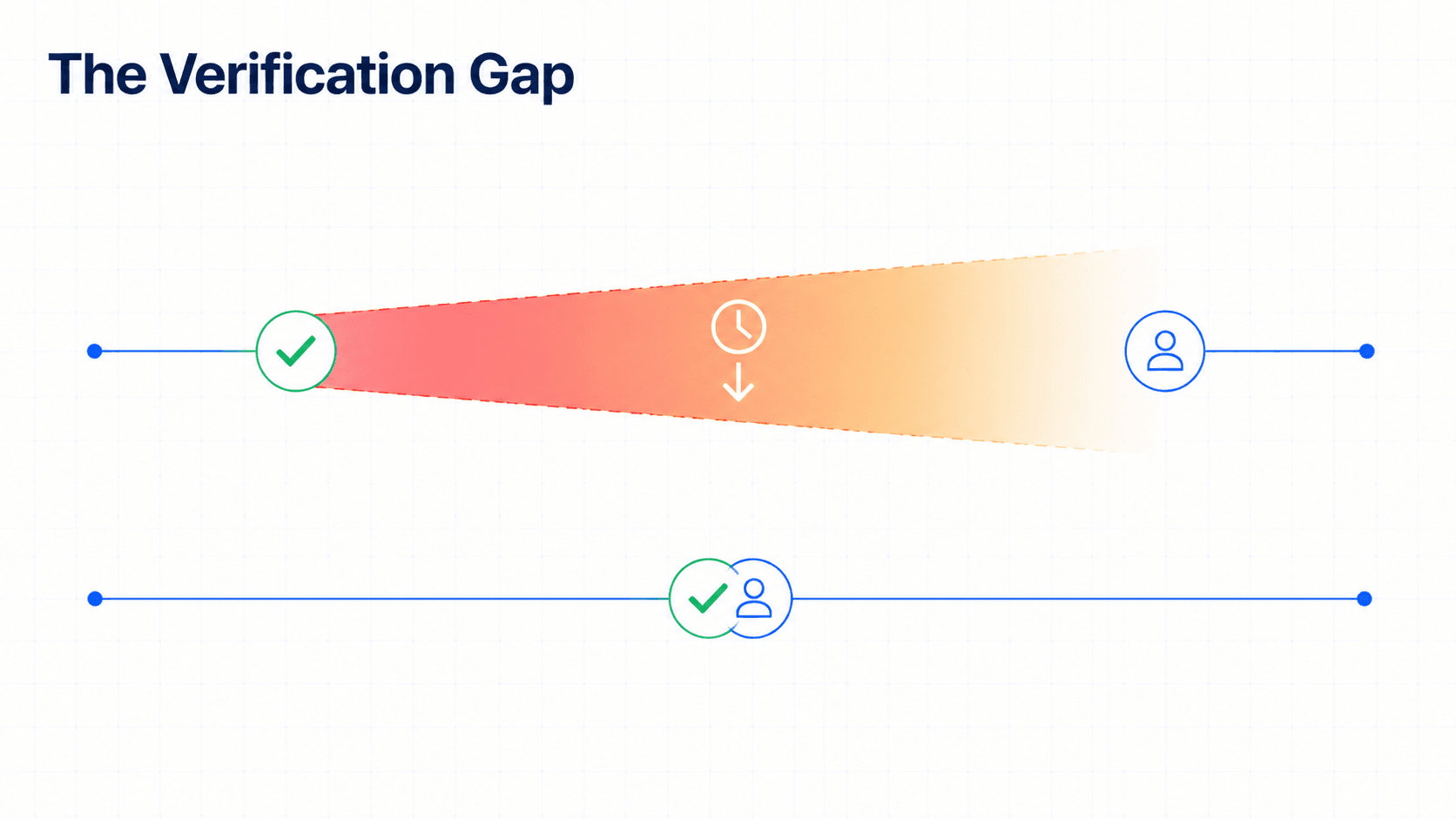
Most B2B data providers verify contact information when they add it to their database — not when you use it. This is called batch enrichment or historical verification: the provider runs a verification pass at collection time, certifies the contact as accurate, and stores it. From that moment forward, the clock is ticking.
The industry average refresh cadence for B2B data providers is every 4–6 weeks. That means a contact certified as accurate on day one could be six weeks out of date by the time it reaches your enrichment queue — and if your provider refreshes quarterly, that gap extends to three months of undetected decay.
⚠️ The batch enrichment timeline
- Day 1: Provider adds contact to database. Verification pass runs. Contact is certified accurate.
- Week 3: Contact changes jobs. Their email becomes invalid. Their title is wrong. The database does not know.
- Week 6: Provider runs scheduled refresh. Contact may or may not be re-verified depending on refresh depth.
- Week 8: Your SDR pulls the contact for enrichment. The record shows the old job, the old email, the old title.
- Result: Your SDR sends a carefully personalised sequence to someone who left eight weeks ago. The email bounces. Your sender domain takes the hit.
This is why Apollo's independent bounce rate sits at approximately 27% in Cleanlist's 2026 testing — and why Hunter.io produces an 11.2% hard bounce rate in Dropcontact's 2025 benchmark (20,000 contacts tested). These are not outliers. They are the expected output of historical verification on a database that refreshes every 4–6 weeks, applied to contact data with a 20–30% annual decay rate.
The architecture is broken by design. A contact certified six weeks ago as accurate is not the same as a contact verified today. The label "verified" on a static database record tells you when the data was checked. It does not tell you whether it is still accurate right now.
What Point-of-Discovery Enrichment Actually Means
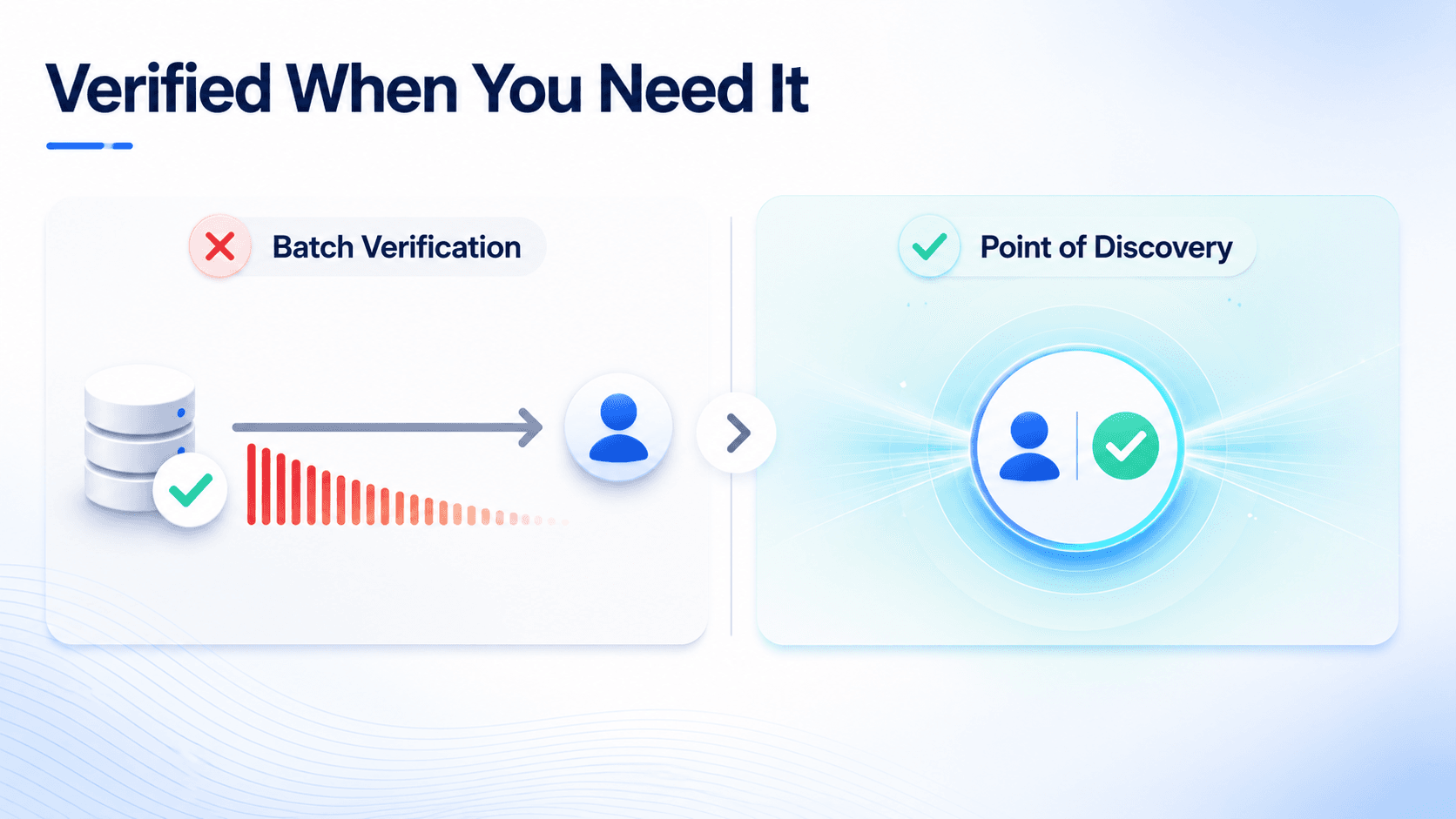
Point-of-discovery enrichment is a verification architecture where the contact's data is checked live against current records at the exact moment you unlock it — not at the moment it was added to the database, and not on a scheduled refresh cycle. The verification event and the enrichment event are the same event.
| Batch / historical verification | Point-of-discovery enrichment | |
|---|---|---|
| When verification runs | When the contact was first added to the database | At the exact moment you click to enrich the contact |
| What it reflects | The state of the contact weeks, months, or years ago | The state of the contact right now |
| Gap between verification and use | Days to months — depends on refresh cycle | Zero — verification and use are simultaneous |
| Decay risk | High — 20–30% of records become inaccurate annually | Minimal — check happens at point of use |
| Who uses it | Apollo, Hunter.io, Lusha, ZoomInfo on standard plans | SalesTarget.ai — verification runs at moment of enrichment |
| Expected bounce rate | 15–27% in independent testing | Targets under 5% |
🔍 What the live check covers at point of enrichment
- MX record lookup — confirms the domain has an active mail exchange server right now
- SMTP handshake — pings the mail server to confirm the specific address exists, without sending an email
- Role-based address detection — flags generic addresses (info@, support@, admin@) that go to shared inboxes, not decision-makers
- Catch-all domain detection — identifies domains that accept all email regardless of whether the specific address exists
Why This Matters for Your Domain Reputation — Not Just Your Reply Rate
A 5% email bounce rate is the threshold at which Gmail, Yahoo, and Microsoft begin throttling your sending domain. Above that, inbox placement drops. Above 10%, emails are routed to spam or rejected outright. Domain reputation damage is cumulative — a single high-bounce campaign affects deliverability across every future send from that domain.
| Bounce rate | What happens to your domain | Recovery time |
|---|---|---|
| Under 2% | Healthy sender — normal deliverability | N/A |
| 2–5% | Caution — inbox providers flag the pattern | 2–4 weeks clean sending |
| 5–10% | Gmail and Yahoo throttle your domain — emails routed to spam | 4–8 weeks minimum |
| 10%+ | Microsoft / Gmail may reject outright — full domain rebuild required | 2–3 months |
| Apollo (independent test) | ~27% bounce rate — Cleanlist 2026 testing | — |
| Hunter.io (independent test) | 11.2% hard bounce — Dropcontact 2025 benchmark, 20,000 contacts | — |
| SalesTarget.ai | Targets under 5% — point-of-discovery verification | — |
How SalesTarget.ai's Built-In Enrichment Works
SalesTarget.ai's built-in lead enrichment is not a separate product layered onto a prospecting database — it is the same action. Find the contact, click to enrich, and the verification runs live at that moment. No export step. No CSV. No waiting for a scheduled database refresh.
- Search first, spend later. Apply ICP filters (industry, company size, geography, job title, tech stack) before any credits are used. The search is free. Credits are only spent when you unlock a contact.
- Has Email + Has Phone toggles. Filter to show only contacts with verified data available before committing credits. Every result on your list is reachable before enrichment begins.
- Point-of-discovery verification at unlock. When you click to enrich, the live check runs. The data you receive reflects the contact's current state — not when they were added to the 840M+ profile database.
- No separate tool required. Enrichment, verification, ICP filtering, and outreach sequencing all live in the same platform. The enriched contact flows directly into your sequence or built-in CRM.
Conclusion: The Database Size Is Not the Problem
Most teams shopping for a B2B data platform ask about database size. 300 million contacts. 840 million profiles. The number sounds like a quality signal. It is not. A 300 million contact database where 22.5% of records are stale is 67.5 million contacts pointing at the wrong person, the wrong email, or a company that no longer exists in the same form.
The right question is not how many contacts a platform has. It is when were those contacts last verified — and does that verification happen before or after you spend your credits?
Point-of-discovery enrichment solves the timing problem at the architectural level. SalesTarget.ai's Lead Explorer verifies every contact live at the moment of enrichment. The Has Email toggle ensures you only see contacts with verified data available before spending a credit. And the 840M+ profile database — combined with ICP filters, intent signals, and point-of-discovery verification — means the contacts you pull are accurate today, not when someone collected them six weeks ago.
The list is not lying to you because of the vendor. It is lying to you because of the architecture. Point-of-discovery fixes the architecture.
Stop enriching stale data. Verify at the moment of discovery.
SalesTarget.ai checks every contact live when you enrich — not months after it was collected.
50 credits · 7-day free trial · No credit card required