Your reps are spending half their day on research. The lists they build are stale before outreach goes out. Response rates are flat, pipeline is thin, and the leads that do come in often don't match the profile your team can actually close.
Sales prospecting is the process of finding and qualifying potential buyers who match your ideal customer profile, then reaching them with targeted outreach before a competitor does. In B2B sales, that means moving from a broad market to a specific, verified contact with a relevant problem, the authority to act on it, and timing that makes engagement likely.
Done right, prospecting fills your pipeline with decision-makers who have both intent and budget. Done wrong, it burns rep time, inflates pipeline with contacts that will never convert, and eventually damages the sender reputation of the domain your whole team emails from.
This guide covers how B2B sales prospecting works, what separates effective from broken approaches, and how SalesTarget.ai brings the entire prospecting workflow into one place.
Why Do B2B Sales Teams Struggle to Find Qualified Prospects?
Most prospecting failures aren't about effort. Teams are putting in the hours. The failure points are structural.
Why High Lead Volume Does Not Always Create Sales Opportunities
Volume is not the same as quality. A list of 2,000 contacts with no fit filter creates noise, not pipeline. According to HubSpot's State of Sales Report, sales reps spend only around 28% of their week actually selling; the rest goes to admin, data entry, and chasing contacts who were never going to convert. [HubSpot State of Sales Report, 2024] Feeding more leads into a targeting process that isn't working just means more wasted outreach and a more crowded inbox with a worse reply rate.
How Poor Contact Data and Weak Targeting Affect Outbound Sales
B2B contact data decays at roughly 30% per year as buyers change jobs, get promoted, or leave companies entirely. [Gartner B2B Data Quality Research] When your prospect list is built on stale emails and wrong titles, bounce rates spike, sender reputation drops, and reply rates follow. Weak targeting compounds this: if you're reaching people in the wrong function at companies too small to use your product, no level of personalization fixes the message.
Why Manual Prospecting Slows Down Sales Pipeline Growth
Building prospect lists by hand, cross-referencing LinkedIn, exporting from one tool, verifying in another, then importing to a CRM, can take two to three hours per rep per day. That's time pulled directly from outreach and calls. The bigger issue is that manual processes don't scale. What works for one rep doesn't replicate across a team, and data quality varies with whoever built the list that week.
What Is Prospecting in Sales and How Does It Work?
What Is the Main Purpose of Sales Prospecting?
Sales prospecting exists to build a consistently replenished pipeline of buyers who fit your ideal customer profile and show signals that they're ready to engage. Without it, pipeline becomes reactive, dependent on inbound you don't control. Prospecting puts outbound in your hands.
How B2B Sales Prospecting Connects With Lead Generation
Lead generation and prospecting overlap but aren't the same. Lead generation is often inbound: content, ads, and SEO bring potential buyers to you. Prospecting is outbound: you identify specific contacts, qualify them against your ICP, and initiate contact. B2B teams that rely only on inbound see inconsistent pipeline. Prospecting fills the gaps and gives revenue teams control over timing and volume.
What Is the Difference Between a Lead, Prospect, and Qualified Sales Opportunity?
A lead is any contact whose information you have, earned or bought. A prospect is a lead who has been reviewed and matches your ICP criteria: right company size, industry, role, and a likely relevant problem. A qualified sales opportunity is a prospect who has shown interest or intent and has been assessed for budget, authority, need, and timing. Moving a contact from raw lead to qualified opportunity is the core job of the prospecting process.
How Does Prospecting Move Buyers Into the Sales Pipeline?
Prospecting identifies who to target, enriches and verifies their contact data, qualifies them against your ICP, and pushes them into a structured outreach sequence. Each engaged prospect who responds positively becomes a pipeline entry. The sequence is: find, qualify, reach, engage, convert. Every step that passes contacts through without proper qualification makes the pipeline less accurate and harder to forecast.
Why Is Sales Prospecting Important for B2B Lead Generation?
Finding Decision-Makers Who Match Your Ideal Customer Profile
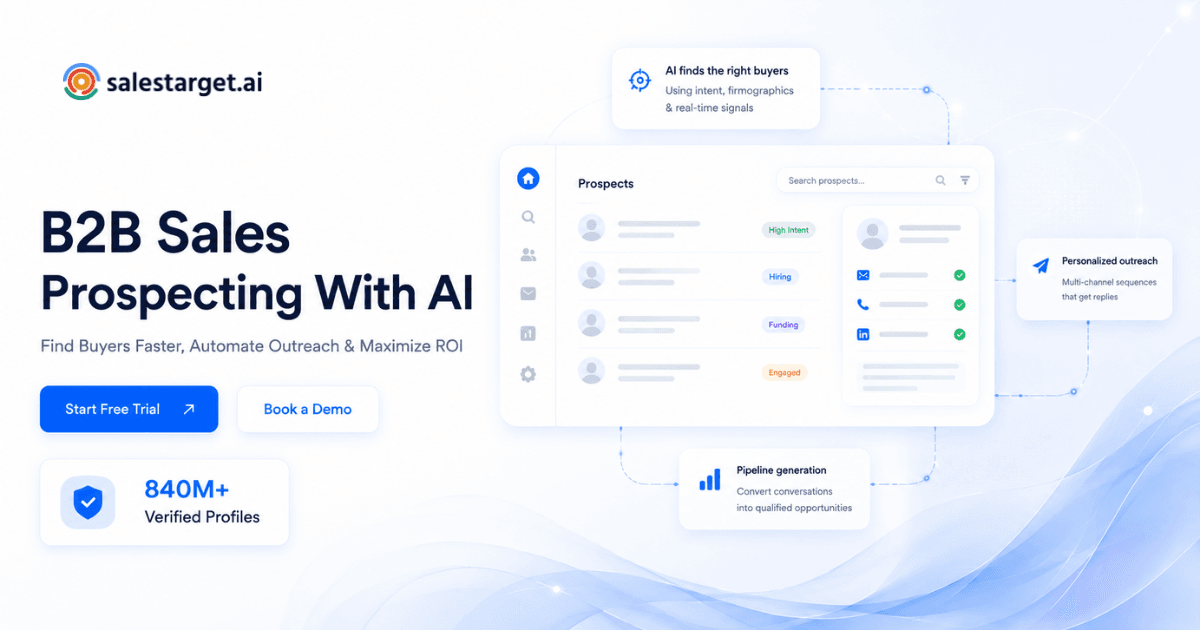
Reaching the right person matters more than reaching more people. A well-defined ICP lets you filter by company size, industry, revenue band, tech stack, and specific job function so outreach lands with buyers who have both the authority and the need. SalesTarget.ai's Lead Explorer covers 840M+ verified professional profiles, searchable across stacked filters: role, seniority, department, company revenue, location, and live buying intent signals, so the list you build already reflects the buyer you're trying to reach.
Improving Lead Quality and Sales Conversion Rates
Quality prospecting improves conversion at every stage. When your outreach list reflects real buyer fit, reply rates go up, meetings are more likely to progress, and reps spend less time disqualifying contacts after the first call. Salesforce's State of Sales research found that top-performing teams are significantly more likely to use data-driven approaches to prospect identification compared to lower performers. [Salesforce State of Sales, 2024] That gap widens as markets get more competitive.
Building a Consistent Pipeline of Qualified B2B Leads
Inconsistent prospecting creates pipeline cycles: strong when a campaign runs, thin when it ends. Teams that build a repeatable, structured process, with defined ICPs, consistent data sources, and a sequenced outreach cadence, generate pipeline as a system rather than a sprint. That predictability is what revenue leaders need to forecast accurately and what boards expect when evaluating a sales team's operational maturity.
Reducing Time Spent on Low-Intent Prospects
Every hour a rep spends on a contact who was never going to buy is an hour not spent on one who might. Intent data changes this equation. Filtering for contacts who are actively researching relevant topics, or whose companies are showing buying signals like funding rounds, leadership changes, or hiring spikes, lets teams front-load outreach toward contacts with the highest probability of engaging now.
How Does the B2B Sales Prospecting Process Work Step by Step?
Step 1: Define Your Ideal Customer Profile and Buyer Personas
Start with your best existing customers. Map who you actually close by industry, company size, revenue range, buyer job title, and tech stack. The ICP is the filter every other step runs through. Without it, every downstream decision is a guess.
Step 2: Identify Target Companies and Key Decision-Makers
Using your ICP, identify which companies to prioritize and which specific contacts to reach within them. Firmographic filters narrow the company list. People filters narrow to the right function and seniority within those companies. The goal is a short, high-fit list, not a broad one.
Step 3: Find B2B Contacts Using Prospecting Tools
Manual search doesn't scale. A B2B contact database with real-time, verified data gives you access to relevant contacts without spending hours on LinkedIn cross-referencing job titles. SalesTarget.ai's Lead Explorer covers 146M+ business entities and 840M+ profiles, searchable in plain English or with stacked filters across 50+ data sources.
Step 4: Enrich and Verify Prospect Contact Information
A name and company name aren't enough. You need verified professional emails, phone numbers, and mobile contacts before outreach. Enrichment in Lead Explorer runs at the point of finding the contact, unlocking verified contact data in a single click. The Email Validator then runs MX and SMTP checks to confirm deliverability before any email goes out. SalesTarget.ai validates 90% of emails before they enter sequences.
Step 5: Identify Buyer Intent Signals and Qualify Prospects
Not every ICP-match is ready to buy right now. Intent signals narrow the list further: who is actively researching your category? Which companies are showing business events, like funding rounds or hiring spikes, that suggest expansion? SalesTarget.ai surfaces 4,000+ real-time buying signals on a 30 to 90 day lookback, powered by Bombora Intent Topics, alongside business event triggers.
Step 6: Personalize Email and LinkedIn Outreach
Generic outreach gets ignored. Personalization at scale means using role, company size, industry, and recent business context to make each message feel specific, not mass-sent. SalesTarget.ai's Email Outreach and LinkedIn Outreach modules run AI-personalized sequences across both channels in one coordinated flow, so context doesn't break between touchpoints.
Step 7: Follow Up and Track Prospect Engagement
Most replies don't come from the first touch. A structured follow-up cadence, timed around working hours and spaced to avoid spam risk, keeps outreach active without saturating contacts. Unibox inside SalesTarget.ai consolidates every reply into one inbox, sorted by intent (Interested, Follow-Up, Not a Fit), so reps see exactly who to prioritize and who to remove.
Step 8: Convert Qualified Prospects Into CRM Opportunities
When a prospect engages, they need to move into the pipeline without manual handoffs. SalesTarget.ai's CRM receives leads directly from sequences, logs every email and call to the lead timeline automatically, and creates follow-up tasks when a reply or meeting is booked. No CSV exports, no copy-pasting between tools.
What Are the Most Effective Sales Prospecting Strategies for B2B Teams?
Ideal Customer Profile-Based Prospecting
Build every list from your ICP outward. Industry, company size, revenue, and role filters eliminate noise before outreach starts. This is the baseline. Without it, every other strategy runs on a flawed list.
LinkedIn Prospecting to Reach B2B Decision-Makers
LinkedIn is where B2B decision-makers are visible and accessible. Effective LinkedIn prospecting goes beyond connection requests: personalized DMs, follow-up on engagement, and conditional sequences that branch based on whether someone replied or connected. SalesTarget.ai automates this with human-like pacing and built-in safety limits that protect accounts from LinkedIn restrictions.
Cold Email Prospecting With Verified Contact Data
Cold email still works when the list is clean and the message is relevant. What kills it is bad data (bounces that destroy sender reputation) and generic copy (flat reply rates). Start with verified contacts, use AI-generated sequences tailored to role and industry, and rotate across multiple warmed inboxes to maintain deliverability across high-volume campaigns.
Account-Based Prospecting for High-Value Buyers
For enterprise or high-value deals, narrow down to a tightly defined account list and reach multiple stakeholders within the same target company. This approach reduces volume but raises deal size and conversion probability. It also requires richer personalization and multi-thread outreach that coordinates across roles.
Intent-Based Prospecting to Prioritize Active Buyers
Timing is a competitive advantage. A contact who matches your ICP and is actively researching your category right now is worth more than ten contacts who might be interested in six months. Prioritizing outreach by intent score means your highest-effort sequences go to the contacts most likely to respond today.
Multichannel Prospecting With Email and LinkedIn
Reaching a prospect on one channel and again on another, with consistent context, consistently outperforms single-channel outreach. A prospect who doesn't open an email may respond to a LinkedIn DM with the right note. Running both from one platform, as SalesTarget.ai does, keeps messaging aligned and sequences coordinated without manual handoffs between tools.
How to Find Qualified B2B Leads Through Sales Prospecting
Use B2B Contact Databases to Identify Relevant Buyers
A B2B contact database gives you access to verified, searchable contacts across industries and roles without the hours of manual research. The quality of the underlying data determines the quality of the list. Freshness, coverage, and enrichment depth are the three things to evaluate before trusting a database for outbound.
Apply Firmographic and Job-Role Filters to Narrow Prospect Lists
Stack filters: industry, employee count, annual revenue, location, job title, seniority, and department. Stacking tightens the list but improves fit. Fewer contacts with higher match rates outperform large lists with poor targeting in every metric that matters.
Identify Buying Signals Before Starting Outreach
Funding announcements, new executive hires in sales or operations roles, job postings in your product category, and technology adoption changes all signal that a company is in a phase where your product becomes relevant. Running outreach against a signal-qualified list changes the framing from interruption to timely offer.
Verify Email Addresses and Contact Details
Every unverified email is a bounce risk. Bounces above 2% signal spam risk to mailbox providers. Above 5%, you're heading toward deliverability damage that can take months to reverse. Verify before you send, not after you see bounce rates climb.
Score Prospects Based on Fit, Intent, and Engagement
ICP fit + active intent signals + engagement (email opens, link clicks) gives you a ranked list of who to prioritize. Reps working from scored lists close faster because they're entering conversations where interest already partially exists, rather than building it from zero.
What Features Should You Look for in Sales Prospecting Tools?
Accurate B2B Contact Data and Lead Enrichment
The database is the foundation. Evaluate freshness (when data was last verified), coverage (profiles and business entities), and enrichment depth (email, phone, mobile). Data that's six months old is already partially stale in fast-moving industries where contacts change roles frequently.
Advanced Prospect Search and Buyer Intent Filters
Beyond basic title and industry filters, look for tools that search by tech stack, buyer intent topics, business events, and company growth signals. SalesTarget.ai's AI-powered search lets reps describe their target audience in plain English and returns a filtered result instantly, removing the friction of learning complex filter logic.
Email Verification and Contact Data Quality Checks
Verification should happen at the point of enrichment, not as an afterthought. Real-time MX and SMTP checks catch invalid addresses before outreach starts. SalesTarget.ai's Email Validator also runs disposable-email detection and risk scoring, so the contacts that make it into sequences are high-confidence.
Automated Email and LinkedIn Outreach
Automation handles the repetitive steps, follow-up timing, sequence pacing, inbox rotation, so reps focus on replies and real conversations. Look for tools that handle both email and LinkedIn in one coordinated flow rather than requiring separate platforms for each channel.
CRM Integration and Prospect Activity Tracking
Every prospecting activity should log to a lead record automatically. When reps manually update CRM after every call or email, they don't do it consistently. Native CRM means the record is always current without adding work at the end of each interaction.
AI Sales Prospecting and Workflow Automation
AI accelerates the parts of prospecting that don't need a human decision: building sequences, personalizing at scale, scoring leads, and surfacing at-risk deals. The AI Copilot inside SalesTarget.ai handles these tasks conversationally, free inside the platform, so reps find leads, generate sequences, and query pipeline without switching tools.
How Does AI Sales Prospecting Help Generate Qualified Leads?
Identifying High-Fit Prospects Using AI-Based Search
AI converts plain-English queries into targeted lead searches. Instead of manually stacking 12 filters, a rep can describe their target audience and get a filtered, ranked result in seconds. This compresses research time that used to take hours into minutes.
Reducing Manual Prospect Research and Data Entry
AI handles sourcing, enrichment, and logging steps that reps would otherwise do manually. SalesTarget.ai users save approximately 6 hours per rep per week by eliminating manual data entry and prospect research, with follow-up completion rates reaching 91%.
Personalizing Sales Outreach Based on Prospect Information
AI-generated sequences pull from the prospect's role, company size, industry, and recent business activity to produce first-touch emails and follow-ups that read as relevant rather than mass-produced. The AI Spintax Generator creates variation across touches so each follow-up doesn't mirror the one before it.
Automating Follow-Ups Across Email and LinkedIn
Follow-ups are where most manual processes break down. Reps forget, get distracted, or misjudge timing. Automated sequences with conditional branching (if they opened but didn't reply, send follow-up A; if they didn't open, send follow-up B) keep every prospect in a consistent cadence without requiring rep oversight on each contact.
Prioritizing Prospects Through Buyer Intent and Engagement Signals
AI scoring surfaces which prospects opened emails, clicked links, or match high-intent signals from external data sources. Reps working a scored list spend their calls and time on contacts where interest already exists, rather than cold-starting every conversation.
Why Choose SalesTarget.ai for B2B Sales Prospecting?
Find and Enrich B2B Leads With Lead Explorer
SalesTarget.ai's Lead Explorer covers 840M+ verified professional profiles and 146M+ business entities. Search by role, industry, company size, revenue, tech stack, and intent topics. One-click enrichment surfaces verified professional email, personal email, phone, and mobile without leaving the platform. Enrichment and verification happen at the moment you find the contact, not from a batch scraped months ago.
Run Connected Email and LinkedIn Outreach Sequences
Multi-step sequences run across email and LinkedIn in one coordinated flow. Email Outreach auto-builds campaigns from a plain-English description of your audience, complete with first touch, follow-ups, and pacing. LinkedIn Outreach handles connection requests, DMs, and follow-ups with AI personalization, human-like delays, and built-in account protection.
Verify Prospect Emails and Reduce Bounce Risks
The Email Validator runs real-time MX and SMTP checks on every contact before outreach, with disposable-email detection and risk scoring. 90% of emails are validated before any sequence starts, keeping bounce rates low and sender reputation clean across your sending domains.
Manage Sales Opportunities With a Built-In CRM
Leads from sequences land in the CRM automatically. Every email, call, and meeting logs to the lead timeline without manual entry. The built-in AI dialer captures call notes automatically and saves them to the record, so reps never write up call summaries by hand. SalesTarget.ai users see deal cycles close 3.2X faster compared to teams running outbound across disconnected tools.
Simplify Prospect Research and Outreach With a Free AI Copilot
The AI Copilot is free inside the platform. It handles lead search in plain language, generates full outreach sequences, queries pipeline status, flags at-risk deals, and creates and assigns tasks across the team. Reps ask; it delivers, inside the same workspace where sequences and CRM already live.
Manage Prospecting, Outreach, and Sales in One Platform
Apollo gives you data and engagement but still requires add-ons for deliverability and a real CRM. Instantly and Smartlead run cold email well but have no native B2B database, no LinkedIn automation, and no real pipeline management. SalesTarget.ai keeps every step, from finding a contact to closing the deal, inside one workspace. If you're building outbound across five disconnected tools, see how SalesTarget.ai consolidates the stack.
What Are the Most Common Sales Prospecting Mistakes to Avoid?
Targeting Too Many Prospects Without Checking Buyer Fit
Bigger lists don't mean better pipeline. A list of 500 well-qualified contacts outperforms a list of 5,000 poor-fit ones in reply rates, meeting rates, and close rates. Run ICP filters before building a list, not after campaign results come back flat.
Using Outdated or Unverified B2B Contact Information
Bad data is expensive. A 20% bounce rate on an email sequence signals spam risk to mailbox providers and can damage domain reputation that takes months to rebuild. Verify at the point of enrichment. Ask whether the tool you're using refreshes data continuously or relies on a database that hasn't been touched in two years.
Sending Generic Outreach Messages to Every Prospect
"Hi [First Name], I help companies like yours with [vague benefit]" isn't prospecting. It's a waste of a contact. Personalization at scale means using role, industry, company size, and business context to make each message feel specific. AI sequence generation handles this automatically at volume.
Ignoring Buyer Intent and Engagement Signals
Reaching a contact at the wrong moment means competing against their current priorities rather than aligning with them. A company that just raised a Series A is likely evaluating tools. A VP of Sales who just joined a new company is building their stack. Intent signals tell you when to reach out, not just who to reach.
Sending Too Many Follow-Ups Without Checking Responses
Five follow-ups to a contact who already replied "not interested" is a list management failure. Automated sequences need to branch correctly: contacts who reply should exit the sequence and move to a rep for handling. Failure to configure this correctly burns contacts and creates the kind of outreach that gets your domain flagged.
Failing to Update Prospect Records and Track Sales Activity
A CRM full of stale records kills forecasting accuracy. When outreach activity, calls, meetings, and replies don't get logged consistently, managers lose visibility and deals fall through the cracks. Automatic logging removes the dependency on rep discipline and creates a reliable record regardless of who handled the contact.
How Do You Measure the Success of Your Sales Prospecting Efforts?
Prospect-to-Qualified-Lead Conversion Rate
Of all the contacts you outreach to, what percentage become qualified leads that enter an active sales process? This reveals how well your targeting and qualifying process is working before outreach starts.
Positive Reply Rate and Meeting Booking Rate
Positive reply rate tracks replies that show genuine interest. Meeting booking rate tracks how many of those convert to a calendar event. A low meeting rate after positive replies usually indicates a handoff problem, not a prospecting problem. Address them separately.
Email Bounce Rate and Contact Data Accuracy
Bounce rates above 2% are a warning. Above 5%, deliverability risk becomes real. Track this per campaign and per data source to identify where your contact data is weakest and prioritize verification workflows accordingly.
Qualified Pipeline Generated From Prospecting
Pipeline value attributed to outbound prospecting, measured in opportunity value and stage distribution, shows how much revenue your prospecting investment is generating. This is the number that justifies or challenges the prospecting budget in every quarterly review.
Prospecting Time per Qualified Sales Opportunity
How many hours does it take to put one qualified opportunity into the pipeline? If the current answer is four to six hours, that's a process problem as much as a talent problem. Tools that automate sourcing, enrichment, verification, and sequencing show clear ROI here and create the capacity for reps to work higher volumes without proportionally more hours.
How to Build a More Effective B2B Sales Prospecting Process With SalesTarget.ai
Your pipeline is a direct output of how well your prospecting process runs. If leads are thin, data is stale, outreach is generic, or activity isn't tracked, you can identify exactly where the problem sits and fix it systematically.
SalesTarget.ai was built for this specific problem. Lead Explorer finds and enriches contacts against your ICP using 840M+ profiles and real-time intent signals. Email and LinkedIn sequences run from one workspace with AI personalization that adapts to each prospect's role and company context. The Email Validator keeps bounce rates low before sequences start. The built-in CRM logs every touch and auto-creates follow-up tasks. The AI Copilot handles the research, content generation, and pipeline querying that reps usually spend hours on each week.
What that means in practice: reps spend time on conversations, not on research and data entry. Pipeline is built from buyer-fit contacts with verified contact data and real intent signals, not from a recycled list that was accurate two years ago.
Stop running outbound across five disconnected tools. Start a free demo with SalesTarget.ai and see what it looks like to prospect, reach, and close inside one platform.