Most enterprise account targeting starts in familiar territory: firmographics, tech stacks, funding rounds, hiring patterns, intent signals. Sales teams build prospect lists around these data points, then layer on contact intelligence for specific buyers. What rarely enters the picture is the company's board of directors.
That's a missed opportunity. A capable lead enrichment tool can do more than surface job titles and email addresses. It can help teams uncover the leadership connections, strategic expertise, and cross-company relationships that sit at the board level. This intelligence won't replace your existing account research workflow, but it adds a signal layer that most competitors overlook entirely.
For SDRs, account executives, and revenue teams working enterprise deals, understanding who governs a target account can reshape how you prioritize, research, and engage. And when combined with approaches like reverse prospecting and modern B2B prospecting tools , board-level data becomes even more actionable.
What Is Board Member Intelligence?
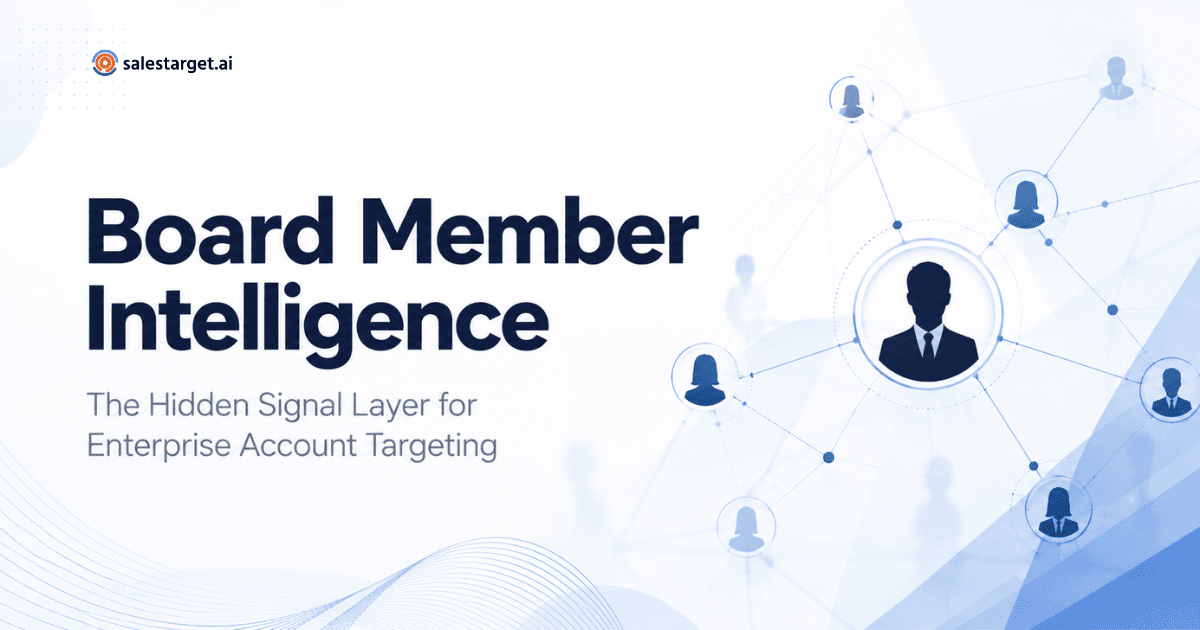
Board member intelligence is the structured collection and analysis of data about the individuals serving on a company's board of directors. It includes their professional backgrounds, other board seats they hold, executive experience, industry expertise, investor relationships, and cross-company connections.
This goes beyond standard contact enrichment. While most b2b contact data platforms focus on operating executives, department heads, and direct buyers, board-level data captures the governance layer: the people advising on strategy, capital allocation, and long-term direction.
For enterprise sales teams, this matters because board composition often reflects a company's strategic priorities. A board stacked with cybersecurity veterans signals a different set of investments than one dominated by supply chain and logistics leaders.
Board member intelligence doesn't tell you who signs the purchase order. What it does is add context that helps you understand where a company is heading and what kinds of solutions might be relevant to their strategic roadmap. Paired with a robust lead enrichment tool, this context integrates directly into your prospecting workflow alongside firmographic, technographic, and intent data.
Why Board Intelligence Matters for Enterprise Account Targeting ?
Enterprise deals rarely hinge on a single data point. They're won through layered research, precision timing, and a deep understanding of the target account's business context. Board member intelligence adds several practical signal types to that mix:
- Leadership experience: Board members with executive backgrounds in specific functions (CTO, CFO, CRO) can indicate areas of strategic focus within the company.
- Cross-company relationships: Many board members serve on multiple boards simultaneously. These shared connections can reveal industry clusters, partnership patterns, and potential referral paths.
- Industry expertise: The concentration of industry-specific expertise on a board can signal the sectors and verticals a company is prioritizing.
- Investor connections: Board members affiliated with venture capital or private equity firms often carry influence over growth strategies and technology investments.
- Market expansion signals: Former executives who led international expansion, vertical market entry, or M&A activity bring that orientation to their board roles.
- Strategic transformation experience: Board members who oversaw digital transformation, IPO preparation, or major operational shifts can indicate the company is planning similar moves.
According to the OECD's Corporate Governance Factbook (2023), board composition and the diversity of board expertise are increasingly recognized as indicators of corporate strategic direction across global markets. This underscores why governance-layer data is more than a curiosity; it's a practical lens for understanding enterprise priorities.
None of this replaces conventional b2b intent data providers or firmographic screening. But when you combine board-level context with technology install data, buying intent signals, and ICP and buyer persona qualification, the picture becomes substantially richer.
5 Practical Use Cases for Board Member Intelligence
1. Prioritize High-Value Enterprise Accounts
Not all target accounts deserve the same level of attention. Board composition can add a useful ranking signal when your team is deciding where to focus.
For example, if your product addresses data governance, and a target account recently added two board members with deep regulatory and compliance backgrounds, that account likely warrants higher priority than a peer company with no governance-focused leadership changes.
This kind of signal works best alongside firmographic filters, technographic data, and intent scores. Think of it as an additional weight in your account scoring model.
Illustrative Example: Account Prioritization Scoring Model
| Signal Layer | Weight | Example Data Point |
|---|---|---|
| Firmographic Fit | 30% | Industry, Revenue, Employee Count |
| Technographic Fit | 20% | Current Tech Stack |
| Intent Signals | 25% | Content Engagement, Search Activity |
| Board-Level Intelligence | 15% | Relevant Board Expertise, New Appointments |
| Relationship Proximity | 10% | Shared Connections, Past Interactions |
This is an illustrative example, not a universal benchmark. Adjust weights based on your specific ICP and sales cycle.
2. Improve Account Research Before Outreach
SDRs and AEs who reference a company's strategic direction in their outreach stand out from the noise. Board member backgrounds offer one of the fastest ways to understand that direction.
If a board member previously led a major ERP migration at another company, and you sell integration middleware, that's a relevant talking point. Not a pitch, but a credible reason to start a conversation about the challenges that come with large-scale system changes.
This approach is about preparation depth, not name-dropping board members in cold emails.
3. Identify Cross-Company Connections
Shared board memberships create visible relationship paths between companies. If your champion at Company A sits on the board of Company B, that's a warm introduction path worth exploring.
These connections are difficult to uncover manually. A well-structured lead enrichment software platform can surface them automatically, mapping the network of relationships across your total addressable market.
You can also use these cross-company patterns to build lookalike account lists. If you've already had success with finding similar B2B prospects using lookalike audiences, adding board-level profile matching makes those models even more precise.
4. Add Context to ICP Qualification
Traditional ICP qualification often stops at company-level attributes: industry, revenue, employee count, geography, technology stack. Adding board-level intelligence introduces a governance dimension.
Consider this: two SaaS companies might look identical on paper. Same size, same industry, similar tech stack. But one has a board that includes experienced SaaS operators and growth-stage investors, while the other's board is dominated by real estate and manufacturing executives. The first company is almost certainly a better fit if you're selling a growth-oriented sales platform.
Board intelligence fills the gap between "this company fits our firmographic criteria" and "this company is actually moving in a direction where our solution makes sense."
5. Strengthen Enterprise Account Segmentation
Segmentation typically relies on industry codes, company size, geographic region, and sometimes technographic data. Board-level characteristics offer another axis entirely.
You could segment accounts by the prevalence of digital transformation experience on the board, or by the concentration of investors from a specific sector. This allows for tighter messaging, more relevant content, and better alignment between your outreach and each segment's strategic priorities.
For revenue leaders building segmented outreach campaigns, this added dimension can meaningfully improve conversion rates at the top of the funnel.
Ready to go beyond surface-level prospecting data?
Layer board-level intelligence and deeper account signals into your enterprise targeting workflow. Explore SalesTarget 's built-in lead enrichment →
Board member intelligence isn't a silver bullet for enterprise prospecting. It won't replace your firmographic filters, intent data, or direct buyer research. What it does is add a layer of strategic context that most sales teams ignore entirely.
When you understand who governs a target company, what expertise they bring, and where their connections lead, you gain a clearer picture of the account's strategic direction. That makes your prioritization sharper, your research more relevant, and your outreach more credible.
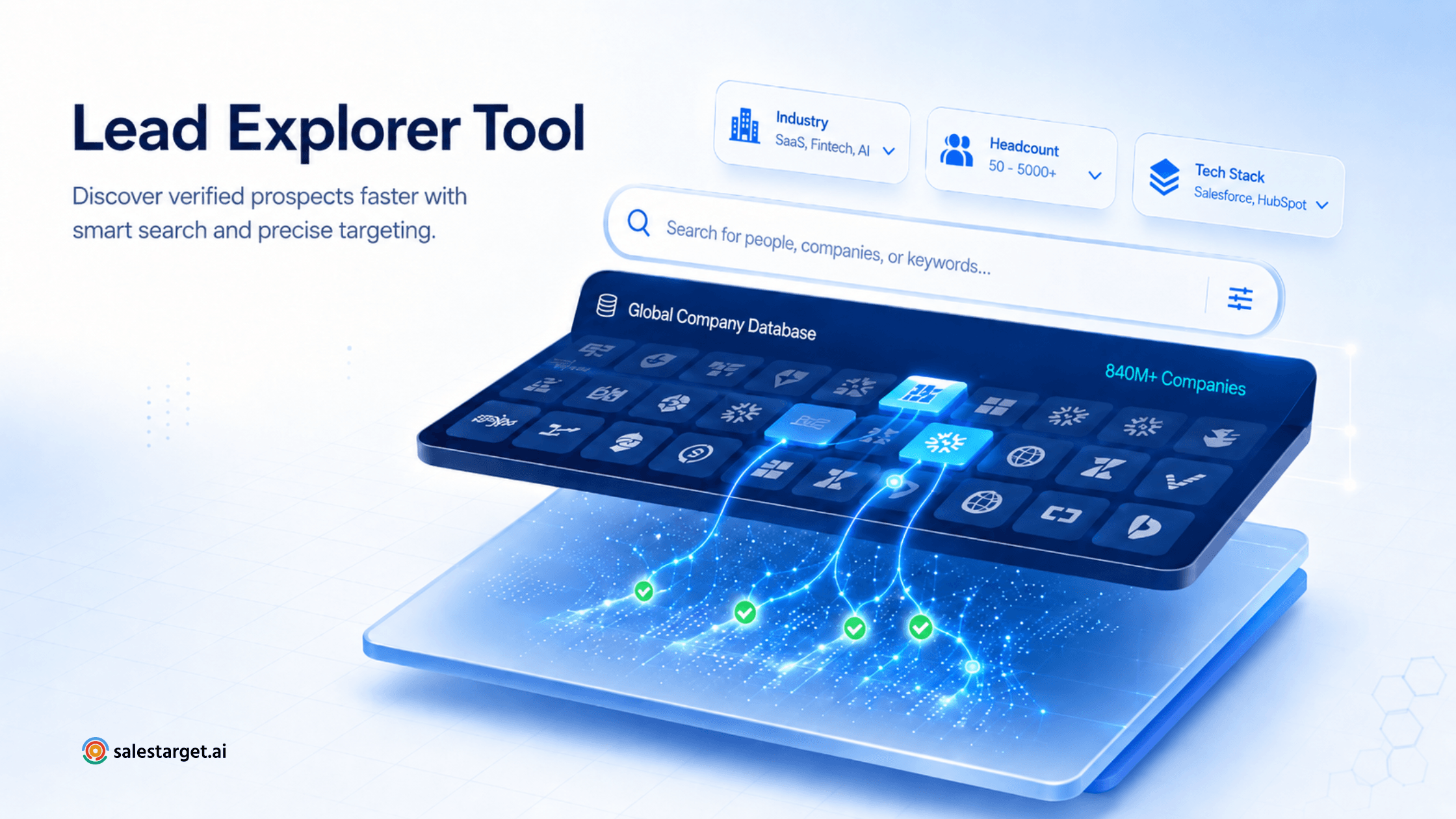
The best ai prospecting tools are moving toward this kind of multi-layered intelligence. Platforms like SalesTarget.ai's Lead Explorer help sales teams consolidate these signals into a single workflow. If your b2b prospecting tools still stop at job titles and company size, you're working with an incomplete map.