Most B2B sales teams treat their prospect database like a single audience. They write one cold email, load every contact into the same sequence, and hope volume compensates for weak targeting. It rarely does. The real foundation of effective email outreach is segmentation: splitting your prospect list into distinct groups so each group receives messaging that actually matches its context. Teams that invest time in building audience segments before launching campaigns see stronger open rates, more replies, and fewer spam complaints.
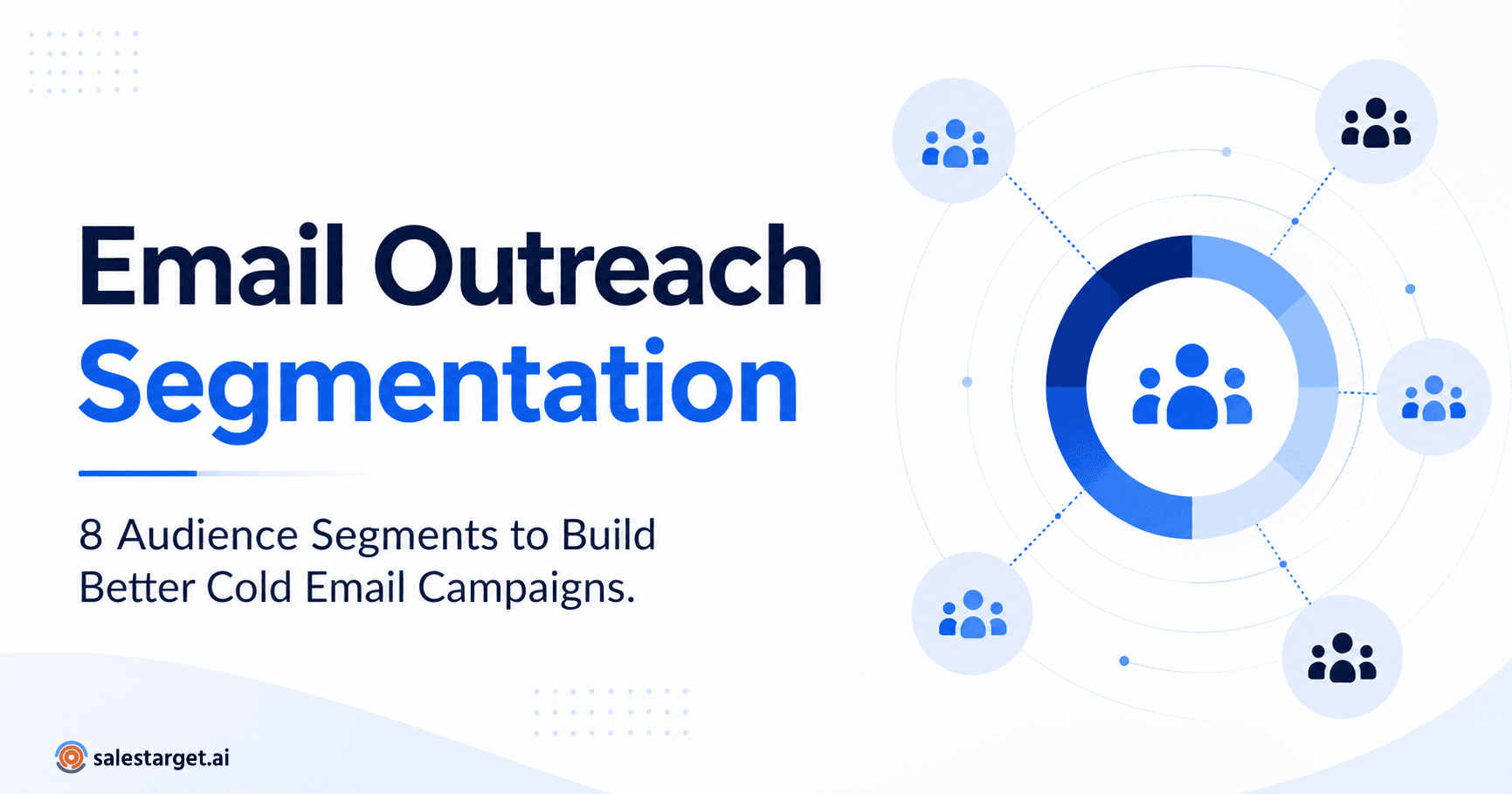
B2B cold email outreach works best when prospect lists are segmented by industry, company size, job role, buying stage, intent signals, geography, technology stack, and prior engagement. Each segment should get messaging tailored to its specific pain points, priorities, and decision-making context rather than a single generic pitch.
Why B2B Email List Segmentation Matters for Cold Outreach?
Sending identical emails to every prospect is the fastest way to burn your sender reputation. Mailbox providers like Google and Microsoft track recipient engagement signals. When hundreds of recipients ignore or delete the same message, deliverability drops across your entire domain. Segmentation protects your sending infrastructure by matching content to audience, which raises engagement and keeps your domain healthy.
From a sales perspective, segmentation gives SDRs a way to prioritize their time. Not every prospect deserves the same level of effort. A VP of Sales at a 500-person SaaS company searching for outbound tools is a higher-priority contact than a marketing coordinator at a 15-person agency. Segmentation surfaces those differences and lets reps focus where deals are most likely. If you are still evaluating which cold email platforms to use, choosing one that supports native segmentation will save significant setup work later.
Segmentation also supports personalization at scale. Writing a unique email for each of 5,000 contacts is unrealistic. Writing five distinct variations for five well-defined segments is manageable and far more effective than a single template.
The 8 B2B Audience Segments Every Cold Outreach Program Should Build
1. Industry or Vertical Segment
A fintech CFO and a healthcare compliance officer have fundamentally different priorities. Industry segmentation lets you reference sector-specific regulations, competitive pressures, and pain points. For SaaS prospects, you might emphasize integration speed. For manufacturing companies, reliability and uptime matter more. Even small adjustments to an opening line that reference an industry trend signal credibility and improve reply rates.
2. Company Size and Revenue Segment
A 20-person startup evaluates tools differently than a 2,000-person enterprise. Startups care about speed, simplicity, and price. Mid-market companies want scalability and workflow automation. Enterprise buyers need compliance documentation, SSO, and multi-team support. Segment by employee count or annual revenue range so your messaging speaks to the right buying criteria.
3. Job Role and Decision-Maker Segment
Founders respond to ROI and competitive positioning. Sales managers want to know how a tool helps their reps hit quota. RevOps leaders care about data hygiene, reporting, and stack consolidation. Separating economic buyers from end users from internal influencers lets you craft angles that resonate with each stakeholder's actual concerns. Teams that invest in cold email software for scaled teams often find that role-based segmentation produces the most noticeable lift in reply quality.
4. Buying Stage or Funnel Segment
Not every cold prospect is equally cold. Some have never heard of your category. Others are actively researching solutions. Messaging should reflect where each contact sits:
- Cold prospects need education on the problem your product solves.
- Problem-aware prospects benefit from data or case references showing the cost of inaction.
- Solution-aware prospects want to understand how your approach differs from alternatives.
- High-intent prospects need a clear, low-friction path to a conversation.
- Previously engaged contacts who went quiet should receive re-engagement sequences, not the same introductory pitch.
5. Buyer Intent Segment
Intent data helps you prioritize outreach toward prospects most likely to be in-market. Signals include repeat visits to your pricing page, engagement with competitor comparison content, relevant job postings at the prospect's company, or recent funding announcements. According to Gartner, B2B buyers typically complete roughly 70% of their purchase research before contacting a vendor (Gartner, "New B2B Buying Journey"). Reaching prospects during that research phase with relevant content gives your outreach a significant advantage.
6. Geography and Market Segment
Geography affects more than time zones. Regulatory environments, business norms, language preferences, and competitive landscapes vary by region. A prospect in Germany may respond better to formal, data-heavy messaging. A prospect in Australia might prefer a more direct, conversational tone. For international cold email campaigns, geography-based segmentation prevents cultural mismatches that damage credibility.
7. Technology or Existing-Stack Segment
Knowing what tools a prospect already uses reveals natural conversation starters. If a company runs HubSpot for CRM and Outreach for sequences, your messaging can reference integration compatibility or gaps in their current stack. Technographic data is available through providers like BuiltWith or company job postings that reference specific platforms. This approach makes your email feel informed rather than random. A detailed cold email platform comparison can help you evaluate which tools offer the best technographic targeting support.
8. Engagement and Previous Interaction Segment
Prospects who opened three previous emails but never replied are a different audience than contacts who have never engaged at all. Segment by engagement history:
- Opened but did not click: test different subject lines or value propositions.
- Clicked but did not reply: try a more direct ask or social proof.
- Replied previously: reference the prior exchange.
- Visited key pages (pricing, case studies): send conversion-oriented follow-ups.
- Never engaged: consider refreshing the data, adjusting the angle, or deprioritizing the contact.
How to Build Your B2B Email Outreach Segments Step by Step?
Building segments is not a one-time project. It is an ongoing process that improves as your data and campaign results accumulate. Here is a practical framework:
- Define the campaign goal. Are you booking demos, generating trial signups, or re-engaging dormant leads? The objective shapes which segments matter most.
- Identify the ideal customer profile. Clarify firmographic, demographic, and behavioral traits that define your best-fit prospects.
- Collect and clean prospect data. Remove duplicates, verify email addresses, and fill in missing fields. Poor data quality undermines every downstream step.
- Choose segmentation criteria. Start with two or three of the eight segments above. Trying all eight simultaneously adds complexity without proportional benefit for smaller lists.
- Build the audience groups. Tag or filter contacts in your CRM or email outreach platform so each segment is clearly defined.
- Create segment-specific messaging. Write distinct opening lines, pain points, and calls to action for each group.
- Personalize at scale. Use AI Email Personalization tools to insert company-specific or role-specific details without manually researching every contact.
- Launch and monitor campaigns. Track open rates, reply rates, bounce rates, and spam complaints per segment.
- Compare segment performance. Identify which segments convert best and which need revised messaging or better data.
- Continuously refine. Retire underperforming segments, split high-performing ones into sub-segments, and update data regularly.
Illustrative example: Consider a team with 8,000 prospects. Sending one generic sequence produces an average 2% reply rate, yielding 160 replies. If the team segments into five groups and tailors messaging for each, even a modest improvement to a 4% average reply rate doubles the result to 320 replies from the same list. The effort shifts from writing more emails to writing smarter ones. According to McKinsey & Company, companies that use advanced personalization in outreach typically generate 40% more revenue from those activities than companies using average approaches (McKinsey, "The Value of Getting Personalization Right").
Segment-to-Message Framework: What to Personalize and How
This framework shows how segmentation directly shapes your messaging angle, not just your contact list.
| Segment | What to Personalize | Example Messaging Angle |
|---|---|---|
| Industry (Healthcare) | Compliance pain points | "HIPAA audit season is approaching—here's how teams are automating documentation." |
| Company Size (Startup, <50) | Speed and budget constraints | "Built for lean teams that need results in weeks, not quarters." |
| Job Role (VP Sales) | Quota and pipeline metrics | "Your reps are spending 3 hours a day on manual prospecting. Here's what that costs." |
| Buying Stage (Solution-Aware) | Competitive differentiation | "You're already comparing tools—here's what most comparison pages leave out." |
| Intent (Pricing Page Visitor) | Urgency and next step | "You explored our pricing last week. Want a 15-minute walkthrough of what fits your team size?" |
| Geography (DACH Region) | Local business norms | "We support GDPR-compliant prospecting with EU-based infrastructure." |
| Tech Stack (Uses Salesforce) | Integration relevance | "Syncs natively with Salesforce so your reps never leave the CRM." |
| Engagement (Opened 3x, No Reply) | Re-engagement angle | "I've shared a few ideas—here's the one most teams start with." |
How AI Email Personalization Supports Segmented Campaigns?
Manual personalization does not scale. Researching each prospect individually to write a custom opening line works for 50 contacts but collapses at 5,000. AI Email Personalization bridges that gap by using segment-level and contact-level data to generate relevant email variations automatically.
Practical applications include:
- Generating opening lines that reference a prospect's industry, recent news, or company milestones.
- Adjusting the primary pain point based on the prospect's role (revenue growth for executives, workflow efficiency for managers).
- Creating multiple subject line variants for A/B testing within each segment.
- Adapting tone and formality based on geography or company culture.
- Maintaining consistent brand voice across thousands of emails without bottlenecking the SDR team.
AI personalization works best when it operates on top of clean segments. The model needs structured data—job title, industry, company size, engagement history—to produce output that feels relevant. Without segmentation, even the best AI tools generate generic results.
What to Look for in Email Outreach Software for Segmented Campaigns?
Not every cold email platform handles segmentation equally well. When evaluating email outreach tools, prioritize these capabilities:
- Native audience segmentation with flexible filtering by any contact field.
- Contact management that supports tagging, grouping, and dynamic list updates.
- AI-assisted personalization that uses segment data to generate relevant copy.
- Campaign automation with segment-specific sequences and follow-up logic.
- Multiple inbox support for distributing volume across sending accounts.
- Deliverability controls including warm-up, throttling, and domain health monitoring.
- A/B testing at the segment level, not just the campaign level.
- Campaign-level reporting that breaks down performance by segment.
The best email outreach software treats segmentation as a core workflow, not an afterthought. Look for platforms where creating a segment, assigning messaging, and launching a campaign can happen within the same workflow rather than requiring manual CSV exports and imports between disconnected tools.
Ready to Put Segmentation to Work?
SalesTarget 's AI Outreach Suite lets you build segmented campaigns, personalize messaging at scale, automate follow-ups, and launch targeted sequences without manually writing every email. Stop sending the same pitch to every prospect.
https://salestarget.ai/email-outreach/ai-outreach-suite">→ Build Smarter AI-Powered Outreach