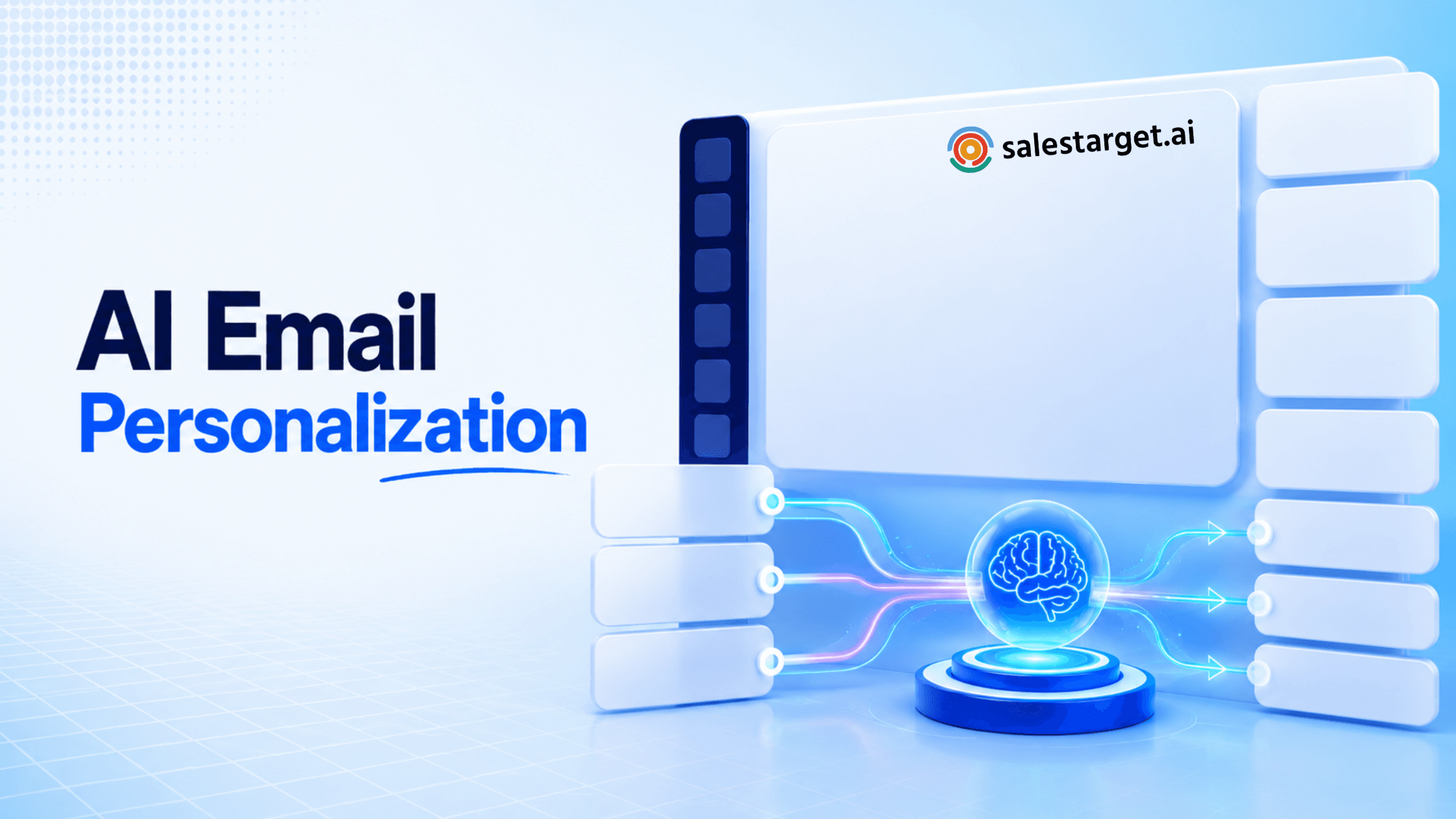
AI Email Personalization: 4x Your Cold Email Reply Rates
Quick Answer: AI Email Personalization uses machine learning, intent data, and large language models to research each prospect and write 1:1 emails at scale. Instead of generic templates, AI analyzes job role, tech stack, company news, and behavior signals to craft emails that feel hand-written — typically lifting reply rates by 2–4x while cutting research time by 90%.
Cold outbound is harder than it has ever been. Inboxes are saturated, buyers are skeptical, and generic templates are filtered, archived, or flagged within seconds. AI Email Personalization is the answer modern sales teams are converging on — and the data backs it up. According to a 2025 McKinsey report on commercial AI adoption, sales organizations using AI-driven personalization saw revenue lift of 10–20% compared to peers relying on static templates.
This guide breaks down what AI Email Personalization really is in 2026, how it works under the hood, where most teams get it wrong, and how platforms like SalesTarget AI combine lead intelligence with generative AI to make every email feel custom-written — even when you are sending thousands a week.
What Is AI Email Personalization?
AI Email Personalization is the practice of using artificial intelligence — typically a mix of large language models, enrichment APIs, and behavioral data — to dynamically generate outreach emails tailored to each individual recipient. It goes far beyond inserting a first name or company name into a template.
A properly built AI personalization engine pulls signals like:
- Job title, seniority, and recent role changes
- Company funding rounds, hiring trends, and tech stack
- Intent signals (content consumed, pages visited, tools researched)
- Social activity such as recent LinkedIn posts or podcast appearances
- Industry-specific pain points and trigger events
It then synthesizes those signals into a short, human-sounding email that references something real about the prospect — not a fake compliment, but a relevant observation.
Why Traditional Email Outreach Fails
Most outbound teams still rely on a familiar formula: scrape a list, drop it into a sequencer, and blast a four-step template. The results are predictable — and getting worse.
Three structural problems plague traditional outreach:
- Template fatigue: Buyers recognize every Apollo and Lemlist opener within two seconds. "I noticed you're the Head of X at Y" is now a deliverability red flag, not a personalization win.
- Surface-level merge fields: {{first_name}} and {{company}} were innovative in 2015. In 2026, they signal laziness.
- Deliverability decay: Inbox providers increasingly cluster similar emails and penalize entire domains. Without varied, contextual copy, even warmed-up mailboxes land in spam.
This is why pure sequencer tools struggle. For a deeper teardown of how modern AI outreach platforms compare on this exact problem, see our SalesTarget AI vs Lemlist comparison.
How AI Improves Email Personalization
AI changes the economics of personalization. What used to take an SDR 8–10 minutes per prospect now takes a model under a second — and the output is often richer because the AI can synthesize multiple data sources simultaneously.
Here is how a modern AI personalization workflow operates:
- Step 1 — Lead enrichment: Pulls firmographic, technographic, and behavioral data from public sources and integrated databases.
- Step 2 — Signal scoring: Ranks which signals are most relevant for your offer (e.g., a fintech company hiring compliance staff is a strong signal for a GRC tool).
- Step 3 — Generative drafting: An LLM writes a custom opener and value proposition tied to those signals.
- Step 4 — Quality control: Guardrails check for hallucinations, tone, length, and spam triggers before sending.
- Step 5 — Continuous learning: Reply, open, and meeting-booked data flow back into the model to improve future outputs.
Key Features of AI Email Personalization Tools
When evaluating a platform, look for these non-negotiable capabilities:
- Real-time lead enrichment from multiple verified data sources
- Intent and trigger event detection (funding, hiring, product launches)
- Native LLM-powered copy generation with brand-voice tuning
- Built-in deliverability infrastructure and email warmup
- A/B testing across opener variants and value propositions
- CRM and inbox integrations (Gmail, Outlook, HubSpot, Salesforce)
- Reply detection and sentiment analysis
Strong deliverability matters as much as strong copy. Even the best AI-written email fails if it lands in spam — which is why email warmup improves deliverability and should be paired with any personalization stack.
Benefits of AI Email Personalization for Sales Teams
Teams that adopt AI personalization consistently see compounding returns across the funnel:
- 2–4x higher reply rates compared to static templates, based on aggregated outbound benchmarks from Gartner and HubSpot.
- 90% reduction in research time per prospect, freeing SDRs to focus on conversations, not data entry.
- Better deliverability because varied, contextual emails avoid spam clustering.
- More accurate ICP refinement as reply patterns reveal which segments resonate.
- Faster ramp time for new reps, who get production-quality copy from day one.
AI Email Personalization vs Traditional Personalization
The gap between AI-driven and manual personalization widens every quarter. Here's a side-by-side view:
| Aspect | Traditional Personalization | AI Email Personalization |
|---|---|---|
| Speed | 8–10 minutes per email | Seconds per email at scale |
| Data Sources | Manual LinkedIn research | Multi-source enrichment & intent signals |
| Reply Rate | 2–4% average | 8–17% on enriched campaigns |
| Scalability | Limited to 30–50/day per rep | Thousands of unique emails daily |
| Cost Efficiency | High labor cost per touch | Up to 60% lower cost per reply |
How SalesTarget AI Helps Businesses Personalize Outreach ?
SalesTarget AI is built specifically for teams that want the lift of AI personalization without stitching together six different tools. The platform combines a real-time lead database, signal-based targeting, and generative email writing in one workflow.
Where it stands apart from sequencer-first tools like Instantly, Apollo, and Lemlist:
- Deeper lead intelligence: The AI-powered lead exploration platform surfaces high-intent prospects with enriched context, not just contact data.
- Signal-first personalization: Emails are generated from verified triggers — hiring, funding, tech-stack changes — not generic role descriptions.
- Deliverability built-in: Native warmup, sending infrastructure, and inbox rotation keep emails out of spam.
- Unified workflow: Targeting, enrichment, writing, sending, and reply analytics in a single dashboard — no Zapier glue required.
Best Practices for AI Email Personalization
To get the most out of AI personalization, treat the model like a junior rep — talented, fast, but in need of direction:
- Feed it tight ICP definitions, not vague "SaaS founders" segments
- Limit emails to 60–90 words; AI tends to over-write
- Always include one specific, verifiable detail per email
- A/B test openers separately from value propositions
- Review the first 100 sends manually before scaling a new sequence
- Pair every campaign with a warmed-up sending domain
Common Mistakes to Avoid
Most teams that try AI personalization and fail make the same handful of errors:
- Over-personalizing: Three sentences of "I saw you went to Stanford and play tennis" feels stalker-ish, not thoughtful.
- Trusting AI without guardrails: Models hallucinate. Always validate company names, role titles, and event references.
- Ignoring deliverability: Brilliant copy in the spam folder converts at 0%.
- Skipping iteration: AI improves with feedback loops. Set up reply tracking from day one.
- Using a single sending domain: Scale safely with multiple domains, inbox rotation, and gradual volume ramps.
The Future of AI-Powered Email Outreach
Three shifts will define the next 24 months of outbound:
- Agentic outbound: AI agents that not only write emails but also research, qualify, and book meetings autonomously.
- Real-time intent triggers: Sub-minute reactions to buying signals like a competitor mention or a job posting.
- Multi-channel orchestration: Email, LinkedIn, voicemail drops, and SMS sequenced by AI based on prospect behavior.
Harvard Business Review's research on AI in B2B selling points to a clear winner — teams that combine human judgment with AI speed will outperform both fully manual and fully automated competitors.
AI Email Personalization is no longer optional. It is the difference between cold outbound that gets ignored and cold outbound that books pipeline. The teams winning right now combine three things: clean lead intelligence, signal-driven AI copy, and rock-solid deliverability.
If your team is still gluing tools together, it's worth seeing how a unified platform changes the math. SalesTarget AI brings targeting, enrichment, and AI writing into one workflow — so SDRs spend their time talking to buyers, not babysitting tabs.