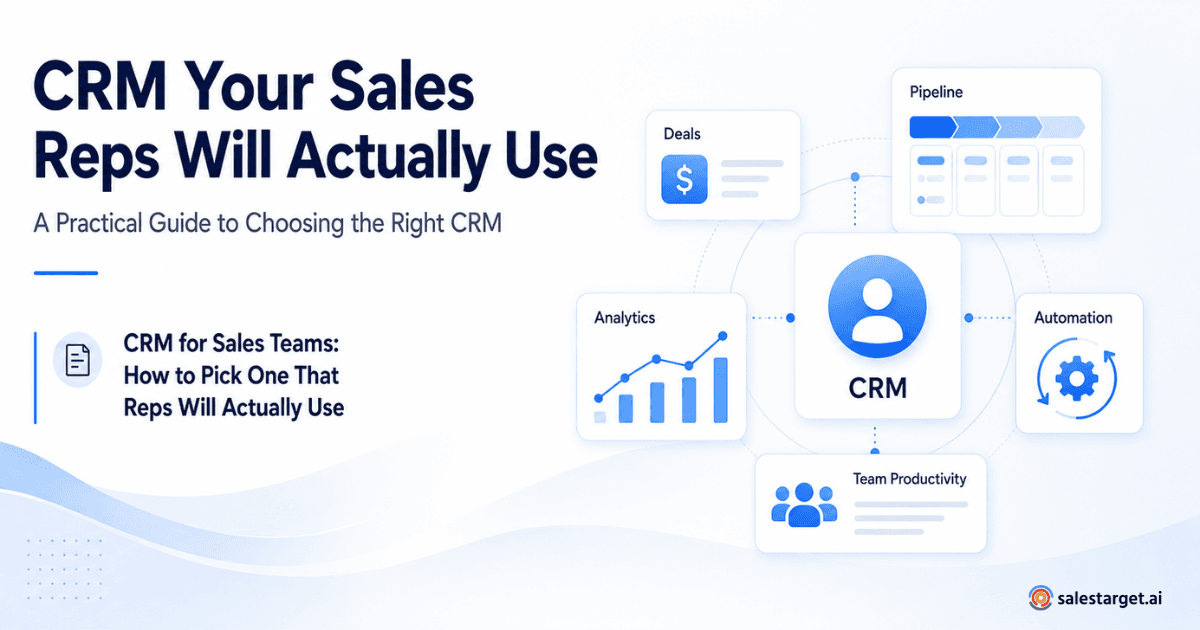
The right CRM for sales teams is not the one with the longest feature list. It is the one your reps will use daily without being forced. Prioritize tools that simplify contact management, pipeline tracking, and follow-up scheduling. If a CRM creates more work than it eliminates, adoption will fail no matter how capable the platform looks on paper.
Most Sales Managers have lived through this cycle. You roll out a CRM with training and high expectations, and six months later half the team tracks deals in spreadsheets. The problem is rarely the software's capabilities. It is that the CRM was not designed for the people entering data every day: your sales reps.
This guide covers what to prioritize when evaluating a CRM for sales teams, why adoption outweighs feature depth, and how to spot when your current system has stopped working. If stale contact data is already an issue, a solid CRM email hygiene routine is one of the fastest ways to rebuild trust in your CRM data.
Why CRM Adoption Matters More Than Feature Count
A CRM your team ignores is worse than no CRM at all. It creates an illusion of visibility. You think you are looking at an accurate pipeline, but you are really seeing partial data from the two or three reps who bother updating it.
Research from Nucleus Research found that productivity gains and process efficiency account for 51 percent of total CRM ROI. But those returns only appear when reps use the system consistently. Industry-wide, CRM implementations still fail to meet expectations 40 to 70 percent of the time, and poor user adoption is the primary cause.
Adoption depends on three things. Low friction for daily tasks: if logging a call takes five clicks and a screen reload, reps will skip it. Visible personal benefit: reps stay with tools that help them close deals, not tools that exist only to serve management reporting. Trustworthy data: when the CRM fills with stale records and duplicates, reps lose confidence and default to their own spreadsheets. A sales team CRM with fifteen modules and hundreds of settings can easily lose to a simpler tool that does five things well.
What Sales Managers Should Look for in a CRM ?
When comparing CRM software for sales teams, these capabilities separate tools reps adopt from tools they abandon.
Easy Rep Adoption
This is the most important factor. Look for a clean interface, minimal required fields, mobile access, and fast load times. If onboarding takes weeks of training, expect resistance. The best CRM for sales reps is one a new hire can use productively within a day or two.
Simple Pipeline and Deal Tracking
Every rep needs a clear view of deal stages, values, and next actions. Sales Managers need a reliable aggregated view across the full team. Good deal tracking shows which opportunities are advancing, which are stalling, and where revenue risk is building.
Automated Follow-Ups and Reminders
Missed follow-ups are one of the most common reasons B2B deals stall. A strong sales CRM automates reminders and task creation so reps are not relying on memory. Look for task-based systems, automated email sequences, and activity-triggered next steps that keep deals moving forward.
Useful Sales Reporting
Reports should answer the questions Sales Managers actually ask: Which reps are on pace? Where do deals get stuck? What is the average cycle length this quarter? Avoid CRMs with dozens of canned reports that make it hard to build the three or four custom views you actually need.
Contact and Account Management
Foundational functionality, but quality varies widely across platforms. Look for easy deduplication, per-contact activity timelines, and the ability to link contacts to accounts and open deals without tedious manual steps.
Integrations and Notification Management
Your CRM should connect to email, calendar, and the tools your team already uses. But integration alone is not enough. You also need thoughtful notification management. Too many alerts train reps to ignore everything, and important signals get buried. If alert fatigue is already a concern, this breakdown of AI-powered CRM notification overload is worth reviewing.
What Makes a CRM Effective for B2B Sales?
B2B sales cycles are longer, involve more stakeholders, and require more touchpoints than consumer transactions. A CRM for B2B sales must handle this complexity without burying reps in admin work.
Key requirements include multi-contact deal tracking so you can map buying committees to a single opportunity. Full activity history across handoffs is essential so account executives get complete context when they pick up a deal. Extended pipeline management keeps months-long deals active without data going stale. And account-level visibility lets you see all contacts, deals, and activity tied to one company in a single view. For a deeper look at identifying and managing at-risk opportunities, see this guide on deal tracking and deal risk.
How to Compare CRM Options Before Buying
Vendor feature charts rarely tell you what matters most. Instead, score each CRM against criteria that drive real adoption and daily results.
CRM Adoption Readiness Scorecard (editorial framework)
Rate each CRM on a 1 to 5 scale across these five dimensions:
- Ease of use: Can a new rep work productively in it within a day?
- Pipeline visibility: Does it give managers a reliable, real-time view of the full team pipeline?
- Follow-up automation: Does it reduce manual effort for scheduling and tracking next steps?
- Reporting clarity: Can you build the reports your team needs without outside help?
- Data quality support: Does it include deduplication, field validation, and activity logging to keep records clean?
A perfect score is 25. Any CRM above 20 is a strong adoption candidate. Below 15, you are heading toward the same problems you are trying to solve. This scorecard works best when two or three reps test each shortlisted tool for a full week before you commit.
Signs Your Sales Team Has Outgrown Its Current CRM
You may not need a new CRM. But these signals suggest your current tool is falling behind.
- Reps keep personal spreadsheets or note apps alongside the CRM because they do not trust it.
- Pipeline reviews rely on verbal updates because CRM data is incomplete.
- New hires take over a week to become productive in the system.
- You cannot answer a simple question like how many deals are at risk this quarter without manual data pulls.
- Follow-up tasks get missed because the reminder system is clunky or ignored.
If more than two of these apply, evaluating alternatives is worth your time.
Why SalesTarget.ai CRM Is Built for Sales Teams ?
SalesTarget.ai CRM was designed around two priorities: the daily workflow of sales reps and the pipeline visibility needs of Sales Managers. Rather than stacking features that add complexity, it focuses on the fundamentals that drive CRM adoption: clean pipeline management, straightforward deal tracking, follow-up automation, and organized contact and account management.
For managers, it provides reliable pipeline data without forcing reps to spend excessive time on entry. For reps, it reduces the administrative overhead that makes other CRMs feel like a burden instead of a tool that helps them sell.
Ready to give your sales team a CRM they will actually use?
Explore SalesTarget AI CRM and see how it simplifies pipeline management, deal tracking, and daily follow-ups for teams that need results without unnecessary complexity.
Choosing a CRM for sales teams is not about finding the longest feature list. It is about finding a tool that fits how your reps work and makes their daily tasks easier. Prioritize adoption, test with real users, and evaluate on what matters: ease of use, pipeline clarity, follow-up automation, reporting, and data quality. The best CRM is the one your team uses every day.