Your sales reps open the CRM and see hundreds of leads. Yet many emails bounce, phone numbers no longer work, and some contacts left their companies months ago. The pipeline looks healthy, but the data behind it is not.
That is a common problem for B2B small business sales teams. Traditional CRM systems store contacts, but they do not help you find prospects, verify data, run outreach, and manage deals in one place.
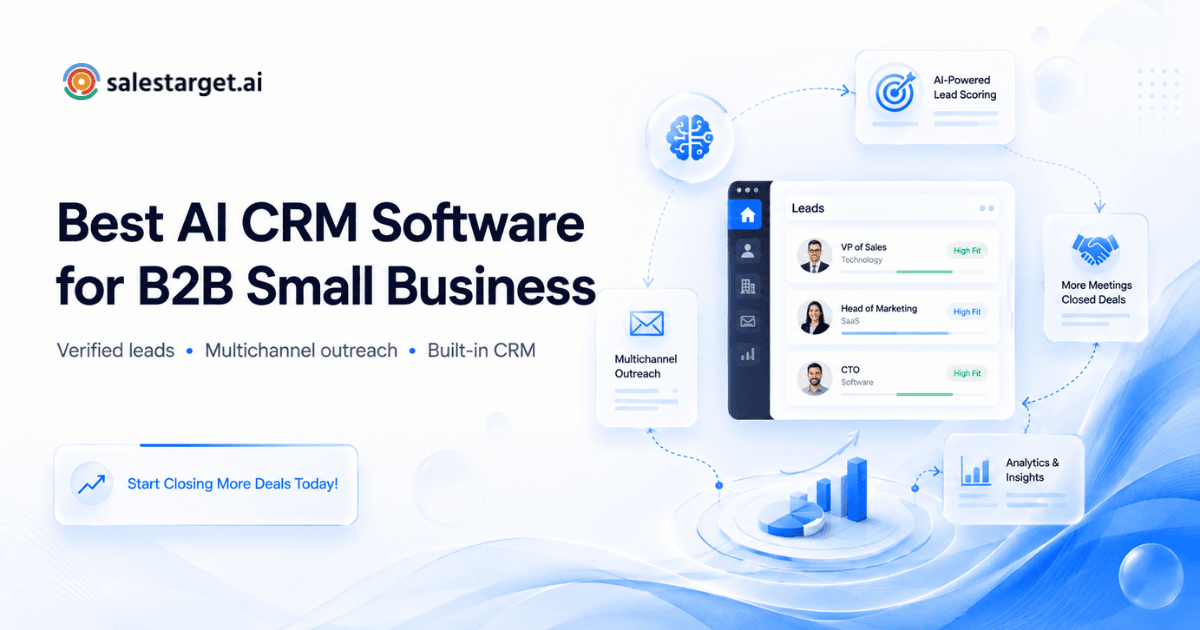
The best AI-powered CRM software for B2B small business sales teams does more than track records. It helps teams find qualified buyers, verify contact information, automate email and LinkedIn outreach, and manage opportunities from a single platform.
For outbound sales teams, that means choosing a CRM with built-in prospecting data, email validation, multichannel outreach, and AI-powered automation. In this guide, you'll learn what features matter most, how to evaluate your options, and which CRM solutions are best suited for growing B2B sales teams.
AI-Powered CRM Software for B2B Small Business: Explained
An AI-powered CRM for B2B small business is a customer relationship management system that adds prospecting, enrichment, and outreach on top of normal contact and deal tracking.
A standard CRM waits for data. An AI CRM goes and gets it: it searches a contact database, scores leads on buying signals, drafts sequences, and logs activity on its own. For a small B2B team the payoff is simple. One login covers finding the buyer, reaching them, and closing them, so you stop paying for and wiring together five separate tools.
Why Small B2B Sales Teams Struggle to Scale Revenue?
Small B2B teams stall on revenue when their tools, data, and time all work against them. Five problems show up again and again.
Too many disconnected sales and prospecting tools
A typical team runs a data tool, an email tool, a validator, a dialer, and a CRM that none of them fully talk to. Salesforce found sales teams use an average of 10 tools to close a deal, and 94% plan to cut that number down (Salesforce State of Sales). Gartner's 2024 B2B seller survey adds the consequence: reps overwhelmed by the volume of technology they use are 45% less likely to hit quota (Gartner). Every handoff between tools is a spot where data breaks.
Manual prospect research slows pipeline growth
When a rep researches each account by hand, switches tabs, and copies details into the CRM, prospecting becomes the bottleneck. The list never gets built fast enough to feed the calendar.
Poor contact data leads to wasted outreach
Bad data is a tax on every campaign. About 22.5% of B2B contact data goes stale each year as people change jobs and companies restructure (Cognism). A list you bought a year ago is already a quarter wrong before you send the first email.
Administrative work takes time away from selling
Reps spend under 30% of their week actually selling. The rest goes to data entry, logging, and internal busywork, per the same Salesforce report. Adding headcount is a temporary fix when the real bottleneck is administrative drag.
Limited visibility into pipeline performance
When activity lives in scattered tools, the forecast is a guess. Leaders cannot see which campaigns created pipeline or which deals are slipping, so they manage on gut feel.
Why AI-Powered CRM Software Matters for Small Business Sales Teams?
AI-powered CRM software matters because it gives a small team the output of a much larger one without adding headcount. The same Gartner survey found the flip side of tool overload: reps who partner well with AI tools are 3.7 times more likely to hit quota. The wins are concrete.
More selling time and less manual work
When the CRM logs calls and emails, writes call notes, and creates follow-up tasks on its own, reps get hours back. The admin that eats most of the week, data entry, status updates, and reporting, is exactly the work automation is built to absorb.
Faster lead generation and qualification
AI search turns a plain-English request into a built list in minutes, scored by buying signals. Reps start the day with prospects who match the profile, not a blank database.
Better follow-up consistency
Deals die in the gaps between touches. An AI CRM creates the next task the moment a lead replies or a meeting ends, so nothing is forgotten. That single habit, automated, lifts reply and conversion rates more than any new script.
Improved sales productivity and forecasting
With every email, call, and deal stage in one system, the dashboard reflects reality. When reps trust the numbers, they keep the CRM current, and a forecast built on live activity beats one stitched together from memory.
Lower software costs through consolidation
One platform replaces the data tool, the sender, the validator, the dialer, and the CRM. Fewer subscriptions, fewer integrations, one bill.
Key Features to Look for in CRM Software for B2B Small Business
The right CRM for a B2B small business covers the whole outbound motion, not just storage. Look for these seven things.
Contact and account management
Clean records for people and companies, linked together, with a full activity timeline per lead. This is the baseline every CRM should nail.
Lead generation and data enrichment
The CRM should find new contacts and fill in verified email, phone, and mobile, not wait for you to import a CSV. A built-in prospecting database that enriches a record with one click keeps reps building lists instead of copying from spreadsheets.
Email and LinkedIn outreach capabilities
Sending should live inside the CRM across both channels. The best setups run email sequences and LinkedIn automation in one coordinated flow, so context carries from a connection request to a follow-up email.
Sales automation and workflow management
Automation should handle the repetitive parts: sequence pacing, inbox rotation, task creation, deal updates. The rep decides strategy. The system does the grunt work.
Pipeline tracking and reporting
A live deal pipeline plus a dashboard showing open deals, meetings, email stats, and pending tasks. If you cannot see it, you cannot forecast it.
AI assistance and productivity tools
An AI assistant that finds leads, writes sequences, and answers questions about your pipeline in plain language. That is the difference between an AI CRM and a CRM with a chatbot bolted on.
Data quality and email verification
Built-in email validation that checks every address before you send. This protects sender reputation and keeps bounces low, which decides whether your emails reach inboxes at all.
How to Choose the Right CRM Software for Your Sales Team?
Pick a CRM by matching it to how your team actually sells, then pressure-test adoption and total cost. Run through five checks.
Define your sales process and growth goals
Map your real motion first: inbound, outbound, or both, and how many touches a deal takes. Buy for the motion you run, not the one a demo shows.
Evaluate prospecting and outreach capabilities
Ask one question. Can this tool find and contact a new buyer, or only store one I already found? For an outbound team, a CRM with no prospecting is half a tool.
Compare ease of use and team adoption
A CRM only works if reps use it. Auto-logging and auto-created tasks drive adoption more than any training session, since the system does the updating for them.
Review reporting and forecasting features
Check that the dashboard ties activity to pipeline and revenue. You want to see which campaigns and reps create deals, not just a list of contacts.
Calculate total cost of ownership
Add up every subscription, then add the hidden integration tax of wiring them together. One platform that does the work of five usually costs less than five that barely connect.
Best AI-Powered CRM Software for B2B Small Business Sales Teams
Here are five strong options for B2B small business sales teams, with the gap each one leaves for an outbound motion.
Salestarget.ai
An all-in-one outbound platform with a built-in CRM. It combines an 840M+ contact database, email and LinkedIn outreach, email validation, an AI dialer, and an AI Copilot in one workspace. Best for small B2B teams that want to find, reach, and close from a single login instead of stitching tools together.
HubSpot CRM
A polished CRM with a generous free tier and strong marketing features. The gap for outbound teams: native prospecting data and high-volume cold outreach sit behind add-ons, so you still bolt on a data source and a sender.
Pipedrive
A clean, sales-first deal pipeline that small teams adopt fast. It tracks deals well but has no native B2B database or built-in multichannel sending, so prospecting and outreach happen elsewhere.
Zoho CRM
An affordable, broad CRM inside a large software suite. It scales in features but can get complex to set up, and serious outbound data and deliverability still come from outside the core CRM.
Apollo.io
A data and engagement platform with a big contact database. The gap: you typically add a deliverability layer and a real CRM on top, since closing and pipeline management are not its core. Salestarget.ai is positioned publicly as an Apollo alternative for teams that want data, sending, validation, and CRM together.
Why Growing B2B Sales Teams Switch to Salestarget.ai?
Growing B2B teams switch to Salestarget.ai to collapse their stack into one workspace and stop losing leads in the gaps between tools. Seven reasons stand out.
Replace Multiple Sales Tools With One Unified Platform
One login covers data, email, LinkedIn, validation, dialing, and CRM. Fewer tools means fewer broken handoffs and less context-switching for reps.
Access 840M+ Verified Contacts for Faster Prospecting
Lead Explorer holds 840M+ verified profiles, 146M+ companies, and 4,000+ buyer signals across 50+ data sources. You build a targeted list in minutes, not days.
Find, Enrich, and Verify Leads in One Place
This is where most stacks leak, and it is the point most "best CRM" articles miss. Many tools verify a contact when it is first scraped, then sell it months later as "verified." The platform enriches a lead the moment you find it and verifies the contact at that point of use. With 22.5% of B2B data going stale each year, freshness at the moment you reach out is what protects reply rates, not a checkmark from last quarter.
Run Email and LinkedIn Outreach From a Single Platform
Sequences run across email and LinkedIn in one flow, with AI-built steps and pacing. A reply on one channel updates the play on the other, so a prospect never gets the same pitch twice.
Improve Deliverability With Built-In Email Validation
Built-in email validation checks up to 90% of emails before sending and runs SPF, DKIM, and DMARC checks with inbox warm-up. That matters more than ever. Google and Yahoo's 2024 sender rules require bounce rates under 2%, and a dirty list blows past that fast, which drags your whole domain into spam.
Manage Pipeline and Deals With a Built-In CRM
The built-in CRM catches campaign leads automatically, logs every email and call, and creates follow-up tasks on reply or after a meeting. The AI dialer even writes your call notes for you, so reps stop reconstructing conversations from memory.
Use AI Copilot to Automate Prospecting and Outreach
The AI Copilot finds leads, writes full personalized sequences in seconds, and answers questions about deals, meetings, and tasks in plain language. Want to see it run on your own list?.
Common CRM Mistakes Small Businesses Make
Most CRM regret traces back to the same handful of mistakes. Here are the five that cost small teams the most.
Choosing a CRM without prospecting capabilities
The most common mistake is buying a storage-only CRM, then bolting a data tool, a sender, and a validator around it. For an outbound team, the system of record should be where leads are generated, not just parked.
Paying for features the team never uses
Enterprise CRMs sell modules small teams never touch. You pay for complexity and configure for months. Buy for the motion you run today.
Ignoring data quality and email verification
Teams obsess over copy and ignore the list. A great email to a dead address still bounces. Verify first, then sharpen the message.
Using too many disconnected tools
Each tool has a fair return on its own. Stacked together they create a meta-problem: reps lose hours switching apps and reconciling data that never matches. Consolidation is the fix.
Focusing on features instead of sales outcomes
Long feature checklists feel safe and tell you nothing about results. Judge a CRM by what it moves: more meetings, faster cycles, higher follow-up completion.
The Future of AI CRM Software for B2B Sales
The future of AI CRM software is a system that runs the routine outbound work on its own and tells the rep where to spend their time. Four shifts are already underway.
AI-assisted prospecting and lead research
AI is moving from filters to plain-English search and live buying signals. You describe the buyer, and the system builds and scores the list against real intent.
Automated outreach and follow-ups
Sequences write themselves from an audience description, pace themselves, and branch on replies. The rep approves and personalizes. The CRM handles the cadence.
Predictive pipeline management
AI flags at-risk deals before they slip and recommends the next move, so leaders manage on signals instead of stale stages.
Revenue intelligence and sales insights
The CRM ties every touch to revenue and answers questions in plain language: which campaign drove pipeline, which rep needs help, where deals stall.
Conclusion: Choosing the Best CRM Software for B2B Small Business
Go back to the pain you started with: a CRM full of leads that bounce, dead numbers, and a forecast built on stale data. That problem does not get solved by adding another point tool. It gets solved by closing the gaps between them. The best CRM software for a B2B small business is the one that finds the buyer, verifies the contact, runs the outreach, and tracks the deal in a single workspace.
Salestarget.ai is built around that single-workspace idea: a large verified contact database, email and LinkedIn outreach, validation that protects your sender reputation, and a built-in CRM with an AI Copilot handling the busywork. Find who is buying, reach them, and close them in one place. See it on your own pipeline at Salestarget.ai, or start free and build your first list today.