Every quarter has the same story. The pipeline review shows a healthy number. Reps are confident. Then, in the final two weeks, deals stall, contacts go dark, and the forecast crumbles. The issue isn't usually a lack of pipeline - it's a lack of visibility into which deals are actually healthy and which ones are quietly dying.
A deal risk scorecard solves this. It's a structured framework you build inside your deal tracking software to flag warning signs before they turn into lost revenue. In this guide, we'll walk through exactly how to create one, which signals to include, and how validated contact and account data makes the entire system more reliable.
What Is a Deal Risk Scorecard?
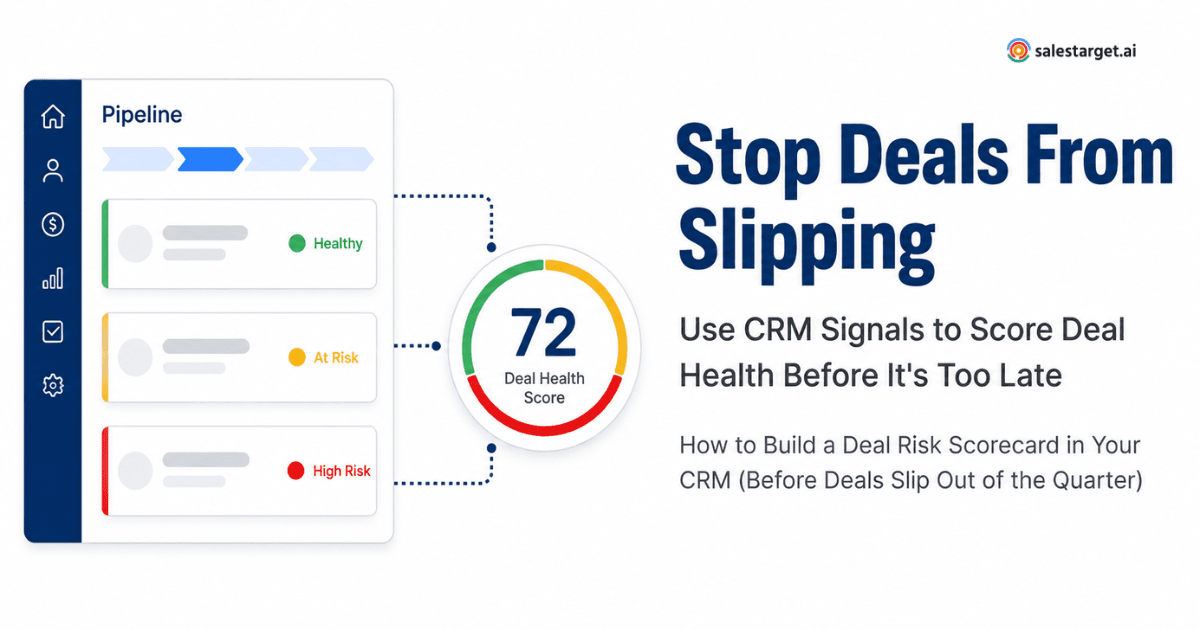
A deal risk scorecard is a weighted scoring model applied to each active opportunity in your CRM. It evaluates specific, measurable signals - like stakeholder engagement, deal velocity, and data quality - and assigns a risk level to each deal.
This is different from the default probability field most CRMs attach to pipeline stages. Stage-based probability assumes every deal at "Proposal Sent" has the same likelihood of closing, which anyone who's run a pipeline review knows isn't true. A risk scorecard adds a layer of objective, signal-based evaluation on top of stage progression.
Why Deal Risk Scoring Matters for Sales Teams ?
Without a structured way to identify risk, pipeline reviews become opinion-driven exercises. A rep says a deal is "looking good" and a manager has no data to challenge that. Risk scoring changes the conversation.
It supports better forecasting by separating healthy deals from shaky ones. It improves sales performance management by giving managers specific coaching opportunities. And it creates accountability in sales pipeline management- reps can't hide behind optimistic gut-feel when a scorecard highlights three red flags on an opportunity.
If you're evaluating tools to support this kind of structured pipeline management, a buyer's guide to deal tracking software can help you compare capabilities across platforms.
The 7 Signals to Include in a Deal Risk Scorecard
Not every signal carries the same weight. Prioritize the ones your team can actually measure and act on inside your CRM.
1. Decision-Maker Engagement
Is the economic buyer or a confirmed decision-maker actively participating? Check for direct email threads, meeting attendance, or logged calls. If your CRM only shows engagement from a junior champion, the deal carries more risk than the stage suggests.
2. Recent Activity and Response Time
Healthy deals have bi-directional activity. Look at the last inbound response from the buyer—not just outbound touches from the rep. A deal with five rep emails and zero replies in two weeks is stalling, regardless of what the opportunity notes say.
3. Deal Age and Stage Duration
Compare each deal's time-in-stage against your historical average for that stage. If your typical "Negotiation" stage lasts nine days and a deal has sat there for twenty-two, that's a measurable risk signal. Most sales management software can surface this with a simple report or calculated field.
4. Next-Step Clarity
Is there a concrete, time-bound next step logged in the CRM? "Follow up next week" isn't a next step -"Demo with CFO on Thursday at 2 PM" is. Deals without a specific next step are more likely to stall.
5. Contact and Account Data Quality
This one is overlooked more than any other signal. If the primary contact's email bounces, the phone number is outdated, or the company data is incomplete, your reps are working with a broken map. Invalid or duplicate contacts distort engagement metrics, inflate pipeline counts, and lead to inaccurate risk assessments. A CRM for sales teams is only as useful as the data inside it.
6. Buying Signals and Intent
Has the prospect requested pricing, asked about implementation timelines, involved procurement, or visited specific product pages? These signals indicate forward momentum. Their absence at a late stage is a warning.
Teams running AI multichannel sales platforms can often track these signals across email, LinkedIn, and phone in a single view.
7. Competitive or Commercial Risk
Is a competitor actively involved? Has the prospect pushed back on pricing or terms? Are there budget freezes or organizational changes? These factors don't disqualify a deal, but they add risk that should be scored.
How to Build the Scorecard in Your Deal Tracking Software
You don't need a custom application. Most CRM platforms support this with custom fields, formulas, or workflow builders. Here's a practical approach:
Assign each of the seven signals a score from 0 to 2. Zero means the signal shows clear risk. One means it's unclear or partially met. Two means the signal is healthy. That gives you a total possible score of 14.
| Risk Level | Score Range | Action |
|---|---|---|
| Green — Healthy | 11–14 | Stay the course |
| Yellow — Needs Attention | 7–10 | Rep addresses gaps this week |
| Red — High Risk | 0–6 | Manager review + action plan |
Illustrative benchmark: If a pipeline contains 40 active opportunities and 8 have gone more than 14 days without a meaningful buyer interaction, 20% of the pipeline deserves an immediate risk review. That's a simple calculation, but it's the kind of visibility most teams don't have without a structured scorecard.
According to Salesforce's State of Sales research , high-performing sales teams are significantly more likely to use data-driven methods for forecasting and pipeline management - underscoring why objective deal scoring outperforms gut instinct.
How Lead Validation Improves Deal Risk Scores
A scorecard is only as reliable as the data feeding it. If contact records contain invalid emails, outdated job titles, or duplicate entries, signals like "decision-maker engagement" and "recent activity" become meaningless. You'll score deals as healthy when the engagement data is pointing at the wrong person—or a person who left the company months ago.
Lead validation addresses this directly. By verifying and enriching contact and account data before it enters pipeline scoring, you ensure that:
- Stakeholder information is current
- Engagement metrics reflect real buyer activity
- Qualification criteria are based on accurate firmographic data
- Pipeline visibility isn't distorted by duplicates or incomplete records
SalesTarget AI Lead Validation tools are designed for exactly this workflow—cleaning and verifying CRM data so that downstream processes like deal-risk scoring produce results teams can actually trust.
How to Turn the Scorecard Into Sales Pipeline Automation
A scorecard sitting in a spreadsheet doesn't help anyone. The real value comes when your CRM triggers actions based on risk levels. Here's what that looks like in practice with an AI powered CRM or a modern workflow builder:
- Red score triggers a manager review and blocks the deal from commit-stage forecasting until the flag is resolved.
- Missing decision-maker contact triggers an automated stakeholder research task or enrichment workflow.
- No buyer activity for 10+ days triggers an AE follow-up task with suggested re-engagement messaging.
- Invalid contact data triggers a validation and enrichment workflow to refresh the record.
- Stalled stage duration triggers a pipeline review tag and alerts the deal owner's manager.
Sales pipeline automation turns a static risk assessment into a living system that pushes the right action to the right person at the right time.
How to Use Deal Risk Scores in Weekly Pipeline Reviews
Use the scorecard as the backbone of your pipeline meeting. Instead of asking reps to narrate every deal, filter for Yellow and Red deals first. For each flagged deal, ask:
- What's the specific next step and when is it scheduled?
- Who is the confirmed economic buyer and when did they last engage?
- What changed since last week to move the score in either direction?
- Is the contact and account data validated and current?
This structure keeps reviews focused, data-driven, and action-oriented. It also gives managers a repeatable coaching framework tied to observable signals rather than subjective rep confidence.
Common Mistakes to Avoid
Scoring too many signals. If you track fifteen variables, the scorecard becomes noise. Start with five to seven and add complexity only after you've proven the model works.
Relying on rep self-reporting. "I feel good about this deal" isn't a data point. Build the scorecard on system-captured signals wherever possible.
Ignoring data quality. A scorecard built on top of stale, duplicate, or invalid contact data will produce confident-looking scores that are fundamentally wrong.
Treating all deals equally. A $15K opportunity and a $250K opportunity shouldn't be reviewed through the same lens. Weight your review cadence and escalation thresholds by deal value.
Never recalibrating. If your scorecard hasn't changed in six months, it's probably outdated. Review which signals actually correlated with closed-lost deals each quarter and adjust.
You won't predict every lost deal. That's not the point. A deal risk scorecard gives your team a structured, repeatable way to identify warning signs early enough to do something about them. It shifts pipeline reviews from opinion-driven conversations to signal-driven ones. And when the data feeding those signals is validated and accurate, the entire system becomes something your forecast can actually rely on.
Score Every Deal. Trust Every Forecast.
Stop guessing which deals will close and which ones are quietly dying. SalesTarget.ai CRM gives you validated contacts, real-time deal signals, and the pipeline visibility to make every forecast defensible.