Cold Email Reply Rates: Why Prospects Respond (or Don't)
You can get email opens.
You may even get clicks.
Replies, however, determine whether cold email outreach actually works or quietly fails.
When prospects open emails but do not respond, the reason is rarely accidental. Cold email reply rates are shaped by relevance, trust, timing, and restraint — not clever wording or aggressive follow-ups.
This guide explains why prospects reply to cold emails (and why they don't), based on real outbound patterns rather than theory.
You'll learn:
- What cold email reply rates truly measure
- Why prospects decide to respond or ignore outreach
- What high-performing cold outreach emails have in common
- How AI cold email outreach influences reply rates
- How to automate cold outreach emails without damaging trust
- What strong outbound teams do differently over time
Everything is explained practically, without unnecessary filler.
What Cold Email Reply Rates Really Measure
Cold email reply rate is not a measure of attention.
It reflects intent.
- Open rate means the email was noticed
- Reply rate means the message was worth engaging with
A reply indicates that the prospect:
- Understood the message
- Found it relevant to their role or challenge
- Felt comfortable responding
- Did not feel pressured into action
This makes reply rate one of the strongest quality signals in cold email outreach.
Inbox providers also view replies as a positive engagement signal, which can improve future inbox placement instead of emails being filtered into promotions or spam folders.
Why Prospects Don't Reply (Even When They Open)
Most cold emails fail not because they go unread, but because they do not answer one key internal question:
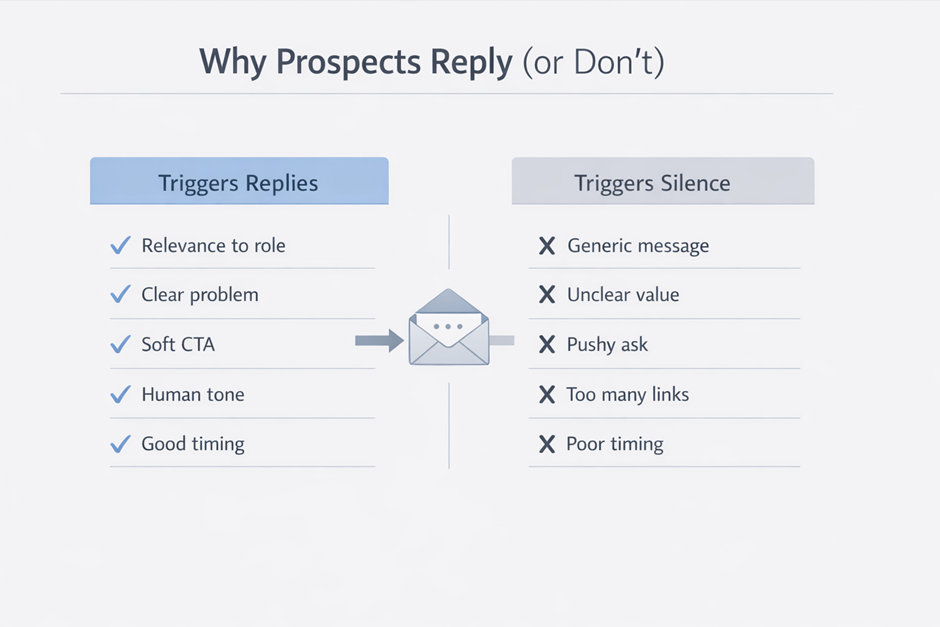
"Why should I respond to this right now?"
Common reasons prospects remain silent:
- The message feels generic
- The problem is unclear or poorly framed
- The request feels too large or too early
- The timing does not feel right
- The sender lacks credibility
Silence usually signals low relevance or low trust — not rejection.
What Actually Drives Cold Email Reply Rates
1. Relevance Matters More Than Personalization
Personalization alone does not increase replies.
Relevance does.
Prospects respond when an email:
- References a problem they recognize
- Matches their role or responsibilities
- Demonstrates basic understanding of their context
Using names or company details without meaningful relevance often feels forced and is ignored. Effective cold email outreach focuses on context, not compliments.
2. One Clear Idea Per Email
Reply rates decline when emails attempt to cover too much.
High-reply emails:
- Focus on one problem
- Present one idea
- Ask one simple question
Low-reply emails:
- Pitch multiple features
- Over-explain the product
- Include links too early
Clarity reduces friction. Friction reduces replies.
3. Soft CTAs Generate More Responses
Replies happen when the request feels easy to answer.
Reply-friendly calls to action include:
- "Is this relevant for you?"
- "Worth a brief conversation?"
- "Should I close the loop?"
What tends to perform poorly early:
- "Book a demo"
- "Schedule a call"
- "Here's my calendar"
Prospects reply when they feel in control, not pressured.
What the Best Cold Outreach Emails Have in Common
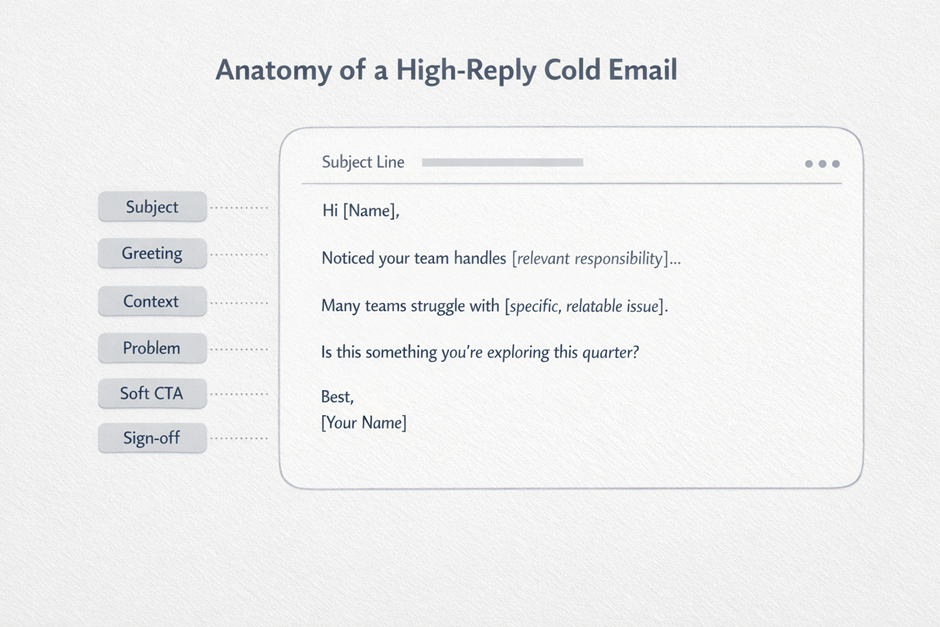
Across high-performing campaigns, emails that generate replies consistently share similar traits.
They are:
- Short (typically 40–80 words)
- Plain text, with minimal formatting
- Problem-led rather than product-led
- Calm and neutral in tone
- Free of links in the first message
- Written at a natural, human pace
These patterns apply across both manual outreach and AI email outreach. The difference is not the tool — it is the discipline behind its use.
How AI Cold Email Outreach Affects Reply Rates
AI is not the reason reply rates decline.
Poor automation strategy is.
When applied correctly, AI cold email outreach can help by:
- Improving relevance at scale
- Maintaining consistent quality
- Testing variations efficiently
- Optimizing timing and follow-ups
When applied poorly, AI leads to:
- Repetitive phrasing
- Excessive automation
- Pattern detection by inbox providers
- Erosion of prospect trust
Reply rates improve when AI supports human judgment rather than replacing it.
Automation vs Manual Outreach: Reply Rate Impact
| Factor | Manual Outreach | AI Email Outreach |
|---|---|---|
| Consistency | Low | High |
| Personal relevance | Variable | Scalable |
| Follow-up quality | Inconsistent | Structured |
| Volume control | Risky | Controlled |
| Reply tracking | Manual | Automatic |
AI-driven outreach performs best when automation is applied with limits and oversight.
Follow-Ups: Where Most Replies Occur
Most replies do not arrive after the first email.
They often appear after:
- Follow-up #2
- Follow-up #3
- Follow-up #4
Effective follow-ups:
- Add context
- Reduce pressure
- Acknowledge silence respectfully
Repeating the same message rarely increases replies. Progression does.
Why Timing and Cadence Matter
Prospects are more likely to reply when:
- They are not rushed
- The message feels timely
- Follow-ups do not feel aggressive
Sending too frequently:
- Feels intrusive
- Encourages ignoring behavior
- Damages sender trust
Sending too slowly:
- Loses momentum
- Breaks context
Balanced cadence protects both reply rates and sender reputation.
Common Mistakes That Hurt Cold Email Reply Rates
Avoid these common errors:
- Pitching in the first email
- Asking for too much too early
- Over-personalizing without relevance
- Including links too soon
- Automating without review
- Treating silence as failure
No reply is feedback, not rejection.
How High-Performing Teams Improve Reply Rates
Strong teams do not rely on shortcuts.
They build repeatable systems.
High-performing outbound teams:
- Track replies, not just opens
- Test one variable at a time
- Review real prospect conversations
- Adjust messaging based on objections
- Use AI for execution, not decision-making
Reply rates improve through consistent learning, not hacks.
Why Reply Rates Matter More Than Any Other Metric
Open rates show visibility.
Clicks show interest.
Replies show trust.
Effective cold email outreach follows a clear path:
Open → Reply → Conversation → Pipeline
When opens are high but replies are low, relevance is missing.
When replies suddenly drop, trust is likely declining.
Reply rate should be treated as the primary signal of outreach health.
Final Thought: Replies Are Earned
Cold email reply rates reflect trust.
Prospects respond when:
- The message feels relevant
- The sender sounds human
- The request feels safe
AI email outreach helps teams scale this approach — when used carefully.
Replies do not come from louder outreach.
They come from better systems.
Improve Reply Rates Without Losing Trust
Teams looking to increase replies while maintaining strong inbox placement can use SalesTarget email outreach workflows to scale relevance without adding pressure.