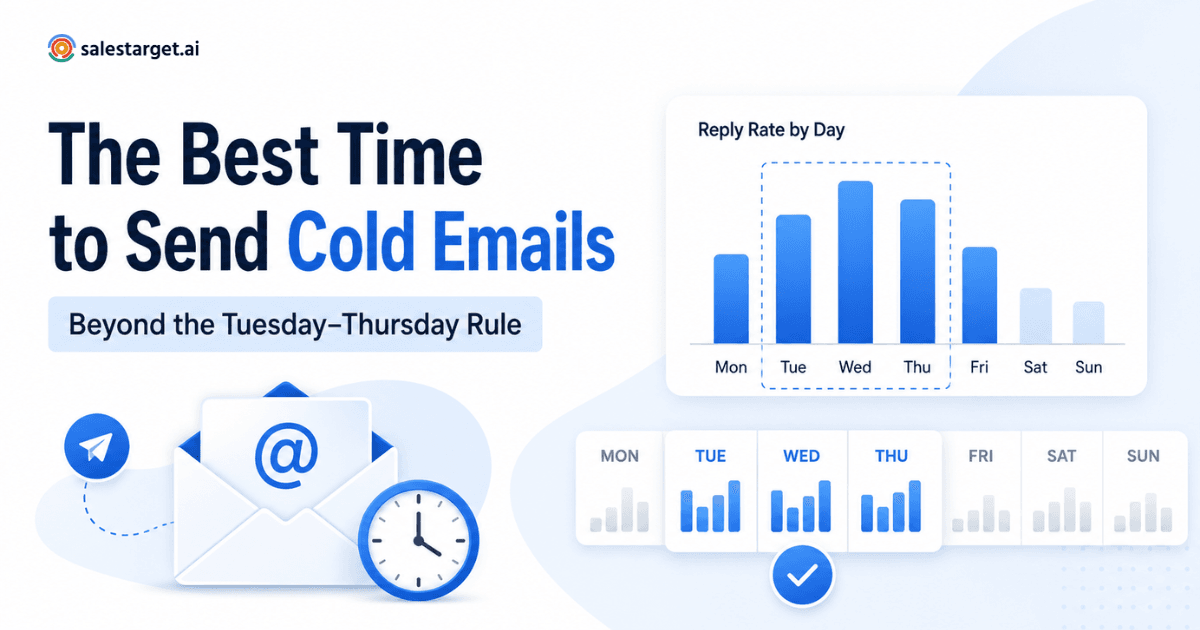
The Tuesday–Thursday Rule Is Not the Whole Story
Most cold email marketing advice starts with the same tip: send on Tuesday or Thursday morning. It's repeated so often that many sales teams treat it as settled strategy. But recent reply data from multiple large-scale studies tells a more complicated story. The real answer depends on your audience, your industry, and the metrics you actually track.
If you're optimizing for reply rate rather than open rate, the "best day" shifts depending on who you're emailing, when they work, and how crowded their inbox is that morning.
What the Data Actually Says About Cold Email Timing
Belkins analyzed 7.5 million cold emails sent in 2025 and found that Thursday and Wednesday tied for the highest weekday reply rate at 0.48% each. Their earlier study of 16.5 million emails placed Thursday at 6.87% and Monday at 5.29%—a 30% gap between the best and worst weekday.
Instantly's 2026 Benchmark Report, covering billions of cold email interactions, recommends launching new sequences on Monday and scheduling follow-ups for Wednesday, when engagement peaks (source: Instantly 2026 Cold Email Benchmark Report). Saleshandy's analysis of 53 million cold emails found 9:30–11:30 AM in the recipient's local time zone is the optimal window, regardless of the day.
These three major datasets don't agree on a single best day. Wednesday, Thursday, and even Monday each take the top spot depending on the study.
Open rate data is even less reliable. Apple Mail Privacy Protection inflates open rates by an estimated 5–10 percentage points industry-wide. Hunter's 2026 State of Cold Email report, based on 31 million emails (hunter.io/the-state-of-cold-email), found that campaigns without open tracking achieved a 68% higher reply rate (7.4% vs. 4.4%). Reply rate is the metric that matters. Open rate is a directional signal at best.
Why Tuesday and Thursday Became the Default
The Tuesday–Thursday recommendation emerged from early email marketing studies—mostly warm and newsletter campaigns—that showed higher open and click rates mid-week. Monday inboxes are flooded. Friday attention drifts. Mid-week sits in the productive sweet spot.
Cold email outreach operates differently. Your prospect didn't subscribe. And because so many teams followed the same mid-week advice, those days now carry the heaviest send volume—more inbox competition, not less. When everyone sends on the same day, the advantage disappears.
The Variables That Matter More Than the Day of the Week
Recipient Time Zone
A well-timed email sent at 9 AM Eastern is a 6 AM interruption in San Francisco and a mid-afternoon arrival in London. Belkins' data shows morning sends between 8 AM and noon in the recipient's local time produced a 0.54% reply rate—the highest of any window. If your cold email platform doesn't support time-zone scheduling, you're leaving replies on the table.
Prospect Role and Seniority
Belkins' 2025 data breaks reply rates by role: founders replied at 0.57%, C-level executives at 0.42%, VPs at 0.32%. Companies with 0–10 employees replied at 0.72%—more than three times the 0.22% rate at enterprises with 10,000+ employees. If you're prospecting into enterprise accounts, you need sharper personalization and cold email subject lines that earn attention, not just a better send day.
Industry and Inbox Competition
SaaS decision-makers receive 15+ cold emails per week. A legal professional might get two. That gap shows up directly in reply rate benchmarks. When choosing best cold email software for your team, look for platforms that let you segment sends by industry and adjust timing accordingly. Woodpecker's 20-million-email dataset confirms that campaigns with fewer than 50 recipients average a 5.8% reply rate, compared to 2.1% for campaigns targeting 1,000+ contacts.
Lead Quality and Personalization
Personalized campaigns produce roughly double the reply rate of generic sends. Woodpecker's data shows personalized campaigns replying at 17–18% versus 7–9% without personalization. A well-researched cold email subject line sent on a Monday will outperform a generic template sent on the "perfect" Thursday.
Follow-Up Timing
58% of all replies come from the first email in a sequence (Instantly, 2026), but 42% arrive on follow-ups. The first follow-up alone can increase total replies by roughly 50%. Three follow-up messages is the sweet spot. Follow-up timing often matters more than initial send timing. Teams that automate lead collection and cold email outreach can test different follow-up intervals alongside send days to find what works for their audience.
The Best Time to Send Cold Emails in 2026
There is no universal best time. But there is a practical framework for finding yours. Start with these defaults as a baseline, then test:
- Send window: 8–11 AM in the recipient's local time zone.
- Initial send day: Tuesday, Wednesday, or Thursday.
- Follow-up spacing: 2–3 days after the initial send.
- Sequence length: 3–5 emails over 10–14 days.
Then isolate variables. Test one factor at a time across comparable audience segments: send day, send time, audience segment, and subject line approach. Track reply rate, positive reply rate, and meeting-booked rate for each test. The goal is to find the best window for each audience segment in your pipeline.
How Cold Email Software Changes the Timing Equation
Modern email outreach software eliminates much of the guesswork. A capable cold email platform lets you:
- Schedule sends by recipient time zone
- A/B test subject lines and send times
- Segment audiences by industry and seniority
- Automate follow-up sequences
- Measure reply rate at the campaign level rather than relying on inflated open metrics
Without email outreach tools that support this kind of testing, timing optimization stays theoretical.
Stop Optimizing for Opens Alone
A 50% open rate means nothing if nobody replies. Here's the hierarchy that matters for sales teams:
- Reply rate tells you whether people are responding.
- Positive reply rate tells you whether responses indicate interest.
- Qualified reply rate tells you whether the prospect fits your ICP.
- Meeting-booked rate tells you whether outreach generates pipeline.
- Pipeline generated tells you whether the channel is worth the investment.
Too many teams celebrate high open rates while their reply-to-meeting conversion sits below 1%.
A Practical Cold Email Timing Test for Sales Teams
Split a comparable audience segment—same ICP, same industry, same seniority—into two groups. Send Group A on Tuesday at 9 AM in their local time zone. Send Group B on Thursday at 9 AM. Use identical subject lines, body copy, and follow-up sequences. After 7–10 days, compare reply rate and positive reply rate. Then run a second test changing only the send time (9 AM vs. 11 AM) on whichever day won. This isolates one variable at a time so results actually tell you something useful.
Original Analysis: Day-of-Week Reply Variance vs. Other Factors
Analysis based on publicly available data from Belkins' 2025 B2B Cold Outreach Benchmarks (7.5M and 16.5M email datasets) and Woodpecker's 20M Cold Email Statistics report.
Cross-referencing these datasets, the gap between the best and worst weekday reply rate is roughly 30%. That sounds significant until you compare it to other variables:
- Personalized campaigns see a ~100% lift over generic sends.
- Campaigns targeting fewer than 50 prospects see a 176% lift over 1,000+ contact campaigns.
- Founders reply at nearly three times the rate of enterprise VPs.
The day you choose matters, but it's one of the smaller levers in your entire cold email marketing strategy.
The Real Best Time to Send Cold Emails
The strongest timing strategy isn't copied from a benchmark report. It comes from testing your specific audience, measuring reply rate and meetings booked, and iterating as inbox behavior changes. Treat Tuesday–Thursday, 8–11 AM as a starting hypothesis. Then let your own campaign data prove or disprove it.
- Treat published "best day" data as a starting hypothesis, not a rulebook.
- Prioritize reply rate and meetings booked over open rate.
- Always send in the recipient's local time zone, targeting the 8–11 AM window.
- Test one timing variable at a time across comparable audience segments.
- Invest in cold email software that automates time-zone scheduling, follow-up sequencing, and reply-rate measurement.
Build a Repeatable Cold Email Engine with SalesTarget AI
SalesTarget's Email Outreach platform helps sales teams build, schedule, and automate cold email campaigns with time-zone-aware sending, built-in A/B testing, automated follow-up sequences, and reply-rate analytics that go beyond opens. Stop guessing about timing and start measuring what generates pipeline.
➤ See How a SaaS Team Turns Email Outreach Into a Repeatable Growth Channel