Your reps are toggling between six tabs, copy-pasting prospect data into a spreadsheet, and sending follow-ups from memory. Half the list has dead emails. Reply rates are sinking. And the "sales stack" your team cobbled together last year now costs more in context-switching than it saves in automation.
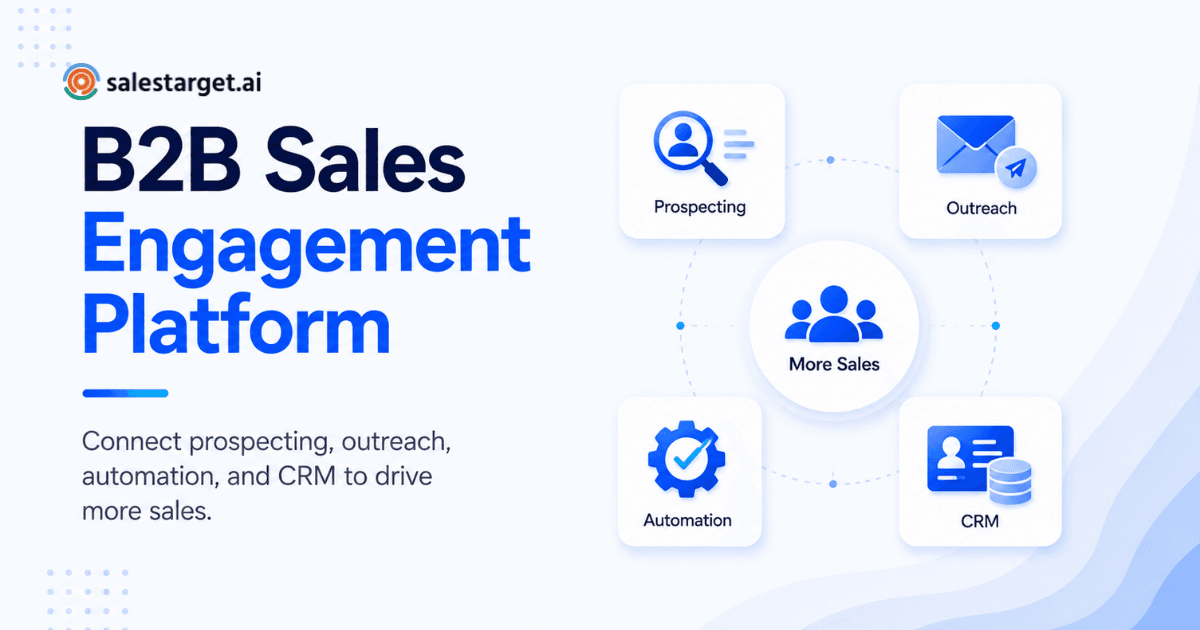
The best B2B sales engagement platform is one that keeps prospecting, multichannel outreach, email validation, and CRM in a single workflow, so reps spend time selling instead of stitching tools together. SalesTarget.ai does exactly that: it combines a 840M+ contact database, email and LinkedIn outreach sequences, built-in email validation, an AI Copilot, and a lightweight CRM on one bill, replacing the patchwork of point tools most outbound teams run today.
This guide breaks down what a sales engagement platform should actually do, the features that separate the best from the rest, and how to build a workflow that turns outbound activity into qualified pipeline.
Best B2B Sales Engagement Platform: What Sales Teams Need in The AI Era?
Sales teams in 2026 need more than a sequencing tool that fires emails on a timer. They need a single workspace that connects who to target, how to reach them, and what happened after the outreach. That means AI-assisted prospecting, multichannel execution across email and LinkedIn, real-time contact verification, and pipeline tracking, all without the data living in five different apps.
According to McKinsey, roughly one-third of all sales tasks can be automated with current technology, yet the average rep still spends only about 28% of their week on actual selling. The gap between what is possible and what most teams actually do is where the right sales engagement software makes its impact.
What Is a B2B Sales Engagement Platform?
A B2B sales engagement platform is software that organizes and automates how sales teams interact with prospects across channels (email, LinkedIn, phone) and tracks those interactions through to pipeline and revenue.
It sits between your lead data and your CRM, handling the middle layer: sequencing outreach, scheduling follow-ups, personalizing messages, rotating inboxes, and logging activity. The best platforms go further, bundling prospecting data, email validation, and CRM functionality so you are not paying for (and integrating) four separate tools.
SalesTarget.ai is built around this idea. Instead of bolting a cold email tool onto a separate data provider, then piping results into a third-party CRM, the entire flow lives in one workspace: find leads in Lead Explorer, push them into an email and LinkedIn sequence, validate contacts at the point of enrichment, and close deals in the built-in CRM.
The Sales Stack Problem: Too Many Tools, Too Much Manual Work
Fragmented prospecting, outreach, and CRM workflows
Most outbound teams run a data tool, a cold email sender, a LinkedIn automation tool, and a CRM. Each one has its own login, its own data model, and its own pricing page. The result: reps waste time exporting CSVs, deduplicating records, and hoping nothing broke in the last Zapier sync.
Manual prospect research and repetitive sales tasks
Research from Salesforce shows that sales reps use an average of eight tools to close a single deal. Every tab switch is a micro-interruption. Reps lose time looking up company size, verifying emails in a separate tool, and manually logging call notes, tasks that should happen in the background.
Disconnected email, LinkedIn, phone, and CRM activity
When email sequences run in one tool and LinkedIn outreach runs in another, nobody has a full picture of how a prospect has been touched. A rep sends a LinkedIn message on Monday, and a colleague fires an email Tuesday, both unaware of the other. That kind of overlap kills credibility and reply rates.
Limited visibility into what drives meetings and pipeline
If outreach data sits in one tool and pipeline data sits in another, connecting activity to revenue requires a spreadsheet and a lot of guesswork. Sales leaders end up measuring vanity metrics (emails sent, open rates) instead of what matters: meetings booked, qualified opportunities created, and revenue generated.
Core Features of Sales Engagement Platforms
B2B sales prospecting and contact enrichment
A platform without its own data forces you to buy a separate prospecting tool. SalesTarget.ai's Lead Explorer gives teams access to 840M+ verified professional profiles and 146M+ business entities with 4,000+ intent and buyer signals, sourced from 50+ data providers. You can search by industry, role, seniority, tech stack, revenue, and intent topics, or just describe your target audience in plain English and let the AI build the list.
Enrichment happens in the same click: one-click enrichment unlocks verified professional email, personal email, phone, and mobile. Contacts are verified at the point of enrichment, not based on whenever the data was first scraped. That distinction matters. Stale data is the silent killer of outbound campaigns.
Email outreach automation and sales sequences
The best sales engagement tools automate multi-step email sequences with pacing controls, follow-up triggers, and inbox rotation. SalesTarget.ai auto-builds full sequences from a plain-English audience description: first touch, follow-ups, and timing. It supports unlimited inboxes with AI warm-up, intelligent rotation, and SPF/DKIM/DMARC checks to protect sender reputation.
The AI Content Generator and AI Spintax Generator produce varied, human-sounding copy, so your emails do not all read like the same template with a swapped first name.
LinkedIn outreach automation
Email alone is not enough. LinkedIn outreach automation adds connection requests, DMs, and follow-ups to your sequences. SalesTarget.ai runs LinkedIn alongside email in one coordinated flow, with conditional branching based on replies, timezone-aware scheduling, and built-in safety controls (rate limits, warm-up logic, auto-pause) to protect your account.
Sales cadence software and automated follow-ups
Most deals are lost to inconsistent follow-up, not bad pitching. Sales cadence software keeps every prospect on a structured path: timed touchpoints, channel-specific steps, and automatic triggers when a reply comes in or a prospect goes silent. SalesTarget.ai's Unibox pulls every reply into one view, sorts by intent (Interested, Follow-Up, Not a Fit), and assigns owners so nothing slips.
Multichannel sales engagement
Multichannel means more than offering email and LinkedIn as two separate modules. It means the context from one channel carries into the other. If a prospect opened your email but did not reply, the next LinkedIn message should acknowledge that, not start from scratch. SalesTarget.ai coordinates this in a single sequence, so reps do not have to check two dashboards.
Sales engagement analytics and activity tracking
You need to see more than open rates. SalesTarget.ai tracks replies, meetings, and deal movement alongside outreach activity. A shared dashboard shows email stats, open deals, meetings, and pending tasks, giving sales leaders line-of-sight from first touch to closed-won.
CRM integration and pipeline management
Plenty of engagement platforms claim CRM integration, but "integration" usually means a one-way sync that breaks every time the CRM updates its API. SalesTarget.ai takes a different approach: the CRM is built in. Campaign leads land automatically. Every email and call is logged to the lead timeline. Follow-up tasks are created when a lead replies or a meeting ends. If you already use HubSpot, Salesforce, or Zoho, it connects with those too.
AI-powered sales engagement
SalesTarget.ai's AI Copilot is a conversational assistant built into the platform. Chat with it to find leads, generate personalized email sequences, query CRM deals in plain language, or flag at-risk deals. It personalizes by role, industry, and company size, and produces A/B variations. A Memory feature pulls your website content for on-brand replies. Strategy stays human. The repetitive work does not.
Benefits of Sales Engagement Software for B2B Teams
Reduce repetitive work across prospecting and outreach
When prospecting, enrichment, sequencing, and CRM updates happen in one tool, reps reclaim the hours they used to spend on imports, exports, and tab-switching. SalesTarget.ai users report saving about 6 hours per rep per week on manual admin tasks.
Keep sales reps consistent across every follow-up
Automated cadences mean every prospect gets the right number of touches at the right intervals, regardless of whether the rep remembered to follow up. SalesTarget.ai reports 91% follow-up completion rates across its user base.
Improve prospect targeting and message relevance
With 4,000+ buyer signals and real-time intent data (powered by Bombora Intent Topics, plus business events like funding rounds, hiring spikes, and leadership changes), reps can prioritize the prospects most likely to be in-market right now, not six months ago.
Connect sales activities with pipeline outcomes
SalesTarget.ai's built-in CRM ties outreach activity directly to deal stages. You can see which sequences generate meetings and which ones stall, without exporting data to a spreadsheet.
Give sales leaders better visibility into team performance
A shared pipeline view and a dashboard that tracks email stats, meetings, open deals, and pending tasks gives managers a real-time read on what each rep is doing and what is working.
Scale outbound sales without adding more tools
Adding another 10 reps should not mean adding three more tools. Because SalesTarget.ai handles data, outreach, validation, and CRM in one place, scaling means adding seats, not subscriptions.
How to Build a Better Sales Engagement Workflow?
Start with ICP, buyer signals, and prospect data
Before you write a single email, define your ideal customer profile. Use intent signals and firmographic data (industry, company size, tech stack, revenue) to narrow your target list. SalesTarget.ai's Lead Explorer lets you stack Business + People filters or describe your audience in plain English.
Build targeted lists and verify contact information
Pull your list and enrich contacts in one step. SalesTarget.ai verifies emails at the point of enrichment using MX/SMTP checks, disposable-email detection, and risk scoring, so you are not sending to addresses that were valid six months ago.
Create email and LinkedIn outreach sequences
Build multi-step sequences that combine email and LinkedIn touchpoints. Start with a personalized email, follow with a LinkedIn connection request, and add conditional branches for replies and non-replies. SalesTarget.ai's AI Copilot can generate full sequences in seconds from a plain-English prompt.
Set sales cadence rules and follow-up triggers
Define timing, delays, and triggers. If a prospect replies, the cadence should pause and notify the rep. If there is no response after three touches, escalate the channel (email to LinkedIn, or LinkedIn to phone). SalesTarget.ai supports these rules natively.
Track replies, meetings, and qualified opportunities
Use the Unibox to see every reply in one place, sorted by intent. Track which sequences drive meetings and which die at step two. SalesTarget.ai's CRM logs every touchpoint automatically.
Improve sequences using engagement and pipeline data
Review reply rates, meeting rates, and pipeline velocity by sequence. Cut what is not working. Double down on the messaging, timing, and channel mix that converts. This feedback loop is where most teams leave the biggest gains on the table.
Key Criteria for Choosing the Best B2B Sales Engagement Platform
Data quality and prospecting capabilities
Does the platform have its own B2B database, or are you buying data elsewhere? How fresh is the contact information? SalesTarget.ai verifies contacts at the moment of enrichment, which reduces bounces and protects sender reputation. Compare that to tools that rely on data scraped months ago.
Email and LinkedIn outreach capabilities
Can you run email and LinkedIn from the same sequence, with shared context? Or are they two separate modules with no coordination?
Automation and sales workflow flexibility
Look for conditional branching, timezone-aware scheduling, and the ability to auto-build sequences from a description, not just rigid step-by-step templates.
Deliverability and email validation
A tool that sends emails but does not validate them is a liability. SalesTarget.ai's built-in Email Validator runs MX/SMTP checks and risk scoring before any email goes out. The platform reports 90% of emails validated before sending.
CRM and pipeline management
Does the platform require a separate CRM, or is one built in? SalesTarget.ai includes a lightweight CRM with deal pipeline, task management, and a built-in AI dialer that auto-logs calls and captures call notes to the lead timeline.
Analytics, reporting, and team visibility
You need to see the full funnel: emails sent, replies, meetings, and deals. Not just activity metrics.
AI capabilities and personalization
AI should do more than write subject lines. SalesTarget.ai's AI Copilot handles lead search, sequence generation, CRM queries, at-risk deal alerts, and A/B variation creation.
Pricing, scalability, and total tool cost
Calculate the total cost of your current stack (data + email + LinkedIn + CRM + validation) and compare it to an all-in-one platform. Most teams find they are paying three or four subscriptions for what SalesTarget.ai does in one. See SalesTarget.ai pricing.
Best Practices for B2B Sales Engagement
Personalize outreach using buyer and company context
Generic "Hi {first_name}" emails are a fast track to spam. Reference a prospect's recent funding round, a job posting that signals a pain point, or a tech stack that your product integrates with. SalesTarget.ai surfaces these signals in Lead Explorer so personalization is based on real data, not guesswork.
Combine email, LinkedIn, and phone touchpoints
The best response rates come from sequences that use two or three channels. An email followed by a LinkedIn connection request, then a phone call, covers different buyer preferences. SalesTarget.ai coordinates all three in one workflow.
Keep sales cadences relevant instead of over-automated
A 14-step, 45-day cadence sounds thorough on paper. In practice, it trains prospects to ignore you. Keep cadences tight: 5 to 7 touches over 14 to 21 days. Each step should have a clear reason to exist. If a step is not adding information or changing the channel, cut it.
Protect email deliverability as outbound volume grows
Scaling volume without warming up inboxes, rotating senders, and validating emails will tank your domain reputation. SalesTarget.ai handles this with AI warm-up, intelligent inbox rotation, and SPF/DKIM/DMARC monitoring. This is the part most teams ignore until their domain lands on a blacklist.
Measure meetings and pipeline, not just engagement activity
Open rates are interesting. Reply rates are useful. But the only metric that pays the bills is pipeline created. Track how many meetings each sequence generates and how those meetings convert to qualified opportunities. SalesTarget.ai reports that users see 2.4X more meetings from the same leads when prospecting, outreach, and CRM are connected.
Review and improve sales sequences based on results
Set a weekly or biweekly review cadence. Look at reply rates by step, conversion by channel, and deal velocity by sequence. Kill underperformers. Test new messaging angles. This is the part that separates teams that scale outbound from teams that just send more email.
Why Choose SalesTarget.ai?
Lead Explorer for prospecting, enrichment, and buyer signals
840M+ profiles. 146M+ businesses. 4,000+ intent signals from 50+ data sources. One-click enrichment with 99% verified contact data. Real-time buying signals via Bombora plus business events (funding, hiring, leadership changes). No CSV exports. No third-party data subscriptions.
Email and LinkedIn outreach in one workflow
Build sequences that span both channels with shared context. Conditional branching, timezone-aware scheduling, and human-like delays. AI-generated copy with spintax variations.
Email validation and deliverability controls
Built-in email validation using MX/SMTP checks, disposable-email detection, and risk scoring. AI warm-up, intelligent inbox rotation, and SPF/DKIM/DMARC checks.
Built-in CRM with AI dialer and automatic call notes
Campaign leads land automatically. Every email and call is logged. The AI dialer captures what was said during a conversation and saves call notes to the lead timeline, so reps never write them up by hand. Five modules: Lead Management, Deal Pipeline, Tasks & Follow-Ups, Activity Tracking, Reports & Analytics.
AI Copilot for sales research and execution
Chat to find leads, generate sequences, query deals, flag at-risk opportunities, and create tasks. Memory feature for on-brand replies. Workspace data stays private.
One platform for prospecting, engagement, and pipeline management
SalesTarget.ai replaces the patchwork of Apollo (data + engagement, but no real CRM or deliverability), Instantly and Smartlead (cold email, but no native database or LinkedIn), and Lemlist (outreach, but limited prospecting data). One platform. One bill. One workflow from lead to closed deal.
If you are running outbound across multiple point tools, start a free trial and see what happens when prospecting, outreach, and CRM actually live in the same place.
Common Sales Engagement Mistakes to Avoid
Automating outreach without accurate prospect data
Automation amplifies whatever you feed it. If your contact data is stale, automation just sends bad emails faster. Validate before you send.
Using generic messaging across every segment
A VP of Engineering and a Head of Marketing have different pain points. Segment your lists and tailor your messaging to each persona. SalesTarget.ai's AI Copilot personalizes by role, industry, and company size automatically.
Building long cadences with no clear buying context
If you do not know whether a prospect is actively evaluating solutions, a 12-step sequence is just noise. Use intent signals to prioritize prospects who are in-market and keep cadences short for everyone else.
Tracking activity without connecting it to revenue
Sending 500 emails a day means nothing if you cannot trace them to pipeline. Make sure your engagement tool and CRM share data natively, not through a fragile integration that breaks every quarter.
Adding more sales tools instead of fixing workflow gaps
The instinct is to buy another tool for every problem. The better move is to consolidate. Most outbound teams can replace three to five tools with a platform like SalesTarget.ai and end up with fewer gaps, not more.
Final Takeaway: Choosing the Right Sales Engagement Platform
The outbound teams that win in 2026 are not the ones with the most tools. They are the ones with the fewest gaps between finding a buyer, reaching them, and tracking the deal to close.
The best B2B sales engagement platform is one that removes the duct tape: no more exporting CSVs between your data provider and your sequencer, no more praying that your CRM sync did not break overnight, no more switching between four dashboards to figure out which sequence is generating pipeline.
SalesTarget.ai was built to be that platform. Prospecting, enrichment, email and LinkedIn outreach, validation, CRM, and an AI Copilot, all in one workspace. It is built for outbound teams, not enterprise bloat. And it replaces the point-tool patchwork that is slowing your team down right now.
Run your entire outbound workflow from one place. Start free with SalesTarget.ai