Your team sent 4,000 emails last month and booked 11 meetings, half of them unqualified. The list came from one tool, the sending from another, and the notes live in a rep's head.
The short answer: B2B outbound sales software finds the right buyers, contacts them across email and LinkedIn, and records what happened. Most teams stitch four or five tools together to do that. Salestarget.ai runs all of it in one workspace: lead data, email, LinkedIn, verification, a built-in CRM, and an AI Copilot. Pick one connected platform when you want a single record of truth. Pick specialists when one channel dominates your motion.
This guide compares 10 platforms, gives you a 30-day test you can actually run, and names the point where each tool stops helping.
Best B2B Outbound Sales Software for Modern GTM Teams: Top Picks at a Glance
Three platforms cover most of the outbound job in one login: Salestarget.ai, Apollo, and Instantly. Outreach and Salesloft win on execution discipline inside large sales orgs. Clay and Smartlead are specialists you bolt onto a stack rather than replacements for one.
| Platform | Best for | Where it stops |
|---|---|---|
| Salestarget.ai | Lead data, email, LinkedIn, validation, and CRM in one workspace | No call-recording analysis or enterprise forecasting modules |
| Apollo.io | Contact discovery bundled with sequencing | Deliverability tooling gets added back at high volume |
| Outreach | Enterprise execution layered on Salesforce | Heavier than teams under 20 reps need |
| Salesloft | Cadence discipline and manager coaching | Prospect data is not part of the product |
| Lemlist | Creative personalization across email and LinkedIn | Lead database is thinner than data-first tools |
| Reply.io | Multichannel sequencing plus an AI SDR agent | The AI SDR sits on a separate plan track |
| Instantly | High-volume cold email with built-in lead search | Thin once a reply becomes a deal |
| Smartlead | Sending infrastructure and agency white-labeling | Sourcing contacts stays your problem |
| Clay | Custom enrichment and research workflows | Not a sending tool, and it needs an operator |
| HubSpot Sales Hub | Teams whose CRM is already the center of gravity | Outbound capacity is sold as an add-on to the CRM |
B2B Outbound Sales Software Comparison: Features, Pricing, and Best Use Cases
The honest comparison is not feature count. It is how many separate systems you have to keep in sync to run one campaign.
Outbound Sales Platform Comparison by Core Capabilities
Every platform here sits in one of three shapes. Full-stack platforms (Salestarget.ai, Apollo, HubSpot Sales Hub) carry data, outreach, and records. Execution platforms (Outreach, Salesloft, Reply.io, Lemlist) run the sequence and assume the data arrives from somewhere else. Infrastructure and workflow tools (Instantly, Smartlead, Clay) are very good at one slice and leave the rest to you.
Lead Data, Email, LinkedIn, AI, and CRM Feature Matrix
| Platform | Native lead data | Email sending | LinkedIn automation | Email verification | Built-in CRM | AI agent |
|---|---|---|---|---|---|---|
| Salestarget.ai | Yes | Yes | Yes | Yes | Yes | Yes |
| Apollo.io | Yes | Yes | Partial | Yes | Partial | Yes |
| Outreach | No | Yes | Partial | No | No | Yes |
| Salesloft | No | Yes | Partial | No | No | Yes |
| Lemlist | Partial | Yes | Yes | Yes | No | Yes |
| Reply.io | Yes | Yes | Yes | Yes | Partial | Yes |
| Instantly | Yes | Yes | No | Yes | Partial | Yes |
| Smartlead | Partial | Yes | No | Yes | Partial | Yes |
| Clay | Yes | No | No | Yes | No | Yes |
| HubSpot Sales Hub | Partial | Yes | No | No | Yes | Yes |
Read the Partial column carefully. A LinkedIn "task" that tells a rep to go send a connection request by hand is not LinkedIn automation. A lead inbox is not a CRM. Vendors count both.
Starting Prices, Free Trials, and Additional Costs
Four pricing shapes exist in this category, and they behave very differently as you grow.
| Pricing shape | Who uses it | What scales the bill |
|---|---|---|
| Per seat | Apollo, Outreach, Salesloft, HubSpot | Headcount, including reps who log in twice a week |
| Per mailbox or send volume | Instantly, Smartlead | Domains, inboxes, and monthly send capacity |
| Credit based | Clay, most data vendors | Every enrichment attempt, hit or miss |
| Per contact in sequence | Reply.io, Lemlist | Active prospects, not messages |
Most teams get surprised by the second bill, not the first. Enrichment credits, a verification vendor, extra sending domains, and a LinkedIn automation seat are separate purchases on most of this list. On Salestarget.ai, enrichment and verification happen inside the prospecting step, so neither becomes a second vendor to reconcile.
The Outbound Sales Problem: More Tools, More Activity, Less Pipeline Visibility
Outbound stacks grew by addition. Nothing got removed. Teams now run five logins and still argue about which campaign produced last quarter's pipeline.
Disconnected Lead Data, Outreach Channels, and CRM Records
A list leaves the data tool as a CSV, lands in a sequencer, and reaches the CRM stripped of the reason you targeted that account. The hiring spike or funding round that justified the campaign dies at step one. Reps then write generic copy against accounts that were picked for a specific, now invisible, reason.
Manual Prospecting and Follow-Ups That Slow Down SDR Teams
Reps spend the first hour of the day rebuilding context: who replied, what the last touch said, which account had the leadership change. Follow-ups slip from tab-switching, not from effort. Every manual export is a research step repeated by hand.
Poor Contact Quality and Email Deliverability Issues
Contact records decay fast. An email scraped 14 months ago and verified at scrape time is a bounce in waiting. Bounces damage sender reputation, reputation damages placement, and a placement problem looks identical to bad copy in your reporting. Most teams rewrite subject lines when the real fault was the list.
The Gap Between Outbound Activity and Qualified Pipeline
Activity dashboards are easy to build. Attribution is not. When sends live in one tool and deals live in another, "2,000 emails" and "three opportunities" sit in separate reports with no line drawn between them.
B2B Outbound Sales Software: The Core Systems Behind a GTM Stack
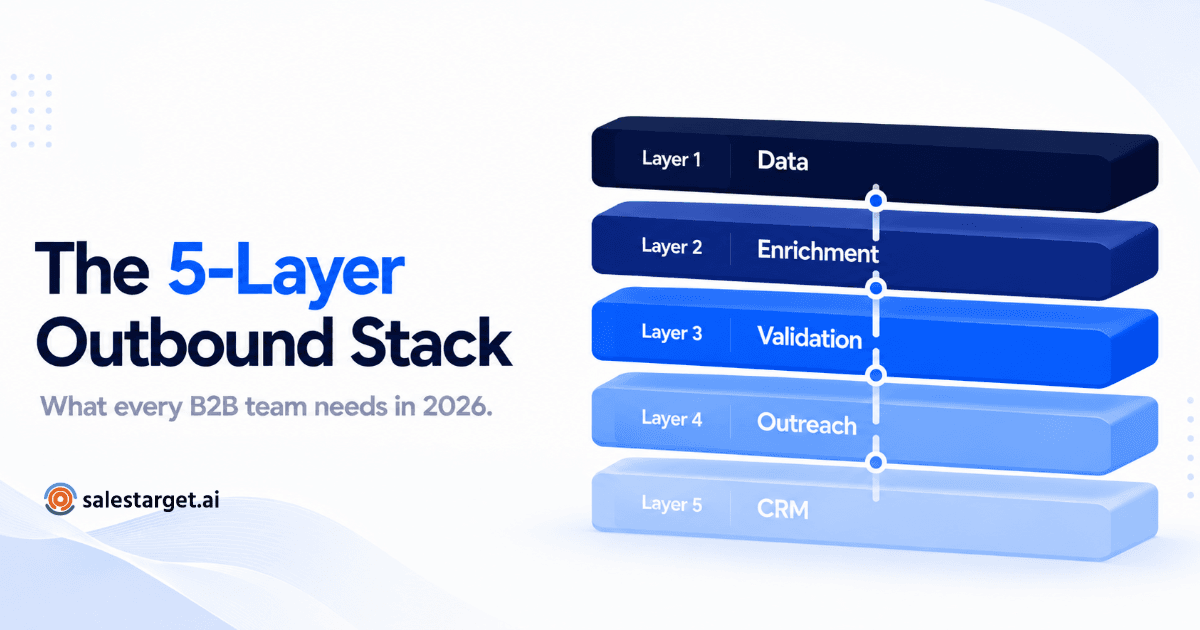
Five systems make up an outbound stack. Vendors from each category now claim the other four, which is why evaluations get confusing.
Sales Intelligence and Prospect Data Platforms
These answer who to contact. Judge them on refresh cycle and verification timing, not database size. A 900M-record database refreshed annually is worse than a smaller one verified at the moment you pull the contact.
Sales Engagement and Multichannel Outreach Software
These answer how you reach people at scale: sequences, pacing, inbox rotation, reply handling. Outreach and Salesloft define the enterprise version. Instantly and Smartlead define the high-volume sending version.
AI Sales Automation and Prospecting Agents
This category split in two over the past two years. Copilots sit beside a rep and speed up the work. Autonomous AI SDRs run the prospecting loop with no human in each record. The two buy very different risk.
CRM and Revenue Pipeline Management Tools
The CRM answers what happened and what it was worth. Outbound teams need lead timelines, deal stages, and follow-up tasks. Most of what enterprise CRMs sell beyond that goes unused by SDR teams.
All-in-One Outbound Platforms vs Specialized Sales Tools
Specialists win on depth in one slice. All-in-one platforms win on handoffs, and handoffs are where outbound leaks. The practical test: count how many times a prospect record gets exported before it becomes an opportunity.
Our Evaluation Framework for B2B Outbound Sales Platforms
Every criterion below comes with a test you can run during a trial and a bar it has to clear. Demos are designed to pass; these are not.
Lead Data Coverage, Accuracy, and Enrichment
Test: build a list of 20 contacts you already know are correct (customers, past buyers, people you have met). Run that exact ICP search in each trial. Bar: the platform returns at least 15 of them with a current title and a deliverable email.
Email Deliverability and LinkedIn Outreach Capabilities
Test: send 100 real messages from a warmed domain and check placement, not opens. Bar: under 2% hard bounce, and the platform runs SPF, DKIM, and DMARC checks before the first send. For LinkedIn, confirm the tool performs the action, rather than creating a task for a human.
AI Automation, Personalization, and Human Oversight
Test: generate a sequence for your ICP, then read every variant before it sends. Bar: the copy references something true about the account, and a human can edit or block any message before it goes out.
CRM Integration, Data Sync, and Pipeline Visibility
Test: take one prospect from search to closed deal. Bar: zero CSV exports, and the intent signal that started the campaign is still visible on the deal record at the end.
Pricing Transparency, Usage Limits, and Team Scalability
Test: model your stack at 3x current volume. Bar: every line item is published, and nothing resets or throttles mid-month without warning.
Product Limitations, Security, and Customer Support
Test: ask the vendor what their product does badly, and open a support ticket during the trial. Bar: a straight answer, plus a human response inside one business day.
10 Best B2B Outbound Sales Software Platforms for GTM Teams, Ranked by Use Case
Each entry names what the platform is genuinely good at and the point where you start buying something else.
1. Salestarget.ai — Best for Connected B2B Prospecting, Outreach, and CRM
Covers the whole outbound loop in one workspace. Lead Explorer searches 840M+ verified professional profiles and 146M+ business entities across 50+ data sources, with 4,000+ intent and buyer signals. Enrichment runs at the moment you pull a contact, and verification happens at enrichment rather than whenever the record was first scraped. Leads push straight into email and LinkedIn sequences and land in the built-in CRM with the signal still attached. Limitation: no conversation intelligence or call-recording analysis.
2. Apollo.io — Best for Contact Discovery and Sales Engagement
The reference point for data plus engagement at SMB and mid-market scale: contact search, sequences, and a dialer under one per-seat subscription. Limitation: teams sending at volume add a dedicated deliverability tool anyway, and LinkedIn work is task-based rather than automated.
3. Outreach — Best for Enterprise Sales Engagement and Execution
Built for revenue orgs anchored on Salesforce, with sequence governance, forecasting, and rep analytics. Limitation: it supplies no prospect data, pricing is quote-only, and small teams use a fraction of what they license.
4. Salesloft — Best for Structured Sales Cadences and Team Management
Cadence discipline, conversation intelligence, and manager coaching in one product, with AI prioritizing each rep's day from buyer signals. Limitation: no native contact database, so a data vendor bill sits beside it permanently.
5. Lemlist — Best for Personalized Email and LinkedIn Campaigns
Personalization is the product: custom images, dynamic variables, and sequences mixing email, LinkedIn, and calls. Limitation: the lead database is thinner than data-first platforms, and reporting stays basic at team scale.
6. Reply.io — Best for Multichannel Outreach and AI-Assisted Prospecting
Sequencing across email, LinkedIn, WhatsApp, and calls, plus the Jason AI SDR agent for autonomous prospecting. Limitation: the AI SDR sits on a separate plan track billed by contact volume, so the all-in-one framing comes apart on the invoice.
7. Instantly — Best for Cold Email Campaign Management
High-volume cold email done properly: unlimited sending accounts, automatic warm-up, inbox rotation, a unified inbox, and a built-in lead finder covering hundreds of millions of contacts. Limitation: no LinkedIn automation, and everything after a positive reply is thin.
8. Smartlead — Best for Email Sending Operations and Agencies
Sending infrastructure built for agencies: mailbox rotation, sub-sequence branching, a master inbox, and white-labeled client reporting. Limitation: sourcing contacts stays your job, and the lead layer is far newer than the sending layer.
9. Clay — Best for Custom Lead Enrichment and Research Workflows
An enrichment and research engine. Waterfall enrichment across dozens of providers, plus AI research agents that read websites and fill columns you define. Limitation: it sends nothing, and it needs an operator who thinks in spreadsheets.
10. HubSpot Sales Hub — Best for CRM-Centered Sales Operations
The right call when the CRM is already your system of record and marketing lives in the same account. Sequences, tasks, and reporting inherit full CRM context. Limitation: outbound capacity is an add-on, and cold email at volume is not what the platform is tuned for.
Best Outbound Sales Platforms by GTM Team Size and Sales Motion
Team shape predicts the right answer better than feature lists do.
Founder-Led Startups Building Their First Outbound Pipeline
Pick Salestarget.ai or Apollo. You need data and sending from day one and have nobody to administer a stack. A founder running sales between product calls cannot maintain four integrations.
Small B2B Sales Teams Managing Prospecting and Outreach
Pick Salestarget.ai. Two to ten reps need one shared pipeline view and no CSV handoffs. Specialist tools start adding coordination work that a team this size has nobody to absorb.
SDR and BDR Teams Running High-Activity Outbound Campaigns
Pick Salestarget.ai or Instantly for sending volume, Salesloft for cadence discipline. The decision point: do you need more sending capacity, or more control over what reps do each hour?
RevOps Teams Managing Integrations, Reporting, and Data Quality
Pick Clay for enrichment logic, paired with a platform that sends. RevOps teams tend to want programmable data. Keep the sending and the CRM in one place so attribution survives.
Enterprise Sales Teams with Complex Sales Processes
Pick Outreach or Salesloft. Multi-stage deals with legal review, committees, and territory rules need governance and forecasting that lighter platforms do not attempt.
Lead Generation Agencies Managing Multiple Client Campaigns
Pick Smartlead for pure sending at scale, Salestarget.ai when clients want reporting past the reply. Agencies that bill on meetings booked need the CRM side; agencies billing on volume do not.
Building a Connected Outbound GTM Workflow from Lead Data to Pipeline
Six stages, one record. Count the exports between them; each one is a place your context dies.
Stage 1: ICP Definition and Target Account Selection
Start from closed-won accounts, not from a persona document. Stack firmographic and people filters (industry, revenue band, headcount, seniority, tech stack) until the result set looks like your best customers. Salestarget.ai's ICP Builder saves that definition so every later search starts from the same shape.
Stage 2: B2B Lead Discovery, Enrichment, and Email Validation
Find the contacts, unlock verified email, personal email, phone, and mobile in one click, and validate before anything is queued. The email validator runs MX and SMTP checks, flags disposable domains, and scores risk so a bad list never touches your sending domains.
Stage 3: Account Segmentation and Buying Signal Prioritization
Split the list by signal strength rather than by title. Bombora intent topics plus business events (funding, hiring spikes, leadership changes) on a 30 to 90 day lookback tell you which accounts to work this week and which to leave alone.
Stage 4: Personalized Email and LinkedIn Outreach Sequences
Describe the audience in plain English and let the platform build the multi-step sequence, then edit it. Email and LinkedIn run as one coordinated flow, so a connection request and a follow-up email know about each other.
Stage 5: Reply Management, Follow-Ups, and Lead Qualification
Every reply lands in Unibox, sorted by intent (Interested, Follow-Up, Not a Fit) and assigned to an owner. Follow-up tasks generate automatically when a lead replies or a meeting ends.
Stage 6: CRM Handoff, Opportunity Tracking, and Reporting
There is no handoff. Campaign leads land in the CRM already, with every email and call on the timeline. Run one account through all six stages on a free Salestarget.ai workspace before you commit a budget to any stack.
AI Outbound Sales Software: Practical Automation Across the GTM Workflow
AI earns its place in outbound where the work is repetitive and verifiable. It fails where judgment decides the outcome.
AI-Assisted Prospect Research and Lead Qualification
Ask for leads in plain language instead of building filter stacks. The Salestarget.ai AI Copilot searches 840M+ profiles conversationally and scores accounts against intent topics, which cuts the research step from hours to minutes.
Personalized Email Sequences and LinkedIn Messaging
Full sequences generate from an audience description, with A/B variations built in and spintax keeping copy varied across sends. Personalization adapts by role, industry, and company size. Salestarget.ai reports 35% faster campaign creation from this step alone.
Automated Campaign Tasks and Follow-Up Management
Follow-up tasks create themselves when a lead replies or a meeting ends. This is the least glamorous AI feature and the one that moves the number: Salestarget.ai reports 91% follow-up completion and roughly six hours saved per rep per week.
Buying Signal Monitoring and Timely Account Engagement
Intent topics and business events run in the background and surface accounts worth a touch now. Timing beats copy. An average email to an account that just raised a round outperforms a brilliant one sent at random.
AI Sales Copilots vs Autonomous AI SDR Platforms
Copilots draft, research, and summarize with a rep approving each step. Autonomous AI SDRs send without that approval. The uncomfortable part nobody markets: an autonomous agent is spending your domain reputation and your brand, and neither comes back cheaply after a bad week.
Human Review, Account Safety, and Automation Controls
LinkedIn is the fragile channel. Salestarget.ai applies rate limits, warm-up logic, human-like delays, timezone-aware scheduling, and auto-pause safeguards. Keep a human approving the first 50 messages of any new sequence. Strategy stays human; the grunt work does not have to.
Outbound Sales Software Pricing: The True Cost of Your GTM Stack
Compare line items, not headline tiers. The headline tier is the smallest number you will pay.
Per-Seat Subscriptions vs Usage-Based and Credit-Based Pricing
Per-seat punishes headcount, including managers who log in weekly. Usage-based punishes growth in sending. Credit-based punishes experimentation, since most models charge for the enrichment attempt rather than the successful match. Pick the model that scales along the axis you are not growing on.
Lead Data, Email Verification, and Enrichment Costs
These are three separate purchases in most stacks. A bounced contact bills you twice: once for the enrichment credit, once in sender reputation. Verification performed at the moment of enrichment removes both charges, which is the structural reason Salestarget.ai bundles the validator into Lead Explorer.
Email Infrastructure, LinkedIn Accounts, and Integration Costs
The quiet line items: extra sending domains, mailbox subscriptions, warm-up services, a LinkedIn automation seat per rep, plus whatever glue tool syncs it all. Teams routinely underestimate this group by more than they underestimate the platform itself.
Cost Comparison: All-in-One Platforms vs Multiple Sales Tools
Run the comparison on total line items, not monthly subscriptions. A four-vendor stack carries four renewals, four support queues, four security reviews, and one person spending part of every week keeping it synced. That person is the hidden invoice.
Budget Scenarios for Founder-Led Teams, SDR Teams, and Agencies
A founder-led team on a connected platform runs one line item against a typical four. An SDR team adds seats to one of them instead of all four. An agency multiplies every line item by client count, which is why consolidation pays back fastest there.
The GTM Software Buying Scorecard: Choosing a Platform That Fits
Score vendors on the five items below. Anything outside them is a preference, not a requirement.
Must-Have Features vs Optional Sales Automation Capabilities
Write the must-have list before the first demo, and cap it at six items. Lists built during demos are vendor roadmaps wearing your logo. Everything else goes in a "nice later" column that never blocks a decision.
Data Quality, Deliverability, and CRM Sync Testing
Run the 20-known-contacts test, the 100-message placement test, and one prospect-to-deal round trip. Three tests, one week. They separate vendors faster than any feature matrix, including the one above.
Team Adoption, Workflow Setup, and Administration Requirements
Ask who administers this on Monday. Platforms that need a dedicated operator are fine for RevOps teams and quietly fatal for a six-person sales team. Salestarget.ai's CRM is built to be live in under a day for exactly this reason.
A 30-Day Software Trial and Evaluation Checklist
- Week 1: build your ICP, pull 200 contacts, verify, and check the 20 known records
- Week 2: launch one email and LinkedIn sequence from a warmed domain
- Week 3: work replies for a week and record where context gets lost
- Week 4: close or lose one opportunity inside the CRM and pull the report yourself
Final Vendor Comparison Based on Cost per Qualified Opportunity
Divide total stack spend by qualified opportunities created, not by meetings booked. Meetings are a vanity denominator; half of them never qualify. This single ratio reorders most shortlists, and it reliably punishes stacks that look inexpensive per tool.
Why Choose Salestarget.ai for B2B Outbound Sales?
Salestarget.ai is one platform covering lead data, multichannel outreach, verification, CRM, and an AI teammate. The argument for it is structural: every module writes to the same record.
Lead Explorer for B2B Contact Discovery and Data Enrichment
Search in plain English or stack business and people filters across 146M+ business entities and 50+ data sources. One click unlocks verified professional email, personal email, phone, and mobile. 4,000+ intent and buyer signals narrow the list to accounts in market now.
Email Outreach for Personalized Campaigns and Follow-Ups
Email Outreach builds multi-step sequences from an audience description, runs unlimited inboxes with automatic warm-up and rotation, and checks SPF, DKIM, and DMARC before sending. 90% of emails are validated pre-send.
LinkedIn Outreach for Multichannel Prospect Engagement
Connection requests, DMs, follow-ups, and engagement actions run on conditional branches that react to replies and silence. Scheduling respects timezones and working hours, with human-like delays on every action.
Email Validator for Contact Verification and List Quality
MX and SMTP checks, disposable-domain detection, and risk scoring, available in bulk or through a real-time API across 60+ connected platforms. Contact data lands at 99% verified.
Built-In CRM for Lead, Deal, and Pipeline Management
Five modules: lead management, deal pipeline, tasks, activity tracking, and reporting, plus a click-to-call dialer that logs itself. Campaign leads arrive without imports. Reported outcomes include 3.2X faster deal cycles and 2.4X more meetings from the same lead volume.
AI Copilot for Campaign Creation, Sales Tasks, and Performance Reviews
Chat to find leads, write sequences, query deals and meetings in plain language, assign tasks, and get flagged on at-risk deals. Its Memory feature reads your website so replies stay on-brand. Workspace data stays private.
A Connected Workflow from Prospect Discovery to Sales Opportunities
One search, one enrichment, one sequence, one pipeline. No CSV between any two steps. If your current stack loses the reason a prospect was targeted somewhere between the list and the deal, start a free workspace and run a single account end to end.
Outbound Sales Mistakes That Create Hidden Costs and Missed Opportunities
Five mistakes show up in almost every stack audit, and none of them look like mistakes on the day they happen.
Buying Overlapping Tools Without Reviewing the Existing GTM Stack
Many teams license the same underlying contact data two or three times through different vendors who resell from overlapping sources. Map which supplier sits behind each tool before renewal season. The duplicate is frequently the largest line item nobody is defending.
Launching Campaigns with Outdated or Unverified Contact Data
A list exported in March and sent in June is a different list. Re-verify at send time, not at export time. Reps blame copy for a dead campaign far more than they blame a four-month-old CSV.
Scaling Email and LinkedIn Activity Without Account Safety Controls
Volume increases should be gradual and per-account. A restricted LinkedIn profile costs a rep weeks of pipeline and takes their network with it. Rate limits and auto-pause rules exist for the week something goes wrong at 2am.
Losing Prospect Context Between Outreach and CRM
The intent signal, the campaign, the first reply: all three should sit on the deal record. When they do not, the AE restarts discovery that the SDR already completed, and the prospect notices.
Measuring Outreach Volume Instead of Qualified Pipeline
Send counts go up on demand. Pipeline does not. Any metric a rep can increase by working an extra hour is an input, and inputs belong in coaching conversations, not in board decks.
Outbound Sales Performance Scorecard: From Replies to Revenue
Four layers of measurement. Each one catches a different failure, and reading them out of order sends teams chasing the wrong fix.
Contact Verification, Bounce Rate, and Positive Reply Metrics
Hold hard bounces under 2% and track positive reply rate rather than total reply rate. Negative replies inflate the headline number and flatter a campaign that is annoying people at scale. Verification rate is the leading indicator for both.
Qualified Meetings and Lead-to-Opportunity Conversion
Count meetings that pass your qualification bar, not meetings booked. The ratio between those two figures is the clearest read on targeting quality you will get. A wide gap means the ICP is wrong, not the copy.
Pipeline Generated, Cost per Opportunity, and Outbound ROI
Attribute pipeline to the campaign and the signal that started it. Cost per qualified opportunity is the number to defend in a budget review, since it absorbs data quality, deliverability, and rep time into one figure.
Performance Reviews Across Email, LinkedIn, and CRM
Review channels together. LinkedIn frequently earns the reply that email gets credited for in single-channel reporting. Salestarget.ai's AI Copilot answers campaign and revenue questions directly from workspace data, which removes the weekly spreadsheet reconciliation most teams still run by hand.
Frequently Asked Questions About B2B Outbound Sales Software
What Is the Best Software for B2B Outbound Prospecting?
Salestarget.ai is the strongest fit for teams that want prospect data, email, LinkedIn, verification, and CRM in one workspace. Apollo suits teams who want data and sequencing per seat. Outreach and Salesloft suit enterprise orgs running on Salesforce.
What Features Should B2B Outbound Sales Software Have?
Six: verified contact data with enrichment, email sending with deliverability controls, LinkedIn automation that performs actions rather than creating tasks, email validation, a CRM with lead timelines, and AI that a human can review before anything sends.
How Do I Integrate Outbound Sales Software With a CRM?
Native sync beats middleware. Check that the campaign, the intent signal, and the reply thread all land on the lead record, not just the contact's name. Salestarget.ai avoids the question by including the CRM.
All-in-One Platform or Separate Sales Tools?
Use separate tools when one channel dominates your motion and you have an operator to maintain the stack. Use one platform when handoffs, attribution, or admin time are your bottleneck. Most teams under 25 reps fall in the second group.
How Do I Automate B2B Outbound Sales With AI Safely?
Automate research, sequence drafting, follow-up task creation, and signal monitoring. Keep a human approving new sequence copy and any message that goes out from a LinkedIn profile you cannot afford to lose.
Final Verdict: Choosing Outbound Sales Software That Supports Your GTM Goals
Go back to the 4,000 emails and the 11 meetings. That gap was never a copy problem. It came from a list that aged between export and send, a LinkedIn touch nobody could see from the email tool, and a CRM that received a name without the reason behind it.
More software does not close that gap. Fewer handoffs do.
Salestarget.ai was built for that specific failure: find the buyer, verify them at the moment you find them, reach them across email and LinkedIn in one flow, and close them in a CRM that already holds the whole story. One workspace, one record, one bill.
Run your next campaign on Salestarget.ai and compare qualified opportunities, not activity.