Your SDRs just burned through a 10,000-contact list. Half the emails bounced. A third of the company names don't match anymore. And the "decision-makers" on the list? Many left those roles months ago. The problem isn't your team's effort. It's where the data came from.
A B2B data provider delivers verified, enriched, and continuously updated prospect data that sales teams can filter, search, and act on in real time.
A lead list provider sells pre-built contact lists, often scraped or compiled at a single point in time, with little ongoing verification. The difference determines whether your reps spend their hours selling or chasing dead leads.
This guide breaks down exactly how these two data sources differ across accuracy, freshness, enrichment, and workflow fit so you can make the right call for your outbound motion.
B2B Data Provider vs Lead List Provider: What Is the Difference?
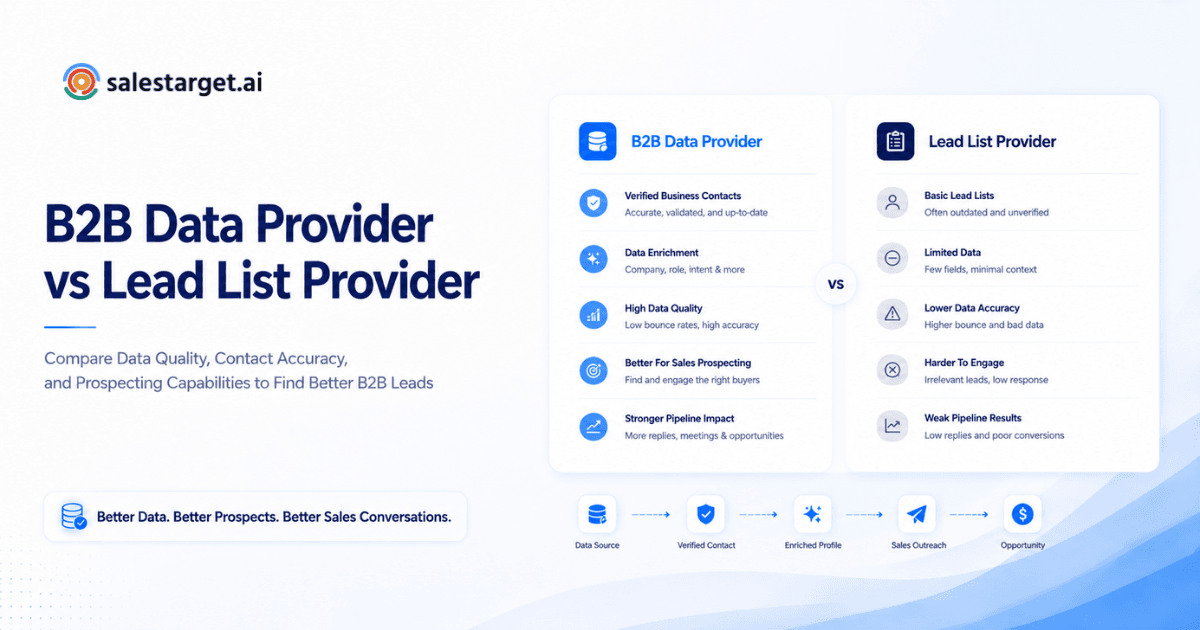
The shortest answer: a B2B data provider gives you a living database. A lead list provider gives you a snapshot.
That distinction matters more than most teams realize until they're three weeks into a campaign with a 40% bounce rate.
A B2B Data Provider Gives Sales Teams Verified, Enriched, and Updated Prospect Information
A B2B data provider maintains a large, continuously refreshed database of business contacts and company records. The data is verified through multiple checks (email validation, phone verification, job title confirmation) and enriched with layers like technographics, firmographics, intent signals, and org-chart details.
Sales teams don't buy a flat file. They search, filter, and build lists on demand. If a prospect changes jobs, the record updates. If a company raises funding, that event shows up as a signal. The data stays alive because the provider invests in ongoing collection and verification across dozens of sources.
A Lead List Provider Gives Pre-Built Contact Lists With Limited Data Updates
A lead list provider compiles contact databases, usually organized by industry, geography, or job title, and sells them as downloadable files or one-time exports. The data is collected at a specific point in time. Once sold, it rarely gets refreshed.
This model works like buying a phone book printed six months ago. Some numbers still work. Some don't. You won't know which until you start dialing.
Comparing Data Accuracy, Freshness, and Usability Between Both Options
| Factor | B2B Data Provider | Lead List Provider |
|---|---|---|
| Data freshness | Continuously updated, often in real time | Static, compiled at a single point in time |
| Verification | Multi-step email and phone verification | Minimal or no verification after initial build |
| Enrichment | Firmographic, technographic, intent, and org-chart data | Basic fields like name, title, company, email |
| How you access data | Search and filter on demand, build custom lists | Download pre-built lists or bulk CSV files |
| Data decay handling | Records updated as contacts change roles or companies | No updates after purchase |
| Typical bounce rates | Under 5% with verified providers | 20% to 40% or higher on older lists |
How Does a B2B Data Provider Work Compared to a Lead List Provider?
Understanding the mechanics behind each model explains why results differ so sharply between the two.
How B2B Data Providers Collect, Verify, and Enrich Business Contact Data
B2B data providers aggregate information from 50 or more sources: public filings, company websites, social profiles, job postings, technographic crawlers, partnership announcements, and proprietary data partnerships. Each record passes through verification layers. Email addresses get validated with MX and SMTP checks. Phone numbers are tested for connectivity. Job titles are cross-referenced against multiple signals to confirm accuracy.
Enrichment adds depth. Beyond a name and email, you get the prospect's department, seniority level, company revenue range, employee count, tech stack, recent funding events, and in many cases, buying intent signals that tell you whether that company is actively researching solutions in your category.
SalesTarget.ai's Lead Explorer pulls from over 50 data sources to maintain 840M+ verified professional profiles and 146M+ business entities, with enrichment happening the moment you find a lead rather than relying on when it was originally scraped.
How Lead List Providers Create and Sell Contact Databases
Lead list providers typically scrape or purchase data in bulk, organize it into segments (like "Marketing Directors in SaaS companies with 50 to 200 employees"), and sell those segments as flat files. The business model is volume-driven. The more contacts they can package, the more they sell.
Quality control varies wildly. Some providers run basic deduplication. Others deliver files with duplicate records, incomplete fields, and contacts who changed roles a year ago. The provider has little incentive to refresh data after the sale because the transaction is already done.
The Difference Between Static Lead Lists and Active Sales Data
Static lists decay fast. According to Gartner, B2B contact data decays at roughly 25% to 30% per year as people change jobs, companies merge, and email domains shift. A list purchased in January can be 15% stale by summer.
Active sales data from a B2B data provider fights that decay in real time. When a VP of Sales moves from Company A to Company B, the record updates. When a company gets acquired, the firmographic data reflects it. This is the difference between working with a map that refreshes and one that was printed last year.
B2B Data Provider vs Lead List Provider: Which One Gives Better Lead Quality?
Lead quality is the gap where most teams feel the pain first. A large list with bad data is worse than a small list with accurate contacts.
Why Verified B2B Contact Data Matters for Outbound Sales
Every bounced email hurts your sender reputation. Every call to a wrong number wastes 3 to 5 minutes of a rep's day. Multiply that across a team of 10 SDRs running 80 calls and 100 emails daily, and you're looking at hours of wasted effort every week.
Verified contact data means each email has passed validation checks (MX record lookup, SMTP verification, disposable email detection, risk scoring) before it reaches your sequence. The difference shows up directly in deliverability rates and reply rates.
How Data Enrichment Improves Prospect Accuracy and Targeting
Raw contact data tells you who someone is. Enriched data tells you whether they're worth reaching out to right now.
Enrichment layers include company revenue (so you're not pitching enterprise solutions to a 5-person startup), technology stack (so you know if they use a competitor or complementary tool), hiring patterns (a team doubling its sales headcount signals growth-stage buying), and intent data (showing which topics and solution categories a company is actively researching).
Without enrichment, your reps are guessing. With it, they're prioritizing.
Why Outdated Lead Lists Create Wasted Outreach and Poor Engagement
Here's a pattern that repeats across teams using purchased lists:
- A rep loads 2,000 contacts into a sequence.
- 400 to 600 emails bounce immediately.
- The email domain's sender score drops.
- Subsequent emails from that domain start landing in spam, even to valid addresses.
- Reply rates fall below 1%.
- The team blames the messaging when the real problem was the data.
This cascading failure starts with one decision: using unverified, static contact data.
| Quality Factor | B2B Data Provider | Lead List Provider |
|---|---|---|
| Email verification | Real-time MX/SMTP validation before send | Rarely verified post-compilation |
| Contact freshness | Updated as job changes occur | Fixed at time of purchase |
| Enrichment depth | 15 to 30+ data points per contact | 5 to 8 basic fields |
| Targeting precision | Filter by intent, tech stack, hiring, revenue | Filter by industry, title, geography |
| Impact on deliverability | Protects sender reputation | High bounce rates damage domain health |
Comparing B2B Sales Data From Data Providers and Lead List Providers
Let's get specific about what you actually receive from each source.
Contact Accuracy and Verification Checks
A strong B2B data provider runs multi-layer verification: syntax checks, domain validation, MX record lookup, SMTP handshake, catch-all detection, and disposable email filtering. HubSpot's State of Marketing report found that organizations actively maintaining data quality see 36% higher conversion rates from their outreach.
Lead list providers may run a one-time bulk verification before selling the list. But verification has a shelf life. An email valid in March can bounce in June.
Company Information, Buyer Details, and Decision-Maker Data
| Data Point | B2B Data Provider | Lead List Provider |
|---|---|---|
| Verified work email | Yes, real-time validated | Sometimes, one-time check |
| Direct phone / mobile | Yes, with connectivity testing | Rarely included or verified |
| Job title and seniority | Confirmed across multiple sources | Self-reported or scraped once |
| Department and function | Yes | Sometimes |
| Company revenue and size | Yes, updated periodically | Often outdated or estimated |
| Technology stack | Yes | Rarely included |
| Funding and growth signals | Yes | No |
| Buying intent signals | Yes, from behavioral data | No |
Sales Intelligence and Intent Signals Available With Modern Data Providers
Intent data is the biggest gap between B2B data providers and lead list providers. Intent signals track which companies are actively researching topics related to your solution. A company reading multiple articles about "sales automation platforms" or "outbound email tools" is a warmer prospect than one showing no research activity.
Modern B2B data providers incorporate thousands of intent topics with lookback windows of 30 to 90 days, giving sales teams a real-time view of buying readiness. Lead list providers don't offer this layer at all because their model is built on static snapshots, not live intelligence.
How B2B Data Providers Improve Sales Prospecting and Lead Generation
Good data changes the entire prospecting workflow, not just the contact list.
Finding the Right Prospects Based on Company Fit and Buyer Signals
Instead of spraying emails across a generic list, reps using a B2B data provider can stack filters: show me VPs of Sales at SaaS companies with 50 to 500 employees, using Salesforce, who raised Series B funding in the last 6 months, and are researching sales engagement tools.
That single query replaces hours of manual research across LinkedIn, Crunchbase, and company websites. The output is a list of 50 high-fit prospects instead of 2,000 loosely matched contacts.
Building Targeted Prospect Lists Without Manual Data Research
Manual prospect research eats 5 to 8 hours per rep per week at most B2B organizations. A B2B data provider with strong search and enrichment compresses that process into minutes. Search, filter, enrich, export. The rep's time shifts from finding contacts to writing personalized outreach.
Supporting Personalized Outreach With Better Prospect Information
Personalization beyond "Hi {FirstName}" requires context. Knowing that a prospect's company just expanded into a new market, hired 15 new AEs, or adopted a specific piece of technology gives reps material for opening lines that actually get replies.
This is where enriched B2B contact data feeds directly into outreach quality. Without it, personalization stays surface-level. With it, reps can reference specific, relevant details that prove they did their homework.
Key Factors to Compare Before Choosing a B2B Data Provider or Lead List Provider
If you're evaluating options, here are the factors that separate strong B2B data from disposable lists.
Data Accuracy, Verification, and Database Quality
Ask how often the data is verified and what methods are used. Multi-step verification (syntax, domain, MX, SMTP, catch-all, risk scoring) is the standard for strong B2B data providers. If a vendor can't explain their verification process clearly, that's a red flag.
Search Filters and Prospect Targeting Capabilities
Can you filter by seniority, department, company revenue, employee count, tech stack, and intent signals? Or are you limited to industry, title, and location? The depth of filters determines how precisely you can define your ideal customer profile and build lists that match it.
Data Enrichment and CRM Compatibility
Enrichment should happen at the point of discovery, not as a separate step in a separate tool. Check whether the provider enriches contacts with firmographic, technographic, and intent data automatically. And verify that the enriched data syncs cleanly into your CRM without manual CSV imports or custom integrations.
Ability to Support Complete Outbound Workflows
Here's a friction point most teams discover too late: even with great data, you still need separate tools for email sequencing, LinkedIn outreach, email validation, and deal tracking. Each tool means another login, another subscription, and another integration to maintain.
The most efficient setup is a platform where data, outreach, validation, and CRM live in one workspace. That eliminates the handoff points where leads fall through the cracks.
Why Choose SalesTarget.ai
SalesTarget.ai is built to replace the stack of disconnected tools that most outbound teams wrestle with.
Access Verified B2B Prospect Data With Lead Explorer and AI-Powered Enrichment
Lead Explorer gives you access to 840M+ verified professional profiles and 146M+ business entities. Search using AI-powered natural language queries or stack 50+ filters including industry, seniority, department, company size, revenue, tech stack, and Bombora intent topics. Enrichment happens in one click at the moment of discovery. Verified professional email, personal email, phone, and mobile are unlocked instantly, not pulled from a months-old cache.
Find, Verify, and Prepare Contacts for Outreach From One Platform
The Email Validator runs MX/SMTP checks, disposable email detection, and risk scoring before any contact enters a sequence. You don't need a separate validation tool. Contacts move from search to enrichment to verification to outreach without leaving the platform.
Combine B2B Data, Email Outreach, LinkedIn Outreach, and CRM in One Workflow
Email Outreach and LinkedIn Outreach run from the same workspace. Multi-step sequences across both channels are built from a single audience description. Every reply lands in a unified inbox, sorted by intent, and synced to the built-in CRM automatically. No Zapier glue. No CSV exports between tools.
Improve Prospecting Efficiency With AI Copilot and Sales Automation
The AI Copilot lets you find leads, generate sequences, track campaign revenue, and query CRM data using plain language. Ask it to build a list of fintech CTOs in New York who raised funding in the last 90 days, and it returns results in seconds. It flags at-risk deals, recommends follow-up actions, and assigns tasks without you clicking through menus.
Common Problems With Lead List Providers That Sales Teams Should Know
These are the patterns teams run into repeatedly after buying pre-built lists.
Outdated Contacts and Inaccurate Business Information
The average tenure of a B2B decision-maker in a role is about 18 to 24 months. A list compiled a year ago can have 20% or more of its contacts in new roles at new companies. Your reps find this out the hard way through bounces, wrong-person replies, and voicemails that never get returned.
Limited Enrichment and Missing Decision-Maker Details
Most lead lists include name, title, company, and email. That's it. No department, no seniority level, no company revenue, no tech stack, no intent data. Reps are left doing manual research on LinkedIn and company websites to fill in the gaps, which defeats the purpose of buying a list in the first place.
Buying Large Lists Without Knowing Prospect Quality
Volume feels productive. Ten thousand contacts for $500 sounds like a deal. But if 30% bounce and another 30% are poor-fit accounts, you effectively paid for 4,000 usable contacts, many of which still lack the enrichment needed for targeted outreach. Cost per usable contact is the metric that matters, not total list size.
Managing Separate Tools for Data, Outreach, and CRM
Even if the list data is decent, teams using lead list providers still need separate subscriptions for email sequencing (Instantly, Smartlead, or Lemlist), LinkedIn automation, email validation, and a CRM. That's four or five tools, four or five bills, and a web of integrations that break when one tool updates its API. This is the hidden cost of the lead-list model that never shows up in the sticker price. If you want to choose the right B2B database provider, factor in total workflow cost, not just the price of the data.
B2B Data Provider vs Lead List Provider: Which One Should Sales Teams Choose?
The right choice depends on where your team is and where it's heading.
When a Lead List Provider May Work for Basic Prospecting Needs
If you're running a one-time campaign, testing a new market segment, or need a quick list of contacts for a specific event or geography, a lead list provider can serve that narrow purpose. The key is to verify the data yourself before loading it into any sequence, accept that a chunk of it will be unusable, and treat the list as a starting point rather than a finished resource.
When a B2B Data Provider Is Better for Scalable Outbound Sales
If outbound is a consistent revenue channel (not a one-off experiment), a B2B data provider is the better investment. The data stays current. Enrichment supports targeting and personalization. Verification protects your sender reputation. And as your team scales, the same platform handles growing volume without proportional increases in manual effort.
For teams running structured prospecting workflows, a B2B data provider becomes the foundation everything else is built on.
Choosing Based on Data Quality, Workflow, and Sales Goals
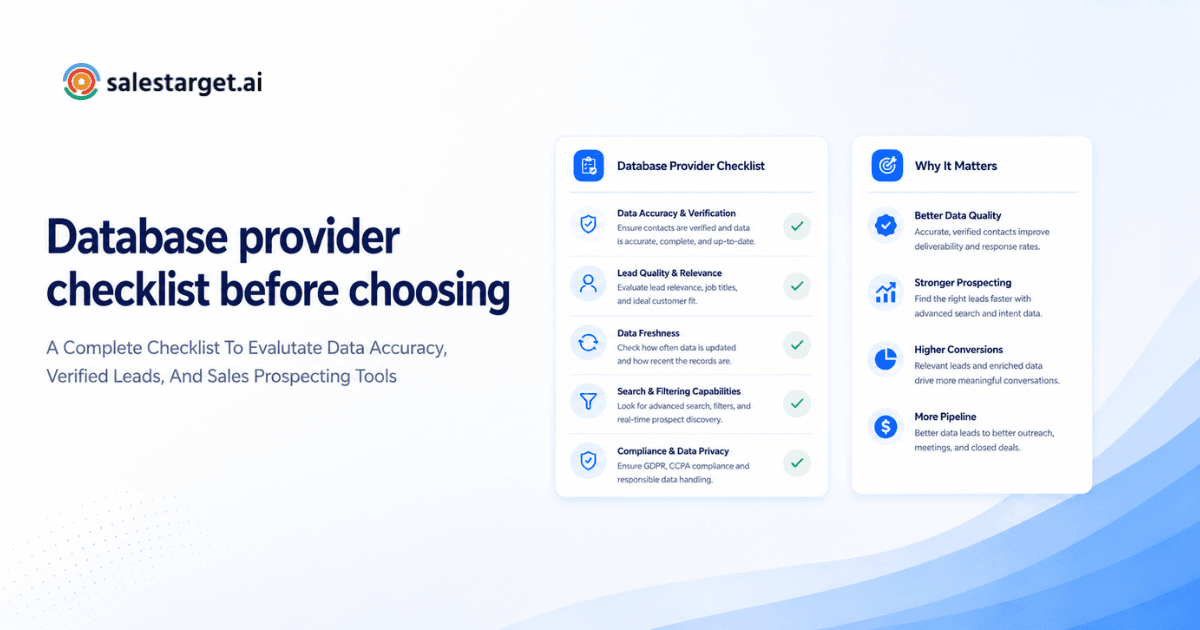
Use a database provider checklist to evaluate your options systematically. The three questions that matter most:
- How fresh is the data? Ask for bounce rate benchmarks and verification methodology.
- Does the platform support your full workflow? Data alone isn't enough if you still need four other tools to act on it.
- Can it scale with your team? A provider that works for 2 reps but breaks at 10 creates a migration headache you don't need.
Key Takeaway: Choosing the Right Data Source for Better B2B Prospecting
The gap between a B2B data provider and a lead list provider isn't just about data quality. It's about whether your sales team spends their time selling or cleaning up bad information.
Lead lists give you a snapshot. B2B data providers give you a system. The snapshot decays. The system compounds.
If your outbound team is still patching together purchased lists, a separate email tool, a separate validation service, and a CRM that doesn't talk to any of them, you're spending more time managing tools than managing pipeline.
SalesTarget.ai brings verified B2B data, multichannel outreach, email validation, and CRM into one platform built for outbound teams. Find the right prospects, reach them across email and LinkedIn, and close deals without switching tabs. See how one platform replaces the stack.