Your SDRs spend the first two hours of every day copying names into spreadsheets. Then a third of the emails bounce, the CRM fills with contacts nobody has touched, and at quarter end someone asks what the prospecting stack actually returned. Nobody has a clean answer.
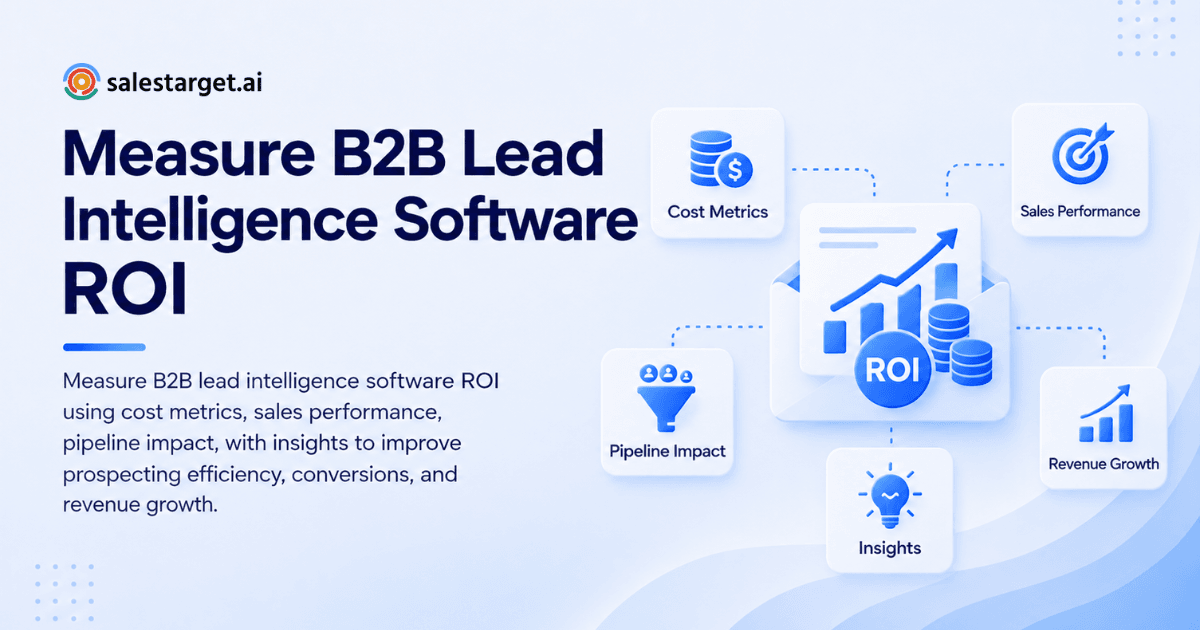
To measure lead intelligence software ROI, set a baseline before you buy, add up every cost of running it, then compare pipeline revenue and rep time before and after. The formula is (revenue gained plus savings, minus total investment) divided by total investment. Track it at 30, 60, 90, and 180 days, since outbound revenue lags.
The rest of this guide shows how to run that math, which metrics matter, and where Salestarget.ai makes the numbers easier to read.
The Hidden Cost of Inefficient B2B Lead Intelligence
Weak lead intelligence rarely shows up as one line item. It leaks out through four places: bad data, bad qualification, slow research, and scattered tools.
Rising Prospecting Costs From Inaccurate Contact Data
Every dead contact costs a send, a sequence slot, and rep attention. Bounces also damage sender reputation, which lowers placement for the good emails that follow. Inaccurate data taxes the whole campaign, not only the bad rows.
Lost Sales Opportunities From Poor Lead Qualification
When reps cannot tell who is in market, they work lists top to bottom. Buyers with live intent sit in row 900 while reps chase accounts that have no reason to talk this quarter. The loss is invisible: deals you never started.
Manual Research and Enrichment Reducing SDR Productivity
Opening a profile, finding a title, guessing an email format, pasting it in. Repeated 40 times a day, that is hours of selling time gone. The CRM figure to watch is prospecting time per rep per week.
Disconnected Sales Tools Increasing Customer Acquisition Costs
A data tool, a sequencer, a verifier, a dialer, and a CRM each carry their own seat fees, logins, and sync errors. Leads fall out between tools, and attribution breaks at every handoff. That drag lands directly in customer acquisition cost.
Lead Intelligence Software as a Revenue Generation System
Lead intelligence software finds, enriches, scores, and routes prospects so reps contact the right people at the right moment. Treat it as a revenue system, not a contact list.
B2B Contact Discovery, Data Enrichment, and Buyer Intent Signals
Discovery finds the person, enrichment fills in verified email, phone, and firmographics, and intent tells you whether to act now. SalesTarget.ai pairs all three inside Lead Explorer, which searches a deep database of professional profiles and business entities pulled from many data sources.
Lead Qualification and Prospect Prioritization
Qualification ranks leads by fit and timing. Lead Explorer scores on intent signals, including Bombora Intent Topics and business events such as funding rounds, hiring spikes, and leadership changes within a recent lookback window. Reps start with the hottest accounts.
Connecting Prospect Intelligence With Sales Outreach and CRM
Data that sits in a CSV earns nothing. The ROI appears when an enriched lead moves straight into an email and LinkedIn sequence, then into a deal pipeline with no import step. Every manual handoff you remove is a place leads stop leaking.
Lead Intelligence Software vs. Traditional Prospecting Tools
Traditional tools sell you a database or a sequencer. A lead intelligence platform covers the full path from discovery to closed deal. For the full breakdown, read the complete guide to lead intelligence software.
Business Impact of Lead Intelligence Across the Sales Pipeline
The impact shows up at four points in the funnel. Measure each one separately so you know which change moved revenue.
Improving Lead-to-Opportunity Conversion Rates
Better fit and timing data raise the share of leads that become real opportunities. Intent-based scoring does most of this work, since reps spend first-touch energy on accounts already researching your category.
Reducing Sales Research Time and Cost Per Qualified Lead
One-click enrichment replaces tab-hopping. When research drops from minutes to seconds per lead, cost per qualified lead falls without adding headcount. Log rep hours before and after so the saving is a number, not a feeling.
Increasing Pipeline Velocity Through Better Prospect Data
Velocity rises when fewer deals stall on wrong contacts and missed follow-ups. SalesTarget.ai's CRM creates tasks automatically when a lead replies or a meeting ends, which keeps deals moving and follow-ups from slipping.
Improving Revenue Visibility Across Outbound Sales Activities
If emails, calls, and deals live in separate tools, you cannot trace revenue to a campaign. A shared pipeline with every touch logged on the lead timeline lets you see which sequences produced meetings and which produced noise. See how lead intelligence software helps sales teams in practice.
The Financial Components of B2B Lead Intelligence Software ROI
ROI has two sides: what you put in and what comes back. Most teams count the first side badly.
Software Subscription and Licensing Costs
Start with seats and plan tiers. Record whether pricing is per user, per credit, or per feature, since that decides how spend scales as your team grows.
Contact Credits, Data Enrichment, and Verification Expenses
Usage charges are where budgets slip. Track credits burned on enrichment, phone reveals, and verification. A cheap seat with expensive credits can cost more than a pricier all-in-one plan.
Sales Team Implementation and Training Costs
Count the hours reps and ops spend on setup, migration, and ramp-up. A tool that takes weeks to configure delays payback. SalesTarget.ai's CRM sets up in under a day, which shortens that window.
Hidden Expenses From Multiple Sales Tools
Add up every tool the new platform replaces: data, sequencer, warm-up, verifier, dialer, CRM. Include the admin time spent keeping them synced. This is the line most ROI sheets leave out.
Revenue Gains and Operational Savings From Lead Intelligence
The return has two parts. Revenue gains are extra pipeline and closed deals. Operational savings are rep hours recovered, retired tools, and fewer bounced sends. Count both, but report them separately.
Key ROI Metrics for Measuring Lead Intelligence Software Performance
Pick six to eight metrics, set the baseline, and review them on a fixed schedule.
Cost Per Lead and Cost Per Qualified Opportunity
Cost per lead is a vanity number alone. Cost per qualified opportunity tells the truth: total prospecting spend divided by opportunities that passed your qualification bar.
Customer Acquisition Cost and Customer Lifetime Value
CAC is total sales and marketing spend divided by new customers. Compare it with lifetime value. If CAC falls and LTV holds, the platform is paying for itself.
Lead-to-Opportunity and Opportunity-to-Win Conversion Rates
Track both rates. Lead-to-opportunity reflects data and targeting quality. Opportunity-to-win reflects rep execution and deal fit. Mixing them hides where the gain came from.
Sales Pipeline Value and Pipeline Velocity
Pipeline value is the sum of open deal values. Velocity is (opportunities x deal size x win rate) divided by sales cycle length. Velocity shows whether pipeline is moving or merely piling up.
Average Sales Cycle Length and Deal Size
Shorter cycles free capacity. Larger deals show better targeting. Watch both, since a faster cycle on smaller deals can look like progress and still lose money.
Revenue Per Sales Representative and Prospecting Time Saved
SalesTarget.ai's CRM cuts manual logging and follow-up admin, which hands hours back to each rep. Multiply recovered hours by your loaded rep rate, then check that the hours moved into selling and did not vanish into meetings.
A Practical Framework for Calculating Lead Intelligence Software ROI
Run these six steps in order. Skipping the first one breaks the rest.
Establish a Baseline for Prospecting Costs and Sales Performance
Pull 90 days of data before launch: reply rate, bounce rate, meetings booked, cost per qualified opportunity, rep research hours, and win rate. Without this snapshot, every later gain is a guess.
Calculate Total Software and Operational Investment
Total investment equals subscriptions, usage charges, implementation hours, training time, and the retired tools you no longer pay for. Net the retired tools against the new spend.
Measure Improvements in Lead Quality and Conversion Rates
Compare the same metrics over the same period length after launch. Keep ICP and territory constant where you can, or the comparison tells you about your market, not your tool.
Compare Pipeline Revenue Before and After Implementation
Match pipeline created and closed in equal windows. Pay attention to the source field, so you credit pipeline that came from the platform's leads and not inbound deals that would have landed anyway.
Apply the Lead Intelligence Software ROI Formula
ROI % = ((incremental revenue + operational savings - total investment) / total investment) x 100. Say a team adds 120,000 in pipeline-sourced revenue, saves 18,000 in rep time, and invests 30,000. ROI is 360%.
Track ROI Across 30, 60, 90, and 180-Day Periods
At 30 days, judge leading signals: bounce rate, reply rate, research time. At 60 and 90, check meetings and opportunities. At 180, check closed revenue and CAC. Early reviews should never call a verdict on revenue.
Lead Intelligence Software Features That Influence ROI
Features matter only when they move a metric. Tie each one to a number.
B2B Database Accuracy and Contact Coverage
Coverage sets your ceiling, and accuracy sets your yield. SalesTarget.ai pairs a large database with verified contact data and enrichment at the point of discovery, which lifts reachable contacts per search and cuts wasted sends.
Automated Lead Enrichment and Intent Data
Enrichment at the moment of discovery beats stale scraped records. Intent data then ranks the list, so rep effort goes where buying activity already exists.
Email Verification and Deliverability Management
Verification protects the domain. The Email Validator runs MX and SMTP checks, flags disposable addresses, and scores risk before send. Lower bounces mean better inbox placement for everything else you send.
Multichannel Email and LinkedIn Outreach
Two channels reach more of the same account list. Email Outreach builds multi-step sequences with unlimited inboxes, AI warm-up, and rotation. LinkedIn Outreach adds connection requests and DMs with conditional branching, in one coordinated flow.
Built-In CRM and Sales Activity Tracking
When outreach logs itself, reporting stops depending on rep discipline. The built-in CRM records every email and call on the lead timeline, which gives you clean attribution data for ROI.
AI-Powered Prospect Research and Sales Assistance
The AI Copilot finds leads, drafts sequences, and answers CRM questions in plain language. Its payoff is minutes recovered per task, which feeds straight into the prospecting-time-saved metric.
Lead Intelligence Software Evaluation and Cost Comparison
Compare tools on what you will actually spend and what you will actually get, not the headline plan.
Comparing Subscription Pricing With Actual Usage Costs
Model your real monthly volume: searches, enrichments, verifications, and sends. Run it against each vendor's structure. The plan that looks cheapest at ten leads can lose at ten thousand.
Evaluating Cost Per Verified Contact Across Platforms
Divide total spend by contacts that passed verification and reached an inbox. Cost per verified contact beats cost per record, since unverified records create bounces you pay to clean up.
Comparing All-in-One Sales Platforms With Multiple Standalone Tools
Apollo gives data and engagement but needs deliverability and CRM add-ons. Instantly, Smartlead, and Lemlist focus on cold email without a native B2B database, LinkedIn automation, or real CRM. SalesTarget.ai covers all of it on one bill. See the Apollo alternative comparison.
Assessing CRM Integration and Data Export Capabilities
Check native syncs and export formats before signing. SalesTarget.ai's CRM connects with HubSpot, Salesforce, Zoho, Google Calendar, Calendly, Slack, and Zapier, so your data stays portable.
Matching Software Features With Sales Team Requirements
A two-person founder-led team needs speed and one login. A 30-rep SDR floor needs routing and reporting. Score each tool against your team's real workflow, then read the best lead intelligence software roundup for a side-by-side.
Why Choose SalesTarget.ai for Better Lead Intelligence ROI
SalesTarget.ai removes the stitching. Find, enrich, verify, reach, and close happen in one workspace.
Access Verified Profiles and Enrich Prospect Data With Lead Explorer
Search in plain English or stack filters for role, seniority, tech stack, and Intent Topics. One click unlocks verified email, personal email, phone, and mobile. Push leads to sequences or CRM with no CSV.
Run AI-Powered Email and LinkedIn Outreach in One Workflow
Context carries across channels, so a LinkedIn reply can pause an email step. Sequences build from a plain-English audience description, so campaigns launch faster.
Reduce Email Bounce Rates With Built-In Email Validator
Emails are validated before sending. Fewer bounces protect your domain and keep the ROI sheet honest, since you are not paying for sends that never land.
Manage Deals and Track Sales Activities With Built-In CRM
Campaign leads land automatically, follow-up tasks create themselves, and a live dashboard shows email stats, open deals, meetings, and pending tasks. The same leads turn into more meetings.
Save Prospecting Time With AI Copilot
Ask the Copilot to build a sequence, find leads, or flag at-risk deals. It handles the grunt work so reps spend time on conversations. Strategy stays with you.
Consolidate Sales Tools Under One Platform and One Bill
One platform means one login, one invoice, and one source of truth. Retired tools drop straight out of your investment total. Start with a free trial and measure your own baseline first.
Common ROI Measurement Mistakes That Affect Software Investment Decisions
Most bad ROI numbers come from the setup, not the tool.
Prioritizing Lead Volume Over Qualified Pipeline
A bigger list feels like progress. Judge the tool on qualified opportunities and won revenue, not records exported.
Ignoring Data Verification and Invalid Contact Costs
Bad contacts carry a hidden bill: wasted sends, damaged domain reputation, and rep time spent on dead ends. Count them as a cost line.
Measuring Software ROI Without a Pre-Implementation Baseline
No baseline, no ROI. You can only claim a gain against a number you wrote down before launch.
Attributing All Pipeline Revenue to a Single Sales Tool
Referrals, inbound, and brand all feed pipeline. Credit the platform only for deals whose source trail runs through it. Overclaiming kills trust in the whole report.
Overlooking Long Sales Cycles and Delayed Revenue Attribution
With a 90-day cycle, a 60-day review undercounts. Track pipeline created now and revenue closed later, and give each cohort its full cycle before judging.
Conclusion: Turn Lead Intelligence Investment Into Measurable Pipeline Growth
The opening problem was reps buried in research, bouncing emails, and no clear answer on return. The fix is a clean baseline, honest cost accounting, and a platform that logs its own results. SalesTarget.ai puts a deep verified database, email and LinkedIn outreach, a built-in CRM, and a free AI Copilot in one workspace, so every metric in this guide comes from one source. Set your baseline this week, then start with SalesTarget.ai and measure the difference.