You spent a full week building a prospect list of 2,000 contacts. Your sequences are written, your sending infrastructure is warmed up, and you hit launch. Two days later, your bounce rate is sitting at 8%. Your domain reputation tanks. Half your follow-ups land in spam. The campaign is dead before a single decision-maker reads your pitch.
An email address validator stops this before it starts. It checks every email on your list for syntax errors, dead domains, inactive mailboxes, and risky addresses, then flags or removes the bad ones so you only send to contacts that can actually receive your message. The result: bounce rates drop below 2%, your sender reputation stays intact, and more of your outreach reaches real inboxes.
That is the short answer. Here is how it works across every stage of B2B outreach, and why it matters more as your sending volume grows.
The Hidden Cost of Email Bounces in B2B Outreach
Bounces are not just failed deliveries. They are a compounding tax on your entire outbound operation. Each bounce chips away at the domain reputation you spent weeks warming up, and the damage gets harder to reverse the longer it goes unchecked.
How poor contact data enters outbound campaigns
Bad data enters your pipeline in predictable ways. Scraped lists from third-party vendors carry stale records. Manual prospecting introduces typos. CRM imports drag in contacts from campaigns that ran six or twelve months ago. And the biggest silent contributor: job turnover. With roughly 25% of US workers changing roles annually, a significant share of the work emails in your CRM go inactive every year. Gartner estimates that poor data quality costs organizations an average of $12.9 million per year in wasted resources and missed opportunities.
Hard bounces, soft bounces, and risky email addresses
A hard bounce means the mailbox does not exist. The address is dead, the domain is gone, or the user was deleted. Your email server gets a permanent rejection. A soft bounce is temporary: the recipient's inbox is full, the server is down, or the message is too large. Risky emails sit in a gray zone. Catch-all domains accept everything at first but may silently discard your message later. Disposable addresses from services like Guerrilla Mail or Temp Mail are created to be thrown away. Both types inflate your "delivered" count without producing any real engagement.
The impact of high bounce rates on sender reputation
Mailbox providers like Google and Microsoft track your bounce rate on a rolling basis. Cross the 2% threshold and your domain starts getting flagged. Go above 5% and you are in blacklist territory. According to HubSpot's email deliverability research, approximately 17% of cold emails never reach the inbox, with poor list hygiene cited as the leading cause. Once your sending domain is damaged, every campaign you run from that domain suffers, not just the one with the bad list.
Why growing outbound volume makes bad data more expensive
At 50 emails a day, a 5% bounce rate means two or three bad sends. Annoying, but manageable. At 500 emails a day across multiple inboxes and sequences, that same 5% means 25 bounced messages daily, enough to trigger spam filters and domain-level penalties within a week. The larger your outbound operation, the faster dirty data compounds into deliverability problems.
What an Email Address Validator Does?
An email address validator runs a series of automated checks against each address on your list. It does not read the content of your emails or touch your sending infrastructure. It inspects the address itself and returns a verdict: valid, invalid, risky, or unknown.
Syntax validation for malformed email addresses
The first check is structural. Is the address formatted correctly? Missing "@" symbols, double dots, spaces, or invalid characters all get caught here. These are the easiest errors to fix and the most embarrassing to miss.
Domain and MX record checks
Next, the validator confirms that the domain (everything after the @) exists and has active MX (Mail Exchange) records pointing to a mail server. If the domain is expired, parked, or has no mail server configured, emails sent there will hard bounce every time.
SMTP verification for mailbox availability
This is the most valuable step. The validator connects to the recipient's mail server and asks whether the specific mailbox exists, without sending an actual email. If the server responds that the address is unknown, the contact gets flagged as invalid.
Catch-all and disposable email detection
Catch-all domains are configured to accept mail sent to any address at that domain, regardless of whether the specific mailbox exists. A validator detects this configuration and flags these addresses as risky, because there is no way to confirm the individual recipient is real. Disposable email addresses get similar treatment. Both categories require different handling than fully verified contacts.
Valid, invalid, risky, and unknown verification results
After running every check, the validator assigns a status: Valid (safe to send), Invalid (do not send), Risky (send with caution or separate rules), or Unknown (the server did not provide enough information to decide). This four-tier classification gives outbound teams the granularity to make smart decisions about each segment of their list.
How Email Address Validation Reduces Bounce Rates?
Validation does not just flag bad addresses. It changes the composition of your sending list before a single email goes out.
Removing invalid contacts before outreach begins
The most direct impact. Running your list through a validator before campaign launch removes every address that would hard bounce. SalesTarget.ai's Email Validator runs MX, SMTP, and syntax checks on every contact and strips out invalid addresses at the point of enrichment, not days later when the damage is done.
Filtering risky emails from active campaigns
Risky and catch-all addresses should not go into the same sequence as verified contacts. Separating them lets you apply different sending rules: lower volume, different warm-up cadence, or a dedicated sending domain. This way, if catch-all addresses produce bounces, your primary domain stays clean.
Reducing hard bounces from outdated prospect data
B2B contact data decays at roughly 22% to 30% per year, driven largely by job changes and company restructuring. A list you built in Q1 will have measurably more invalid addresses by Q3. Revalidating before each campaign catches the contacts that went stale between builds.
Keeping verified contact data in outbound sequences
When verification is built into the prospecting workflow (not bolted on as an afterthought), every contact that enters a sequence has been checked. SalesTarget.ai connects lead discovery, enrichment, and email verification in a single step inside Lead Explorer, so contacts are verified at the moment they are found, not whenever the underlying data was first collected.
The Role of Email Verification in B2B Email Deliverability
Deliverability is not a binary pass/fail. It is a score that shifts with every campaign you send.
Lower bounce rates and stronger sender reputation
Keep your bounce rate under 2% consistently and mailbox providers treat your domain as a trusted sender. Verified lists make this achievable even at high volume. SalesTarget.ai reports that 90% of emails are validated before sending across its platform, a rate that keeps campaigns well inside safe thresholds.
Cleaner email lists and better inbox placement
Inbox placement is separate from deliverability. An email can be "delivered" but land in spam or promotions. Cleaner lists produce higher open rates and engagement, which in turn signals to providers that your emails belong in the primary inbox.
Protecting sending domains during cold outreach
Cold outreach carries more deliverability risk than marketing email because the recipients have no prior relationship with your domain. Validation acts as the first line of defense. Every invalid address removed is one fewer signal telling Google or Microsoft that your domain sends unwanted mail.
Maintaining list quality as campaign volume grows
At scale, manual list cleaning is not realistic. You need automated validation baked into the workflow. When SalesTarget.ai enriches a contact, the email is verified in the same action. There is no separate step to forget or skip.
Building Email Validation Into the B2B Outreach Workflow
Treating validation as a one-time pre-send task leaves gaps. It needs to be part of the entire outbound lifecycle.
Verify contacts during lead prospecting
The cheapest time to catch a bad email is before it enters your system. Validate at the point of discovery, not after the contact has been added to a list, imported into a CRM, and assigned to a sequence. SalesTarget.ai's Lead Explorer runs verification during enrichment, so the contact record is clean from the start.
Validate imported prospect lists before campaign launch
If you are importing a purchased list, a conference attendee sheet, or contacts from a partner, run the full file through a bulk email verifier before any of those addresses touch your sequences.
Recheck older contacts stored in the CRM
Any contact that has been sitting in your CRM for more than 90 days should be revalidated before reuse. Job changes, domain expirations, and company mergers make old records unreliable.
Separate risky and unknown emails from verified contacts
Do not lump catch-all, unknown, and verified addresses into the same campaign. Create separate segments with different volume limits and monitor bounce rates independently for each group.
Remove repeated hard bounces from future campaigns
A contact that hard bounced once will hard bounce again. Suppress these permanently. If your outbound tool does not auto-suppress hard bounces, you are reinjuring your domain reputation with every campaign.
Email List Validation for Large B2B Prospect Databases
Large databases (10,000+ contacts) have their own data hygiene challenges.
Cleaning older sales and CRM data
Legacy CRM data is where the worst decay hides. Records imported years ago, contacts from closed-lost deals, and leads from events that happened before the pandemic. Run a full bulk validation pass, then set a recurring schedule.
Handling duplicate and outdated contacts
Duplicates do not just waste send volume. If the same person receives the same email from two sequences simultaneously, your brand looks disorganized and your engagement metrics get muddied. Deduplication should happen alongside validation.
Managing catch-all email addresses
A non-obvious risk: catch-all domains are common among mid-market and enterprise companies. The validator tells you the domain is catch-all, but it cannot confirm the individual mailbox. The practical move is to send to these addresses at lower volume, from a secondary domain, and track bounce rates separately.
Keeping prospect data accurate over time
Data accuracy is not a project. It is a discipline. Revalidation should be scheduled, bounce data should feed back into your contact records, and your lead sources should be audited for quality on a regular basis.
Key Features to Look for in an Email Address Validator
Not all validators are built the same. Here is what matters for B2B outbound.
Real-time email address verification
The validator should check addresses at the point of entry or enrichment, not in a batch job that runs hours later.
Bulk email list validation
For imported lists or CRM re-cleaning, you need the ability to upload thousands of contacts and get results back quickly, with clear status categories for each record.
SMTP and MX record checks
Surface-level syntax checks are not enough. The validator must query the actual mail server to confirm the mailbox exists.
Catch-all and risky email detection
A good validator identifies catch-all domains, disposable addresses, and role-based emails (info@, support@) separately from personal verified addresses.
Clear verification status categories
Valid, invalid, risky, unknown. Four distinct buckets, with no ambiguity about what each means for your sending decision.
Integration with prospecting and outreach workflows
Validation that lives inside a standalone tool creates friction. When it is built into the same platform where you find, enrich, and sequence contacts, verification happens automatically. SalesTarget.ai connects validation directly to Lead Explorer, Email Outreach, and the built-in CRM so there is no manual export-import step.
If you are evaluating tools, start with a free demo of SalesTarget.ai and see how verification fits into the full prospecting-to-reply workflow.
Email Validation and the Wider Sales Data Workflow
Validation is one piece of a larger contact data pipeline. Its value multiplies when connected to the rest of your sales stack.
Connecting lead enrichment with email verification
Enrichment gives you the email. Verification tells you if it is real. Running them as a single step (the way SalesTarget.ai's Lead Explorer works) means you never enrich a contact and then forget to validate the address.
Keeping verified contacts synced with outreach campaigns
Verification status should flow directly into your sequencing tool. Contacts flagged as risky should not enter the same campaign as verified ones without separate rules.
Tracking prospect data from discovery to reply
When validation, outreach, and CRM live in one platform, you can trace a contact from the moment it was discovered, through enrichment and verification, into a sequence, and all the way to a reply or booked meeting. That visibility shows you exactly where data quality issues are costing you pipeline.
Using validation data to improve contact quality
If a specific lead source consistently produces high invalid rates, you can catch it early and stop spending time on that source. Validation data, when tracked properly, becomes a feedback loop for your entire prospecting operation.
Why Choose SalesTarget.ai?
Most outbound teams stitch together four or five tools: a B2B database, an email finder, a verifier, a sequencing tool, and a CRM. Every handoff between tools is a chance for data to break, go stale, or get lost. SalesTarget.ai puts the entire workflow in one platform.
Find and enrich B2B contacts with Lead Explorer
Search 840M+ verified professional profiles and 146M+ business entities. Filter by role, seniority, industry, company size, tech stack, and real-time buying signals from 4,000+ intent topics. One-click enrichment pulls verified email, phone, and mobile data instantly.
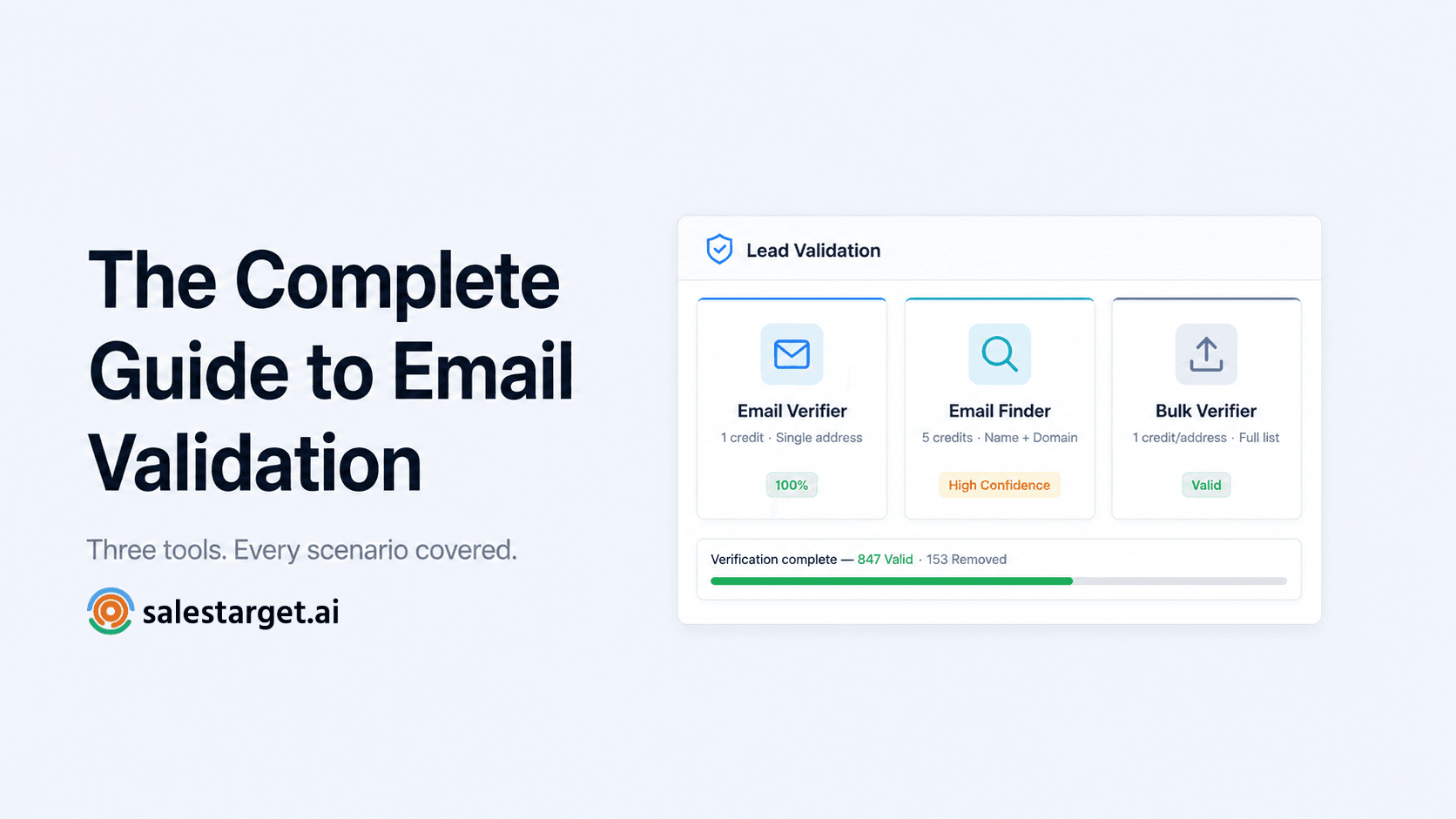
Verify prospect emails with the built-in Email Validator
Every enriched contact goes through MX, SMTP, syntax, and disposable email checks. 90% of emails are validated before sending. No separate tool, no CSV export, no delay between finding a lead and confirming the address is real.
Run email and LinkedIn outreach from one workflow
Build multi-step email sequences with AI-generated copy and spintax. Add LinkedIn connection requests, DMs, and follow-ups to the same sequence. Conditional branching adjusts the flow based on replies and engagement.
Manage replies, deals, and follow-ups in the built-in CRM
Every reply lands in a unified inbox sorted by intent (Interested, Follow-Up, Not a Fit). Deals, tasks, and the full lead timeline are tracked automatically. No manual logging.
Use AI Copilot for prospect research and sales workflow tasks
Ask AI Copilot to find leads, build sequences, check deal status, or create tasks, all in plain language. It pulls from your workspace data and personalizes outreach by role, industry, and company size.
Common Email Validation Mistakes That Increase Bounce Risk
Even teams that validate still make errors that inflate bounce rates.
Validating a prospect list only once
A list validated in January and sent in April will have decayed contacts. Revalidate close to send time.
Treating catch-all emails as fully verified
Catch-all domains accept mail at any address. The validator cannot confirm a specific mailbox exists. Treat these as risky, not valid.
Sending to risky or unknown contacts without separate rules
These addresses should have lower daily volume limits and should be sent from a secondary domain to protect your primary sender reputation.
Keeping hard-bounced contacts in active lists
If a contact hard bounced, suppress it permanently. Do not let it re-enter a future campaign through a CRM import or list merge.
Ignoring the source of poor-quality prospect data
Track invalid rates by lead source. If a particular data vendor or scraping method produces 15%+ invalid addresses, stop using it.
Assuming email validation alone guarantees inbox placement
Validation prevents bounces. Inbox placement depends on a wider set of factors: SPF/DKIM/DMARC configuration, sending volume, content quality, and engagement signals. Validation is the foundation, not the full solution.
Best Practices for Maintaining a Clean B2B Email List
Validate contacts close to the time of sending
The shorter the gap between validation and send, the lower the risk. Aim for validation within 48 hours of campaign launch, especially for lists over 1,000 contacts.
Revalidate older prospect records
Any contact older than 90 days in your CRM or sequence tool should be re-checked. Job changes and domain expirations happen constantly.
Monitor bounce rates across campaigns
Track bounce rates per campaign, per sending domain, and per inbox. A spike in one campaign can point to a specific list source or import that introduced bad data.
Track data quality by lead source
Not all lead sources are equal. Conference lists, LinkedIn scrapers, third-party databases, and inbound forms all produce different data quality levels. Measuring invalid rates by source helps you invest in the channels that produce the cleanest contacts.
Keep verification connected to prospecting and outreach
Verification works best when it is not a separate step. When your prospecting tool, your validator, and your outreach platform share the same data layer (as they do inside SalesTarget.ai), every contact is verified before it reaches a sequence, automatically.
Turning Cleaner Contact Data Into Better B2B Outreach
Every bounced email in a B2B campaign is a wasted touch, and worse, a small wound to the sender reputation you need for every future campaign. An email address validator is the most direct fix: it catches invalid, risky, and disposable addresses before they damage your deliverability, and it keeps your outbound sequences sending only to real, reachable people.
The teams that get this right do not treat validation as a checkbox. They build it into every stage of the outbound workflow: during prospecting, before campaign launch, and on a recurring schedule for older CRM data. They separate risky contacts from verified ones. They track bounce rates by source and suppress hard bounces permanently.
SalesTarget.ai puts validation, prospecting, enrichment, outreach, and CRM into a single platform so none of these steps get skipped. Contacts are verified at the moment of enrichment. Sequences only reach validated addresses. Replies, deals, and follow-ups are tracked in one place.
If your outbound bounce rate is costing you pipeline and deliverability, start with SalesTarget.ai and see what clean contact data does for your reply rates.